The Experimental Philosophy Blog

Philosophy Meets Empirical Research

Menu
  • Home
  • About
  • Guidelines for Comments
  • Labs and Organizations
  • Resources
Menu

Category: Philosophy of Language

Call: “Valence Asymmetries”

Posted on September 19, 2025October 8, 2025 by Alexander Max Bauer

Isidora Stojanovic, Lorenza D’Angelo, Morgan Moyer, and Michelle Stankovic organizing a conference on “Valence Asymmetries,” which will take place at the Universitat Pompeu Fabra from March 19 to 20, 2026.

Abstracts for presentations can be submitted until September 30. The call reads:

The Valence Asymmetries ERC team is happy to announce that it will be organizing the first VALENCE ASYMMETRIES conference on March 19th–20th 2026 at the Pompeu Fabra University in Barcelona, Spain. The event is funded by Isidora Stojanovic’s ERC Advanced Grant “Valence Asymmetries: the positive, the negative, the good and the bad in language, mind and morality” (GA n° 101142133).

This interdisciplinary event will discuss themes which are central to the Valence Asymmetries project, including the role of valence asymmetries in perception, emotion, morality, language, and communication. Discussion will draw upon insights from philosophy, psychology, and linguistics.

There will be invited talks by Hans Alves, Frederique de Vignemont, Saif Mohammad, and Pascale Willemsen. There is also room for 4–6 additional talks, to be selected from open submissions. Each selected talk will be assigned a 50 min slot, including discussion.

We especially encourage submissions on the relation between value, valence, and polarity; theoretical and empirical accounts of valence asymmetries in language, including in negative strengthening, scalar inferences, and irony; the asymmetry between virtue and vice, and between praise and blame, in normative and applied ethics; as well as other discussions of valence asymmetries in linguistics, cognitive science, moral psychology, and cognate areas.

If you are interested in presenting your work at this venue, please submit a 2-page abstract to valence.asymmetries@upf.edu by Sep 30th, with the subject line “valence asymmetries submission.”

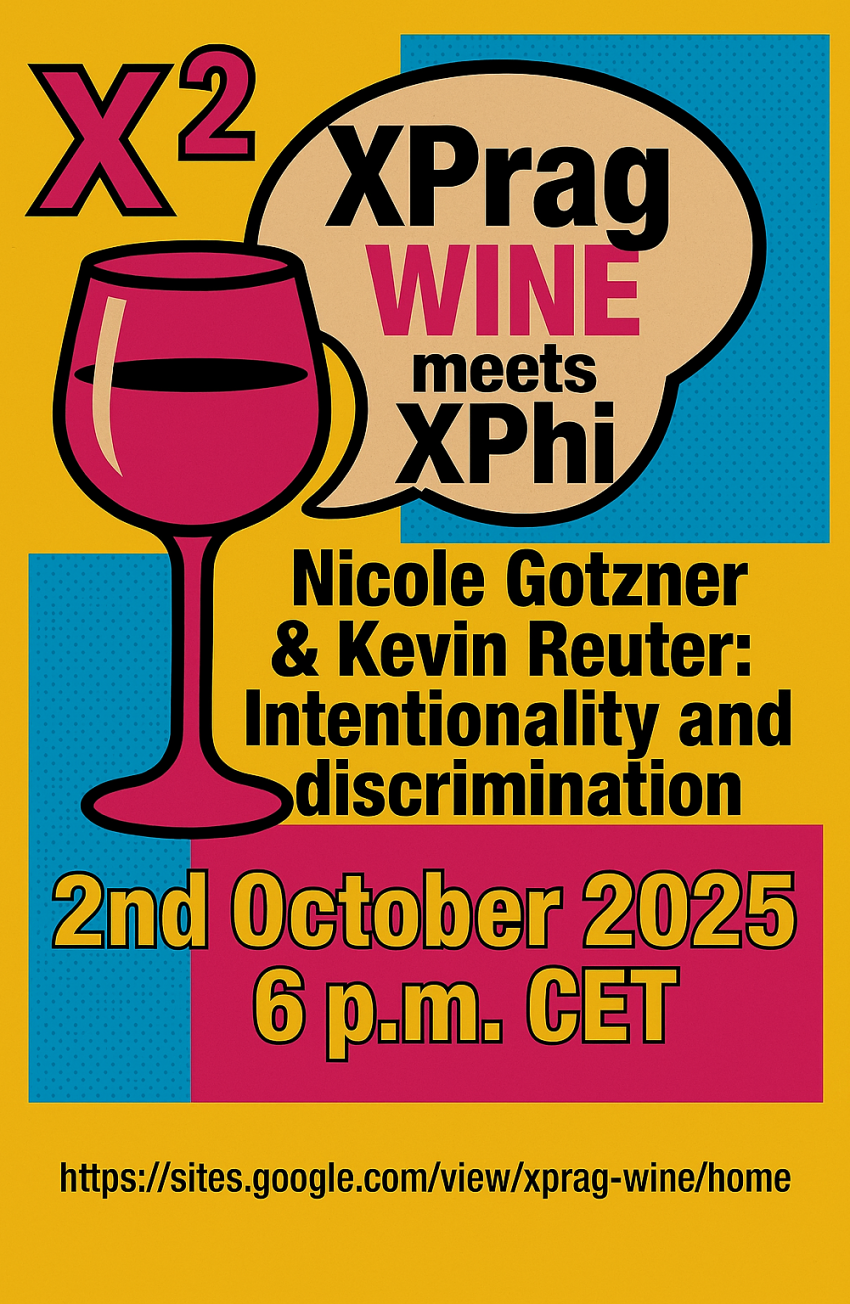
Talk: “Intentionality and Discrimination” (Nicole Gotzner and Kevin Reuter)

Posted on August 31, 2025October 25, 2025 by Alexander Max Bauer

On Tuesday, October 2, the XPRAG Wine Gatherings welcome Nicole Gotzner and Kevin Reuter to talk about “Intentionality and Discrimination” on Zoom. Kevin writes:

Experimental Pragmatics (XPrag) and Experimental Philosophy (XPhi) share a common vision: whenever our assumptions can be empirically tested against the world, we should rise to the occasion. On October 2nd, 2025, don’t miss a talk on “intentionality and discrimination” by Nicole Gotzner (University of Osnabrück) and Kevin Reuter (University of Gothenburg), followed by a discussion on how our communities can exchange ideas and spark new collaborations. We can’t wait to see you there!

The Zoom link and more information are available at the XPRAG Wine Gatherings’ website.

Call: “Laws Many Users”

Posted on August 21, 2025August 21, 2025 by Alexander Max Bauer

Alex Davies and Nikolai Shurakov organize a conference on “Law’s Many Users – Legal Interpretation Within and Beyond Legal Institutions,” which will take place at the University of Tartu from November 12 to 14.

Abstracts for presentations can be submitted until August 12. The call reads:

Law is interpreted and implemented by many hands. Some of them belong to judges, legislators, or lawyers – but many belong to nurses, teachers, municipal officials, or department heads: professionals who encounter law not in courtrooms or casebooks, but in institutional documents, contracts, checklists, and internal protocols. These actors do not interpret law as legal theorists or as abstract “laypeople,” but as role-bound individuals embedded in specific organizational contexts. Their understanding of legal norms is shaped by institutional incentives, bureaucratic hierarchies, resource constraints, inherited routines, and pressures to defer to internal authorities. They are interpreters, but also implementers – conduits through which law acquires practical meaning.

While experimental jurisprudence has deepened our understanding of how legal concepts like causation, intention, or rights are grasped by legal experts and ordinary citizens, it has rarely focused on this middle terrain: how individuals interpret legal rules as part of their job, within the constraints and affordances of organizational life.

This conference is an occasion for exploring that terrain.

Call for Abstracts (submission deadline: August 12, 2025)

We invite submissions from scholars across disciplines interested in how laws and regulations are interpreted, implemented, and transformed in real-world institutional settings.

Legal meaning is shaped not only in courts or legislatures, but in offices, classrooms, clinics, and council chambers – by actors whose interpretations are framed by professional roles, organizational logics, and institutional incentives. This conference invites reflection on the interpretive practices that emerge in such contexts, and how these practices affect what law becomes in use.

We welcome work from experimental jurisprudence, philosophy of language, linguistics, law & economics, public administration, and related fields. Contributions may be theoretical, empirical, or methodological.

Possible topics include (but are not limited to):

  • Studies of how non-lawyers interpret and apply legal or regulatory texts
  • Experimental investigations of interpretation in institutional settings
  • Pragmatic and semantic analysis of policy and legal communication
  • Incentive structures and role-based reasoning in interpretation
  • Legal meaning as mediated through contracts, guidelines, or protocols
  • Interpretive drift and discretion in organizational environments
  • Extensions or critiques of experimental jurisprudence beyond traditional contexts
  • Interdisciplinary methods for studying law “in the wild”

Abstracts are applications for either 30-minute slots (20 minute talk + 10 minute discussion) OR 1-hour slots (30–40 minute talk + 30–20 minute Q&A). Abstracts (max. 600 words – excluding a list of references) should: (a) make clear the line of argument for the conclusion defended; (b) make clear the relevance of the envisioned talk to the conference theme; (c) make clear whether your applying for a 30-minute or 60-minute slot; and (d) be prepared for anonymous review.

Submitting Abstracts: Abstracts should be submitted with a separate coversheet (author, email, institution) to laws.many.users@gmail.com.

Talk: “Creativity in Taboo Terms in Sign Languages” (Donna Jo Napoli)

Posted on April 18, 2025April 18, 2025 by Alexander Max Bauer

On Monday, May 26, from 14:30–16:00 (UTC+1), the “Slurring Terms Across Languages” (STAL) network will present Donna Jo Napoli’s talk “Creativity in Taboo Terms in Sign Languages” as part of the STAL seminar series. The abstract reads:

Deaf signing communities share many of the same language taboos that hearing speakers observe. Still, there are areas that are sticky in sign that are not in speech and vice versa. We will take a peek at how signers create taboo signs, looking at ASL and DGS (the sign language of Germany) and perhaps a couple of other languages, noting primarily morphological creativity but also syntactic creativity.

The talk can be joined using Zoom. Please write an email to stalnetwork@gmail.com for the invitation link.

Talk: “Derogatory Speech – Conversations, Hearers, and Listeners” (Claire Horisk)

Posted on March 3, 2025March 3, 2025 by Alexander Max Bauer

On Monday, March 10, from 14:30–16:00 (UTC+1), the “Slurring Terms Across Languages” (STAL) network will present Claire Horisk’s talk “Derogatory Speech – Conversations, Hearers, and Listeners” as part of the STAL seminar series. The abstract reads:

In discussions of how to mitigate political and cultural polarization, we are often told that we should listen to our opponents. But should we listen regardless of what they say – even to derogatory speech? From the standpoint of philosophy, the prescription to listen lacks subtlety, and we cannot reach greater subtlety without a philosophical account of listening itself. In my recent work, I distinguish between listening and hearing and argue that listening to derogatory speech in the context of a conversation is sometimes morally wrong. In this talk, I expand my account, particularly with respect to how power dynamics affect who counts as a conversational participant.

The talk can be joined using Zoom. Please write an email to stalnetwork@gmail.com for the invitation link.

Hot Off The Press: “Advances in Experimental Philosophy of Lying”

Posted on March 3, 2025March 3, 2025 by Alexander Max Bauer

Alex Wiegmann has edited a new volume on “Advances in Experimental Philosophy of Lying,” a further entry into Bloomsbury’s “Advances in Experimental Philosophy” series. See below for the table of contents.

  • Emanuel Viebahn: “What Does it Take to Tell a Lie?”
  • Romy Jaster and David Lanius: “The Concept of Fake News”
  • Jörg Meibauer: “The Concept of Bullshit”
  • Markus Kneer: “The Truth About Assertion and Retraction – A Review of the Empirical Literature”
  • Shirly Orr: “Truth Evaluators – A Different Point of View in the Lying/Misleading Distinction”
  • Alejandro Erut: “Cross-Cultural Studies on Concepts of Lying – Methodological Approaches and Their Findings”
  • Mailin Antomo: “Lying With Gestures”
  • Louisa Reins: “The Impact of Modality and Presentation Time on Judgments of Deceptive Implicatures as Cases of Lying – An Empirical Investigation”
  • Izabela Skoczeń: “From Lying to Blaming and Perjury – Deceptive Implicatures in the Courtroom and the Materiality Requirement”
  • Neele Engelmann: “Murderer at the Door! To Lie or to Mislead?”

Call: “ESPP 2025”

Posted on February 11, 2025February 11, 2025 by Alexander Max Bauer

The 2025 conference of the European Society for Philosophy and Psychology will take place in Warsaw, Poland, from September 2 to 5, hosted by the Polish Academy of Sciences. As keynote speakers, Emma Borg, Cameron Buckner, Nora Newcombe, and Petra Schumacher are confirmed.

Abstracts for papers, posters, and symposia can be submitted until March 3. The call reads:

The Society invites the submission of papers, posters and symposia. Submissions are refereed and selected on the basis of quality and relevance to psychologists, philosophers and linguists. If you have any questions, contact us by writing an email to espp2025@gmail.com.

Travel scholarships for PhD Students

Thanks to support from IFiS/GSSR, via the NAWA grant PROM Short-term academic exchange (in Polish, PROM Krótkookresowa wymiana akademicka; BPI/PRO/2024/1/00020/DEC/1), we can award up to 10 travel grants for PhD students at universities outside Poland to attend the conference and present a talk or poster. Please see the Call for Applications for these scholarships, which promotes equal opportunity for people with disabilities, and adequate gender representation. Successful applications will be selected on the basis of: (i) quality of the proposed talk or poster, as judged by the ESPP expert reviewers’ report on the anonymised abstract you submit when applying to present at the conference; (ii) NAWA PROM’s eligibility rules (see the Call for Applications).

Submission instructions for papers, posters and symposia

The deadline for all submissions is 3rd March 2025. Submissions should be made online via EasyChair.

Papers should be designed to be presentable within 20 minutes (for a total 30 minutes session). Submissions should consist of a long abstract of up to 1000 words (excluding bibliography). If required, an additional page of tables and/or graphs may be included. A submission for a poster presentation should consist of a 500-word abstract.

When submitting your paper or poster online, please first indicate the primary discipline of your paper (philosophy, psychology, or linguistics) and whether your submission is intended as a paper or a poster. Submitted papers may also be considered for presentation as a poster if space constraints prevent acceptance as a paper or if the submission is thought more suitable for presentation as a poster. All paper and poster submissions (whether abstracts or full papers) should be in DOC or PDF format and should be properly anonymized in order to allow for blind refereeing.

Each person may present only one paper during the conference’s parallel sessions, though you may be a co-author of more than one paper. If you submit multiple single-authored papers only one will be accepted. This includes contributions to submitted symposia.

Symposia are allocated a two-hour slot and consist of a set of four linked papers on a common theme or three linked papers with an introduction. Symposia should include perspectives from at least two of the three disciplines represented in the society (philosophy, psychology and linguistics). Submissions should be made by symposium organizers (not speakers).

When submitting a symposium proposal online, your submissions should include the following three elements in a single PDF:

  1. A list of 3 or 4 speakers which indicates representation of at least two disciplines (individual speakers may also represent multiple disciplines).
  2. A general abstract of up to 500 words, laying out the topics to be addressed and indicating connections among the talks.
  3. Individual abstracts of up to 500 words and provisional titles for each talk. Please do not submit more than one PDF file per symposium.

General Aim

The aim of the European Society for Philosophy and Psychology is to promote interaction between philosophers and psychologists on issues of common concern. Psychologists, neuroscientists, linguists, computer scientists and biologists are encouraged to report experimental, theoretical and clinical work that they judge to have philosophical significance; and philosophers are encouraged to engage with the fundamental issues addressed by and arising out of such work. In recent years ESPP sessions have covered such topics as theory of mind, attention, reference, problems of consciousness, introspection and self-report, emotion, perception, early numerical cognition, spatial concepts, infants’ understanding of intentionality, memory and time, motor imagery, counterfactuals, the semantics/pragmatics distinction, comparative cognition, minimalism in linguistic theory, reasoning, vagueness, mental causation, action and agency, thought without language, externalism, hypnosis, and the interpretation of neuropsychological results.
Talk: “Expressivity in Georgian and other Caucasian Languages” (Thomas Wier)

Posted on February 7, 2025February 7, 2025 by Alexander Max Bauer

On Monday, February 10, from 14:30–16:00 (UTC+1), the “Slurring Terms Across Languages” (STAL) network will present Thomas Wier’s talk “Expressivity in Georgian and other Caucasian Languages” as part of the STAL seminar series. The abstract reads:

Expressive and ideophonic constructions conveying “marked words that depict sensory imagery” (Dingemanse 2012) are frequently found in the languages of all regions of the world, but their distribution, use and functioning across languages of the Caucasus has never been documented from a regional perspective. This talk will give you a brief taste of the various kinds of expressive language present in the three autochthonous Caucasian families: Abkhaz-Adyghean, Kartvelian and Nakh-Daghestanian. It will also look at greater length at the specific morphological and syntactic peculiarities of expressives in Georgian, which exhibit exuberant consonant clusters, processes of reduplication uncharacteristic of the language as a whole, as well as specific morphosyntactic alignment splits between different classes of expressive.

The talk can be joined using Zoom. Please write an email to stalnetwork@gmail.com for the invitation link.

Talk: “How Language Supports the Acquisition of Predicates of Mental States and Emotions” (Kristen Syrett and Misha Becker)

Posted on January 15, 2025January 15, 2025 by Alexander Max Bauer

On Monday, January 20, from 14:30–16:00 (UTC+1), the “Slurring Terms Across Languages” (STAL) network will present Kristen Syrett and Misha Becker’s talk “How Language Supports the Acquisition of Predicates of Mental States and Emotions” as part of the STAL seminar series. The abstract reads:

As children acquire adjectives, they must tackle the challenge that while some properties denoted by these predicates are stable and visually salient (e.g., color, shape), others (e.g., emotions and mental states like happy, sad, or confident) lack a reliable physical correlate, and are typically only inferable via second order characteristics. How, then, do children master the meanings of adjectives that label these fleeting, internal, abstract states? One answer may lie in the very linguistic environment in which these adjectives appear. Previous work in language acquisition has documented the power of the frame and complementation patterns for verb learning, subject form for control and raising verbs, count syntax for acquiring nouns, and adverbial modification for different types of gradable adjectives. In this talk, I draw on this prior work to lay a foundation for a series of experiments investigating how children might recruit both syntactic and semantic cues in the input to narrow the hypothesis space for emotion/mental state adjective meaning. I begin by presenting extensive evidence from CHILDES corpora showing that while these adjectives are relatively infrequent in the input, they diverge from other adjectives (e.g., those of color, shape, size, or multidimensional subjective adjectives) in their preference of syntactic position, their requirements on subject animacy, and their syntactic complementation patterns. Next, I present data from a set of word guessing studies using scripted dialogues that both adults and older children (age 5–8) recruit the type of subject and syntactic complement to constrain adjective meaning. Finally, I present a set of binary forced-choice word learning studies putting emotion/mental state against color and shape showing once again, that the presence of an animate subject and syntactic complement points to an emotion/mental state adjective meaning, this time for preschoolers. Taken together, these experiments – the first to document the combined power of syntax and semantics for acquiring abstract adjective meaning – make connections between emotion/mental state adjectives and mental state verbs in word learning, thereby further demonstrating the potential universality of syntactic bootstrapping, and the role of language itself in focusing young word learners’ attention on mental aspects of the situation that are not readily observable.

The talk can be joined using Zoom. Please write an email to stalnetwork@gmail.com for the invitation link.

Call (Extended): “The Many Faces of Expertise”

Posted on January 1, 2025January 1, 2025 by Alexander Max Bauer

This year’s “Jornadas Novatores” conference will take place at the University of Salamanca from February 27 to 28. This time, it will be all about expertise, and experimental philosophy will also be considered (see below). Invited speakers are Reiner Grundmann (University of Nottingham) and Michel Croce (University of Genoa).

Abstracts for presentations can be submitted before January 7. The call reads:

Jornadas Novatores is an annual 2-day conference dedicated to topics in philosophy of science and technology, but also open to contributions in related branches of philosophy, including epistemology, argumentation theory, philosophy of language and mind, feminist philosophy etc. The next edition of “Jornadas Novatores” invites contributions that advance research on the topic of expertise and its relation to a broad range of issues of social relevance.

The topic of expertise and expert knowledge has gained momentum in the last decade, and it now occupies a central position in philosophy. Many important issues related to the nature and social function of experts have been discussed in depth. The analysis of the concept has led to identifying levels of expert knowledge, and the debate about its nature has distinguished objective (knowledge-based) approaches from reputational or functional approaches, for which the credentials and social role are essential to the attribution of expertise. From an epistemological perspective, expertise is generally understood as a combination of theoretical knowledge, skills and experience, but the exact relation between them is still under discussion. In argumentation theory, the appeal to expert opinion is treated as a special kind of argument, the evaluation criteria and strength of which is a matter of dispute. The many social and political dimensions of the impact of expertise on democratic societies have also been addressed, including the intricate problem of the asymmetry of power and responsibility that comes with the distribution of expertise in society.

These discussions have also brought to light questions about expertise and expert knowledge that have received less attention. The main aim of our 2-day conference is to advance these discussions by including questions and methods of research that have remained peripheral to the central debates on expertise, as well as to build bridges between philosophical research on the topic and other perspectives. We seek proposals that critically examine topics such as, but not limited to, the following:

  • Gender bias and expertise
  • Cultural and social factors that influence the adscription of expertise
  • Experimental approaches to study of the nature of expertise and its attribution
  • Experts’ disagreement in the context of scientific and technological public controversies
  • Expertise and critical thinking
  • Testimonial injustice and trust in experts
  • The many forms of pseudo-expertise
  • Trust in experts and trust in social institutions
  • The relation between trust, expertise and regulatory science.

Participation

We invite abstract submissions for 30-minute talks (with 10 minutes for discussion in a 40-minute slot). Please send your proposals (around 1000 words long, excluding bibliography, and prepared for blind review) to jornadasnovatores@usal.es before 7th of January.

  • Previous
  • 1
  • 2
  • 3
  • 4
  • Next

Search

Categories

Tags

Agency Artificial Intelligence Basic Needs Behavior Beliefs Bias Bioethics Blame Causation Cognitive Science Consciousness Corpus Analysis Cross-Cultural Research Decisions Determinism Distributive Justice Emotions Essentialism Expertise Folk Morality Framing Free Will Intention Intuition Jurisprudence Knowledge Large Language Models Moral Psychology Norms Pejoratives Pragmatics Psycholinguistics Psychology Reasoning Reflective Equilibrium Replication Responsibility Self Semantics Side-Effect Effect Slurs Thought Experiments Valence Values Virtue

Recent Posts

  • Job: “COST-X” (Turin, Italy)
  • Call: “International Congress of Empirical Biomedical Ethics”
  • Job: “Hearing and Remembering” (Turin, Italy)
  • Job: Lectureship or Senior Lectureship in Philosophy (Loughborough, UK)
  • Call: “18th International Congress of Logic, Methodology and Philosophy of Science and Technology”

Recent Comments

  1. Joanna Demaree-Cotton on Where Should I Publish My X-Phi? A New ResourceApril 24, 2026

    Thanks for the comment, that's really useful. We'll definitely add AJP (missed you accidentally first time!), and that note.

  2. AJP Editor on Where Should I Publish My X-Phi? A New ResourceApril 24, 2026

    AJP is published by Taylor & Francis, and we have an member of the editorial team ('associate editor' in our…

  3. Nova Praxis on The Folk Concept of ArtJuly 11, 2025

    This article highlights an important point: everyday people don’t rely on rigid definitions to determine what qualifies as art. They’re…

  4. Koen Smets on Priming Effects Are Fake, but Framing Effects Are RealMay 27, 2025

    That is indeed exactly the question I have as well. I operationalize it as having de facto contradicting intuitions, in…

  5. Joshua Knobe on Priming Effects Are Fake, but Framing Effects Are RealMay 24, 2025

    Hi Koen, Thanks once again. This idea brings up all sorts of fascinating questions, but for the purposes of the…

Archives

  • August 2026
  • July 2026
  • June 2026
  • May 2026
  • April 2026
  • March 2026
  • February 2026
  • January 2026
  • December 2025
  • November 2025
  • October 2025
  • September 2025
  • August 2025
  • July 2025
  • June 2025
  • May 2025
  • April 2025
  • March 2025
  • February 2025
  • January 2025
  • December 2024
  • November 2024
  • October 2024
  • September 2024
  • August 2024
  • July 2024
  • June 2024
  • May 2024
  • April 2024
  • March 2024

Meta

  • Log in
  • Entries feed
  • Comments feed
  • WordPress.org

Imprint • Disclaimer • Privacy Statement • Cookie Policy

© 2024 The Experimental Philosophy Blog
Manage Consent
To provide the best experiences, we use technologies like cookies to store and/or access device information. Consenting to these technologies will allow us to process data such as browsing behavior or unique IDs on this site. Not consenting or withdrawing consent, may adversely affect certain features and functions.
Functional Always active
The technical storage or access is strictly necessary for the legitimate purpose of enabling the use of a specific service explicitly requested by the subscriber or user, or for the sole purpose of carrying out the transmission of a communication over an electronic communications network.
Preferences
The technical storage or access is necessary for the legitimate purpose of storing preferences that are not requested by the subscriber or user.
Statistics
The technical storage or access that is used exclusively for statistical purposes. The technical storage or access that is used exclusively for anonymous statistical purposes. Without a subpoena, voluntary compliance on the part of your Internet Service Provider, or additional records from a third party, information stored or retrieved for this purpose alone cannot usually be used to identify you.
Marketing
The technical storage or access is required to create user profiles to send advertising, or to track the user on a website or across several websites for similar marketing purposes.
  • Manage options
  • Manage services
  • Manage {vendor_count} vendors
  • Read more about these purposes
View Preferences
  • {title}
  • {title}
  • {title}