The Experimental Philosophy Blog

Philosophy Meets Empirical Research

Menu
  • Home
  • About
  • Guidelines for Comments
  • Labs and Organizations
  • Resources
Menu

Tag: Cognitive Science

Summer School: “Advanced Methods in Eye Tracking”

Posted on April 17, 2026April 17, 2026 by Alexander Max Bauer

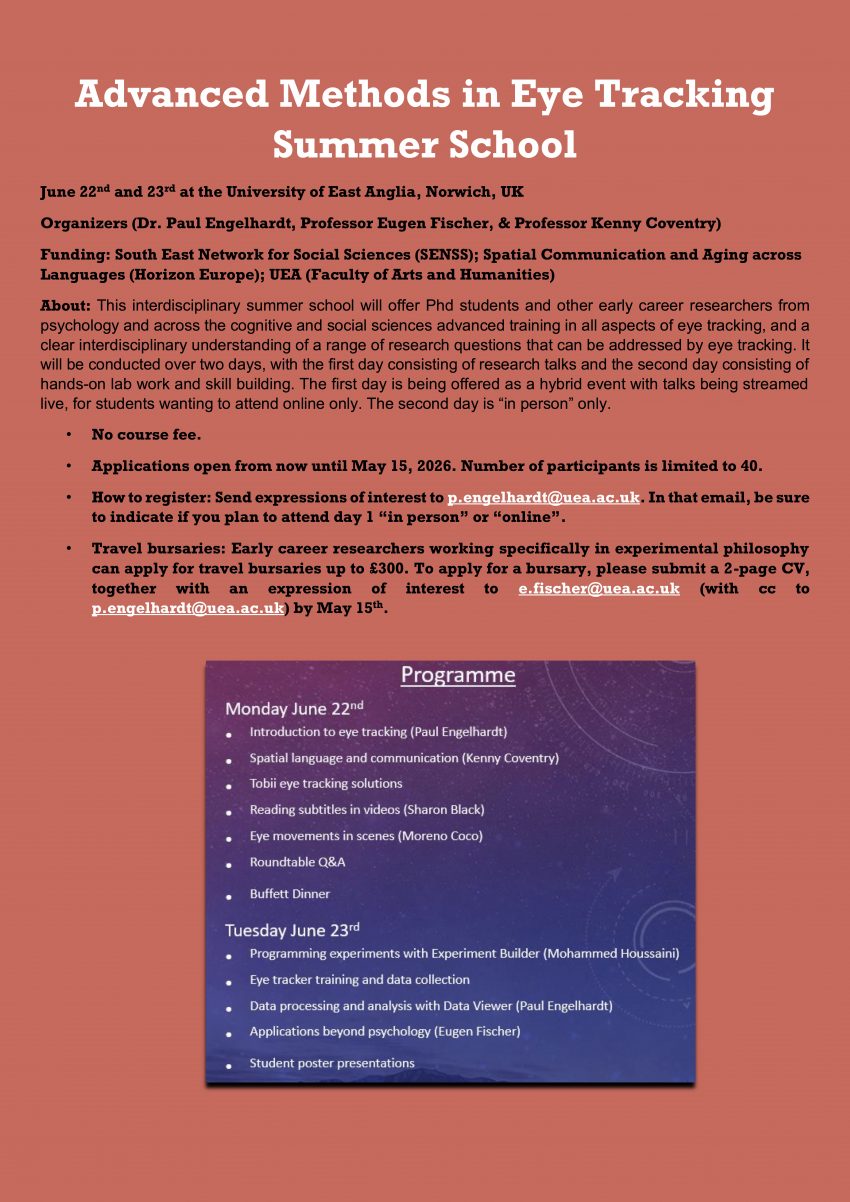
From June 22 to 23, 2026, the summer school “Advanced Methods in Eye Tracking” will take place at the University of East Anglia, UK.

See the poster for details. The announcement reads:

This interdisciplinary summer school will offer Phd students and other early career researchers from psychology and across the cognitive and social sciences advanced training in all aspects of eye tracking, and a clear interdisciplinary understanding of a range of research questions that can be addressed by eye tracking. It will be conducted over two days, with the first day consisting of research talks and the second day consisting of hands-on lab work and skill building. The first day is being offered as a hybrid event with talks being streamed live, for students wanting to attend online only. The second day is “in person” only.

Call: “New Methods in Semantics of Artefacts”

Posted on April 17, 2026April 17, 2026 by Alexander Max Bauer

From September 15 to 16, 2026, the conference “New Methods in Semantics of Artefacts – Meaning Beyond Linguistic Signs” will take place at the Cité de la Mode et du Design, Paris.

Abstracts can be submitted until May 25, 2026, 12:00 CEST. The call reads:

Conference details

Our organizing committee, with the support of the École Pratique des Hautes Études (EPHE–Paris Sciences Lettres) and the Institut Français de la Mode (IFM), invites submissions to the New Methods in Semantics of Artefacts: Meaning beyond linguistic signs conference, to be held on 15–16 September 2026 at the Cité de la Mode et du Design in Paris.

We are delighted to announce our invited speakers:

Philosophy: Enrico Terrone (University of Genova), Nicola Di Stefano (CNR Italy); Cognitive psychology: Charles Spence (University of Oxford); Linguistics: Philippe Schlenker (École Normale Supérieure / NYU), Pritty Patel-Grosz (University of Oslo); Musicology: Ben Curry (University of Birmingham).

Topic of the conference

Objects such as perfumes, works of art, and creations in design, gastronomy, or entertainment often give rise to mental representations that go beyond the objects themselves. Through perception and interaction, individuals attribute meanings, associations, and symbolic values to such objects, even when these meanings are not explicitly expressed in language. Understanding how such meanings emerge is a shared challenge for philosophy, linguistics, and the cognitive sciences, and this conference aims to put these complementary approaches into dialogue.

The philosophical tradition has long sought to ground what one would ordinarily call the meaning of objects in a general theory of signs – an approach exemplified, within contemporary naturalized philosophy, by Millikan’s work (Beyond concepts, 2017), as well as by more targeted theories addressing the meanings of particular kinds of objects. Pursuing the formalization of such a general theory of signs, the super-linguistics program (Schlenker, Patel-Grosz, among others) holds that formal linguistic theory can be productively extended across various domains of non-linguistic signs, drawing on notions such as the constituency (or grouping) principle central to syntax, the use of logical variables for object tracking, and the variety of inference types investigated in semantics and pragmatics. Finally, several theoretical frameworks in psychology may help address the origins of artefact meaning: in addition to the cognitive foundations of such meaning – cross-modal associations, conceptual representations, affordances, technical reasoning, and intention-based accounts – psychology can illuminate the transmission and cultural learning of the meanings that objects come to bear.

We aim to take stock of the experimental methods and conceptual tools used to study the semantics of objects, and to foster epistemological transfers from the semantics of one domain to another – music, design objects, fragrances, images, food, dance, and so forth – with particular attention to the plurality of sensory modalities through which these objects are perceived.

Submission guidelines

Each selected contributor will be invited to give a 45-minute presentation, including Q&A.

We welcome contributions that place particular emphasis on:

  • the choice and clarification of the semantic concepts employed; and/or
  • attempts at formalization; and/or
  • the originality of the empirical methods applied.

Contributions will be selected from submitted abstracts. Abstracts should be between 400 and 500 words in length, including footnotes but excluding references, and must be suitable for blind review.

The submission deadline is 25 May 2026, 12:00 noon (Paris time).

All abstracts should be submitted to: semanticsofartefacts.conference@gmail.com.

Authors will be notified of acceptance by 18 June 2026.

If your abstract is accepted for presentation, we will cover coffee breaks and lunches during the two-day conference. At present, our funding does not allow us to reimburse travel and accommodation expenses.

Call: “Measuring the Mind”

Posted on April 4, 2026April 4, 2026 by Alexander Max Bauer

Daniela Nica and Sandra Branzaru organize a hybrid workshop on “Measuring the Mind – Conceptual Issues in Psychology, Psychiatry and Cognitive Science” that will take place at the University of Bucharest from May 29 to 30, 2026.

Submissions for contributions can be submitted until April 15, 2026. The call reads:

Psychology, psychiatry, and cognitive science increasingly rely on sophisticated measurement technologies while remaining tied to inherited assumptions about what is being measured. Many constructs – emotion, memory, attention, intelligence, disorder – are still treated as if they were stable, homogeneous, mind‑independent natural kinds with latent quantitative essences, even as empirical work reveals pervasive heterogeneity, context‑sensitivity, and replication failure across domains such as affective neuroscience, psychopathology, and social cognition. At the same time, related debates in the philosophy of biology, metaphysics, and cognitive ontology emphasize conceptual relativity and the need to re‑engineer scientific categories in light of concept‑laden evidence.

This conference asks what follows for measurement and classification if psychological and psychiatric categories are better understood as populations of variable, situated instances or relational patterns in high‑dimensional spaces, rather than as tokens of fixed types. How should we think about constructs, latent variables, and diagnostic entities if variation is ontologically primary and averages are statistical abstractions? When do our instruments partially constitute the phenomena they purport to detect? To what extent do replication “failures” reveal construct instability or ontological mismatch rather than methodological error?

We invite contributions from philosophy of psychology and psychiatry, philosophy of cognitive science, philosophy of biology, metaphysics and metametaphysics, as well as empirically oriented work in psychology, psychiatry, and neuroscience that engages these conceptual issues. Topics include, but are not limited to: cognitive and psychiatric ontology; natural kinds, homeostatic property clusters and relational or internal realism; measurement theory, psychometrics and the “quantitative imperative”; classification and re‑classification in psychiatry and cognitive science (e.g., RDoC, HiTOP); construct instability and the replication crisis; predictive processing and constructionist theories of mind and emotion; and the concept‑ladenness of evidence and data‑driven ontology re‑engineering.

Our aim is to articulate and critically assess conceptual frameworks that could underpin a “variation‑first” science of mind, in which explanation, generalization, and measurement are explicitly aligned with the heterogeneous, context‑bound phenomena they target.

The conference is organized by the Faculty of Philosophy, University of Bucharest, and is open to MA and PhD students, early PhDs and postdocs, as well as established researchers in philosophy of psychology, psychiatry, cognitive science, philosophy of biology, and related empirical fields.

Submission of abstracts up to 300 words is welcome via email: measuringthemind@gmail.com

  • Email subject line: “abstract submission”
  • Anonymity: Please include identifying information (name, affiliation, contact email) in the body of the email and submit an anonymized abstract as attachment.
  • Deadline for submissions: 15 April 2026
  • Notification of acceptance: on or before 10 May 2026

Date: May 29–30

Format: mixed (in‑person and online)

Contact email: measuringthemind@gmail.com

Organizers:

  • Drd. Daniela Nica
  • Drd. Sandra Branzaru

Talk: “Cognitive Foundations of Geometry” (Véronique Izard)

Posted on March 19, 2026March 19, 2026 by Alexander Max Bauer

As part of the IHPST’s Séminaire PhilSciCog at the Université Paris 1 Panthéon-Sorbonne, Véronique Izard will talk about “Cognitive Foundations of Geometry” on March 26, 2026, from 02:00–03:30 (UTC). The hybrid session can be accessed via Zoom (Meeting ID: 950 6108 6376, Code: 535047). The abstract reads:

From the first months of life, young children can perceive numeric quantities and perform additive or multiplicative operations on quantities. These abilities support the acquisition of number concepts later in life, and have been proposed to enable humans’ arithmetic cognition. What about geometry, another major branch of mathematics? In this talk, I will present two recent studies assessing the scope and the limits of human geometric intuition. The first study focused on Euclidean geometry, and found that children and adults encode a rich repertoire of geometric properties, at several levels of abstraction. The second study probed intuitions for non-Euclidean geometry and revealed the existence of a pervasive Euclidean bias in adults, identifying limits to the flexibility of human geometric intuition.

Call: “Toronto Workshop on Moral Psychology and Moral Theory”

Posted on March 19, 2026March 19, 2026 by Alexander Max Bauer

Organized by Andrew Sepielli, the “Toronto Workshop on Moral Psychology and Moral Theory” will take place at the University of Toronto from November 7 to 8, 2026.

Submissions for contributions can be submitted until July 1, 2026. The call reads:

The workshop aims to bring together philosophers, psychologists, and legal scholars working on questions about the relationship between empirical research on moral cognition and the foundations of moral theory. The goal is to foster interdisciplinary discussion about how empirical work in fields such as psychology, neuroscience, and evolutionary theory bears on moral judgment and the evaluation of moral beliefs.

Invited speakers include:

  • Paul Bloom (Psychology, University of Toronto / Yale University)
  • Joshua Knobe (Philosophy and Psychology, Yale University)
  • Liane Young (Psychology, Boston College)
  • Roseanna Sommers (Law and Psychology, University of Michigan)
  • Brendan de Kenessey (Philosophy, University of Toronto)

We invite submissions addressing topics at the intersection of empirical research and moral theory. Relevant topics include, but are not limited to:

  • experimental philosophy
  • the psychology of moral cognition
  • causal cognition and moral judgment
  • the neuroscience of moral judgment
  • evolutionary approaches to morality
  • empirical work bearing on normative ethics or metaethics
  • methodological questions about the role of empirical research in moral theory
  • debunking arguments and related challenges to moral belief

Five contributed papers will be selected. Contributed talks will consist of a 45-minute presentation followed by 45 minutes of discussion. The workshop is designed to be discussion-focused, with substantial time devoted to questions and conversation about each paper.

We welcome submissions from scholars in philosophy, psychology, law, and related disciplines. Submissions from early-career scholars are especially encouraged.

Submission Guidelines:

Please submit an abstract of 750–1000 words, along with a brief CV, to: torontomoralpsych@gmail.com 

Submissions should not be anonymized.

Important Dates:

Submission deadline: July 1, 2026

Notification of decisions: August 1, 2026

Limited support for travel and accommodation may be available.

Questions about the workshop may be directed to the conference organizer, Andrew Sepielli (Philosophy, University of Toronto), at: torontomoralpsych@gmail.com

Hot Off The Press: “Indirect Freedom”

Posted on January 10, 2026January 10, 2026 by Alexander Max Bauer

Andrew James Latham published a book on indirect compatibilism, a new compatibilist account of free will that also takes into account experimental philosophy and cognitive neuroscience. The summary reads:

This book advances a new kind of compatibilist account of free will: indirect compatibilism. It is the first sustained philosophical analysis of the idea that the ordinary concept of free will is a conditional one.

Indirect compatibilism is the combination of two theses. The first is that the best understanding of our concept of free will is that it is a conditional concept – that indeterminism or libertarian powers are necessary if they are actual, but not if they are not. The second is indirection – that actions are free either when they are caused by standard conscious psychological processes, or else by sub-personal-level processes influenced in various ways by conscious psychological processes. The book combines traditional philosophical analysis with empirical work – in particular, experimental philosophy and cognitive neuroscience – to produce a detailed description and defence of indirect compatibilism. Indirect compatibilism resolves two important problems in the free will literature: that people as a matter of fact do not accept that free actions can exist in a deterministic universe, and that some simple actions are under the direct control of conscious psychological processes.

Indirect Freedom will appeal to researchers and graduate students interested in the metaphysics of free will, experimental philosophy, philosophy of mind, and cognitive neuroscience.

Call: “Valence Asymmetries”

Posted on September 19, 2025October 8, 2025 by Alexander Max Bauer

Isidora Stojanovic, Lorenza D’Angelo, Morgan Moyer, and Michelle Stankovic organizing a conference on “Valence Asymmetries,” which will take place at the Universitat Pompeu Fabra from March 19 to 20, 2026.

Abstracts for presentations can be submitted until September 30. The call reads:

The Valence Asymmetries ERC team is happy to announce that it will be organizing the first VALENCE ASYMMETRIES conference on March 19th–20th 2026 at the Pompeu Fabra University in Barcelona, Spain. The event is funded by Isidora Stojanovic’s ERC Advanced Grant “Valence Asymmetries: the positive, the negative, the good and the bad in language, mind and morality” (GA n° 101142133).

This interdisciplinary event will discuss themes which are central to the Valence Asymmetries project, including the role of valence asymmetries in perception, emotion, morality, language, and communication. Discussion will draw upon insights from philosophy, psychology, and linguistics.

There will be invited talks by Hans Alves, Frederique de Vignemont, Saif Mohammad, and Pascale Willemsen. There is also room for 4–6 additional talks, to be selected from open submissions. Each selected talk will be assigned a 50 min slot, including discussion.

We especially encourage submissions on the relation between value, valence, and polarity; theoretical and empirical accounts of valence asymmetries in language, including in negative strengthening, scalar inferences, and irony; the asymmetry between virtue and vice, and between praise and blame, in normative and applied ethics; as well as other discussions of valence asymmetries in linguistics, cognitive science, moral psychology, and cognate areas.

If you are interested in presenting your work at this venue, please submit a 2-page abstract to valence.asymmetries@upf.edu by Sep 30th, with the subject line “valence asymmetries submission.”

Call: “Cognitive Tools in Action”

Posted on March 24, 2025March 24, 2025 by Alexander Max Bauer

Valentina Cuccio and Francesco Parisi will organize the conference “Cognitive Tools in Action” in Messina, Italy, from May 28 to 30. Marianna Bolognesi, Anna Ciaunica, Elena Cuffari, Lambros Malafouris, Erik Myin, Gerard Steen, Vittorio Gallese, and Michele Cometa have been confirmed as keynote speakers.

Abstracts can be submitted until March 30. The call reads:

The conference “Cognitive Tools in Action” aims to explore the diverse ways in which cognition is both shaped by tools and manifests itself as a dynamic interplay of strategies and embodied actions.

The term “cognitive tools” encompasses both external instruments (e.g., artworks, technologies, artifacts, and media) that modulate cognitive processes, and internal strategies (e.g., metaphor) employed in cognitive processing. By emphasizing “in action,” we seek to foreground the deeply embodied, sensorimotor, and interactive nature of cognition.

This conference invites scholars from a range of disciplines (including but not limited to anthropology, arts, literature, neuroscience, performance studies, philosophy, psychology), to reflect on the reciprocal relationship between cognitive tools and the environments, bodies, and contexts in which they operate.

Call: “EPSA25”

Posted on January 15, 2025January 15, 2025 by Alexander Max Bauer

The 10th biennial meeting of the European Philosophy of Science Association will take place at the University of Groningen from August 27 to 30.

Abstracts for presentations, symposia, and posters can be submitted until January 31. The call reads:

Call for papers, symposia and posters

The European Philosophy of Science Association invites submissions for its 10th biennial meeting, EPSA25, to be held in Groningen (Netherlands) on 27-30 August 2025.

The conference will feature contributed talks, symposia, and posters covering all subfields of the philosophy of science and will bring together a large number of philosophers of science from Europe and overseas.

We also welcome philosophically minded scientists and investigators from areas outside the philosophy of science, for example, as symposium participants; and we particularly welcome submissions from women, ethnic minorities, and other under-represented groups in the profession. Childcare facilities will be provided.

The conference has ten sections:

  1. General Philosophy of Science
  2. Philosophy of the Physical Sciences
  3. Philosophy of the Life Sciences
  4. Philosophy of the Cognitive Sciences
  5. Philosophy of the Social Sciences
  6. Philosophy of Technology and Philosophy of Interdisciplinary Research
  7. Philosophy of Science in Practice
  8. Formal Philosophy of Science
  9. Ethical and Political Issues Concerning Science
  10. Integrated History, Philosophy, and Social Studies of Science

The EPSA25 Programme Committee, headed by Marie I. Kaiser (Bielefeld) and Olivier Sartenaer (Namur), will strive for quality, variety, and diversity on the programme. A selection of accepted contributed and symposium papers will appear in the European Journal of Philosophy of Science (EJPS).

Submission Categories

We invite submissions in any of the following three categories:

1. Contributed Papers

Submissions of proposals for contributed papers to be presented at the conference must contain a short abstract (max. 1000 characters) as well as an extended abstract (max. 1000 words).

The short abstract must be copied or typed into the abstract field in the conference management system EasyChair (https://easychair.org/my/conference?conf=epsa25). The short abstract will be used for assigning reviewers. Please include the number and title of the most relevant section at the end of the abstract. In addition, please tick up to 4 sections that apply to the submission in the topic section of the submission form in EasyChair. This information will be used to optimize the schedule of the conference.

The extended abstract must start with the title of the paper as it is also typed into the submission form. The extended abstract serves as the basis for the review. Please prepare it for blind review and submit it as a PDF file.

Please tick whether you want your submission to be considered for the poster session in case of non-acceptance as a talk, or whether the submission should be considered only as a talk.

The allocated time for delivering contributed papers as talks at the conference will be 30 minutes, including discussion. Presenters are expected to be present at the conference.

2. Symposia

Submission of proposals for symposia to be presented at the conference must contain a short abstract (max. 1000 characters) as well as a full proposal (max. 3000 words).

The short abstract must be typed into the abstract form in the conference management system EasyChair (https://easychair.org/my/conference?conf=epsa25). The short abstract will be used for assigning reviewers. Please include the number and title of the most relevant section at the end of the abstract. In addition, please tick all sections that apply to the submission in the topic section of the submission form in EasyChair. This information will be used to optimize the schedule of the conference.

The full symposium proposal must start with the title of the symposium as it is also typed into the submission form. In addition, it must include the contact details of the organizer(s), who may or may not be speaker(s), the names and short CVs of all speakers (max. 1 page in total), a general description of the topic, its significance and how the individual talks contribute to the topic and relate to each other (max. 1500 words), as well as titles and abstracts of all talks (max. 300 words for each). The full symposium proposal serves as the basis for the review. Please submit it as a PDF file.

Accepted symposia will be allocated 120 minutes, including discussions. They can have any format, but the maximum number of speakers is five. If a symposium has a classical format (successive talks & discussions) we encourage the organizers to include four talks (each 30 min) to fall in with the rhythm of contributed talks.

Symposium proposals that explore connections between different areas or research programmes in philosophy of science or between philosophy of science and sciences are especially encouraged. Online presentation will be allowed in symposia, but they should be exceptions and well justified. Plans for online presentation must be described in the symposium proposal.

3. Posters

We invite contributions of posters, which will be presented in a dedicated poster session. Posters can be submitted either specifically for the poster session or as a second option for papers that are also submitted as contributed talks.

Submissions of proposals for posters must contain a short abstract (max. 1000 characters) as well as an extended abstract (max. 1000 words). For poster submissions, please follow the guidelines for contributed papers and select the submission category “poster” (or “contributed paper” and poster option “yes”).

Submission Guidelines and Rules

The deadline for all submissions is by 31 January 2025, 11.55pm GMT.

All submissions should be made through the conference management system EasyChair at https://easychair.org/my/conference?conf=epsa25

Authors can simultaneously make one submission for each of the three above types (contributed paper, symposium, poster), but any author can appear on the programme only once as a presenter. In case of acceptance of multiple submissions by one author, the programme committee will give symposium participation priority over contributed talks and contributed talks over posters.

For co-authored contributed papers, symposium papers, and posters, only one presenter of the paper or poster must be chosen and identified as such in EasyChair. Accordingly, authors presenting at EPSA25 may also appear as co-authors of other papers that are part of the programme, but not as first author/presenter.

Decisions on the acceptance of submissions will be made by the end of April 2025.

To present at the conference, the conference fee must be paid before 31 May 2025. In addition, presenters must be active and paying members of the EPSA.

The final program of the conference will be released in June 2025.

Contact us

For all enquiries related to EPSA25 submissions, please contact the following mailbox: epsa.pc@philsci.eu

Job: “PhD Scholarships in Neurophilosophy” (Munich, Germany)

Posted on January 7, 2025October 27, 2025 by Alexander Max Bauer

The Graduate School of Systemic Neuroscience (GSN) at the University of Munich offers PhD scholarships in neurophilosophy.

Applications are possible until November 25. The job announcement reads:

PhD scholarship at GSN

You can apply for a neurophilosophy PhD scholarship in an annually recurring call for scholarships (application period from early December to mid-February). The GSN offers a structured doctoral program with an independent PhD (GSN Doctoral Program), in which you can choose from a wide range of interdisciplinary courses together with your TAC (Thesis Advisory Board) to put together an interdisciplinary study program tailored to your individual research interests. This gives you a sound neuroscientific insight into the (natural) scientific contexts that are important for your neurophilosophical doctoral project. In addition, there is an extensive range of “soft skills” and an attractive social program.

Call for PhD scholarships in Neurophilosophy

The application round for 2024/25 is now open and will close on 17 February 2025 (12:00 noon CET).

The Graduate School of Systemic Neurosciences (GSN) at LMU Munich invites applications for several PhD scholarships in Neurophilosophy. The GSN is the teaching entity for the Munich Center of Neurosciences – Brain & Mind (MCN). By creating an interdisciplinary network of research, the GSN provides a stimulating environment for students and faculty to produce novel formulations of current concepts and theories. Successful applicants will be affiliated with the Research Center for Neurophilosophy and Ethics of Neurosciences at the GSN.

Projects in the research center fall in the following areas:

  • philosophy of cognitive neuroscience (explanation, reduction)
  • philosophy and cognitive science of agency (mental causation, free will, moral psychology, abilities)
  • philosophy and cognitive science of reasoning (e.g. deductive and non-deductive reasoning, logic and neural networks, decision making)
  • ethics of neuroscience (research ethics, enhancement)
  • philosophy of perception
  • philosophy and social cognition

In the new application round we encourage applications in smaller focus areas in order to build research groups. In the 2024/25 round the focus areas are:

  • human agency (esp. mental causation, complex action, multi-tasking, attention, reductive and non-reductive explanation of agency)
  • metacognition (esp. metacognition in perception, self-evaluation and sense of self)
  • group cognition (group epistemology, collective decisions and group responsibility)

However, single exceptional and independent projects in one of the other areas are also encouraged.

Applicants should have advanced training in philosophy (typically a Master’s degree in philosophy) and a genuine interest in the neurosciences. This includes the willingness to acquire substantial knowledge of empirical work relevant to their philosophical project. Cooperative projects with empirical scientists in the network of the MCN are strongly encouraged.

The application period will open on 1 December 2024 and will close on 17 February 2025 (12:00 noon CET). Please check our website and the GSN website for details concerning the application procedure. The application includes an outline of your proposed research project, a CV, an official transcript of your academic work (list of attended courses; grades), diplomas and two separate academic reference letters. Please also name two potential supervisors (possibly including one non-philosopher) from the core or affiliated neurophilosophy faculty of the GSN.

How to apply for a GSN PhD scholarship

Please follow the standard application process for GSN PhD applications:

  • Details of the process and application form

In addition to the application form, please submit a short exposé (max. 3000 words) that

  • gives an outline of your main project
  • explains how your project fits with the focus topic or one of the other topics listed in the call for applications
  • names two or three potential supervisors (at least two in the GSN faculty)
  • sketches an interdisciplinary cooperation project (an empirical study that relates to your theoretical work)
  • 1
  • 2
  • Next

Search

Categories

Tags

Agency Artificial Intelligence Autonomous Systems Basic Needs Behavior Beliefs Bias Bioethics Blame Causation Cognitive Science Consciousness Corpus Analysis Cross-Cultural Research Decisions Determinism Distributive Justice Emotions Essentialism Expertise Folk Morality Framing Free Will Gender Intention Intuition Jurisprudence Knowledge Large Language Models Moral Psychology Norms Pejoratives Psycholinguistics Rationality Reasoning Replication Responsibility Self Side-Effect Effect Slurs Thought Experiments Truth Valence Values Virtue

Recent Posts

  • Summer School: “Advanced Methods in Eye Tracking”
  • Call: “New Methods in Semantics of Artefacts”
  • Call: “Law Observed”
  • Call: “Artificial Life as Experimental Philosophy”
  • Conference: “Social Ontology and Empirical Inquiry”

Recent Comments

  1. Nova Praxis on The Folk Concept of ArtJuly 11, 2025

    This article highlights an important point: everyday people don’t rely on rigid definitions to determine what qualifies as art. They’re…

  2. Koen Smets on Priming Effects Are Fake, but Framing Effects Are RealMay 27, 2025

    That is indeed exactly the question I have as well. I operationalize it as having de facto contradicting intuitions, in…

  3. Joshua Knobe on Priming Effects Are Fake, but Framing Effects Are RealMay 24, 2025

    Hi Koen, Thanks once again. This idea brings up all sorts of fascinating questions, but for the purposes of the…

  4. Koen Smets on Priming Effects Are Fake, but Framing Effects Are RealMay 24, 2025

    Great! In the meantime I thought of another potentially interesting example of framing—Arnold Kling’s Three Languages of Politics. Just about…

  5. Joshua Knobe on Priming Effects Are Fake, but Framing Effects Are RealMay 23, 2025

    Thanks Koen! This is all super helpful.

Archives

  • April 2026
  • March 2026
  • February 2026
  • January 2026
  • December 2025
  • November 2025
  • October 2025
  • September 2025
  • August 2025
  • July 2025
  • June 2025
  • May 2025
  • April 2025
  • March 2025
  • February 2025
  • January 2025
  • December 2024
  • November 2024
  • October 2024
  • September 2024
  • August 2024
  • July 2024
  • June 2024
  • May 2024
  • April 2024
  • March 2024

Meta

  • Log in
  • Entries feed
  • Comments feed
  • WordPress.org

Imprint • Disclaimer • Privacy Statement • Cookie Policy

© 2024 The Experimental Philosophy Blog
Manage Consent
To provide the best experiences, we use technologies like cookies to store and/or access device information. Consenting to these technologies will allow us to process data such as browsing behavior or unique IDs on this site. Not consenting or withdrawing consent, may adversely affect certain features and functions.
Functional Always active
The technical storage or access is strictly necessary for the legitimate purpose of enabling the use of a specific service explicitly requested by the subscriber or user, or for the sole purpose of carrying out the transmission of a communication over an electronic communications network.
Preferences
The technical storage or access is necessary for the legitimate purpose of storing preferences that are not requested by the subscriber or user.
Statistics
The technical storage or access that is used exclusively for statistical purposes. The technical storage or access that is used exclusively for anonymous statistical purposes. Without a subpoena, voluntary compliance on the part of your Internet Service Provider, or additional records from a third party, information stored or retrieved for this purpose alone cannot usually be used to identify you.
Marketing
The technical storage or access is required to create user profiles to send advertising, or to track the user on a website or across several websites for similar marketing purposes.
  • Manage options
  • Manage services
  • Manage {vendor_count} vendors
  • Read more about these purposes
View Preferences
  • {title}
  • {title}
  • {title}