The Experimental Philosophy Blog

Philosophy Meets Empirical Research

Menu
  • Home
  • About
  • Guidelines for Comments
  • Labs and Organizations
  • Resources
Menu

Month: March 2026

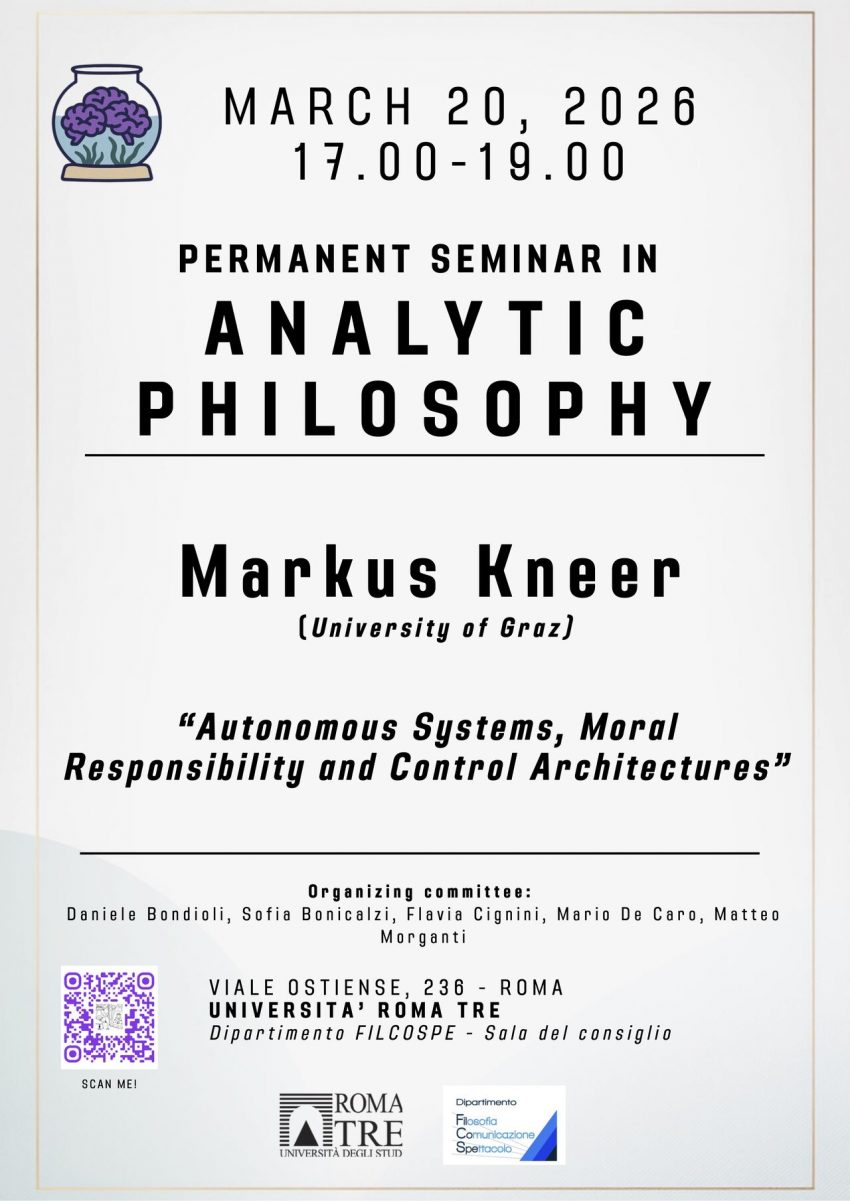
Talk: “Autonomous Systems, Moral Responsibility and Control Architectures” (Markus Kneer)

Posted on March 19, 2026April 17, 2026 by Alexander Max Bauer

On March 20, from 17:00–19:00 (UTC+1), the Permanent Seminar in Analytic Philosophy (PSAP) of Università Roma Tre will host a talk by Markus Kneer about “Autonomous Systems, Moral Responsibility and Control Architectures.” The hybrid session can be accessed via Teams. The abstract reads:

Matthias (2004) and Sparrow (2007) have argued that the use of self-learning systems can engender “responsibility gaps” – situations in which nobody is morally responsible for a potential harm. In this talk, I will present empirical evidence as to whether laypeople are sensitive to such alleged “responsibility gaps” or whether their retributive dispositions might get in the way (see Danaher, 2016). I will also present new data concerning the question whether we can avoid such situations by imposing tight control architectures to ensure meaningful human control (see e.g. “human-in-the-loop v. on-the-loop,” Docherty, 2012; “tracking & tracing,” Santoni de Sio & van den Hoven, 2018).

Talk: “Cognitive Foundations of Geometry” (Véronique Izard)

Posted on March 19, 2026April 17, 2026 by Alexander Max Bauer

As part of the IHPST’s Séminaire PhilSciCog at the Université Paris 1 Panthéon-Sorbonne, Véronique Izard will talk about “Cognitive Foundations of Geometry” on March 26, 2026, from 15:00–16:30 (UTC+1). The hybrid session can be accessed via Zoom (Meeting ID: 950 6108 6376, Code: 535047). The abstract reads:

From the first months of life, young children can perceive numeric quantities and perform additive or multiplicative operations on quantities. These abilities support the acquisition of number concepts later in life, and have been proposed to enable humans’ arithmetic cognition. What about geometry, another major branch of mathematics? In this talk, I will present two recent studies assessing the scope and the limits of human geometric intuition. The first study focused on Euclidean geometry, and found that children and adults encode a rich repertoire of geometric properties, at several levels of abstraction. The second study probed intuitions for non-Euclidean geometry and revealed the existence of a pervasive Euclidean bias in adults, identifying limits to the flexibility of human geometric intuition.

Call: “Toronto Workshop on Moral Psychology and Moral Theory”

Posted on March 19, 2026March 19, 2026 by Alexander Max Bauer

Organized by Andrew Sepielli, the “Toronto Workshop on Moral Psychology and Moral Theory” will take place at the University of Toronto from November 7 to 8, 2026.

Submissions for contributions can be submitted until July 1, 2026. The call reads:

The workshop aims to bring together philosophers, psychologists, and legal scholars working on questions about the relationship between empirical research on moral cognition and the foundations of moral theory. The goal is to foster interdisciplinary discussion about how empirical work in fields such as psychology, neuroscience, and evolutionary theory bears on moral judgment and the evaluation of moral beliefs.

Invited speakers include:

  • Paul Bloom (Psychology, University of Toronto / Yale University)
  • Joshua Knobe (Philosophy and Psychology, Yale University)
  • Liane Young (Psychology, Boston College)
  • Roseanna Sommers (Law and Psychology, University of Michigan)
  • Brendan de Kenessey (Philosophy, University of Toronto)

We invite submissions addressing topics at the intersection of empirical research and moral theory. Relevant topics include, but are not limited to:

  • experimental philosophy
  • the psychology of moral cognition
  • causal cognition and moral judgment
  • the neuroscience of moral judgment
  • evolutionary approaches to morality
  • empirical work bearing on normative ethics or metaethics
  • methodological questions about the role of empirical research in moral theory
  • debunking arguments and related challenges to moral belief

Five contributed papers will be selected. Contributed talks will consist of a 45-minute presentation followed by 45 minutes of discussion. The workshop is designed to be discussion-focused, with substantial time devoted to questions and conversation about each paper.

We welcome submissions from scholars in philosophy, psychology, law, and related disciplines. Submissions from early-career scholars are especially encouraged.

Submission Guidelines:

Please submit an abstract of 750–1000 words, along with a brief CV, to: torontomoralpsych@gmail.com 

Submissions should not be anonymized.

Important Dates:

Submission deadline: July 1, 2026

Notification of decisions: August 1, 2026

Limited support for travel and accommodation may be available.

Questions about the workshop may be directed to the conference organizer, Andrew Sepielli (Philosophy, University of Toronto), at: torontomoralpsych@gmail.com

Call: “Folk Epistemology and Science Skepticism”

Posted on March 8, 2026March 8, 2026 by Alexander Max Bauer

From August 10 to 14, 2026, the Cologne Summer School will take place at the University of Cologne. This year’s topic will be “Folk Epistemology and Science Skepticism,” with special guest Mikkel Gerken.

Proposals for brief presentations on Gerken’s work can be submitted until April 15, 2026. The call reads:

The Cologne Summer School is an annual, week-long, event at which leading epistemologists present their current work in a series of lectures, defend their views against critical comments, and discuss their work with participants. The Summer School mainly aims at professional philosophers and graduate students, but anyone is welcome to apply. In 2026 our special guest will be Mikkel Gerken (University of Southern Denmark).

Gerken works in epistemology, philosophy of science, and philosophy of mind. In Epistemic Reasoning and the Mental (Palgrave 2013), Gerken considers how externalism in philosophy of mind bears on the nature of the epistemology of inference. In On Folk Epistemology (OUP 2017), he argues that folk epistemological heuristics explain patterns of intuitive judgments that have mistakenly been taken to motivate epistemic contextualism, pragmatic encroachment, and knowledge-first epistemology. Doing so involves engagement with cognitive psychology as well as methodological considerations about the relationship between folk epistemological intuitions and epistemological theorizing. In Scientific Testimony (OUP 2022), Gerken argues that testimony is a vital part of science and articulates epistemic norms governing it. Furthermore, he considers scientific testimony to the lay public and empirically informed science communication strategies for addressing science skepticism. In addition to the monographs, Gerken has published on epistemic injustice, epistemic norms of action and assertion, transcendental arguments, the necessary a posteriori, philosophical skepticism, philosophical methodology etc.

Cologne Summer School Themes: The 2026 Summer School will address a range of issues from foundational to applied social epistemology. Many of the discussions will revolve around an important real-life problem – namely, science skepticism. For example, we will examine how science skepticism is related to varieties of philosophical skepticism. Furthermore, we will consider how folk epistemological heuristics and conversational norms may fuel public skepticism about science. We will also consider ways in which epistemologists and philosophers of science may play a role in combating science skepticism. Thus, some of the discussions overlap with issues in philosophy of science. Throughout, there will be an emphasis on philosophical methodology and epistemology’s relationship to empirical research in the social and cognitive sciences.

Topics will include

  • Philosophical skepticism and real-life (science) skepticism
  • Folk epistemology and its relation to epistemology
  • Epistemic norms of assertion and science communication
  • Internalism and externalism in epistemology and mind
  • Intuitive judgments and philosophical methodology
  • The epistemic roles of science in society

The Summer School is free but limited to 50 participants. Online application is possible through April 15. Please supply a short letter that sketches your academic background and main motivation for participating in the Summer School. If you are interested in giving a brief presentation (approx. 20 minutes) related to Gerken’s work, please also send an abstract of no more than 1,000 words.

Apply via email to:
summerschoolphilosophy@uni-koeln.de
Search

Categories

Tags

Agency Artificial Intelligence Autonomous Systems Basic Needs Behavior Beliefs Bias Bioethics Blame Causation Cognitive Science Consciousness Corpus Analysis Cross-Cultural Research Decisions Determinism Distributive Justice Emotions Essentialism Expertise Folk Morality Framing Free Will Gender Intention Intuition Jurisprudence Knowledge Large Language Models Moral Psychology Norms Pejoratives Psycholinguistics Rationality Reasoning Replication Responsibility Self Side-Effect Effect Slurs Thought Experiments Truth Valence Values Virtue

Recent Posts

  • Where should I publish my X-Phi? A new resource
  • Call: “The New Measurement Heretics”
  • Summer School: “Advanced Methods in Eye Tracking”
  • Call: “New Methods in Semantics of Artefacts”
  • Call: “Law Observed”

Recent Comments

  1. Joanna Demaree-Cotton on Where should I publish my X-Phi? A new resourceApril 24, 2026

    Thanks for the comment, that's really useful. We'll definitely add AJP (missed you accidentally first time!), and that note.

  2. AJP Editor on Where should I publish my X-Phi? A new resourceApril 24, 2026

    AJP is published by Taylor & Francis, and we have an member of the editorial team ('associate editor' in our…

  3. Nova Praxis on The Folk Concept of ArtJuly 11, 2025

    This article highlights an important point: everyday people don’t rely on rigid definitions to determine what qualifies as art. They’re…

  4. Koen Smets on Priming Effects Are Fake, but Framing Effects Are RealMay 27, 2025

    That is indeed exactly the question I have as well. I operationalize it as having de facto contradicting intuitions, in…

  5. Joshua Knobe on Priming Effects Are Fake, but Framing Effects Are RealMay 24, 2025

    Hi Koen, Thanks once again. This idea brings up all sorts of fascinating questions, but for the purposes of the…

Archives

  • April 2026
  • March 2026
  • February 2026
  • January 2026
  • December 2025
  • November 2025
  • October 2025
  • September 2025
  • August 2025
  • July 2025
  • June 2025
  • May 2025
  • April 2025
  • March 2025
  • February 2025
  • January 2025
  • December 2024
  • November 2024
  • October 2024
  • September 2024
  • August 2024
  • July 2024
  • June 2024
  • May 2024
  • April 2024
  • March 2024

Meta

  • Log in
  • Entries feed
  • Comments feed
  • WordPress.org

Imprint • Disclaimer • Privacy Statement • Cookie Policy

© 2024 The Experimental Philosophy Blog
Manage Consent
To provide the best experiences, we use technologies like cookies to store and/or access device information. Consenting to these technologies will allow us to process data such as browsing behavior or unique IDs on this site. Not consenting or withdrawing consent, may adversely affect certain features and functions.
Functional Always active
The technical storage or access is strictly necessary for the legitimate purpose of enabling the use of a specific service explicitly requested by the subscriber or user, or for the sole purpose of carrying out the transmission of a communication over an electronic communications network.
Preferences
The technical storage or access is necessary for the legitimate purpose of storing preferences that are not requested by the subscriber or user.
Statistics
The technical storage or access that is used exclusively for statistical purposes. The technical storage or access that is used exclusively for anonymous statistical purposes. Without a subpoena, voluntary compliance on the part of your Internet Service Provider, or additional records from a third party, information stored or retrieved for this purpose alone cannot usually be used to identify you.
Marketing
The technical storage or access is required to create user profiles to send advertising, or to track the user on a website or across several websites for similar marketing purposes.
  • Manage options
  • Manage services
  • Manage {vendor_count} vendors
  • Read more about these purposes
View Preferences
  • {title}
  • {title}
  • {title}