Christoffer Lundbak Olesen (Aarhus University), Mads Hansen (University of Bristol), and Karsten Olsen (Aarhus University) invite academics who work in or are familiar with consciousness research to take part in a preregistered study on whether differences in subjective experience shape philosophical intuitions about consciousness.
The invitation reads:
We are conducting a research study investigating academics who work in or are familiar with consciousness research. The study explores whether differences in subjective experience influence philosophical intuitions about consciousness, particularly the divide between physicalist and dualist perspectives. The study is part of an accepted Preregistered Report.
We kindly invite you to participate in this study by completing an anonymous questionnaire (approx. 30 minutes). Your participation would help to illuminate how theoretical and experiential factors relate, and whether disagreement within the field may be influenced by pre-theoretic experiential biases.
The link will take you to the website containing the survey. Here you will first be asked to provide your voluntary consent before proceeding to the study survey, which includes questions about your metaphysical views on consciousness, scenario-based thought experiments, and a set of validated psychological instruments that help us understand your experiential profile. Participation is entirely voluntary and anonymous. All data will be handled securely and in full compliance with GDPR.
We would also be very grateful if you could forward this invitation to colleagues who work on or are interested in consciousness.
The study is conducted as a collaboration between experimental researchers and philosophers at Aarhus University and the University of Bristol. If you would like to be informed when the results of the study come out, please reply with your preferred email, and you will receive a message from us.
On October 14, 2026, from 16:00–18:00 (UTC+1), the Experimental Philosophy Online Work-in-Progress Workshop takes place via Teams. Pietro Tunesi (Trinity College Dublin) presents on redesigning ethical thought experiments, and Jordan Wylie, Nathan Liang, and Charlotte Austin (Cornell University) present on what people do and do not want to know in the moral domain. The workshop is organized by James Andow, Joanna Demaree-Cotton, and Eugen Fischer.
The announcement reads:
We are delighted to announce the October session of the Experimental Philosophy Online Work-in-Progress Workshop, on Wednesday, October 14th, 16:00–18:00 (UK time), via Teams:
Pietro Tunesi (Trinity College Dublin): Redesigning Ethical Thought Experiments: Reassessing the Experimental Challenge to Moral Intuition.
Jordan Wylie, Nathan Liang, and Charlotte Austin (all Cornell University): What people (don’t) want to know in the moral domain.
If you would like to receive a Teams invite, please send an email with the header “Register for X-Phi workshop” to moralpsychlab@uehiro.ox.ac.uk
In recent years, research on causation has increasingly made use of computational modeling. For example, classic questions about the causal status of omissions, the prospects of causal pluralism, or the influence of morality on causal judgment, are now being re-visited in the light of computational models of how people judged what caused an event. These models differ on the details, but at their core they assume that people make causal judgments by simulating different possible ways that things could have happened.
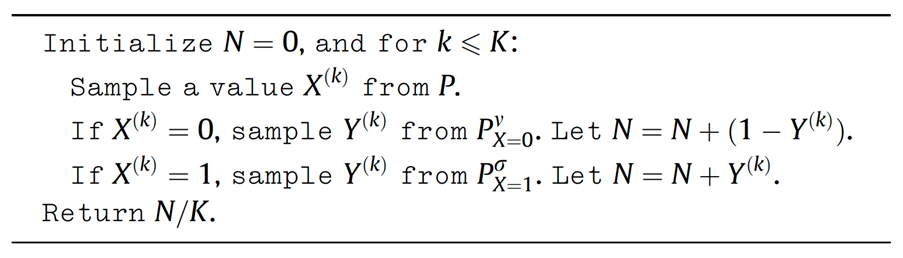
Unfortunately, the papers that describe the computational models can be a bit intimidating:
Not everyone has the technical background to implement a particular model from scratch on the basis of formulae like these. This means that the barrier to contributing to the new wave of research on causation inspired by computational modeling is relatively high.
I designed an R package that makes this barrier considerably lower. The package also comes with an interactive app, so you can use it even if you don’t do any R programming.
Here is an example of how you can use the app. Suppose you are interested in the causal judgments people would make about this story:
Billy and Suzy are freight train conductors. One day, they happen to approach an old two-way rail bridge from opposite directions at the same time. There are signals on either side of the bridge. Billy’s signal is red, so he is supposed to stop and wait. Suzy’s signal is green, so she is supposed to drive across immediately. Neither of them realizes that the bridge is on the verge of collapse. If they both drive their trains onto the bridge at the same time, it will collapse. Neither train is heavy enough on its own to break the bridge, but both together will be too heavy for it. Billy decides to ignore his signal and drives his train onto the bridge immediately at the same time that Suzy follows her signal and drives her train onto the bridge. Both trains move onto the bridge at the same time, and at that moment the bridge collapses.
Was it Billy’s or Suzy’s decision that caused the bridge to collapse?
It is easy to compute the predictions made by a computational model for this scenario.
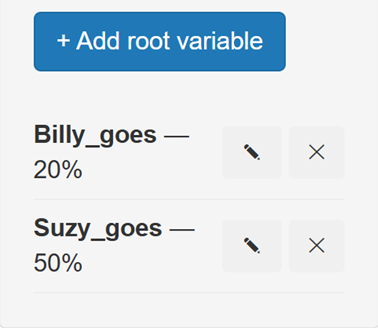
Enter a description of the scenario that the app can understand. We first enter information about the ‘root variables’ whose own causes are not explicitly represented in the story. There is one variable for whether Billy decides to go, and one for whether Suzy decides to go:
For each variable, we specify a ‘sampling probability.’ This probability tells the computational model how often it should simulate the possibility where the event described by the variable happens. For instance the sampling probability of ‘Billy_goes’ is the probability that the model simulates a possibility where Billy decides to drive his train onto the bridge. Here we have specified a lower sampling probability for Billy than for Suzy, because people are biased to think of possibilities where people follow social norms, and we want the model to reflect this.
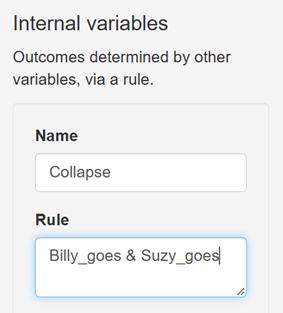
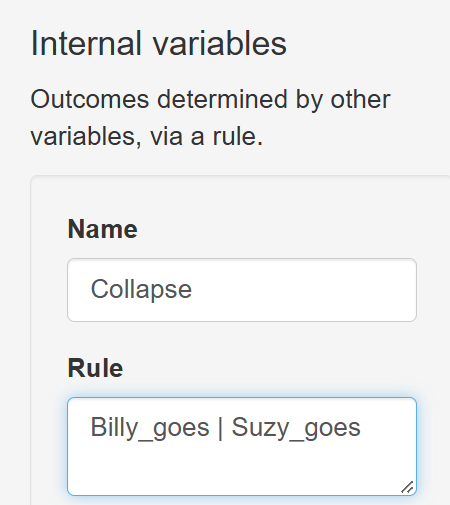
Then we define variables for the events that depend on other events defined in the story. Here we define a variable for whether the bridge collapses. We use the simple rule given in the story: the bridge collapses if Billy AND Susy drive their train onto the bridge:
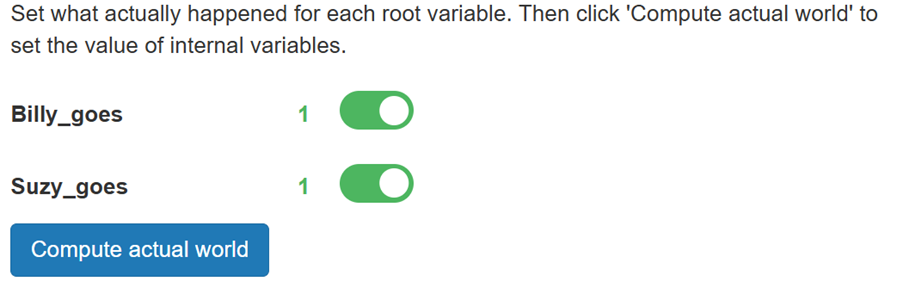
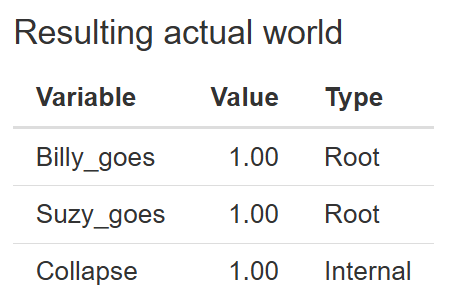
The next step is to specify what happened in the actual world: Billy goes, Suzy goes, and the bridge collapses. We do that simply by toggling the value of the root variables:
Clicking on ‘compute actual world’ lets the app automatically calculate what happens to the bridge (it collapses):
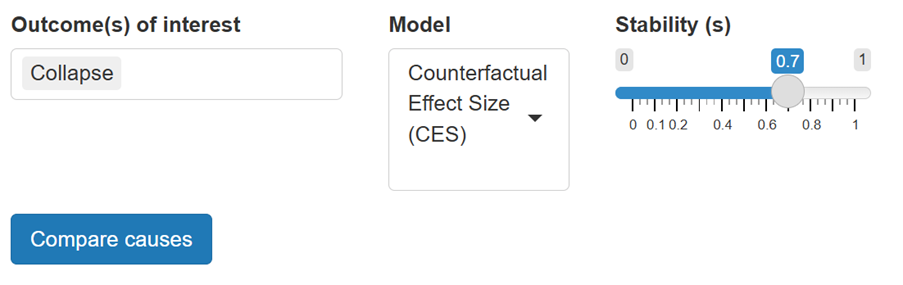
Finally, we ask for causal judgments. Here you can choose which computational model you want to use. For illustration I choose the Counterfactual Effect Size model. You can also modify the value of a ‘stability’ parameter that determines to what extent the model simulates possibilities that stay close to what happened in the actual world:
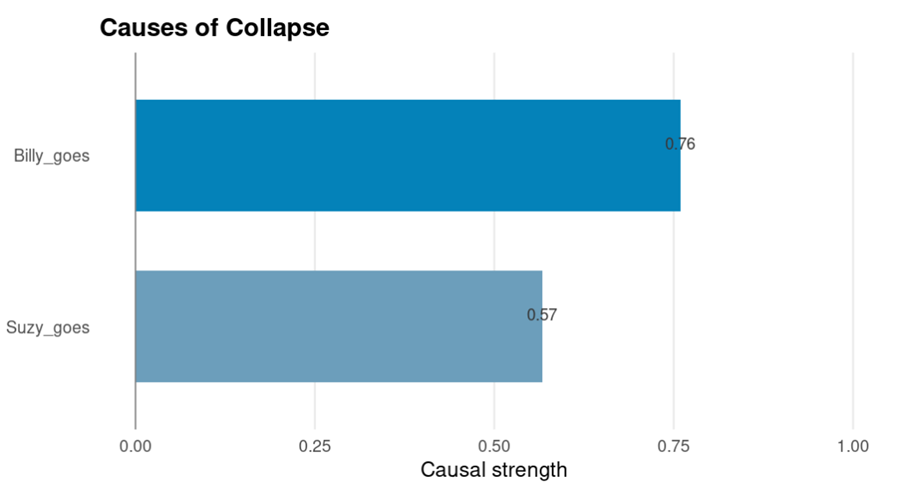
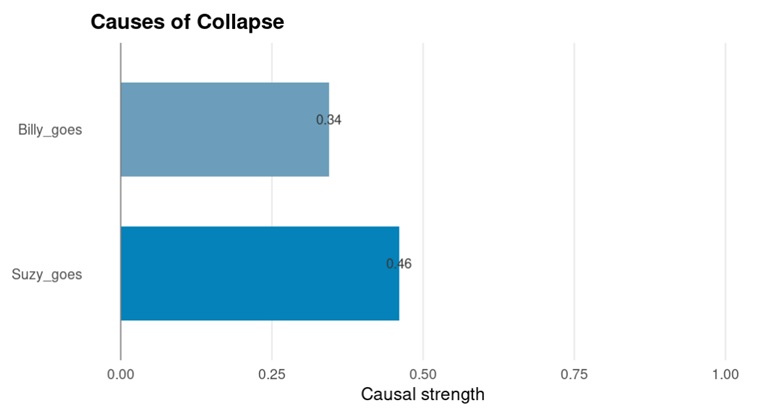
Clicking ‘Compare causes’ shows the relative contribution of Billy and Suzy to the bridge collapse:
The model thinks that Billy’s decision to go is what caused the bridge to collapse. If you run the experiment, you will probably find that this is what people think too.
The power of computational models comes from their capacity to make surprising predictions. For example, you can modify the story slightly such that the bridge collapses if either Suzy OR Billy drives onto the bridge. Simply modify the rule for the ‘Collapse’ variable:
Now the model thinks that it was Suzy’s decision that caused the bridge to collapse:
If you do the experiment, you will probably find that people think this too (see Icard, Kominsky, and Knobe, 2017). So, the model helped discover a surprising fact: sometimes the decisions of people who break social norms are judged as less causal rather than more.
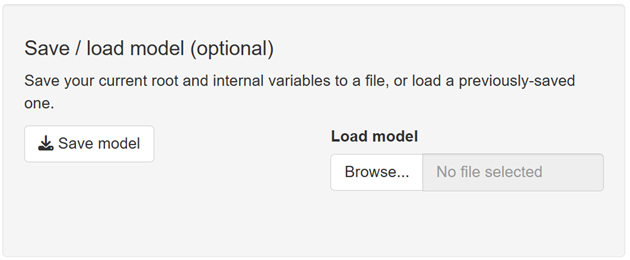
Once you have created a causal model of a scenario, you can save it for future use:
And that’s it!
Currently the app implements two different computational models: the Counterfactual Effect Size (CES) and the Necessity-Sufficiency model (Quillien & Lucas, 2024; Icard, Kominsky, and Knobe, 2017). There are other models of causal judgment out there, and they might be implemented in a future version.
You can read more about the R package (which powers the app) here. The app is easiest to use, but for research purposes ultimately the R package offers more flexibility. For more background on the computational models themselves you can read the relevant papers (see References).
Hopefully this tool allows more people to contribute to the new wave of research on causation inspired by computational models. If you have questions about the app or the package I’m very happy to answer them either in the comments or by email.
Literature
Icard, Thomas, Jonathan Kominsky, and Joshua Knobe (2017): “Normality and Actual Causal Strength,” Cognition 161, 80–93. (Link)
Quillien, Tadeg, and and Christopher Lucas(2024): “Counterfactuals and the Logic of Causal Selection,” Psychological Review 131 (5), 1208–1234. (Link)
Quillien, Tadeg (2026): causaljudgment: Computational Models of Causal Judgment, R package version 0.1.0. (Link)
Benjamin Ferguson, Peter Matthews, David Ronayne, and Roberto Veneziani are inviting academic philosophers to take part in a short online survey on exploitation. Participants will evaluate various abstract scenarios, and the survey takes roughly ten minutes to complete.
The announcement reads:
We are conducting a survey about academic philosophers’ views of (1) the effect of exploitation on subjective wellbeing, (2) how morally wrong exploitative relations are, and (3) norms around that wrongfulness, by asking you to evaluate various abstract scenarios.
It takes roughly 10 minutes to complete the questions, with the option to answer more if you like. If you complete the survey, we will enter you in our prize draw to receive one of ten $100 (or local currency equivalent) Amazon vouchers (unless you opt out).
Click here to take our survey (if you are using a VPN, please disconnect it before answering or we cannot use your responses):
In March 2027, the first “Complutense Workshop on Intuitions and Experimental Philosophy” will take place at the Facultad de Filosofía of the Universidad Complutense de Madrid, Spain, with keynotes by María José Frápolli Sanz and James Andow.
Abstracts can be submitted until November 1, 2026. The call reads:
Submission deadline: 1 November 2026
Notification of acceptance: 15 December 2026
Conference date(s): March 2027
Workshop Venue: Facultad de Filosofía, Universidad Complutense de Madrid, Spain.
Details
Intuitions are a source of evidence that many people use to a greater or lesser extent. We rely on them to investigate a wide variety of issues, for example, moral, mathematical, or religious questions, or to examine other people’s opinions on a host of different topics. Although there is debate about what is an intuition, appealing to intuitions has been one of the most widely used methods in many areas within analytic philosophy. The accepted view (see Goldman, 2007; Weinberg, 2007; Williamson, 2007, p. 2; Baz, 2012, p. 87; Koopman, 2012; Kornblith, 2014) is that intuitions play a fundamental evidential role.
Besides, there has been a dispute within analytic philosophy between three different groups of philosophers during the last decades. First, the “autonomists” (see, e.g., Bealer, 1998; Liao, 2008; Sosa, 2013; Chalmers, 2014; Devitt, 2015) defend that introspection and appeal to intuition can be used to answer many philosophical questions. Second, those who defend that analytic philosophers do not employ intuitions as evidence in philosophical practice. Following Nado (2016, p. 782), we can call them “intuition deniers” (see, e.g., Williamson, 2007; Deustch, 2009; Cappelen, 2012). Third, those who think that analytic philosophers use intuitions as evidence but doubt this method, arguing instead for the need to apply more rigorous methods drawn from scientific disciplines such as psychology, the social sciences, or linguistics; we can call them “experimental philosophers” (see, for example, Machery et al., 2004; Knobe and Nichols, 2007; Mallon et al., 2009; Alexander et al., 2010).
This workshop aims to include presentations addressing the relationship between intuitions and experimental philosophy. The presentations accepted are expected to develop novel perspectives or adopt novel approaches that shed light on traditional problems associated with intuitions in analytic philosophy. Both experimental and theoretical papers will be accepted, as well as explicit defenses of any of the above positions, papers that point out desiderata that all three should fulfill, or papers dealing with other issues related to intuitions and experimental philosophy.
Some possible topics that presentations may address are:
Intuitions and mental experiments.
Conflicting intuitions in questionnaires.
Intuitions and justification.
Calibration of intuitions.
Differences in the use of intuitions in different areas of analytic philosophy.
Empirical or theoretical analyses of the role of intuition talk in the arguments of analytic philosophers.
Empirical or theoretical analyses of philosophical practices making use of intuitions.
Using intuition in conceptual engineering.
Submission
Please submit an abstract including:
Title of the paper.
Abstract (400–500 words) clearly presenting the research question, theoretical framework, and main argument (in English or Spanish).
Institutional affiliation.
The deadline for submitting abstracts is 1 November 2026. Abstracts must be anonymized (also anonymize self-citations) and must have a section including the bibliographic references (not included in the word count). Abstracts should be sent to the following email: davbordo@ucm.es, specifying the following subject: 1st Workshop on Intuitions and Experimental Philosophy.
María José Frápolli Sanz (Universidad de Granada, Spain; Institute of Philosophy. School of Advance Study, University of London, United Kingdom).
James Andow (University of Manchester, United Kingdom).
Organizers
David Bordonaba-Plou (Universidad Complutense de Madrid, Spain).
Martín Capece del Toro (Universidad Complutense de Madrid, Spain).
Scientific Committee
Asier Arias Domínguez (Universidad Complutense de Madrid, Spain), Filippo Batisti (), Antonio Blanco Salgueiro (Universidad Complutense de Madrid, Spain), David Bordonaba-Plou (Universidad Complutense de Madrid, Spain), Esteban Céspedes (Instituto de Sistemas Complejos de Valparaíso, Chile), Antonio Duarte Calvo (Universidad Complutense de Madrid, Spain), María Dolores García Arnaldos (Universidad Complutense de Madrid, Spain), Krzysztof Sękowski (University of Warsaw, Poland).
The group of Kristina Liefke at Ruhr-University Bochum is preparing to advertise a postdoctoral position on experimental philosophy of memory. The position is expected to be formally advertised in October. The announcement reads:
My group is expecting to shortly advertise a four-year postdoc position on x-phi of memory and the continuism-discontinuism debate (conditional on a final positive funding decision in late November).
This will be a project-based 100% research position without any teaching. We expect to formally (but still conditionally) advertise the position in mid-October. The selected candidate will need to take up the position by January 2027.
If you should be interested in this position – or have students or colleagues who might be interested –, please do not hesitate to get in touch with Kristina Liefke, or to forward this message.
For more information about Kristina Liefke’s group, visit the department’s website.
The Uehiro Oxford Institute at the University of Oxford is hiring a postdoctoral research fellow for the project “Moral Psychology of Autonomy in Healthcare.” Applications are possible until October 16, 2026. The job announcement reads:
Contract type
Fixed term (3 years)
Hours
Full time (37.5 / 1 FTE)
About the role
The full-time postdoctoral fellow in philosophy will conduct independent and collaborative research in the Philosophical Moral Psychology Lab under the supervision of Dr Joanna Demaree-Cotton. The post is fixed term for 3 years. The fellow will work as part of a collaborative interdisciplinary team contributing to projects within the Philosophical Moral Psychology Lab. Though they may work on various topics in the lab, the fellow’s research will include contributions to the Moral Psychology of Autonomy in Healthcare project, looking at topics such as: autonomy-based rights in healthcare; inequities in respect for medical autonomy; what it means to be ‘listened to’; whether there are moral duties of listening; cross-cultural understandings of medical autonomy and patient consent.
The lab includes researchers with complementary skills in philosophical and psychological methods respectively. The fellow will be expected to collaborate with researchers whose expertise lies in experimental moral psychology.
The fellow will be expected to actively contribute to research relevant to the Philosophical Moral Psychology Lab, and also provide guidance to junior members of the research group including research assistants, PhD students, and/or project volunteers. The Philosophical Moral Psychology Lab conducts interdisciplinary research that draws on moral philosophy, ethics, experimental philosophy and moral psychology. The lab investigates the factors and psychological processes that shape moral intuitions, moral reasoning, and moral agency, and develops empirically-informed contributions to normative debates in philosophical ethics. Current research areas include: consent and autonomy; gender bias and medical ethics; moral dilemmas; moral responsibility and blame; moral duties to the dead; animal and AI ethics. For more information about the research group, see https://moralpsychlab.web.ox.ac.uk/home.
The start date of the role is 1 January 2027 or as soon as possible thereafter, and no later than 1 October 2027.
About you
You will hold a PhD or DPhil in Philosophy (or related field), or be close to completion by the advertised closing date for this application.
It is essential for the postholder to have expertise in ethics and moral philosophy. The possession of interdisciplinary skills is desirable, and interest in relevant interdisciplinary research (e.g. psychologically-informed ethics, philosophically-informed moral psychology, experimental philosophy, and/or philosophy of psychology) is essential. The successful candidate will have demonstrated excellent research skills and willingness to work collaboratively with others.
The duties and skills required are described in further detail in the job description.
Application process
Applications for this vacancy are to be made online.
For your online application, you will be required to upload your curriculum vitae and a supporting statement. The supporting statement is to be a maximum of 3 pages in length and demonstrate that you meet each of the selection criteria for the post, using examples of your skills and experience. This may include experience gained in employment, education, or during career breaks (such as time out to care for dependents).
As part of your application you will be asked to provide details of two referees and indicate whether we can contact them now. References will only be requested for shortlisted candidates.
For further details, please refer to the How to apply section of the job description. Any further enquires about the application process may be directed to hr@humanities.ox.ac.uk. Enquiries about the role may be directed to joanna.demaree-cotton@uehiro.ox.ac.uk.
The closing date for applications is 12.00 noon on 16 October 2026. Only applications received before this time can be considered.
Shortlisting will take place by 9 Nov 2026 and interviews will be held the week of 16 Nov 2026. Interviews will be held online.
Please quote Vacancy ID 188742 on all correspondence.
Heidelberg University, Germany, is hiring a postdoctoral researcher and lab manager to set up and run the EthicsLab, a behavioural lab based at the Institute for Philosophy and the Institute for Molecular Systems Engineering and Advanced Materials.
Applications are reviewed starting November 1, 2026, and the position remains open until it is filled. The job announcement reads:
Heidelberg University is one of Europe’s leading research institutions. At the Institute for Philosophy and the Institute for Molecular Systems Engineering and Advanced Materials, we are looking for a
Post-doctoral researcher and lab manager (f/m/d)
The position
Conducting independent interdisciplinary research
Setting up and managing a behavioural lab (“EthicsLab”), which offers researchers (including yourself) the resources to conduct empirical research into questions relating to ethics
Teaching students in philosophy and science programmes as specified by the teaching load ordinance (LVVO), which is currently 4 hours per week (2 courses) during term time
Collaborating with colleagues across disciplines and institutions
Writing collaborative or solo grant applications
Contributing to administration and participating in activities at the two institutes
Your profile
You have a PhD in experimental philosophy, psychology, cognitive science, or a similar field
You conduct high-quality independent research as evidenced by publications in internationally leading journals or presses
You employ methods from the behavioural or cognitive sciences to conduct research into questions relating to ethics, e.g. in moral psychology, social epistemology, or applied ethics
You are able and keen to direct the EthicsLab
You collaborate with philosophers and scientists alike
Documented experience in teaching and supervising students in both philosophy and science is an asset
A successful track record of securing third-party funding is an asset
What we offer
A fully funded position, starting 1 April 2027 or as soon as possible thereafter. The initial appointment is limited to three years and may be extended for a further three years. Salary is in the German E13 pay range (currently ca. €66,000/year before tax, depending on experience). On top, employment includes social security and child benefits, health insurance, pension, and sick pay. The position can be shared.
Possibility to temporarily reduce the teaching load
An English-speaking academic community; German language skills are not required
A dynamic, collegial, and interdisciplinary working environment
Opportunities to supervise students, if desired
Opportunity for ‘Habilitation,’ if desired
Support programmes for early-career researchers (career coaching, mentoring, networking, etc)
To apply, please send your application in either English or German (CV, certificates, list of publications, two publications (10–30 pages each), a research statement of max one page, a teaching portfolio including a complete list of classes taught and student evaluations, contact details of three referees) in one PDF document to office-heinzelmann@uni-heidelberg.de. We begin reviewing applications on 1 November 2026 until the position has been filled (soft deadline). For questions regarding the position, please contact Alex Wiegmann at ps356@uni-heidelberg.de.
Heidelberg University is committed to equal opportunities and diversity. Qualified women are strongly encouraged to apply. Applicants with severe disabilities will be given priority in cases of equal qualification. Information on job vacancies and data protection can be found at: www.uni-heidelberg.de/stellenmarkt.
Aníbal Astobiza is recruiting participants for a short online study on how people evaluate and decide whether to trust artificial intelligence. Participants are randomly assigned to one of two tasks, taking part takes up to five minutes, and all responses are anonymous.
We are recruiting participants for a short online study on how people evaluate and decide whether to trust artificial intelligence.
Participants are randomly assigned to one of two complementary tasks concerning AI framing, human judgement, confidence, and responses to imperfect AI advice.
Duration: up to 5 minutes
Eligibility: adults aged 18 or over
Language: English
Format: anonymous and accessible by phone or computer
No camera, microphone, name, email address, or location is requested
On September 30 from 17:00–18:30 (UTC+2), Christophe Heintz (Central European University) will talk about “When Do People Trust What They Are Told – Studies on Epistemic Vigilance” in the Empirically Informed Philosophy of Mind Seminar, organized by Sacha Behrend and Elodie Boissard. The talk can be accessed via Zoom.
The announcement reads:
We are pleased to invite you to the next session of the Empirically Informed Philosophy of Mind online Seminar.
Who: Christophe Heintz (Department of cognitive science, Central European University)
When: Wednesday, September 30, from 5 pm to 6:30 pm (CET)
What: When do people trust what they are told: studies on epistemic vigilance
I will describe the mechanisms that humans have for updating their beliefs in view of what is communicated. I will argue that trusting what others have communicated is a process of belief updating that can be modelled as Bayesian. I will show that this process account for our ability to make the most of what is communicated, but also for behaviours that have been interpreted as signs of gullibility. I will then specify the challenges that our society face because assessment of trustworthiness needs to be made not just for other humans, but also for social institutions.
This seminar series explores novel research in philosophy of mind, emphasizing “empirically informed” approaches. These approaches bridge analytic philosophy and empirical sciences such as cognitive science, neuroscience and psychiatry, providing new insights into specific mental phenomena. By combining conceptual analysis with empirical findings, these methodologies foster reciprocal contributions between philosophy and the sciences. The seminar aims to unite researchers, creating a collaborative community to showcase the dynamism of these interdisciplinary methods.
Schedule 2026
September 30: Christophe Heintz (Department of cognitive science, Central European University), “When do people trust what they are told: studies on epistemic vigilance”
October 7: Stéphane Lemaire (Université de Rennes, Centre Atlantique de philosophie), “How do moods represent future prospects?”
November 6: Charlotte Gauvry (King’s College London), TBA
December 17: Frédérique de Vignemont (Institut Jean Nicod), TBA
To provide the best experiences, we use technologies like cookies to store and/or access device information. Consenting to these technologies will allow us to process data such as browsing behavior or unique IDs on this site. Not consenting or withdrawing consent, may adversely affect certain features and functions.
Functional
Always active
The technical storage or access is strictly necessary for the legitimate purpose of enabling the use of a specific service explicitly requested by the subscriber or user, or for the sole purpose of carrying out the transmission of a communication over an electronic communications network.
Preferences
The technical storage or access is necessary for the legitimate purpose of storing preferences that are not requested by the subscriber or user.
Statistics
The technical storage or access that is used exclusively for statistical purposes.The technical storage or access that is used exclusively for anonymous statistical purposes. Without a subpoena, voluntary compliance on the part of your Internet Service Provider, or additional records from a third party, information stored or retrieved for this purpose alone cannot usually be used to identify you.
Marketing
The technical storage or access is required to create user profiles to send advertising, or to track the user on a website or across several websites for similar marketing purposes.