
Rodrigo Díaz (University of Geneva)
Alexander Max Bauer (University of Oldenburg)
Joanna Demaree-Cotton (University of Oxford)
Photo by Ahmad Ardity (Pixaby)
If you write experimental philosophy papers, you probably have a paper rejected precisely because it is experimental philosophy. The explicit reason for rejection might have been something direct like “What sort of method are the authors relying on? Is it experimental philosophy? If so, why should psychologists care about it?” or something vague like “The paper does not contain enough in-depth philosophical discussion and argument to be relevant for the general philosophical readership.”1 When thinking about where to (re)submit your paper, you might have wondered which venues welcome experimental philosophy (apart, of course, from the recently-launched journal Experimental Philosophy).
As an experimental philosopher, you might have intuitions (pun intended) about which journals welcome this kind of work, or anecdotal evidence from colleagues. However, as an experimental philosopher, you might also reject putting too much weight on individual intuitions and anecdotical evidence. This is why many of us have kept coming back to Justin Sytsma’s blog post “Publishing in experimental philosophy, part II: Some numbers on where we publish” on The New Experimental Philosophy Blog, which provided data from PhilPapers on the number of experimental philosophy papers published in different journals. Unfortunately, as well as being relatively hard to access since the blog went offline, the post is now about eight years old, and thus may not reflect recent publication trends.
The present post aims to provide updated PhilPapers data on the number of experimental philosophy papers published across different journals and to complement the crowdsourced data compiled on the Where should I publish my x-phi? website.
To examine which journals publish the most experimental philosophy papers, we first exported the complete list of papers within the “Experimental Philosophy” category of PhilPapers. Anyone can do this simply by going to the category page and selecting the relevant option on the right sidebar. The list of papers is the result of PhilPapers’ use of thrawling techniques and crowd-sourcing by its users.2 It is thus important to note that the list is not perfect and likely contains duplicates and miscategorized entries. Nevertheless, it is arguably better than individual intuitions and anecdotal data.
At the time of our analysis, this list contained 3434 entries (for reference, when Justin wrote his blog post, it was a little more than 1000). Going through this by hand would be beyond tedious. Hence, we wrote a little Python script to help us wade through the data. You can take a closer look at it on GitHub. So, if you’d like to do things differently from how we do in the following, you can just go ahead and try it yourself.
So, what does the script actually do? First, it takes the raw text data from PhilPapers and systematically breaks each reference down into its core components: authors, publication year, title, and source. Since the boundary between a paper’s title and its publishing source isn’t always perfectly clear, the script evaluates different punctuation marks as potential split points. It then runs a scoring system on the remaining text to determine if the source is likely to be an academic journal (for an overview of the script’s classifications, see Table 1). The script adds points to this “confidence score” if it detects classic journal patterns, like volume and issue numbers. It also adds points if it spots specific journal-related keywords (such as “ISSN” or “quarterly”). Conversely, it deducts points if it encounters keywords pointing to other publication formats (like “handbook” or “dissertation”). Based on this score, the entry is either classified as a “likely journal”, marked as “other”, or flagged for manual review. Finally, the script assigns each publication to a specific five-year period (e.g., “2001–2005”) and produces a list of the most frequently mentioned journals per time period (see Table 2) as well as two corresponding graphics (see Figures 1 and 2).
Such a – rather complex – automated approach is, of course, far from flawless. We rely on a few heuristics that introduce some pitfalls. For instance, because the parsing mechanism uses regular expressions to look for punctuation boundaries and volume numbers, it can easily get confused. And as explained above, we rely in part on manually curated dictionaries that are far from exhaustive. So, what happens when the script encounters an unmapped source or a weird edge case? It plays it safe and flags it. In this run, 102 entries were classified as “Needs review.” For this blog post, we didn’t manually sift through these entries.
| Category | Number | Percent |
| Likely from a journal | 2344 | 70.86 % |
| Likely not from a journal | 862 | 26.06 % |
| Needs review | 102 | 3.08 % |
| Total | 3308 | 100.00 % |
Despite skipping these entries, the remaining dataset is more than large enough to reveal clear trends. Here is the breakdown of the top 25 journals publishing experimental philosophy over the last two decades:
| Rank | Journal | 2001–2005 | 2006–2010 | 2011–2015 | 2016–2020 | 2021–2025 | Total |
| 1 | Philosophical Psychology | 8 | 22 | 56 | 51 | 38 | 175 |
| 2 | Review of Philosophy and Psychology | 0 | 25 | 39 | 34 | 39 | 137 |
| 3 | Synthese | 7 | 0 | 19 | 60 | 43 | 129 |
| 4 | Cognition | 2 | 14 | 23 | 31 | 29 | 99 |
| 5 | Mind & Language | 3 | 28 | 24 | 27 | 10 | 92 |
| 6 | Philosophical Studies | 1 | 14 | 20 | 23 | 8 | 66 |
| 7 | Cognitive Science | 2 | 0 | 13 | 30 | 19 | 64 |
| 8 | Frontiers in Psychology | 0 | 0 | 9 | 21 | 26 | 56 |
| 9 | Journal of Cognition and Culture | 1 | 29 | 9 | 3 | 4 | 46 |
| 10 | Journal of Business Ethics | 9 | 17 | 5 | 12 | 2 | 45 |
| 11 | Philosophy Compass | 0 | 10 | 17 | 8 | 5 | 40 |
| 12 | Philosophy and Phenomenological Research | 2 | 6 | 16 | 11 | 2 | 37 |
| 13 | Analysis | 6 | 10 | 3 | 9 | 7 | 35 |
| 14 | Consciousness and Cognition | 2 | 5 | 20 | 2 | 4 | 33 |
| 15 | Erkenntnis | 0 | 0 | 7 | 10 | 10 | 27 |
| 16 | Episteme | 0 | 0 | 11 | 10 | 4 | 25 |
| 17 | Ethics and Behavior | 0 | 0 | 4 | 15 | 4 | 23 |
| 18 | Behavioral and Brain Sciences | 3 | 19 | 0 | 0 | 1 | 23 |
| 19 | Metaphilosophy | 0 | 0 | 16 | 3 | 3 | 22 |
| 20 | Philosophia | 0 | 0 | 5 | 10 | 4 | 19 |
| 21 | Australasian Journal of Philosophy | 0 | 1 | 6 | 3 | 8 | 18 |
| 22 | Journal of Experimental Social Psychology | 0 | 0 | 5 | 10 | 2 | 17 |
| 23 | Noûs | 0 | 4 | 7 | 4 | 2 | 17 |
| 24 | Journal of Consciousness Studies | 3 | 5 | 6 | 2 | 1 | 17 |
| 25 | Philosophical Explorations | 0 | 7 | 5 | 5 | 0 | 17 |
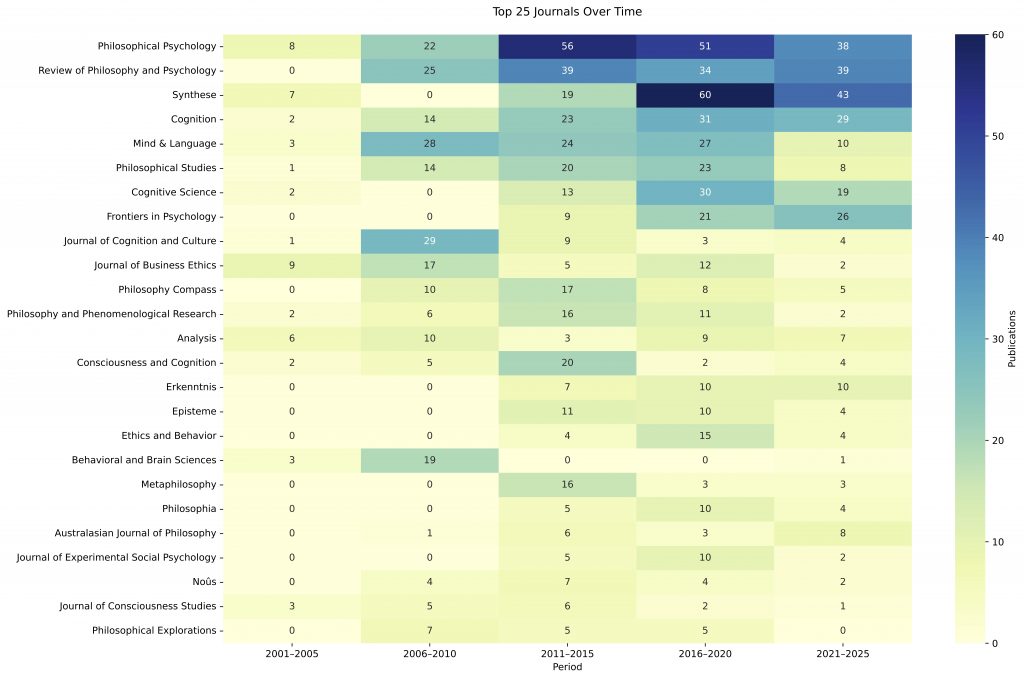
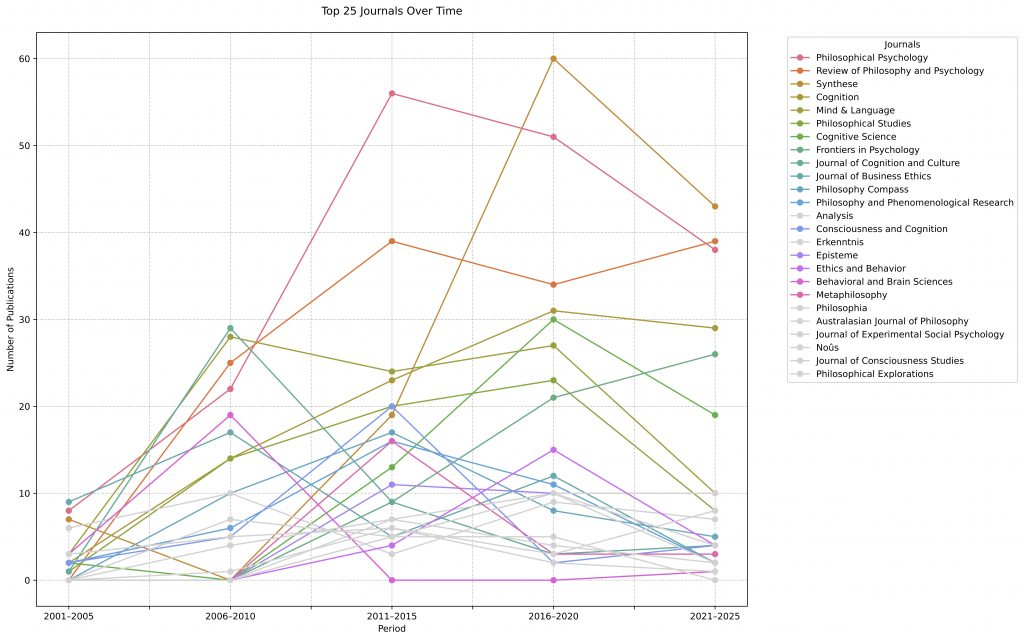
Note that the top 25 venues account for 1279 of the 2344 cases identified as likely from a journal (see Table 1). This is slightly more than half (54.56 %). The other half is scattered across 379 different sources, 361 of which have published fewer than 10 x-phi articles in the past two decades. In sum, these data represent decent evidence that these 25 journals, at least, are open to publishing experimental philosophy.
But, of course, we would caution against over-interpreting these patterns. Even setting aside potential inaccuracies in the data itself (e.g., over- or under-estimations of papers published, miscategorizations of journals or subfield), these data are by no means a perfect signal of friendliness to experimental philosophy.
For one, the category of “Experimental Philosophy” on PhilPapers is defined broadly. We don’t know how these trends are affected by further divisions in the style and focus of papers within this broad category. For another, past trends (as Hume would remind us) are no guarantee of future behaviour. Editorial policies and inclinations can change over time. Furthermore, arguably a truer measure of a journal’s “friendliness” would be the rate of acceptance vs. rejection of submitted experimental philosophy papers (absolutely, and compared to the acceptance rate of non-experimental papers). However, we only have data on the number of accepted papers, not the number of rejected papers. Relatedly, publication trends will be affected not only by acceptance rates but also by submission rates. One explanation for why a journal has not published many experimental philosophy papers is that the journal is not open to publishing x-phi. But another explanation is that experimental philosophers simply haven’t been submitting their work to that journal.
This leads us to a final point. We hope these data are useful to experimental philosophers looking to identify venues where they can be confident that “but it’s experimental philosophy” will not be taken as a sufficient reason for rejection. Still, we would like to encourage experimental philosophers to submit their work to general philosophy journals, if they want their work (and experimental philosophy more generally) to reach a broader philosophical audience. The numbers show that general philosophy journals do not currently publish many experimental philosophy papers. But if we avoid submitting this kind of work to those journals, the situation can only get worse. Let’s try to avoid reifying the patterns observed until now.
- These are, unfortunately, real examples from journal reports. ↩︎
- See https://philpapers.org/help/about.html. ↩︎