On October 14, 2026, from 16:00–18:00 (UTC+1), the Experimental Philosophy Online Work-in-Progress Workshop takes place via Teams. Pietro Tunesi (Trinity College Dublin) presents on redesigning ethical thought experiments, and Jordan Wylie, Nathan Liang, and Charlotte Austin (Cornell University) present on what people do and do not want to know in the moral domain. The workshop is organized by James Andow, Joanna Demaree-Cotton, and Eugen Fischer.
The announcement reads:
We are delighted to announce the October session of the Experimental Philosophy Online Work-in-Progress Workshop, on Wednesday, October 14th, 16:00–18:00 (UK time), via Teams:
Pietro Tunesi (Trinity College Dublin): Redesigning Ethical Thought Experiments: Reassessing the Experimental Challenge to Moral Intuition.
Jordan Wylie, Nathan Liang, and Charlotte Austin (all Cornell University): What people (don’t) want to know in the moral domain.
If you would like to receive a Teams invite, please send an email with the header “Register for X-Phi workshop” to moralpsychlab@uehiro.ox.ac.uk
In March 2027, the first “Complutense Workshop on Intuitions and Experimental Philosophy” will take place at the Facultad de Filosofía of the Universidad Complutense de Madrid, Spain, with keynotes by María José Frápolli Sanz and James Andow.
Abstracts can be submitted until November 1, 2026. The call reads:
Submission deadline: 1 November 2026
Notification of acceptance: 15 December 2026
Conference date(s): March 2027
Workshop Venue: Facultad de Filosofía, Universidad Complutense de Madrid, Spain.
Details
Intuitions are a source of evidence that many people use to a greater or lesser extent. We rely on them to investigate a wide variety of issues, for example, moral, mathematical, or religious questions, or to examine other people’s opinions on a host of different topics. Although there is debate about what is an intuition, appealing to intuitions has been one of the most widely used methods in many areas within analytic philosophy. The accepted view (see Goldman, 2007; Weinberg, 2007; Williamson, 2007, p. 2; Baz, 2012, p. 87; Koopman, 2012; Kornblith, 2014) is that intuitions play a fundamental evidential role.
Besides, there has been a dispute within analytic philosophy between three different groups of philosophers during the last decades. First, the “autonomists” (see, e.g., Bealer, 1998; Liao, 2008; Sosa, 2013; Chalmers, 2014; Devitt, 2015) defend that introspection and appeal to intuition can be used to answer many philosophical questions. Second, those who defend that analytic philosophers do not employ intuitions as evidence in philosophical practice. Following Nado (2016, p. 782), we can call them “intuition deniers” (see, e.g., Williamson, 2007; Deustch, 2009; Cappelen, 2012). Third, those who think that analytic philosophers use intuitions as evidence but doubt this method, arguing instead for the need to apply more rigorous methods drawn from scientific disciplines such as psychology, the social sciences, or linguistics; we can call them “experimental philosophers” (see, for example, Machery et al., 2004; Knobe and Nichols, 2007; Mallon et al., 2009; Alexander et al., 2010).
This workshop aims to include presentations addressing the relationship between intuitions and experimental philosophy. The presentations accepted are expected to develop novel perspectives or adopt novel approaches that shed light on traditional problems associated with intuitions in analytic philosophy. Both experimental and theoretical papers will be accepted, as well as explicit defenses of any of the above positions, papers that point out desiderata that all three should fulfill, or papers dealing with other issues related to intuitions and experimental philosophy.
Some possible topics that presentations may address are:
Intuitions and mental experiments.
Conflicting intuitions in questionnaires.
Intuitions and justification.
Calibration of intuitions.
Differences in the use of intuitions in different areas of analytic philosophy.
Empirical or theoretical analyses of the role of intuition talk in the arguments of analytic philosophers.
Empirical or theoretical analyses of philosophical practices making use of intuitions.
Using intuition in conceptual engineering.
Submission
Please submit an abstract including:
Title of the paper.
Abstract (400–500 words) clearly presenting the research question, theoretical framework, and main argument (in English or Spanish).
Institutional affiliation.
The deadline for submitting abstracts is 1 November 2026. Abstracts must be anonymized (also anonymize self-citations) and must have a section including the bibliographic references (not included in the word count). Abstracts should be sent to the following email: davbordo@ucm.es, specifying the following subject: 1st Workshop on Intuitions and Experimental Philosophy.
María José Frápolli Sanz (Universidad de Granada, Spain; Institute of Philosophy. School of Advance Study, University of London, United Kingdom).
James Andow (University of Manchester, United Kingdom).
Organizers
David Bordonaba-Plou (Universidad Complutense de Madrid, Spain).
Martín Capece del Toro (Universidad Complutense de Madrid, Spain).
Scientific Committee
Asier Arias Domínguez (Universidad Complutense de Madrid, Spain), Filippo Batisti (), Antonio Blanco Salgueiro (Universidad Complutense de Madrid, Spain), David Bordonaba-Plou (Universidad Complutense de Madrid, Spain), Esteban Céspedes (Instituto de Sistemas Complejos de Valparaíso, Chile), Antonio Duarte Calvo (Universidad Complutense de Madrid, Spain), María Dolores García Arnaldos (Universidad Complutense de Madrid, Spain), Krzysztof Sękowski (University of Warsaw, Poland).
From August 23 to 28, 2027, the 18th International Congress of Logic, Methodology and Philosophy of Science and Technology (CLMPST 2027) will take place at Kobe University, Japan. One of its twenty-one thematic sections is devoted to empirical and experimental philosophy of science and technology.
Abstracts can be submitted until November 15, 2026. The call reads:
CLMPST is the premier forum on Logic, Methodology and Philosophy of Science and Technology. Its aim is to bring together active researchers in this broad field. The International Congress of Logic, Methodology and Philosophy of Science and Technology (CLMPST) is organized under the auspices of the Division of Logic, Methodology and Philosophy of Science and Technology of the International Union of History and Philosophy of Science and Technology (IUHPST/DLMPST).
CLMPST has a long history – it started in 1960, and has been held every four years since then in capital cities and/or by leading university centres in this field. Recent previous CLMPST Congresses were held in Buenos Aires (2023), Prague (2019), Helsinki (2015), Nancy (2011), and Beijing (2007). The 2027 edition will take place at Kobe University in Kobe, Japan.
Aims and Scope
As in previous editions, CLMPST 2027 aims to foster connections between the research fields of logic and philosophy of science and technology, as well as research studying the foundations and methodology of science and technology. We are looking forward to having papers and symposia on all topics pertaining to our fields, from mathematical logic to metaphilosophy, from the foundations of the exact sciences to philosophy of the social sciences, from philosophy of technology to historical perspectives on the sciences, presented by researchers from all regions and cultures of the world.
CLMPST 2027 calls for contributed papers and contributed symposia in 21 thematic sections:
A. Logic
A.1 Mathematical Logic
A.2 Philosophical Logic
A.3 Computational Logic and Applications of Logic
A.4 Historical Aspects of Logic
A.5 Educational Aspects of Logic
B. General Philosophy of Science
B.1 Methodology
B.2 Formal Philosophy of Science and Formal Epistemology
B.3 Empirical and Experimental Philosophy of Science and Technology
B.4 Metaphysical Issues in the Philosophy of Science and Technology
B.5 Ethical, Social and Political Issues in the Philosophy of Science and Technology
B.6 Historical Aspects in the Philosophy of Science and Technology
B.7 Educational Aspects of Philosophy of Science and Technology
C. Philosophical Issues of Particular Disciplines
C.1 Philosophy of the Formal Sciences (including Logic, Mathematics, Statistics)
C.2 Philosophy of the Physical Sciences (including Physics, Chemistry, Earth Science, Climate Science)
C.3 Philosophy of the Biological Sciences
C.4 Philosophy of the Biomedical and Health Sciences
C.5 Philosophy of the Cognitive and Behavioural Sciences
C.6 Philosophy of Computing and Computation
C.7 Philosophy of the Humanities and the Social Sciences
C.8 Philosophy of the Applied Sciences and Technology
C.9 Philosophy of Emerging and Interdisciplinary Sciences
The language of the congress is English.
Contributed Papers
Submissions will be made through the EasyChair platform. Please submit an abstract of 500 words, including the references, prepared for anonymous review. Indicate to which congress section you submit the paper (tick the appropriate box). The allocated time for each contributed paper is 30 minutes, including discussion.
Contributed Symposia
Symposia are groups of talks on a common theme. Each symposium consists of four to twelve papers. In EasyChair, please make a submission for (a) the symposium as a whole; and (b) each paper in the symposium (so, for example, for a four-paper symposium, you should make a total of five submissions).
(a) For the symposium as a whole, please provide an abstract with a general description of the format and the topic of the proposed symposium and its significance (up to 500 words), and suggest a symposium chair. If desired, it is acceptable for the symposium organiser to be the chair. Indicate to which congress section you submit the symposium (tick the appropriate box). After the abstract, please list the titles of the talks in the order they should appear at the conference. Please provide the symposium with an acronym, and write this acronym at the beginning of the title of the symposium.
(b) For each paper within a symposium, please submit a 500-word abstract (including references). Indicate to which congress section the symposium belongs. Please write the acronym of the symposium at the beginning of the title of the talk.
Note to symposium organisers: Papers intended to be presented as parts of a symposium must be submitted by their respective authors. Symposium organisers should contact all symposium speakers in advance and make sure that they submit their abstracts by the submission deadline of 15 November 2026.
Although the exact format of symposia is up to the symposium organizers, the allocated time for each symposium paper is 30 minutes.
Important Dates
Submission deadline: November 15, 2026
Notifications of acceptance: Early March 2027
18th CLMPST, Kobe University, Japan: August 23–28, 2027
Ivar Hannikainen and Joshua Knobe are running a study on philosophers’ intuitions about thought experiments and are looking for participants. Taking part takes about five minutes, and all responses are anonymous. Participants who complete the study are shown how philosophers and non-philosophers answered each of the questions.
We are running a quick study on philosophers’ intuitions about certain thought experiments. If you happen to have a moment, it’s available here.
After you take the study, it will give you information about how philosophers and non-philosophers answered each of the questions. All responses are completely anonymous.
Rodrigo Díaz (University of Geneva) Alexander Max Bauer (University of Oldenburg) Joanna Demaree-Cotton (University of Oxford)
Photo by Ahmad Ardity (Pixaby)
If you write experimental philosophy papers, you probably have a paper rejected precisely because it is experimental philosophy. The explicit reason for rejection might have been something direct like “What sort of method are the authors relying on? Is it experimental philosophy? If so, why should psychologists care about it?” or something vague like “The paper does not contain enough in-depth philosophical discussion and argument to be relevant for the general philosophical readership.”1 When thinking about where to (re)submit your paper, you might have wondered which venues welcome experimental philosophy (apart, of course, from the recently-launched journal Experimental Philosophy).
As an experimental philosopher, you might have intuitions (pun intended) about which journals welcome this kind of work, or anecdotal evidence from colleagues. However, as an experimental philosopher, you might also reject putting too much weight on individual intuitions and anecdotical evidence. This is why many of us have kept coming back to Justin Sytsma’s blog post “Publishing in experimental philosophy, part II: Some numbers on where we publish” on The New Experimental Philosophy Blog, which provided data from PhilPapers on the number of experimental philosophy papers published in different journals. Unfortunately, as well as being relatively hard to access since the blog went offline, the post is now about eight years old, and thus may not reflect recent publication trends.
The present post aims to provide updated PhilPapers data on the number of experimental philosophy papers published across different journals and to complement the crowdsourced data compiled on the Where should I publish my x-phi? website.
To examine which journals publish the most experimental philosophy papers, we first exported the complete list of papers within the “Experimental Philosophy” category of PhilPapers. Anyone can do this simply by going to the category page and selecting the relevant option on the right sidebar. The list of papers is the result of PhilPapers’ use of thrawling techniques and crowd-sourcing by its users.2 It is thus important to note that the list is not perfect and likely contains duplicates and miscategorized entries. Nevertheless, it is arguably better than individual intuitions and anecdotal data.
At the time of our analysis, this list contained 3434 entries (for reference, when Justin wrote his blog post, it was a little more than 1000). Going through this by hand would be beyond tedious. Hence, we wrote a little Python script to help us wade through the data. You can take a closer look at it on GitHub. So, if you’d like to do things differently from how we do in the following, you can just go ahead and try it yourself.
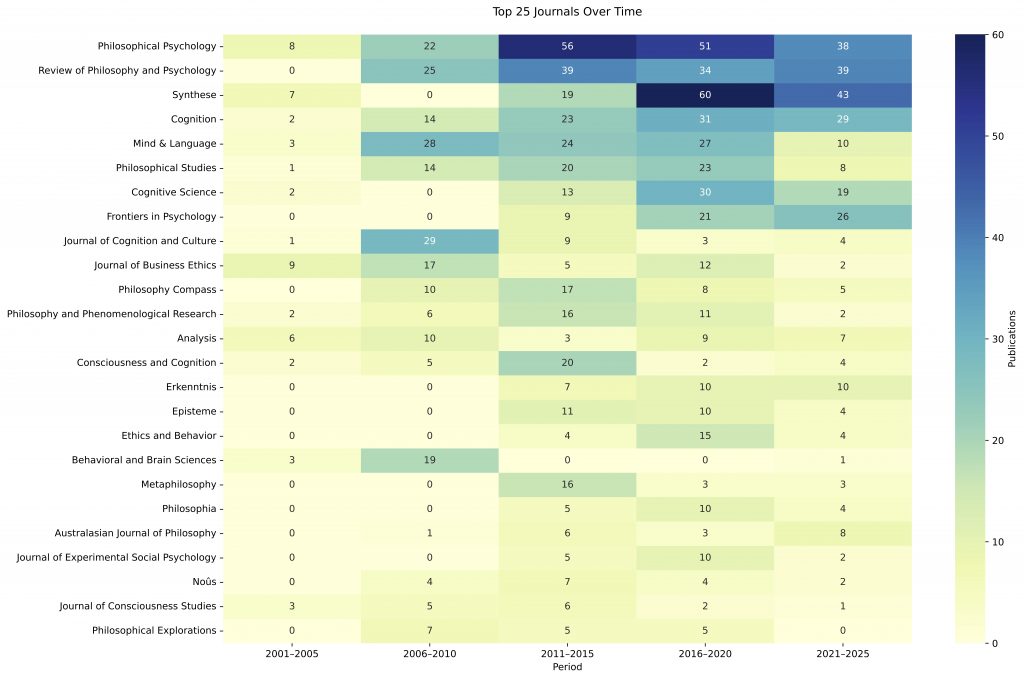
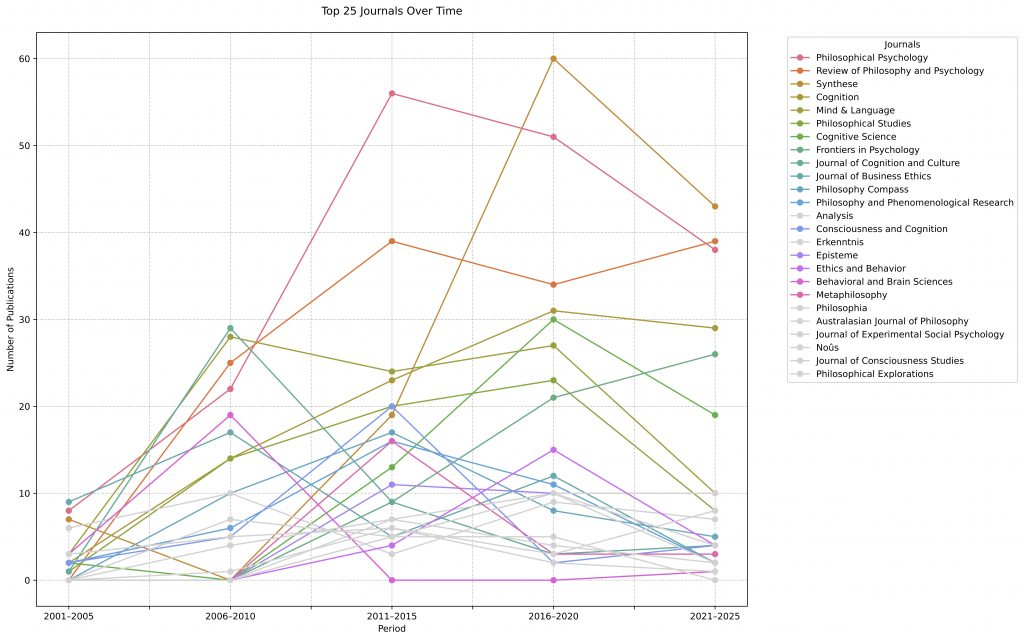
So, what does the script actually do? First, it takes the raw text data from PhilPapers and systematically breaks each reference down into its core components: authors, publication year, title, and source. Since the boundary between a paper’s title and its publishing source isn’t always perfectly clear, the script evaluates different punctuation marks as potential split points. It then runs a scoring system on the remaining text to determine if the source is likely to be an academic journal (for an overview of the script’s classifications, see Table 1). The script adds points to this “confidence score” if it detects classic journal patterns, like volume and issue numbers. It also adds points if it spots specific journal-related keywords (such as “ISSN” or “quarterly”). Conversely, it deducts points if it encounters keywords pointing to other publication formats (like “handbook” or “dissertation”). Based on this score, the entry is either classified as a “likely journal”, marked as “other”, or flagged for manual review. Finally, the script assigns each publication to a specific five-year period (e.g., “2001–2005”) and produces a list of the most frequently mentioned journals per time period (see Table 2) as well as two corresponding graphics (see Figures 1 and 2).
Such a – rather complex – automated approach is, of course, far from flawless. We rely on a few heuristics that introduce some pitfalls. For instance, because the parsing mechanism uses regular expressions to look for punctuation boundaries and volume numbers, it can easily get confused. And as explained above, we rely in part on manually curated dictionaries that are far from exhaustive. So, what happens when the script encounters an unmapped source or a weird edge case? It plays it safe and flags it. In this run, 102 entries were classified as “Needs review.” For this blog post, we didn’t manually sift through these entries.
Category
Number
Percent
Likely from a journal
2344
70.86 %
Likely not from a journal
862
26.06 %
Needs review
102
3.08 %
Total
3308
100.00 %
Table 1: Number of sources per category
Despite skipping these entries, the remaining dataset is more than large enough to reveal clear trends. Here is the breakdown of the top 25 journals publishing experimental philosophy over the last two decades:
Rank
Journal
2001–2005
2006–2010
2011–2015
2016–2020
2021–2025
Total
1
Philosophical Psychology
8
22
56
51
38
175
2
Review of Philosophy and Psychology
0
25
39
34
39
137
3
Synthese
7
0
19
60
43
129
4
Cognition
2
14
23
31
29
99
5
Mind & Language
3
28
24
27
10
92
6
Philosophical Studies
1
14
20
23
8
66
7
Cognitive Science
2
0
13
30
19
64
8
Frontiers in Psychology
0
0
9
21
26
56
9
Journal of Cognition and Culture
1
29
9
3
4
46
10
Journal of Business Ethics
9
17
5
12
2
45
11
Philosophy Compass
0
10
17
8
5
40
12
Philosophy and Phenomenological Research
2
6
16
11
2
37
13
Analysis
6
10
3
9
7
35
14
Consciousness and Cognition
2
5
20
2
4
33
15
Erkenntnis
0
0
7
10
10
27
16
Episteme
0
0
11
10
4
25
17
Ethics and Behavior
0
0
4
15
4
23
18
Behavioral and Brain Sciences
3
19
0
0
1
23
19
Metaphilosophy
0
0
16
3
3
22
20
Philosophia
0
0
5
10
4
19
21
Australasian Journal of Philosophy
0
1
6
3
8
18
22
Journal of Experimental Social Psychology
0
0
5
10
2
17
23
Noûs
0
4
7
4
2
17
24
Journal of Consciousness Studies
3
5
6
2
1
17
25
Philosophical Explorations
0
7
5
5
0
17
Table 2: Number of x-phi publications in journals per period
Figure 1: Heatmap of x-phi publications in journals per periodFigure 2: Line chart of x-phi publications in journals per period (journals which have published more than 10 x-phi papers in at least one period are highlighted)
Note that the top 25 venues account for 1279 of the 2344 cases identified as likely from a journal (see Table 1). This is slightly more than half (54.56 %). The other half is scattered across 379 different sources, 361 of which have published fewer than 10 x-phi articles in the past two decades. In sum, these data represent decent evidence that these 25 journals, at least, are open to publishing experimental philosophy.
But, of course, we would caution against over-interpreting these patterns. Even setting aside potential inaccuracies in the data itself (e.g., over- or under-estimations of papers published, miscategorizations of journals or subfield), these data are by no means a perfect signal of friendliness to experimental philosophy.
For one, the category of “Experimental Philosophy” on PhilPapers is defined broadly. We don’t know how these trends are affected by further divisions in the style and focus of papers within this broad category. For another, past trends (as Hume would remind us) are no guarantee of future behaviour. Editorial policies and inclinations can change over time. Furthermore, arguably a truer measure of a journal’s “friendliness” would be the rate of acceptance vs. rejection of submitted experimental philosophy papers (absolutely, and compared to the acceptance rate of non-experimental papers). However, we only have data on the number of accepted papers, not the number of rejected papers. Relatedly, publication trends will be affected not only by acceptance rates but also by submission rates. One explanation for why a journal has not published many experimental philosophy papers is that the journal is not open to publishing x-phi. But another explanation is that experimental philosophers simply haven’t been submitting their work to that journal.
This leads us to a final point. We hope these data are useful to experimental philosophers looking to identify venues where they can be confident that “but it’s experimental philosophy” will not be taken as a sufficient reason for rejection. Still, we would like to encourage experimental philosophers to submit their work to general philosophy journals, if they want their work (and experimental philosophy more generally) to reach a broader philosophical audience. The numbers show that general philosophy journals do not currently publish many experimental philosophy papers. But if we avoid submitting this kind of work to those journals, the situation can only get worse. Let’s try to avoid reifying the patterns observed until now.
These are, unfortunately, real examples from journal reports. ↩︎
From September 22 to 23, 2026, the workshop “Do Experiments Replicate? Philosophical Reflections on the Use and Misuse of Statistics and Econometrics” will take place at the Jagiellonian University, Poland.
Abstract submissions are possible until June 1, 2026. The call reads:
The workshop “Do experiments replicate? Philosophical Reflections on the Use and Misuse of Statistics and Econometrics” aims to provide a forum for exchanging ideas on the replicability of randomized experiments, such as randomized field experiments in economics, randomized controlled trials and preclinical studies in medicine, and psychological experiments.
The workshop promotes philosophical and methodological discussions of conceptual and methodological issues in statistical analysis, econometric modeling, and the methodology of experimentation.
Keynote Speakers:
Barbara Osimani
Samuel Fletcher
Experimental results are considered reliable because, under comparable conditions, they are expected to yield similar outcomes. However, this assumption has recently been challenged by numerous replication efforts that report results differing from those of the original studies in psychology, medicine, biology, the social sciences, and economics. A surprisingly large fraction of published findings have been found to be non-replicable. Replicability rates range from 11% for in vitro and in vivo preclinical research to 60–90% for clinical trials. Experimental economists fall within this range and, like psychological experimenters, achieve around 60% replicability.
The replication crisis has called into question the credibility of published findings and undermined trust in science. However, the replication crisis, with few exceptions, has received only limited attention from philosophy of science. Despite the efforts of several pioneers, the philosophical and conceptual problems in randomized controlled trials, randomized field experiments, laboratory experiments, econometric modeling, and the statistical analysis of experimental data remain largely uncharted territory in the philosophy of science. The workshop aims to establish a forum for exchanging ideas among philosophers of medicine and economics, philosophers of statistics, and methodologically inclined researchers interested in the conceptual problems of the replication crisis.
The Workshop “Do experiments replicate? Philosophical Reflections on the Use and Misuse of Statistics and Econometrics” invites contributions that focus on experimentation and statistical analysis in economics and medicine, as well as problems that trouble statistical inference from experiments, broadly construed.
Some exemplary topics of talks:
The design of randomized experiments in medicine and economics.
Statistical hypothesis testing.
Non-frequentist approaches to comparing treatment and control group outcomes.
Comparisons of design-based and model-based inference.
Estimating statistical models.
Measuring replication success and replicability rates.
Assessing the quality of empirical evidence.
Making inferences from the literature review with conflicting results.
Other problems in philosophy of statistics related to the replication crisis.
Abstracts no longer than 500 words (including references) should be submitted in an attachment, not including author details, by email with the subject ‘replication workshop’ sent to: mariusz.maziarz@uj.edu.pl.
Deadline for submission: June 1st, 2026
Decisions will be announced by June 15th, 2026.
This activity was supported by a grant funded by the Strategic Program Excellence Initiative at the Jagiellonian University.
Following the “Measurement Heretics Workshop – Being, Meaning, and Measuring Well,” Rebecca Jackson, Michele Luchetti, Morgan Thompson, and Aja Watkins edit a volume on the topic.
Abstracts for contributions can be submitted until June 15, 2026. The call reads:
This edited volume stems from the Measurement Heretics Workshop – Being, Meaning, and Measuring Well, organized by Rebecca Jackson at Durham University on March 11–13, 2026. We warmly welcome proposals from researchers in the philosophy, history, sociology, and anthropology of measurement (broadly construed) who would like to address the themes in the description below.
Once the list of contributions is selected, the volume proposal will be submitted for consideration to Chicago University Press.
Topic description
What we measure, and how we measure, matters deeply. In the human sciences especially, the definition and status of what we call “measurement,” the distinguishing or desirable features of measurement, and whether (and when) we should measure at all, has seen a resurgence of interest and debate. This volume engages with scientific, medical, and social measuring practices of the past and present, inviting contributions that dissect and reform the meaning and desirability of fundamental notions in philosophy of measurement – or as we call them, measurement heresies.
This is not the first time fundamental notions in measurement, or “dogmas,” have been challenged in disparate areas of study. The current wave of philosophically influenced history of measurement owes its roots to works such as Chang’s Inventing Temperature (2004), which troubled the dogma that accurate instruments require a prior foundation of true theories of what is being measured. Prior to this, sociological and historical work had already troubled the separation between the purity of numbers and the messiness of human knowers, showing that the growing emphasis on quantification in the 19th and 20th century was marked by the influence of bureaucracy and social agendas more than it mirrored the practice of physicists (Porter 1995; Collins 1975; Gould 1981). Looking further back, stances that today are well within the orthodoxy were once at the center of heated debates. The Kantian dogma of the non-measurability of psychological properties was challenged by Fechner’s “heretical” psychophysics, which on the one hand initiated a long and influential debate on the quantifiability of sensation and, on the other, inspired Mach’s relational theory of measurement in physics that seeded later developments in measurement theory and philosophical debates on the nature of measurement. Waves of reform and reaction in the 20th century included tension between physicists and psychophysicists (Campbell 1920; Stevens 1946), and theories of measurement as foundational to the project of logical positivism (Reichenbach 1927; Carnap 1966). When psychometric visions and techniques were first beginning to shape theory of measurement in psychology (Cronbach and Meehl 1955; Campbell and Fiske 1959), reformist projects led to the beginning of the representational theory of measurement in the physical sciences (Krantz et al. 1971; Suppes et al. 1989; Luce et al. 1990). Reconciling the two has proven difficult but philosophically productive, as several volumes and special issues have shown (Berglund et al. 2013; Vessonen 2017; Pendrill 2019; Mari et al. 2023; Uher 2025; Basso et al. 2026; Luchetti 2026). More recently, works on patient-centered and health measures have challenged the dogma that measurement can, and should, be carried out from a stance of aperspectival objectivity (Duque et al. 2024; McClimans 2024).
There is still much to be done to bring the dogmas of philosophers, inherited from the above mentioned 20th century reformist projects, to face the challenge of measuring in biomedical, clinical, and social contexts. A particular challenge here is to measure that which is unique or highly contextual, such as the lived experience of persons, and to measure moving targets that are more affected by, than reflected by, data meant to capture them (Godman & Marchionni 2022; Runhardt 2025; Zahle 2023). This work has been ongoing in medical humanities, sociological, historical, geographical, anthropological, and literary scholarship, as well as in geophysical and environmental sciences, in ways that have not yet been articulated together. This volume brings the heresies (and the heretics) together, to map the terrain of the current re-evaluation which is taking place in Measurement Studies more broadly.
The purpose of this book is to give space to critical re-evaluations of dogmas regarding fundamental notions about measurement and to invite novel interpretations of formal and informal measurement concepts. We invite contributions focusing on topics including (but not limited to) the following:
STANDARDISATION
COMPARABILITY
QUANTIFICATION, QUANTITIES, and/or MAGNITUDES
MEASUREMENT SCALES
PRECISION and/or RELIABILITY
VALIDITY and/or VALIDATION
ACCURACY and/or SENSITIVITY/SPECIFICITY
PROXIES
We also invite contributions that are critical of the activity of measurement in general:
What are the affective and real-world impacts of measuring and being measured on human and non-human subjects?
When is it worse to measure at all, and when is it worth it to measure (even badly) to provide voice to marginalized actors within a system?
What would it look like to gather evidence against measurement itself, as being an intervention?
Rather than chapters taking the form of a strictly circumscribed philosophical argument, we invite authors to address one of the above topics from their own disciplinary perspective. We expect chapters to reference a case or cases from past or present measuring practices. The editorial team will explicate the broader philosophical implications in the introductory and concluding chapters.
Confirmed contributors
Nicholas Binney (HHU Düsseldorf)
Femke Truijens (University of Rotterdam)
Riana Betzler (San José State University)
Submission details
Please submit an abstract aimed at an interdisciplinary audience (600–800 words, not including references) to the following email address: measurementheretics@gmail.com
The deadline for abstract submission is June 15th, 2026. Authors of selected contributions will be notified at the end of July. An authors’ workshop will take place online in November 2026, and the final submission of the chapters (6k–8k words) is planned for March 2027.
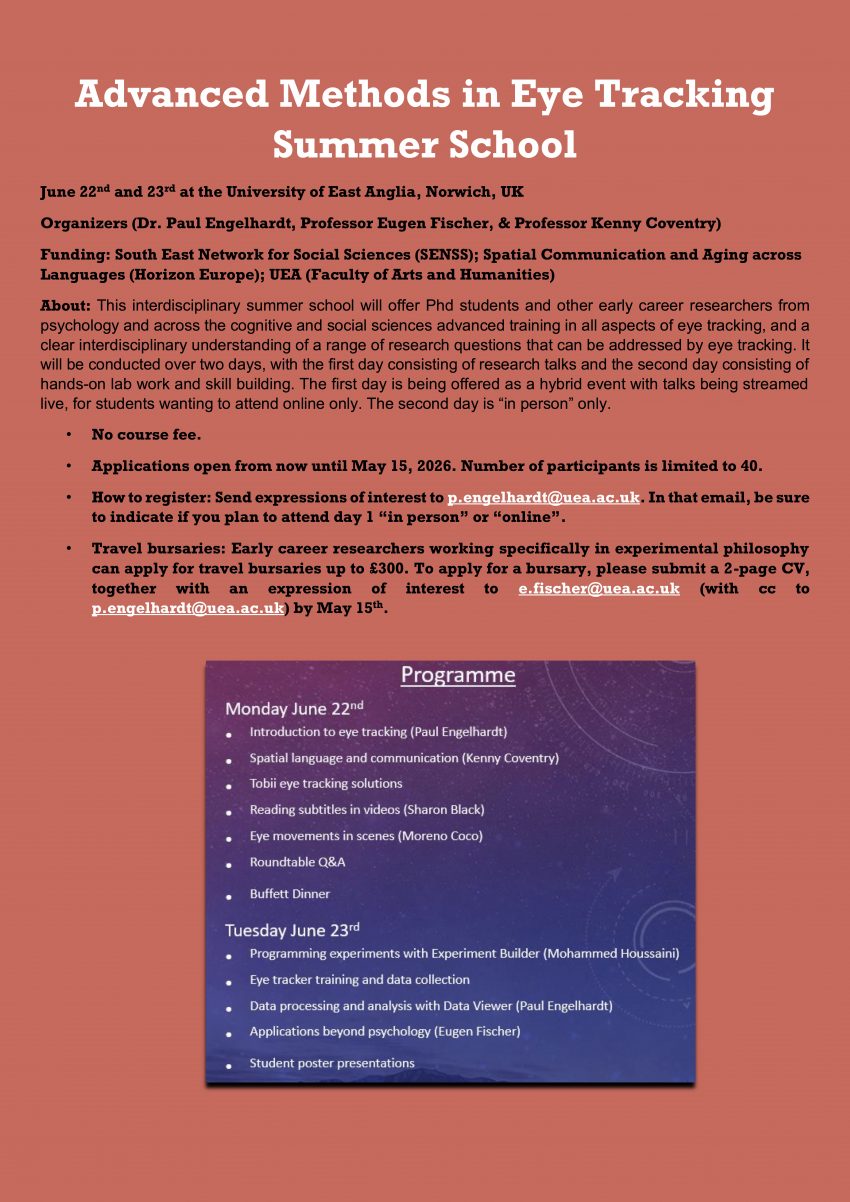
From June 22 to 23, 2026, the summer school “Advanced Methods in Eye Tracking” will take place at the University of East Anglia, UK.
See the poster for details. The announcement reads:
This interdisciplinary summer school will offer Phd students and other early career researchers from psychology and across the cognitive and social sciences advanced training in all aspects of eye tracking, and a clear interdisciplinary understanding of a range of research questions that can be addressed by eye tracking. It will be conducted over two days, with the first day consisting of research talks and the second day consisting of hands-on lab work and skill building. The first day is being offered as a hybrid event with talks being streamed live, for students wanting to attend online only. The second day is “in person” only.
Ben Gaskin and Simon McGregor organize a special session of The 2026 Artificial Life Conference titled “Artificial Life as Experimental Philosophy,” which will take place in Waterloo, Canada, from August 17 to 21, 2026.
Papers can be submitted until March 30, 2026. The call reads:
ALife has always had a markedly philosophical character – a fact not unnoticed by some philosophers. Daniel Dennett, for instance, saw in ALife the creation of testable thought experiments – in simulating a thing, you render explicit your assumptions. Despite this clear affinity, however, the engagement he foresaw has not materialised.
This is not for ALife’s lack of interest in or relevance to traditionally philosophical content, but perhaps rather for its practicing an alternate philosophy in which the reflexive relationship between pragmatic and theoretical is constitutive. Here philosophy and science are united, with thought in turn structuring and being structured by experimental practice. In this respect, ALife may be closer to the original tradition of natural philosophy than philosophy in its more modern disciplinary forms.
This session invites broad reflection on the nature of this relationship between philosophy and artificial life. What role do computational experiments play in philosophical inquiry – and what role should they? How does ALife address questions that philosophy also claims – agency, autonomy, emergence, individuality – and how does its treatment differ? The conference theme itself poses one such question: what is life, and what does it mean to be life-like?
Call for Papers
We welcome both experimental work whose philosophical motivations or implications are brought to the fore, and philosophical or theoretical work that engages directly with ALife methods and results. We are as interested in what can be said in principle as in what your work specifically reveals – and especially in work that does not sit neatly in either of these.
Questions of Interest
Questions we are interested in include:
What are we doing when we simulate a thing?
Where is emergence when it happens in a machine – how do silicon and simulations reshape the question of emergence?
What is the relationship in simulations between form, function, parameters, and dynamics?
If the rules are made up, what do they teach us – how do we reconcile tunability with the language of findings?
What are the laws of motion of living matter, and how does ALife relate to theoretical biology?
Is life just physics, or is there something more – what can ALife tell us about the relationship between vitalism and mechanism?
What is ALife’s precedent, what does it inherit, and how does it differ – from the automata of Hero to the gavra of Rava to Jābir’s takwīn?
Could artificial life ever really be alive – and if so, what are the implications?
How does wet ALife relate to these questions – does it change what counts as artificial, as alive, or both?
These are examples, not boundaries – we welcome any work that engages with the philosophical dimensions of artificial life. Contributions from across ALife, philosophy, history and philosophy of science, and related fields are encouraged.
Submissions
Papers should be 3–8 pages in ALIFE format. We welcome experimental, theoretical, and position papers. Accepted papers will be published in the ALIFE 2026 proceedings (MIT Press). The conference is hybrid – presentations can be given in person or online. Please select the “Artificial Life as Experimental Philosophy” special session when submitting. For full formatting guidelines, see the ALIFE 2026 Call for Papers.
From April 11 to 12, 2026, the conference “Social Ontology and Empirical Inquiry – Conflicts and Connections” will take place at the University of Pittsburgh. The conference page reads:
We are pleased to announce a two-day interdisciplinary workshop hosted by the Center for Philosophy of Science at the University of Pittsburgh, focusing on the intersection of social metaphysics and empirical research in the social sciences.
The workshop aims to foster dialogue between philosophers and social scientists who are interested in the nature of social reality and in how conceptual and empirical approaches to understanding it can be fruitfully integrated.
Social scientists and philosophers have long sought to clarify what it means for entities such as races, genders, institutions, and social structures to exist and to act. Meanwhile, empirically-oriented social scientists have developed increasingly sophisticated methods for measuring, modeling, and explaining such phenomena. This workshop will bring these conversations together to explore the conflicts and connections between conceptual–theoretical frameworks and empirical–methodological practices in the study of the social world.
To provide the best experiences, we use technologies like cookies to store and/or access device information. Consenting to these technologies will allow us to process data such as browsing behavior or unique IDs on this site. Not consenting or withdrawing consent, may adversely affect certain features and functions.
Functional
Always active
The technical storage or access is strictly necessary for the legitimate purpose of enabling the use of a specific service explicitly requested by the subscriber or user, or for the sole purpose of carrying out the transmission of a communication over an electronic communications network.
Preferences
The technical storage or access is necessary for the legitimate purpose of storing preferences that are not requested by the subscriber or user.
Statistics
The technical storage or access that is used exclusively for statistical purposes.The technical storage or access that is used exclusively for anonymous statistical purposes. Without a subpoena, voluntary compliance on the part of your Internet Service Provider, or additional records from a third party, information stored or retrieved for this purpose alone cannot usually be used to identify you.
Marketing
The technical storage or access is required to create user profiles to send advertising, or to track the user on a website or across several websites for similar marketing purposes.