The Experimental Philosophy Blog

Philosophy Meets Empirical Research

Menu
  • Home
  • About
  • Guidelines for Comments
  • Labs and Organizations
  • Resources
Menu

Category: Blog

What Journals Publish Experimental Philosophy?

Posted on June 12, 2026June 13, 2026 by Alexander Max Bauer

Rodrigo Díaz (University of Geneva)
Alexander Max Bauer (University of Oldenburg)
Joanna Demaree-Cotton (University of Oxford)

Photo by Ahmad Ardity (Pixaby)

If you write experimental philosophy papers, you probably have a paper rejected precisely because it is experimental philosophy. The explicit reason for rejection might have been something direct like “What sort of method are the authors relying on? Is it experimental philosophy? If so, why should psychologists care about it?” or something vague like “The paper does not contain enough in-depth philosophical discussion and argument to be relevant for the general philosophical readership.”1 When thinking about where to (re)submit your paper, you might have wondered which venues welcome experimental philosophy (apart, of course, from the recently-launched journal Experimental Philosophy).

As an experimental philosopher, you might have intuitions (pun intended) about which journals welcome this kind of work, or anecdotal evidence from colleagues. However, as an experimental philosopher, you might also reject putting too much weight on individual intuitions and anecdotical evidence. This is why many of us have kept coming back to Justin Sytsma’s blog post “Publishing in experimental philosophy, part II: Some numbers on where we publish” on The New Experimental Philosophy Blog, which provided data from PhilPapers on the number of experimental philosophy papers published in different journals. Unfortunately, as well as being relatively hard to access since the blog went offline, the post is now about eight years old, and thus may not reflect recent publication trends.

The present post aims to provide updated PhilPapers data on the number of experimental philosophy papers published across different journals and to complement the crowdsourced data compiled on the Where should I publish my x-phi? website.

To examine which journals publish the most experimental philosophy papers, we first exported the complete list of papers within the “Experimental Philosophy” category of PhilPapers. Anyone can do this simply by going to the category page and selecting the relevant option on the right sidebar. The list of papers is the result of PhilPapers’ use of thrawling techniques and crowd-sourcing by its users.2 It is thus important to note that the list is not perfect and likely contains duplicates and miscategorized entries. Nevertheless, it is arguably better than individual intuitions and anecdotal data.

At the time of our analysis, this list contained 3434 entries (for reference, when Justin wrote his blog post, it was a little more than 1000). Going through this by hand would be beyond tedious. Hence, we wrote a little Python script to help us wade through the data. You can take a closer look at it on GitHub. So, if you’d like to do things differently from how we do in the following, you can just go ahead and try it yourself.

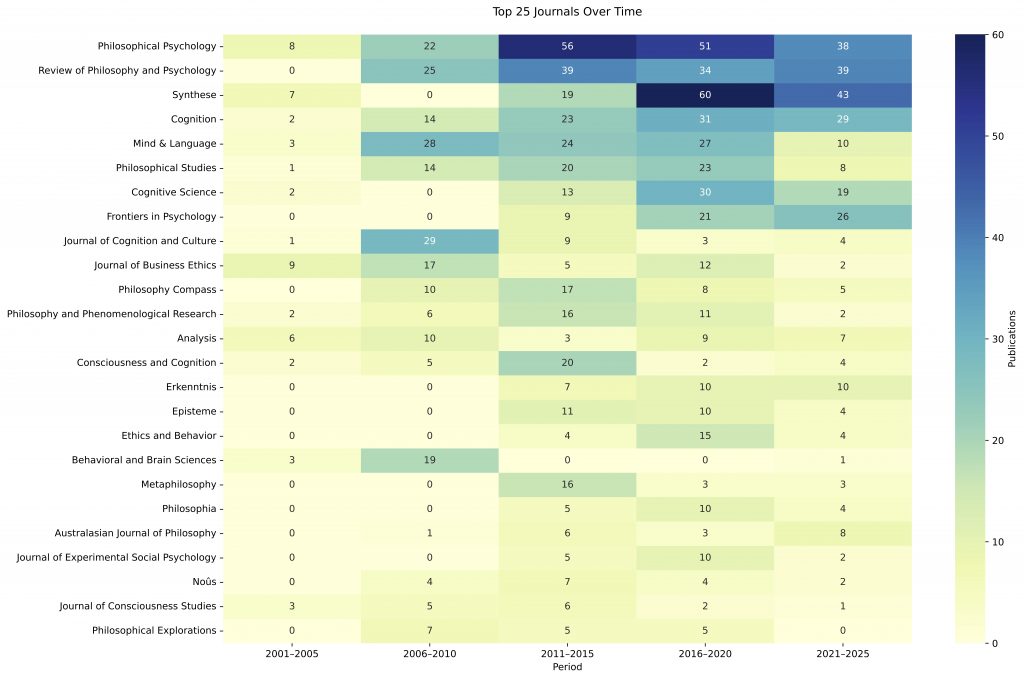
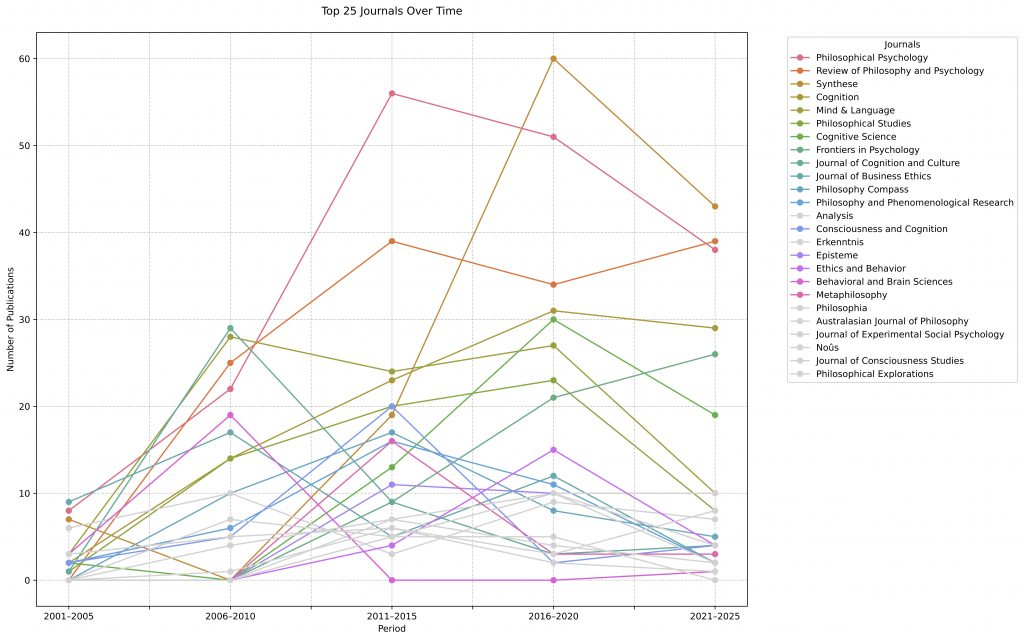
So, what does the script actually do? First, it takes the raw text data from PhilPapers and systematically breaks each reference down into its core components: authors, publication year, title, and source. Since the boundary between a paper’s title and its publishing source isn’t always perfectly clear, the script evaluates different punctuation marks as potential split points. It then runs a scoring system on the remaining text to determine if the source is likely to be an academic journal (for an overview of the script’s classifications, see Table 1). The script adds points to this “confidence score” if it detects classic journal patterns, like volume and issue numbers. It also adds points if it spots specific journal-related keywords (such as “ISSN” or “quarterly”). Conversely, it deducts points if it encounters keywords pointing to other publication formats (like “handbook” or “dissertation”). Based on this score, the entry is either classified as a “likely journal”, marked as “other”, or flagged for manual review. Finally, the script assigns each publication to a specific five-year period (e.g., “2001–2005”) and produces a list of the most frequently mentioned journals per time period (see Table 2) as well as two corresponding graphics (see Figures 1 and 2).

Such a – rather complex – automated approach is, of course, far from flawless. We rely on a few heuristics that introduce some pitfalls. For instance, because the parsing mechanism uses regular expressions to look for punctuation boundaries and volume numbers, it can easily get confused. And as explained above, we rely in part on manually curated dictionaries that are far from exhaustive. So, what happens when the script encounters an unmapped source or a weird edge case? It plays it safe and flags it. In this run, 102 entries were classified as “Needs review.” For this blog post, we didn’t manually sift through these entries.

CategoryNumberPercent
Likely from a journal234470.86 %
Likely not from a journal86226.06 %
Needs review1023.08 %
Total3308100.00 %
Table 1: Number of sources per category

Despite skipping these entries, the remaining dataset is more than large enough to reveal clear trends. Here is the breakdown of the top 25 journals publishing experimental philosophy over the last two decades:

RankJournal2001–20052006–20102011–20152016–20202021–2025Total
1Philosophical Psychology822565138175
2Review of Philosophy and Psychology025393439137
3Synthese70196043129
4Cognition21423312999
5Mind & Language32824271092
6Philosophical Studies1142023866
7Cognitive Science2013301964
8Frontiers in Psychology009212656
9Journal of Cognition and Culture12993446
10Journal of Business Ethics917512245
11Philosophy Compass010178540
12Philosophy and Phenomenological Research261611237
13Analysis61039735
14Consciousness and Cognition25202433
15Erkenntnis007101027
16Episteme001110425
17Ethics and Behavior00415423
18Behavioral and Brain Sciences31900123
19Metaphilosophy00163322
20Philosophia00510419
21Australasian Journal of Philosophy0163818
22Journal of Experimental Social Psychology00510217
23Noûs0474217
24Journal of Consciousness Studies3562117
25Philosophical Explorations0755017
Table 2: Number of x-phi publications in journals per period
Figure 1: Heatmap of x-phi publications in journals per period
Figure 2: Line chart of x-phi publications in journals per period (journals which have published more than 10 x-phi papers in at least one period are highlighted)

Note that the top 25 venues account for 1279 of the 2344 cases identified as likely from a journal (see Table 1). This is slightly more than half (54.56 %). The other half is scattered across 379 different sources, 361 of which have published fewer than 10 x-phi articles in the past two decades. In sum, these data represent decent evidence that these 25 journals, at least, are open to publishing experimental philosophy.

But, of course, we would caution against over-interpreting these patterns. Even setting aside potential inaccuracies in the data itself (e.g., over- or under-estimations of papers published, miscategorizations of journals or subfield), these data are by no means a perfect signal of friendliness to experimental philosophy.

For one, the category of “Experimental Philosophy” on PhilPapers is defined broadly. We don’t know how these trends are affected by further divisions in the style and focus of papers within this broad category. For another, past trends (as Hume would remind us) are no guarantee of future behaviour. Editorial policies and inclinations can change over time. Furthermore, arguably a truer measure of a journal’s “friendliness” would be the rate of acceptance vs. rejection of submitted experimental philosophy papers (absolutely, and compared to the acceptance rate of non-experimental papers). However, we only have data on the number of accepted papers, not the number of rejected papers. Relatedly, publication trends will be affected not only by acceptance rates but also by submission rates. One explanation for why a journal has not published many experimental philosophy papers is that the journal is not open to publishing x-phi. But another explanation is that experimental philosophers simply haven’t been submitting their work to that journal.

This leads us to a final point. We hope these data are useful to experimental philosophers looking to identify venues where they can be confident that “but it’s experimental philosophy” will not be taken as a sufficient reason for rejection. Still, we would like to encourage experimental philosophers to submit their work to general philosophy journals, if they want their work (and experimental philosophy more generally) to reach a broader philosophical audience. The numbers show that general philosophy journals do not currently publish many experimental philosophy papers. But if we avoid submitting this kind of work to those journals, the situation can only get worse. Let’s try to avoid reifying the patterns observed until now.

  1. These are, unfortunately, real examples from journal reports. ↩︎
  2. See https://philpapers.org/help/about.html. ↩︎

Where Should I Publish My X-Phi? A New Resource

Posted on April 22, 2026June 13, 2026 by Joanna Demaree-Cotton
Photo by Ahmad Ardity (Pixaby)

We (Sinéad Cleary, Joanna Demaree-Cotton, and Alexander Max Bauer) are excited to announce a new community resource to help experimental philosophers choose journals for their work.

https://sites.google.com/view/wheretopublishxphi

After another recent round of identifying a suitable journal for one of our own recent experimental philosophy manuscripts (going through the process of identifying prospective journals with any record of publishing experimental studies, as well as basics – subfield, word count, etc.), we figured: why not pool the community’s knowledge and resources? The result is a crowd-sourced, interactive table compiling journals that publish experimental philosophy. The table includes links to official journal guidelines as well as existing crowdsourced metrics and sources, and lets users filter and sort by keywords and various categories.

This resource was partly inspired by the memory of a previous resource compiled by Justin Sytsma in 2018 (see here and here). However, some things have (happily for x-phi) changed since then. To give just one example, while in 2018 Justin noted only one experimental paper published in Ergo, this journal now has an area editor in the field of experimental philosophy (shout out to Pascale Willemsen!) and a number of great experimental philosophy papers have appeared on its pages in recent years. We have not attempted any analysis of change over time, nor have we attempted to replicate Justin’s efforts to quantify how much x-phi is published where. But we expect things have changed for other venues as well. Indeed, as of 2026 there’s a brand new dedicated journal for publishing experimental philosophy.

We have also designed the resource with the future in mind. We hope that continued crowd-sourced input from the x-phi community – from you! – will go into correcting, maintaining, and updating this resource, as inevitable errors are identified and things change in the field.

With that in mind, we would love the community to offer feedback in response to the following questions:

  1. Are you aware of journals that publish x-phi work that are not currently included?
  2. Some journals currently have empty entries under “Examples of x-phi papers recently published,” as we haven’t had the capacity to locate relevant papers. If you know of suitable examples, we’d be grateful if you could nominate references!
  3. Do you have any additional notes or comments we should include about specific journals listed here (in the “Notes” column or otherwise)?
  4. Do you have other information that you believe should be included and would help researchers decide where to submit their work? If so, do you have ideas about how we might source this information?

One final caveat. We acknowledge that this resource is imperfect in many ways. We regard it as a work-in-progress – but one that does not pretend to aim at perfection (though we hope to correct any outright errors). It is a community resource based on crowdsourced information, not a formal analysis. We have tried to be transparent about where different pieces of information come from through consistent hyperlinking and attribution notes. Unsourced data can be assumed to be anecdotal or individual opinion. We have no doubt that some of the primary/sub-field classifications are up for debate. And we take no stand on such questions as to whether one should or should not pay attention to journal rankings or this-or-that metric when publishing (plenty of healthy debate on these issues exists in the academic blogosphere!). We include these sources or metrics because we know that many people do consider them, and consolidating these different sources into a single spreadsheet might save folks some time. Our hope is simply that this is a useful resource to the experimental philosophy community (at different career stages, with different professional and research needs, with different views on publication).

Please comment or get in touch with your comments, feedback, or updates!

Special thanks go to Kevin Reuter, Edouard Machery, Carme Isern-Mas, and Eugen Fischer for invaluable feedback that helped us put this together.

The 2024 X-Phi Blog Recap

Posted on December 31, 2024January 1, 2025 by Alexander Max Bauer

It’s the last day of the year; time for a little recap of the blog.

After the “New Experimental Philosophy Blog” by Justin Sytsma, Joe Ulatowski, and Dan Weijers sadly went offline around the end of 2023 or the beginning of 2024, this blog stepped in, starting with a repost of The Revolver Case Revisited on March 4.

Since then, 40 blog posts (this one included) have been published by Mario Attie-Picker, Rodrigo Díaz, Josh Knobe, and me. Eleven of them are original texts, another eleven are announcements, nine are calls, six are from our “Hot of the Press,” and another three are from our “Faces of X-Phi” series.

In total, these posts were seen more than 4,500 times by more than 2,500 visitors. Many came from social networks: More than 1,000 views originated from Twitter, another nearly 200 from Bluesky, and six from – yes, it still exists – Facebook. Some traffic also came from news sites: Slightly more than 200 views came from Vox and another nearly 50 from Daily Nous. Also, roughly 200 views can be attributed to traffic from search engines, including – in descending order – Google, Bing, Baidu, DuckDuckGo, and Yahoo.

While most views came from the United States (nearly 2,000), Germany (nearly 500), and the United Kingdom (also nearly 500), we had visitors from all over the globe, coming from 67 countries.

Thank you all for reading and contributing. Have a happy new year, and stay curious!

Search

Categories

Tags

Agency Artificial Intelligence Basic Needs Behavior Beliefs Bias Bioethics Blame Causation Cognitive Science Consciousness Corpus Analysis Cross-Cultural Research Decisions Determinism Distributive Justice Emotions Essentialism Expertise Folk Morality Framing Free Will Intention Intuition Jurisprudence Knowledge Large Language Models Moral Psychology Norms Pejoratives Pragmatics Psycholinguistics Psychology Reasoning Reflective Equilibrium Replication Responsibility Self Semantics Side-Effect Effect Slurs Thought Experiments Valence Values Virtue

Recent Posts

  • Job: ERC Starting Grant 2027 with the Interdisciplinary Centre for Ethics (Kraków, Poland)
  • Call: “XPHI UK Work in Progress Workshop Series”
  • What Journals Publish Experimental Philosophy?
  • Job: “Aesthetics for Biological Conservation” (Florence, Italy)
  • Job: “Center for Logic, Language, and Cognition” (Turin, Italy)

Recent Comments

  1. Joanna Demaree-Cotton on Where Should I Publish My X-Phi? A New ResourceApril 24, 2026

    Thanks for the comment, that's really useful. We'll definitely add AJP (missed you accidentally first time!), and that note.

  2. AJP Editor on Where Should I Publish My X-Phi? A New ResourceApril 24, 2026

    AJP is published by Taylor & Francis, and we have an member of the editorial team ('associate editor' in our…

  3. Nova Praxis on The Folk Concept of ArtJuly 11, 2025

    This article highlights an important point: everyday people don’t rely on rigid definitions to determine what qualifies as art. They’re…

  4. Koen Smets on Priming Effects Are Fake, but Framing Effects Are RealMay 27, 2025

    That is indeed exactly the question I have as well. I operationalize it as having de facto contradicting intuitions, in…

  5. Joshua Knobe on Priming Effects Are Fake, but Framing Effects Are RealMay 24, 2025

    Hi Koen, Thanks once again. This idea brings up all sorts of fascinating questions, but for the purposes of the…

Archives

  • June 2026
  • May 2026
  • April 2026
  • March 2026
  • February 2026
  • January 2026
  • December 2025
  • November 2025
  • October 2025
  • September 2025
  • August 2025
  • July 2025
  • June 2025
  • May 2025
  • April 2025
  • March 2025
  • February 2025
  • January 2025
  • December 2024
  • November 2024
  • October 2024
  • September 2024
  • August 2024
  • July 2024
  • June 2024
  • May 2024
  • April 2024
  • March 2024

Meta

  • Log in
  • Entries feed
  • Comments feed
  • WordPress.org

Imprint • Disclaimer • Privacy Statement • Cookie Policy

© 2024 The Experimental Philosophy Blog
Manage Consent
To provide the best experiences, we use technologies like cookies to store and/or access device information. Consenting to these technologies will allow us to process data such as browsing behavior or unique IDs on this site. Not consenting or withdrawing consent, may adversely affect certain features and functions.
Functional Always active
The technical storage or access is strictly necessary for the legitimate purpose of enabling the use of a specific service explicitly requested by the subscriber or user, or for the sole purpose of carrying out the transmission of a communication over an electronic communications network.
Preferences
The technical storage or access is necessary for the legitimate purpose of storing preferences that are not requested by the subscriber or user.
Statistics
The technical storage or access that is used exclusively for statistical purposes. The technical storage or access that is used exclusively for anonymous statistical purposes. Without a subpoena, voluntary compliance on the part of your Internet Service Provider, or additional records from a third party, information stored or retrieved for this purpose alone cannot usually be used to identify you.
Marketing
The technical storage or access is required to create user profiles to send advertising, or to track the user on a website or across several websites for similar marketing purposes.
  • Manage options
  • Manage services
  • Manage {vendor_count} vendors
  • Read more about these purposes
View Preferences
  • {title}
  • {title}
  • {title}