On Monday, June 10, from 18:00–20:00 (UTC+2), Pascale Willemsen will be talking about “In Praise of Praise” at the University of Oldenburg, Germany. Pascale writes:
Philosophers claim that an agent’s moral responsibility can come in two variations: A blameworthy agent deserves blame, and a praiseworthy agent deserves praise. It is also widely accepted that a central question in moral philosophy concerns the conditions under which an agent is or is appropriately held morally responsible for their behaviour. In contrast, a central topic in moral psychology concerns the conditions under which an agent is judged to be morally responsible for their behaviour and blamed for its negative consequences. While blame and praise are seen as two sides of the same coin, considerably more attention has been paid to blame. In general, moral responsibility researchers have mainly focused on understanding negatively-valenced moral phenomena. In contrast, the positive side of moral responsibility has only played a minor role in the research programmes of moral philosophers, psychologists, and experimental philosophers. As a result, we understand relatively little about what praise is, when it is ascribed, and how it is verbally expressed. This is surprising, as researchers strive to tell a story about human morality and moral responsibility as a whole, not merely half of it.
In this talk, I will do three things: First, I summarize the relatively scarce psychological literature which strongly suggests various asymmetries between blame and praise. Second, presenting a series of my own experiments, I demonstrate that blame and praise may differ in another important respect, namely in the way it is verbally expressed by negative and positive evaluative concepts. As a result of all this evidence, I conclude that praise is a unique moral judgment that deserves closer attention. Finally, taking a first stab at the linguistic dimension of praise, I show some pilot corpus studies which explore praise vocabulary.
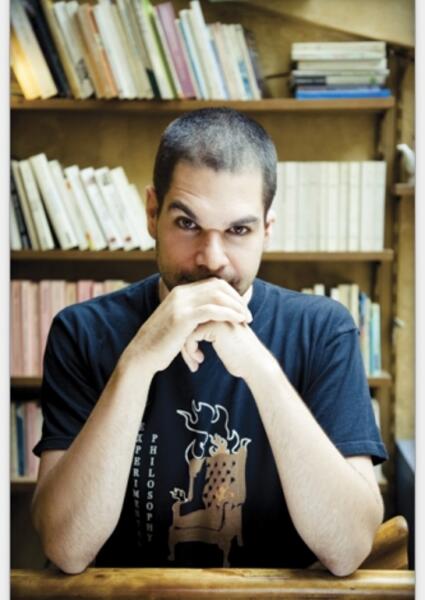
In our “Faces of X-Phi” series, experimental philosophers from all around the globe answer nine questions about the past, present, and future of themselves and the field. Who would you like to see here in the future? Just leave a suggestion in the comments! Today, we present Kevin Tobia.
The Past
(1) How did you get into philosophy in the first place?
It’s an unusual story. The short version is: Philosophy was a better job than DJing.
Here’s the longer version. When I was an undergraduate at Rutgers, I worked various part-time jobs, including mailroom and cleaning services for a government building, tutoring, research assistant (RA) work in a psychology lab, and DJing at college bars. Steve Stich, of Rutgers Philosophy, was recruiting an undergraduate RA to research demographic differences in philosophical intuitions. The job sounded fascinating, so I cut back on the DJing and joined Steve’s project. That turned out to be a terrific decision. At the time, I didn’t fully appreciate the world-class philosophy program at Rutgers and Steve’s brilliance and reputation. But I was hooked by experimental philosophy and fortunate to be in one of the best places to pursue it. I’m forever grateful to Steve for hiring me, mentoring me, and setting me down this path.
(2) And how did you end up doing experimental philosophy?
My entire introduction to philosophy was through experimental philosophy. In the 2010s, when I was starting, there were these little meetups (“MERG”) of experimental philosophers in the New York area. Hearing incredible philosophical discoveries from people like Josh Knobe, Jesse Prinz, Nina Strohminger, and Shaun Nichols inspired me to pursue graduate study, in Oxford on the BPhil, and later at Yale. I worked on X-Phi of various different areas: personal identity and the self, the identity of collectives (like bands), and essentialism.
Later I focused on experimental legal philosophy, or experimental jurisprudence (“X-Jur”), which formed the basis of my philosophy dissertation, Essays in Experimental Jurisprudence (2019). It’s an exciting time in “X-Jur,” with many new and fascinating studies concerning questions of general jurisprudence (e.g. what is the concept of law; are evil laws really law?) and particular jurisprudence (e.g. who is the reasonable person of tort law; how does causation in law differ from causation outside of law; does deception vitiate consent?). There are too many amazing scholars to list here, but for those interested in some of these recent discussions, I’d check out the projects of people including: Guilherme Almeida, Piotr Bystranowski, Raff Donelson, Vilius Dranseika, Brian Flanagan, Ivar Hannikainen, Felipe Jiménez (critiques), Josh Knobe, Markus Kneer, Jamie Macleod, Karolina Prochownik, Roseanna Sommers, Niek Strohmaier, and Noel Struchiner. The field has been introduced and summarized in a few places: here, here, here.
Experimental jurisprudence goes back earlier – Larry Solum noted the possibility, Tom Nadelhoffer and others have earlier legal x-phi papers, and much earlier law and psychology scholarship covers similar territory, especially related to criminal law. So the field is not new, but it has been growing especially rapidly over the past ten years.
(3) Which teachers or authors have influenced you the most on your philosophy journey – and how?
Steve Stich and Josh Knobe are two of the most influential. I was fortunate to have such brilliant and generous advisors. Larry Solan, a model of wisdom, kindness, and humility, was another major influence on my work in law and language. The ideas of all three have shaped my thinking about philosophy, law, and language. All three also share admirable commitments to interdisciplinarity, collaboration, and mentorship.
The Present
(4) Why do you consider experimental philosophy in its present form important?
Let me take one smaller part of this question: What is important about experimental jurisprudence or experimental legal philosophy?
Traditional legal philosophy regularly makes claims about how “we” all understand law and legal concepts; law is replete with concepts that resemble ordinary ones (such as cause, intent, and reasonableness); ordinary judgments directly inform law (e.g. juries deciding mixed questions); and various legal rules and theories offer empirical claims related to ordinary language or understanding (e.g. textualist judges’ interpretive claim to interpret law from the perspective of an ordinary reader). Law, legal judgments and concepts, and legal language are connected in complex ways to ordinary practices, ordinary judgments and concepts, and ordinary language. Understanding these relationships helps elucidate law itself and strikes me as a worthwhile philosophical project, which X-Jur helps advance.
For a more concrete and practical example, consider legal interpretation in the United States. An influential version of “textualism” holds that judges should interpret legal texts as they would be understood by an “ordinary reader.” To do this, judges consult dictionaries or their own intuitions about hypothetical examples. But X-Jur methods can help evaluate conclusions about this “ordinary reader.” A recent Supreme Court (dissenting) opinion cited an X-Jur study on how ordinary readers understand negated conjunctions. As far as I know, this is the first time the Court has referred to such surveys in interpretation. Justice Stephen Breyer’s recent book also draws on experimental jurisprudence research, such as Struchiner, Hannikainen, and Almeida’s findings that people’s rule violation judgments are influenced by both a rule’s text and purpose. For those interested in pursuing philosophy of law and language with concrete practical implications, the Court’s discussion of “the ordinary reader” is an area in which philosophers and experimental philosophers can make unique contributions.
(5) Do you have any critical points to make about experimental philosophy in its current state?
A critique to consider for any field is: Is the field thinking critically about its methods, including innovation and improvement? I ask that question about traditional legal philosophy in “methodology and innovation in jurisprudence.” Traditional jurisprudence and X-Jur share some methodological challenges. For example, when a legal philosopher offers an intuition to a thought experiment, does that philosopher’s intuition replicate the intuitions of others? Robert Cummins lamented that philosophers who did not share certain intuitions were not “invited to the games.” So, when traditional philosophy appeals to shared intuitions, it’s important to critically question whether those intuitions would replicate outside the seminar room.
An X-Phi variant of this concern is the “replication crisis,” which has impacted many empirical fields. In short, some empirical findings have failed to replicate when the same studies are conducted again. On that front, there have been many positive developments in X-Phi: Florian Cova led a team of experimental philosophers to attempt to replicate representative sample studies; many in X-Phi have adopted Open Science practices; there is less emphasis from X-Phi on empirical results that are “surprising.” Generally that all seems to be moving in the right direction.
(6) Which philosophical tradition, group, or individual do you think is most underrated by present-day philosophy?
Philosophy has become highly professionalized, and some today would still equate “doing philosophy” with being part of an academic program (e.g., a professor, postdoc, or enrolled student of philosophy). Of course, a professorship has not always been a requirement to philosophize, and I would love for that understanding of philosophy to return. Take the idea of “public philosophy.” Some of the most successful public philosophers today are working creatively outside of universities. ContraPoints has been enormously successful in bringing philosophy to the public and to issues of our time. Philosophy-through-law is another example. Many talented philosophers come to law school to refine their skills to pursue philosophically informed law and policy work. I would love to see a greater appreciation from academic philosophy for non-university forms of philosophizing (whether in public philosophy, entertainment, journalism, law, policy, advocacy, etc.).
This relates to a critical challenge for the discipline: the changing job prospects of philosophy graduate students. I won’t pretend to have all the answers here, but unless the academic market changes or programs take fewer students, programs should train graduate students to do philosophy through non-academic jobs.
The Future
(7) How do you think philosophy as a whole will develop in the future?
Academic philosophy’s culture has improved in recent years, and I hope this will continue. When I was a graduate student at Oxford, a decade ago, there was a sense that certain philosophical areas and questions were “deeper,” while others were superficial or peripheral – including those that took a perspectival approach, interrogated practical or applied issues, or adopted empirical methods. There were few of us in the feminist philosophy seminar and there was nothing on offer related to philosophy of race, while metaphysics and epistemology were consistently oversubscribed (these areas also used to be described as “core” philosophy). Applied legal-philosophical topics like mass incarceration were often treated as soft or non-philosophical. Things were even more extreme on the empirical front: There was even an effort from one faculty member to ban graduate students from writing experimental philosophy papers! This is obviously one ridiculous example, and there were many other wonderful and supportive faculty at Oxford, but it exemplifies the occasional extreme hostility to certain philosophical approaches that used to exist.
My sense is that in many places this has changed dramatically. Most of all, I hope philosophy will continue to develop in this direction: Welcoming (rather than shaming or banning) new or different perspectives, topics, questions, and methods strengthens the discipline.
(8) What do you wish for the future of experimental philosophy?
Much excitement around the growth of X-Phi and X-Jur came from doing something new: employing different methods, challenging old assumptions, asking fresh questions, unearthing new discoveries to inform philosophical debate. So my wish for the long term would be to find the future of (experimental) philosophy novel. The most disappointing future would be one that rehashes the same debates, in essentially the same ways, ad infinitum.
I’m optimistic about this future. The next generation of philosophers has been pursuing a broad range of questions, including philosophical questions of practical importance. The projects that I’ve advised over the past year exemplify that flourishing range of questions. One student (Zoë Moore) explored lay judgment of responsibility for using brain–computer interface (“BCI”) devices; another (Lindsay Jenkins) is studying attitudes related to technology, autonomy, and decisional privacy concerning abortion access post-Dobbs; another (Natasha Sarna) is studying judgments about privacy and the reasonableness of employer searches in the workplace; another (Nicole Steitz) is analyzing the evolving nature of “textualism” in American legal interpretation.
(9) Do you have any interesting upcoming projects?
I’m finishing a short book for Cambridge’s Elements series that introduces and defends experimental jurisprudence. And for a deeper dive, a large handbook will be released in the next year, The Cambridge Handbook of Experimental Jurisprudence, which offers forty chapters from eighty-four scholars on a range of X-Jur topics.
Another line of projects is inspired by a common objection to experimental jurisprudence. This is the “expertise defense”: X-Jur studies should examine the judgments of legal experts, not laypeople. There is terrific philosophical debate about that question, but the expertise defense also highlights the importance of studying other populations. Eric Martínez led a recent study that surveyed American law professors about what they believe about legal theory questions. There are some interesting findings: for example, the well-known Bourget and Chalmers study finds legal positivism divisive among philosophers, but the law professor study finds positivism is more strongly supported among law professors. This empirical work doesn’t resolve the underlying philosophical debate. But it gives us new and useful material to consider, both concerning positivism and the nature of legal-philosophical expertise (it also raises new questions like: which of these two groups is the experts?).
A final line of work is inspired by another important response to X-Jur: Many studies recruit English-speaking Americans, but are the findings generalizable across other languages and cultures? (Here again, this is also an important question to ask about the intuitions offered in traditional (non-experimental) philosophy). In X-Jur there have been some efforts to address this question. Ivar Hannnikainen and collaborators tested various experimental jurisprudence findings in different languages and cultures, including findings about legal interpretation and the inner morality of law. I’m especially excited to discover more about these questions related to language, culture, and legal philosophy.
The Society for Philosophy of Causation’s second meeting will be held at the University of Göttingen, Germany, from July 19 to 21. The society’s first meeting was held last year at Kyoto University, Japan, where the society was also founded.
While the initial deadline (April 23) has already passed, I was told that submissions will still be considered. The call reads:
Encouraged are submissions on philosophy, psychology, and computer science of causation, and effort will be made to balance these topics. That is, you shouldn’t be discouraged if your submission is more on the cognitive science or computer science side of causation, the name of the society notwithstanding.
The instructions haven’t changed much. Please submit an abstract of 300–1000 words to gosation@causation.science. Specifically, please send an email with your name, the title of your talk, and the abstract in the body of the email and submission as its title. If you have a (drafty or polished) paper, or your abstract can’t be easily pasted as text (e.g., it contains figures or symbols), please in addition attach a PDF of the paper or the abstract. Please mind that the more of the argument your abstract contains, the more likely it will be accepted.
For more information about the Society for Philosophy of Causation and their conference, visit https://causation.science.
The 4th “European Experimental Philosophy Conference,” organized by Izabela Skoczeń, Tomasz Żuradzki, Piotr Bystranowski, Bartosz Janik, Maciej Próchnicki, and Vilius Dranseika, will take place from May 30 to July 2 at Jagiellonian University in Krakow, Poland.
On May 30, there’s a pre-conference symposium on “LLMs for xPhi”. The conference program from May 31 to June 2, then, spans a total of 19 sessions and is complemented by three keynotes:
May 31, 9:30–10:45 (UTC+2)
Ivar Rodriguez Hannikainen (University of Granada): “Letter Versus Spirit – An Overview of Experimental General Jurisprudence”
June 1, 9:30–10:45 (UTC+2)
Katarzyna Paprzycka-Hausman and her team (University of Warsaw): “Reflecting on the Knobe Effect and the Epistemic Side-Effect Effect”
June 2, 13:00–14:15 (UTC+2)
Thomas Nadelhoffer (College of Charleston): “Measuring Free Will Beliefs – What Have We Learned?”
The 32nd “Philosophy Conference” of the University of Valladolid’s Department of Philosophy, organized by José V. Hernández-Conde, will take place from May 16 to 17 in Valladolid, Spain. This year’s instalment is all about experimental philosophy.
May 16, 9:00–18:30 (UTC+2)
Edouard Machery (University of Pittsburgh): “No Luck for Moral Luck”
María Jiménez-Buedo (Universidad Nacional de Educación a Distancia): “What do we Measure in the Dictator Game? Constructs, Validity and the Threat of Methodological Artifacts”
Mikel Asteinza (University of the Basque Country): “Epistemic Determinants of Scientific Disclosure and Their Impact on the Legal Audience – The Case of De-Extinction”
Andrei Moldovan and Obdulia Torres (University of Salamanca): “Expertisia as a Contextual Property”
Fernando Aguiar (Consejo Superior de Investigaciones Científicas): “Would You Hire a Person With an Intellectual Disability? An Experimental Study on Action and Compassion”
Francisco Calvo (University of Murcia): “Of Seahorses and Plants – An Experimental Journey out of Ignorance”
Fernando Sanantonio (Universitat Autònoma de Barcelona): “External Sanctions, Compliance and Avoidance in Vegetarianism as a Normative System”
Daniel Martín (University of Granada): “Attitudes Toward Moral Improvement Based on Virtual Assistance”
May 17, 9:15–14:00 (UTC+2)
Edouard Machery (University of Pittsburgh): “The Geography of Wisdom”
Ivar Hannikainen (University of Granada): “What is ‘Consenting’?”
Javier Anta (University of Salamanca): “An Experimental Approach to the Ordinary Meaning of ‘Information’”
Rodrigo Díaz (Consejo Superior de Investigaciones Científicas): “Describing (Erroneously) Recalcitrant Emotions”
David Rodríguez-Arias (University of Granada): “Contemporary End-of-Life Bioethics – Empirical and Experimental Contributions”
This term at the University of Oldenburg, Stephan Kornmesser and I are teaching a course for master’s students who had no previous contact with x phi.1 We decided to try a hands-on approach rather than just discussing results, debates, and ideas from the field. For this purpose, we divided the course into two parts. In the first half, loosely based on Kornmesser et al. (forthcoming), we introduced some basics of experimental design and statistical analysis. Also, as a paradigmatic example of an early x phi study, we read Knobe (2003). In my opinion, this paper has the advantage of being both short and accessible; the experimental design is simple and the data collected (primarily the nominal yes-or-no responses) can be analyzed quite straightforwardly.
Thereafter, the course was divided into three groups,2 and students were instructed to replicate Knobe’s first study step by step. First, we reconstructed the questionnaire, using a German translation of the vignette (taken from Knobe 2014). Everyone probably knows the vignette, but to refresh your memory, here is the original once again (variations between Harm and Help Condition are indicated by square brackets):
The vice-president of a company went to the chairman of the board and said, “We are thinking of starting a new program. It will help us increase profits, but [and] it will also harm [help] the environment.”
The chairman of the board answered, “I don’t care at all about harming [helping] the environment. I just want to make as much profit as I can. Let’s start the new program.”
They started the new program. Sure enough, the environment was harmed [helped].
Knobe (2003, 190)
Afterwards, students used the questionnaire to ask people on campus whether the chairman brought about the side effect intentionally. Finally, we calculated and interpreted χ2 tests for each group. To foster an understanding of how the χ2 test actually works, we calculated them by hand one step at a time instead of using software.
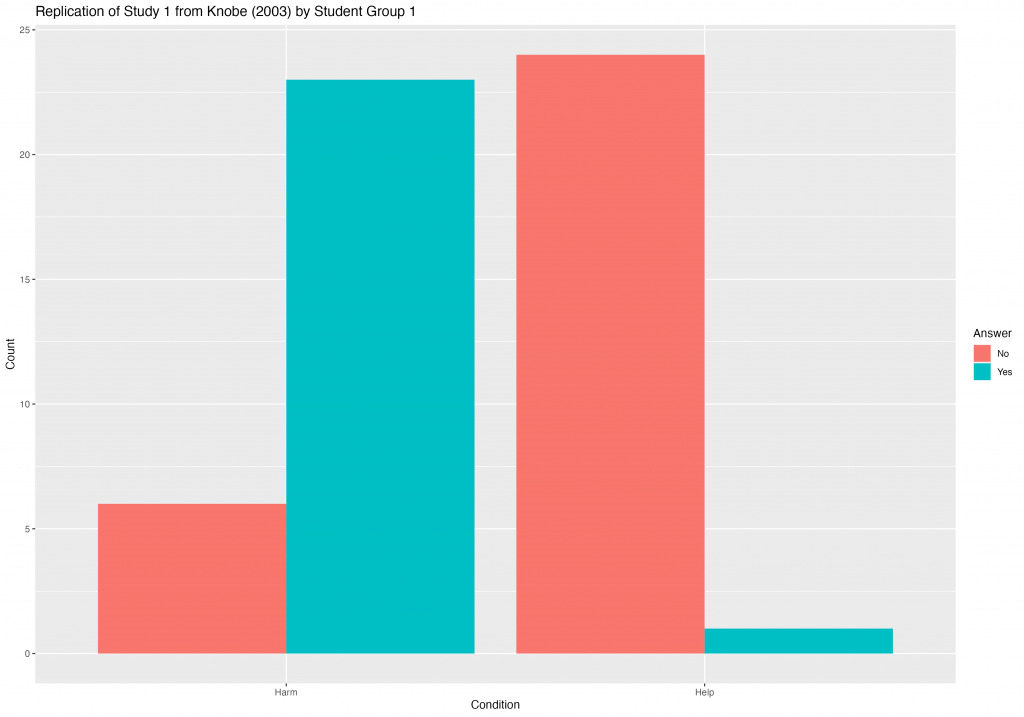
As can be seen in the picture below, showing the results from Group 1, Knobe’s original findings were perfectly replicated.3 In the Harm Condition, most subjects said that the chairman brought about the side effect intentionally, while in the Help Condition, most subjects said that he did not.4
Replication of Study 1 from Knobe (2003) by Student Group 1
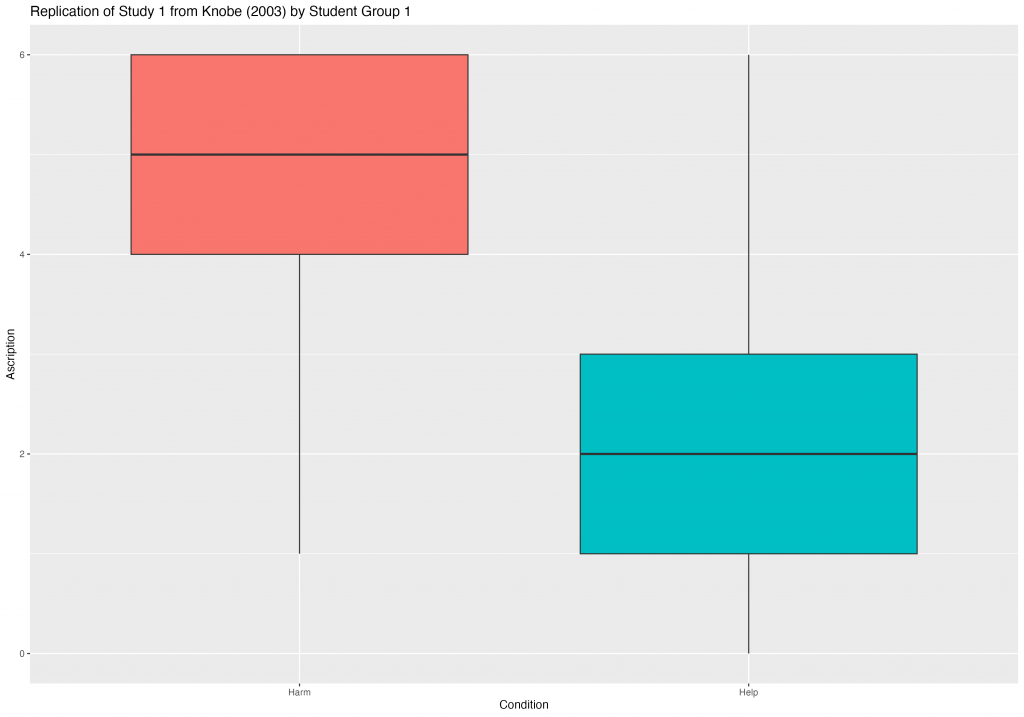
As did Knobe (2003), people were also asked how much praise or blame the chairman deserves. Using the results from Group 1 again as an example, shown in the picture below, the mean of ascribed blame was 4.90 (SD = 1.26), while the mean of ascribed praise was 2.32 (SD = 1.63), which also fits in very well with Knobe’s results.5
Replication of Study 1 from Knobe (2003) by Student Group 1
Where do we go from here? In the second half of our course, the three groups are encouraged to develop their own research questions based on their philosophical interests. They will learn how to design an online survey and set one up themselves. Luckily, we have got a grant for research-based learning instructional projects from the university’s initiative forschen@studium,6 which will be used to recruit subjects from an online panel provider. Hence, learning panel integration will also be on our schedule. This is followed by guided data analysis and interpretation. Finally, the groups present their results to each other and document them in term papers. This means that, in the end, an entire research process is experienced.
Kornmesser, Stephan, Alexander Max Bauer, Mark Alfano, Aurélien Allard, Lucien Baumgartner, Florian Cova, Paul Engelhardt, Eugen Fischer, Henrike Meyer, Kevin Reuter, Justin Sytsma, Kyle Thompson, and Marc Wyszynski (forthcoming): Experimental Philosophy for Beginners. A Gentle Introduction to Methods and Tools, Cham: Springer. (Link)
Knobe, Joshua (2003): “Intentional Action and Side Effects in Ordinary Language,” Analysis 63 (3), 190–194. (Link)
Knobe, Joshua (2014): “Absichtliches Handeln und Nebeneffekte in der Alltagssprache,” translated by Jürgen Schröder, in: Thomas Grundmann, Joachim Horvath, and Jens Kipper (eds.): Die Experimentelle Philosophie in der Diskussion, Berlin: Suhrkamp, 96–101. (Link)
Endnotes
If you are interested in teaching x phi to beginners, you should also take a look at De Cruz (2019). In her blog post, she describes a teaching approach to third-year undergraduates at Oxford Brookes University. ↩︎
Of course, the great students of our course deserve credit! Group 1: Johannes Bavendiek, Marvin Jonas Laesecke, and Aileen Wiechmann; Group 2: Rebecca Kratzer, Frederike Lüttich, and Jule Rüterbories; Group 3: Bastian Göbbels, Finn Ove Gronotte, Marina Hinkel, and Riduan Schwarz. ↩︎
χ2(1, 54) = 27.865, p < 0.001. For comparison: Knobe (2003, 192) reports χ2(1, 78) = 27.2, p < 0.001. ↩︎
t(54) = 6.43, p < 0.001. For comparison: Knobe (2003, 193) reports – pooled for both of his studies – a mean of 4.8 in the harm condition and of 1.4 in the help condition; t(120) = 8.4, p < 0.001. ↩︎
Today, the “XPHI UK Work in Progress Workshop Series,” organized by James Andow and Eugen Fischer, starts. They write:
We are delighted to announce the next series of our monthly online workshop devoted to discussion of work in progress in experimental philosophy. The worshop is held via Teams, the second Wednesday of each month, 16:00–18:00 UK time. The link to the Teams meetings is below.
February 14, 16:00–18:00 (UTC±0)
Renato Turco (University of Genoa): “An Experimental Approach to Empty Definite Descriptions”
Lucien Baumgartner (University of Zurich), Paul Rehren (Utrecht University), and Krzysztof Sękowski (University of Warsaw): “Measuring (Un)Intentional Conceptual Change in Philosophy – A Corpus Study”
March 13, 16:00–18:00 (UTC±0)
Isabelle Keßels (University of Düsseldorf), Paul Hasselkuß (University of Düsseldorf), and Daian Bica (University of Düsseldorf): “The Safety Dilemma Put to the Test”
José V. Hernández-Conde (University of Valladolid) and Agustín Vicente (University of the Basque Country; Ikerbasque): “A Comparative Analysis of the Knobe Effect – Assessing Moral, Aesthetic, and Alethic Reasoning in Autistic and Neurotypical Populations”
April 10, 16:00–18:00 (UTC+1)
Tingting Sui (Peking University), Sebastian Sunday (Peking University): “A Confucian Algorithm for Autonomous Vehicles”
Ryan Doran (University of Barcelona; University of Cambridge): “True Beauty”
May 8, 16:00–18:00 (UTC+1)
William Gopal (University of Glasgow): “Identifying & Rectifying the Instrumentalist Bias in Analytic Social Epistemology”
Giuseppe Ricciardi (Harvard University) and Kevin Reuter (University of Zurich): “Exploring the Agent-Relativity of Truth”
June 12, 16:00–18:00 (UTC+1)
Federico Burdman (Alberto Hurtado University), Gino Marttelo Carmona Díaz (University of the Andes), and María Fernanda Rangel Carrillo (University of the Andes): “Lay Perceptions of Control and Moral Responsibility in Addiction”
Phuc Nguyen (German Cancer Research Center), Andrea Quint (German Cancer Research Center), María Alejandra Petino Zappala (German Cancer Research Center), and Nora Heinzelmann (University of Erlangen-Nuremberg): “A Cross-Cultural Study on the Ethics and Moral Psychology of HPV Vaccination”
On Wednesday, April 10, from 16:00–18:00 (UTC-5), Markus Kneer will be talking about “Biases in Mens Rea Attribution & How to Address Them” at the University of the Andes (Hemiciclo 001) in Bogotá, Colombia. Markus writes:
In this talk I aim to do three things: First, I’ll briefly introduce the new subdiscipline of Experimental Philosophy of Law. Second, I will explore legal conceptions of certain inculpating mental states (mens rea), in particular intention and negligence. To do so, I’ll show how experimental philosophy of law can help elucidate bias in their attribution and potential mismatch between legal and folk conceptions thereof. Third, I will discuss how biases in mens rea attribution could be alleviated.
In our “Faces of X-Phi” series, experimental philosophers from all around the globe answer nine questions about the past, present, and future of themselves and the field. Who would you like to see here in the future? Just leave a suggestion in the comments! Today, we present Josh Knobe.
The Past
(1) How did you get into philosophy in the first place?
I was always obsessed with philosophy, but at least at first, I had a lot of misgivings about going into academia. Back when I was an undergrad, I had a sense that academic philosophy was too much a matter of playing some little game designed to display one’s own cleverness and not enough a matter of genuinely trying to get to the bottom of things.
So after I graduated from undergrad, I left the world of academia and took a bunch of random jobs. I had a job working with homeless people. I spent some time translating documents from French and German for a computer company. I was writing software that helped low-income people get housing. For a little while, I was teaching English in a small town in Mexico.
But that whole time, I was still writing philosophy. I would write philosophy papers on nights and weekends. Then, when I thought a paper was completely done, I would put it in my desk drawer and never show it to anyone again. (Needless to say, all of these philosophy papers were awful.)
After four years of that, I started to feel that my life was going nowhere, and I applied to grad school in philosophy.
(2) And how did you end up doing experimental philosophy?
Even when I first arrived in grad school, I was running experimental studies. I was working with a professor in the psych department and putting together the papers for psychology journals. But fundamentally, I saw that whole thing as a hobby – just a little thing I was doing on the side.
My main focus at the time was on work that was more in the Continental tradition. I was obsessed with Kierkegaard, Sartre, Marx. My advisor was the Nietzsche scholar Alexander Nehamas.
Then, after a few years, I had something of an existential crisis. I started to feel that this work I had been doing in the Continental tradition was not the best way to answer the questions that were troubling me. And I started to think that maybe work using experimental methods – the very thing I had seen as just a hobby – might actually be a better way of pursuing those questions.
(3) Which teachers or authors have influenced you the most on your philosophy journey – and how?
Of course, all of us have been deeply influenced by our teachers and by various great figures from the history of philosophy, but if I think about it honestly, I would have to say that I have been much more influenced by my students and by other philosophers who are more junior than I am. Looking at the generation of philosophers who are now in their 20s and 30s, I feel like they have gone beyond my generation in so many important respects, and my whole approach to philosophy has been shaped by their contributions.
The Present
(4) Why do you consider experimental philosophy in its present form important?
As you probably know, there is a huge literature about this question already – tons of papers exploring metaphilosophical questions about what experimental philosophy is and whether it can shed light on important philosophical issues. But in my view, this entire literature has gotten off on the wrong foot. It isn’t even grappling with the questions that are most relevant here.
Just to start off with, what do experimental philosophers actually do day to day? In the first instance, what they do is to explore questions about how human beings think and feel. If you just pick out an experimental philosophy paper at random and start reading it, you will find a whole lot of evidence and arguments concerning questions about what is going on in human beings’ minds.
Now, what you see in the existing metaphilosophical literature is often an assumption that questions about human beings couldn’t possibly be philosophically relevant just themselves. So the thought is that if you want to understand what is philosophically important here, we have to show that facts about human beings can help us address some other question – a question that is not itself about human beings. Usually, the focus is on arguments of the form: Learning how people think about X can tell us about the true nature of X (e.g., learning how people think about causation can tell us about the true nature of causation). Then the assumption is that the key issue we need to grapple with as we explore the importance of experimental philosophy is whether or not arguments of this form can be made to work.
But this whole way of framing the issue is wrong from the beginning. If you want to understand what is so deep and important about experimental philosophy, you’ve got to actually care about questions concerning human beings. Most of this research is about exactly what it seems to be about. It’s about human beings, and how they think and feel. So if you want to understand why it is philosophically significant, you have to at least be talking about the potential philosophical significance of questions about human beings.
This point is so simple and straightforward that it almost feels like it should go without saying. Research in experimental philosophy of language is fundamentally about human languages, and if you don’t care about contingent facts about human beings and the languages they speak, you will never be able to understand what is supposed to be important about it. Experimental philosophy of law is about human systems of law, and if you think the only important questions in philosophy of law are about, say, the metaphysics of law, you will never understand why people are running all of these experimental studies.
Of course, we all know that some philosophers think contingent facts about human beings have no deeper philosophical significance. We can easily imagine the philosopher who says: “I think that there is no philosophical significance in itself to the study of how human languages actually work. Given that, please try explaining to me why your research in experimental philosophy of language is supposed to be valuable.” But in responding to such a person, we should not start out by conceding that this conception of philosophy might be correct. What we should be doing is arguing against precisely this conception.
(5) Do you have any critical points to make about experimental philosophy in its current state?
When it comes to experimental methods, there has been such a huge improvement over time. I’m really excited about all the reforms that have been introduced in recent years, but there is plenty to criticize about the way we did things in the early years of experimental philosophy.
As you may know, research methods in experimental philosophy were completely transformed by the replication crisis. The field has introduced a whole host of reforms that have allowed us to create more replicable research (larger sample sizes, pre-registration, open data, open code, etc.). The result has been a radical change in the whole character of the field. These days, it feels like there is much less interest in trying to put together flashy or counterintuitive findings and much more interest in just getting things right.
In the early years of experimental philosophy, before all these reforms, I think we were going wrong in some pretty fundamental ways. There was just way too much emphasis on getting results that would be “fun” or “exciting” and way too little on finding the right answer. The inevitable outcome was a whole bunch of results that failed to replicate.
More recent experimental philosophy is doing all the right things to avoid the bad practices we used at that time, but we need to do more on one specific front. There are still too many papers citing studies from that early time that have failed to replicate. If we are getting evidence that something doesn’t actually happen, we need to stop thinking about the philosophical implications of it happening and start thinking about the implications of the fact that it doesn’t happen. (As a small step in that direction, I put together a page with information about recent results that refute claims from my own previous papers.)
(6) Which philosophical tradition, group, or individual do you think is most underrated by present-day philosophy?
Traditionally, I think a whole style or approach to philosophy was tragically underrated. Things are getting better on that front, but I worry that we haven’t yet gone far enough in changing our view about this style of philosophy.
A number of decades ago, there was a clear sense that your goal as a philosopher should be to articulate a big new philosophical view and then argue that everyone else is wrong and your new view is right. So there was a widespread understanding that you were supposed to have some paper where you say: “In this paper, I boldly introduce View X.” Then, over the course of the next few decades, you were supposed to keep saying that View X was right and defending it against all objections. Let’s refer to philosophers who do this as “View X-ers.”
The View X-ers always get a lot of attention, and they can sometimes manage to upstage the philosophers engaged in another, very different form of inquiry. The most noticeable fact about these other philosophers is that they are curious about philosophical questions. They are thinking about the big issues, but they aren’t wedded to any specific view about those issues. Instead, they are focused primarily on trying to think carefully about the evidence and what it suggests about the various different views. We can refer to these philosophers as the “Curious-ers.”
Traditionally, I think the Curious-ers were completely underrated. They did lots of fantastic work, but all the attention got sucked up by the View X-ers. Things are clearly beginning to change on that dimension – but we still have not gone far enough. We need even more love for the Curious-ers!
The Future
(7) How do you think philosophy as a whole will develop in the future?
Well, it’s always a little bit hard to predict the future, but it’s easy to see what direction philosophy is going in right now, so let’s start with that.
When I first joined the field, Anglo-American philosophy was very dominated by certain specific approaches, and every other approach was seen as marginal or peripheral. Work on certain issues in metaphysics was completely dominated by a tradition associated with Kripke and Lewis. Work in political philosophy was completely dominated by a tradition associated with Rawls. And so on.
At this point, twenty years later, all of that has changed. In so many different ways, the influence of that formerly-dominant approach is receding, and all sorts of other approaches are rising in importance. It’s not that any single other approach has come to dominate everything. Rather, it’s that the previously dominant approach is becoming ever less prominent, and in its place, we see a flowering of all sorts of new research programs.
This change in the discipline of philosophy more broadly has led to a corresponding change within experimental philosophy. If you look back at the experimental philosophy that was published in the early 2000s, it’s easy to see that a lot of it is aimed at engaging with the traditions that were so dominant at that time (e.g., using experimental studies to argue against ideas from those specific traditions), but since then, things have changed radically. It’s not so much that recent work offers a different view about those same old questions; it’s more that people’s interests have broadened in so many ways, and people are now exploring all sorts of new issues that are almost completely unrelated to what philosophers were so focused on back then.
If you look at what is happening in philosophy of language these days, you see a massive decline of interest in the more metaphysics-adjacent questions that were so dominant in the 20th century and an embrace of a huge array of new questions coming out of linguistics. Experimental philosophy of language has very much gone in this same direction. These days, you can see a wealth of new research coming out about all sorts of different detailed, linguistic questions (generics, presupposition projection, epistemic modals, thematic roles, lexical causatives, etc.). And the same applies elsewhere. Philosophy of law used to be dominated by a relatively narrow range of questions in general jurisprudence, but in recent years, we see an explosion of new research about all sorts of other questions. Experimental philosophy of law shows that same change. Recent experimental work has looked at the concept of consent, the concept of the reasonable person – a whole array of exciting empirical questions.
(8) What do you wish for the future of experimental philosophy?
As a way into this question, let’s start with an analogy. Consider what we might wish for the future of scholarship in non-Western philosophy. I think that if we reflect on this question, we can get some helpful insight into what we should want for the future of experimental philosophy.
When American philosophers first turn to non-Western philosophy, they sometimes start with a preconceived view about what the important philosophical questions are (roughly, the ones from Western philosophy) and then ask how non-Western philosophy can shed light on those questions. What a terrible idea! Clearly, a better approach would be to pick up some non-Western texts and then look with an open mind at what philosophical insights we can get by exploring those texts. But of course, this takes work. If you are trained in Western philosophy, the first things you think of are questions from Western philosophy, and it can be hard to learn to think differently.
I see experimental philosophy in the same way. When people first start doing experimental philosophy, the obvious first approach is to keep working away on a list of preconceived questions borrowed from non-experimental philosophy. In some cases, people even proceed by just literally taking thought experiments from the non-experimental literature and running experiments using those very thought experiments. Ultimately, it seems unlikely that this will be the best approach. The best approach, I think, is to look at the empirical phenomena and try to think about what is most philosophically important in them.
Of course, this takes work, and if you are trained in non-experimental philosophy, it might be quite difficult at first, but I hope we can keep going even farther in that direction.
(9) Do you have any interesting upcoming projects?
These days, I am working on a bunch of unrelated projects. Here are two that might be worth mentioning:
(1) Matthias Uhl and I are working on a project about the idea that people see certain sorts of environments as the natural environments for human beings. Looking around ourselves, we see plenty of people living in cities, working for corporations, hunched over their laptops as they scroll pictures of acquaintances on Instagram… but people seem to think that this is not the natural environment for a human being to live in. Instead, the natural environment might be something like: walking in a forest while talking in person with a close friend.
What we find is that people attach a special significance to whatever you do when you are in this natural environment. If you behave one way while you are at the office hunched over your laptop but you act a very different way when you are taking a walk in the forest, people think that the way you behave when you are in the forest is more reflective of your true self.
(2) Linas Nasvytis, Fiery Cushman, and I are working on a project about which possibilities naturally come to people’s minds. Suppose you try to imagine something a person could have for lunch. There is no right or wrong answer here; just think of whichever lunch first comes to mind. When people try to do this, they often find that the first thing that comes to mind is something that they see as good. This fact seems like it might reveal something fundamental about people’s representations of categories.
We put together a neural net that represents categories in a way that shows this very same effect. The neural net samples objects from a category, and when it does this, it tends to sample objects that it regards as good. Comparing this computational model to data from human cognition, we are getting at least some initial indication that it might be on the right track.
Needs are something that fundamentally defines us as human beings. In “Empirische Studien zu Fragen der Bedarfsgerechtigkeit” (Empirical Studies on Questions of Need-Based Distributive Justice), I recap a series of vignette studies that examine the role that needs play in dealing with problems of distributive justice. While needs are often underrepresented in discussions of distributive justice, they are shown to have a fundamental importance in people’s thinking.
Among other things, the following becomes clear:
Impartial observers make gradual assessments of the fairness of distributions.
These assessments depend on how well an individual is supplied with a relevant good.
If information on a need threshold is given, these assessments are made relative to this reference point. (Bauer et al. 2023a)
Impartial decision-makers consider need, productivity, and accountability when making hypothetical distribution decisions.
If an individual’s productivity is not sufficient to cover their needs, these higher needs are partially compensated for (at the expense of other individuals who are not so badly off)
Willingness to compensate decreases if an individual is accountable for having produced less or for needing more. (Bauer et al. 2022)
Both impartial observers and impartial decision-makers attribute different levels of importance to different kinds of needs.
This reveals a hierarchy of needs in the following order: Survival, Decency, Belonging, Autonomy. (Bauer et al. 2023b)
Literature
Bauer, Alexander Max, Frauke Meyer, Jan Romann, Mark Siebel, and Stefan Traub (2022): “Need, Equity, and Accountability. Evidence on Third-Party Distribution Decisions from a Vignette Study,” Social Choice and Welfare 59, 769–814. (Link)
Bauer, Alexander Max, Adele Diederich, Stefan Traub, and Arne Robert Weiss (2023a): “When the Poorest Are Neglected. A Vignette Experiment on Need-Based Distributive Justice,” SSRN Working Paper 4503209. (Link)
Bauer, Alexander Max, Jan Romann, Mark Siebel, and Stefan Traub (2023b): “Winter is Coming. How Laypeople Think About Different Kinds of Needs,” PLoS ONE 18 (11), e0294572. (Link)
Bauer, Alexander Max (2024): Empirische Studien zu Fragen der Bedarfsgerechtigkeit, Oldenburg: University of Oldenburg Press. (Link)
To provide the best experiences, we use technologies like cookies to store and/or access device information. Consenting to these technologies will allow us to process data such as browsing behavior or unique IDs on this site. Not consenting or withdrawing consent, may adversely affect certain features and functions.
Functional
Always active
The technical storage or access is strictly necessary for the legitimate purpose of enabling the use of a specific service explicitly requested by the subscriber or user, or for the sole purpose of carrying out the transmission of a communication over an electronic communications network.
Preferences
The technical storage or access is necessary for the legitimate purpose of storing preferences that are not requested by the subscriber or user.
Statistics
The technical storage or access that is used exclusively for statistical purposes.The technical storage or access that is used exclusively for anonymous statistical purposes. Without a subpoena, voluntary compliance on the part of your Internet Service Provider, or additional records from a third party, information stored or retrieved for this purpose alone cannot usually be used to identify you.
Marketing
The technical storage or access is required to create user profiles to send advertising, or to track the user on a website or across several websites for similar marketing purposes.