From May 25 to 26, 2026, the workshop “Incentivized Experiments on Normative Systems” will take place in Kraków, Poland.
More information is available on the workshop’s website.
The Experimental Philosophy Blog
Philosophy Meets Empirical Research
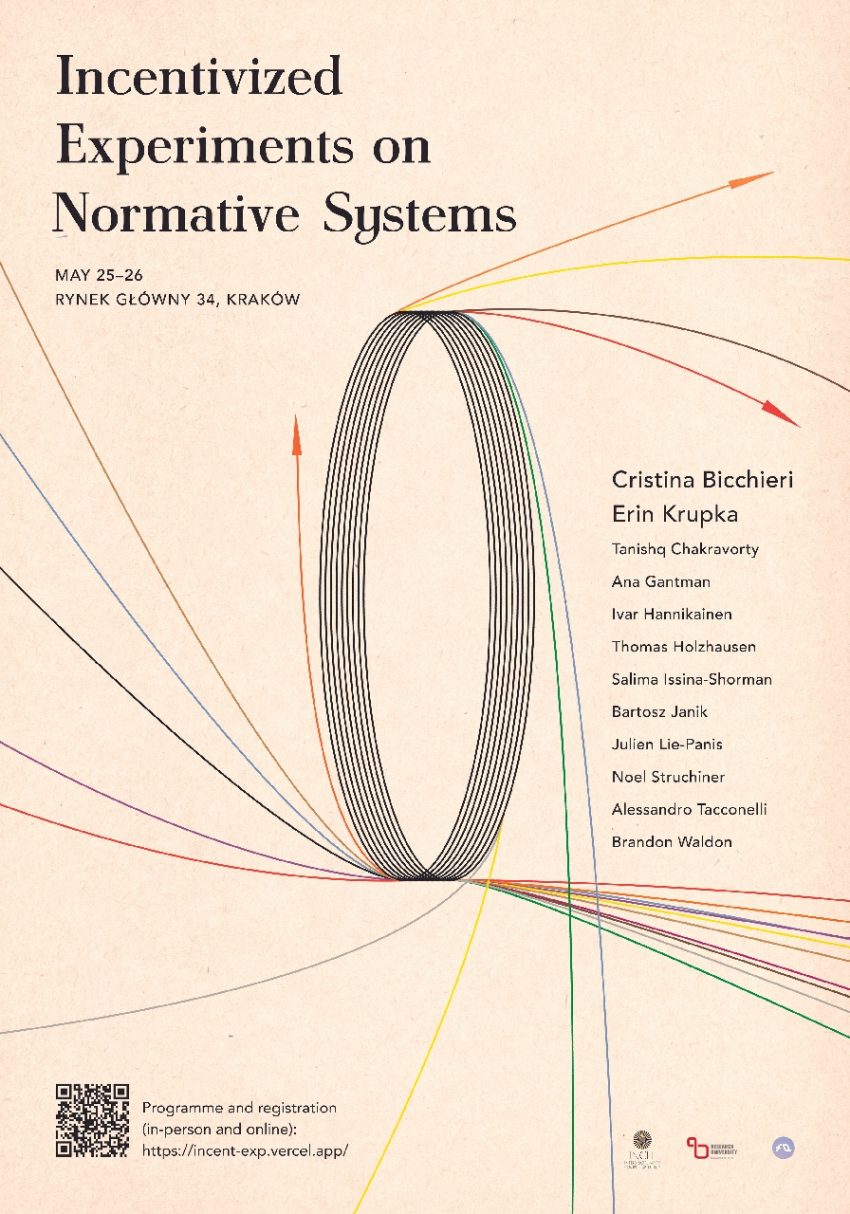
From May 25 to 26, 2026, the workshop “Incentivized Experiments on Normative Systems” will take place in Kraków, Poland.
More information is available on the workshop’s website.
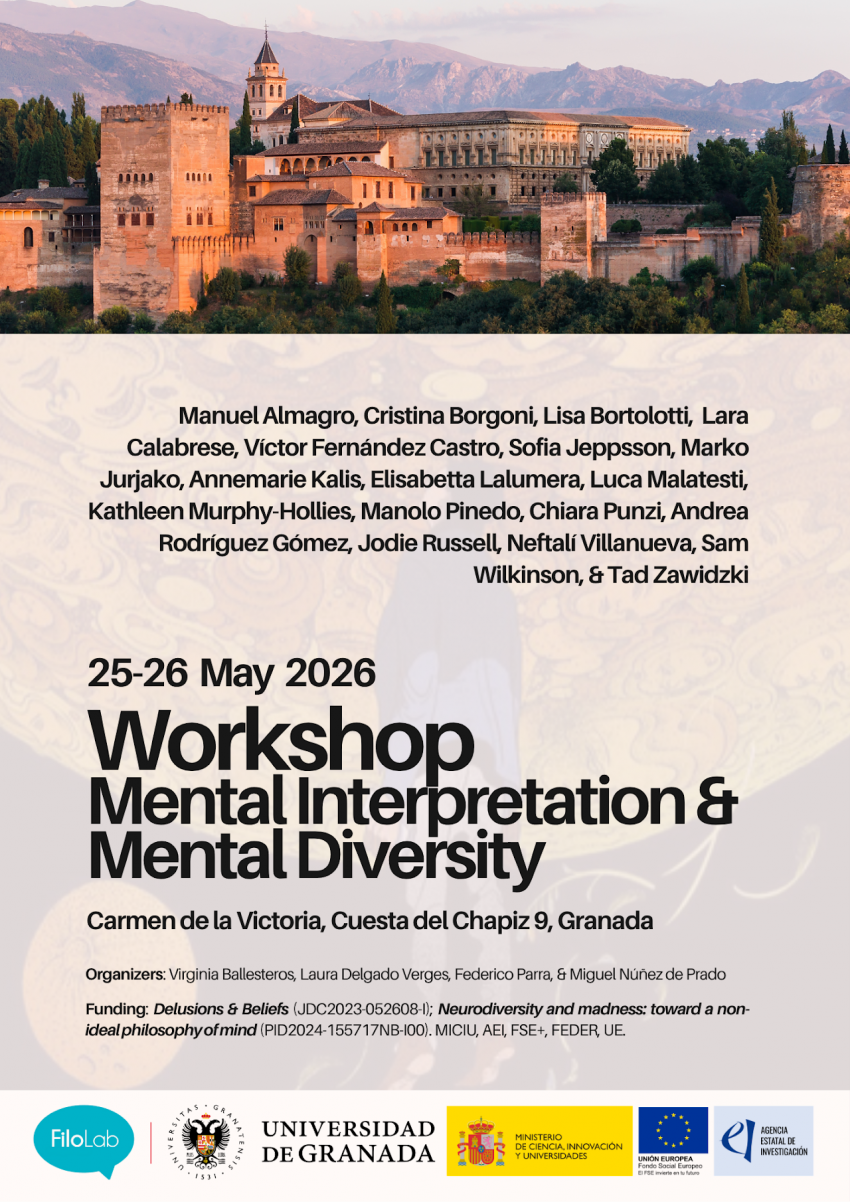
From May 25 to 26, 2026, the workshop “Mental Interpretation & Mental Diversity” will take place at the University of Granada, Spain.
The announcement reads:
There is a marked tendency in the philosophy of mind to characterize mental interpretation – the understanding of each other and ourselves in terms of mental concepts, folk or sciency – in broadly universalist terms. Whether described as the exercise of psychological capacities whose basic structure is universally shared across the species (a Theory of Mind, described in functionalist-representationalist terms), or as a predictive practice based on fundamental norms of rationality, the underlying commitment remains the same: the downtown of mental interpretation is a set of universal rules, functional or rational, that set fixed boundaries to what can plausibly count as a (healthily) minded creature.
This assumption has been challenged from a number of directions. On the one hand, empirical evidence from fields like anthropology and cultural psychology points to a rich intercultural diversity in the meaning and function of mental concepts. This evidence partly converges with experimental studies on attributions of mental states like belief or intention, which reveal a marked context-dependence in the way mental attributions are used and assessed. In parallel, civil right movements like the Neurodiversity or Mad Pride movements have increasingly demanded greater recognition for intracultural cognitive diversity. This includes both subpersonal differences in sensory and executive processing, for which neurodiversity-informed research provides accumulating evidence, as well as person-level differences in how such differences are interpreted and policed in interpersonal practices.
In sum, this points to the need for a philosophy of mind better suited to accounting for this rich diversity in minds and in the ways we talk and think about them. The present workshop aims to move in this direction by bringing together cutting-edge research on mental interpretation, mental diversity, and the connections between them. The contributions address various important topics in this line of inquiry, including the analysis of consequences of different philosophical theories of mental interpretation for our understanding of mental diversity; the link between mental (self-)interpretation and the constitution of mind and mental health; inter- and intra-cultural variability in mental interpretation; mental diversity and counternormative (e.g., mad, neurodivergent) interpretation practices; epistemic and discursive injustices related to mental interpretation; or the interplay of first-, second-, and third-personal perspectives in self-interpretation.
From June 9 to 10, 2026, the fourth workshop of the Empirical Epistemology Network will be held at the University of Stirling, UK.
The announcement reads:
This event considers how place-knowledge – especially in relation to cities – comes to be formed through sensory engagements, lived experiences, and interactions with environments through physical immersion, memory and imagination, and the role these play in giving rise to place(s). Combining academic papers with interactive activities such as storytelling, mapping, walking and artistic interventions, together we will explore the challenges and opportunities for place-based imagining and to reflect on how ways of knowing shape, and are shaped by, engagements with place.
Speakers:
- Pablo Fernandez Velasco (Stirling)
- Paola Di Giuseppantonio Di Franco (Durham, in-person only)
- Rebecca Noone (Glasgow)
- Christina Anderson (UCL)
- Sofya Shahab (Stirling, in-person only)
- Quill R. Kukla (Georgetown)
The overarching goal of the network is to build bridges between epistemologists and empirical researchers from various disciplines. Epistemologists will reflect about the practical relevance of their theoretical research on the nature of knowledge, and empirical researchers will consider whether some of the sharp conceptual tools of epistemologists are helpful for their own work. Participants will be drawn to identify the implicit or explicit assumptions of their work and field of research, assess whether those assumptions are warranted, and think about the consequences of challenging those assumptions. Remote participation, where feasible, is welcome. For more details about the network, up to date information about speakers and links to register, please visit https://empiricalepistemology.stir.ac.uk/index.php/events/.
Small travel and child-care bursaries available. Please note that in-person attendance is limited to 30. If you register and then realise you can’t attend, please let us know asap so that we can free the space for someone else. The Empirical Epistemology Network is run by Giacomo Melis (Stilring), Kirsten Blakey (Toronto), Jack Lyons (Glasgow) and Peter Graham (UC Riverside), and is supported by the Future Leaders Fellows Development Network (award PF 024).
The overarching goal of the network is to build bridges between epistemologists and empirical researchers from various disciplines. Epistemologists will reflect about the practical relevance of their theoretical research on the nature of knowledge, and empirical researchers will consider whether some of the sharp conceptual tools of epistemologists are helpful for their own work. Participants will be drawn to identify the implicit or explicit assumptions of their work and field of research, assess whether those assumptions are warranted, and think about the consequences of challenging those assumptions.
For more information please contact: giacomo.melis1@stir.ac.uk
From May 7 to 8, 2026, the workshop “Philosophy – What and How?” will take place at the University of Vienna, Austria.
The announcement reads:
Views on what philosophy is and how it should be done vary widely. Is philosophy concerned with reality or with our concepts used for grasping aspects of reality? Does philosophy use a priori or empirical methods? What is the role of intuitions? And of the method of cases? What are philosophers trying to find out? Is Philosophy a descriptive or a normative discipline, or both?
Key information:
Dates: May 7–8, 2026, 09:00–18:00
Venue: Sky Lounge (DG), Oskar-Morgenstern-Platz 1, 1090 Wien, AustriaHere is a list of speakers and titles:
- Max Kölbel: Philosophy as Conceptual Engagement
- Yaokun Fu: The Arrovian Impossibility Theorem in Metaphysical Theory Choice
- Sophie Veigl: Beyond Method? Philosophy of Science Between Analysis and Activities
- Elijah Chudnoff: Intuition and Philosophical Progress
- Matti Eklund: The Parochial, the Universal and the Alien
- Asya Passinsky: Ameliorative Metaphysics
- Eric Wallace: Idealisation and Overfitting
- Alice van’t Hoff: Choosing Metalanguages
- Edouard Machery: Arguments won’t help
Registration and more details:
https://philosophywhatandhow.phl.univie.ac.at/
Registration is required but free of charge, and all are welcome (registration form on the bottom of the page).
This workshop is supported by the PACE (pace.phl.univie.ac.at/) and KiC (www.knowledgeincrisis.com/) projects.
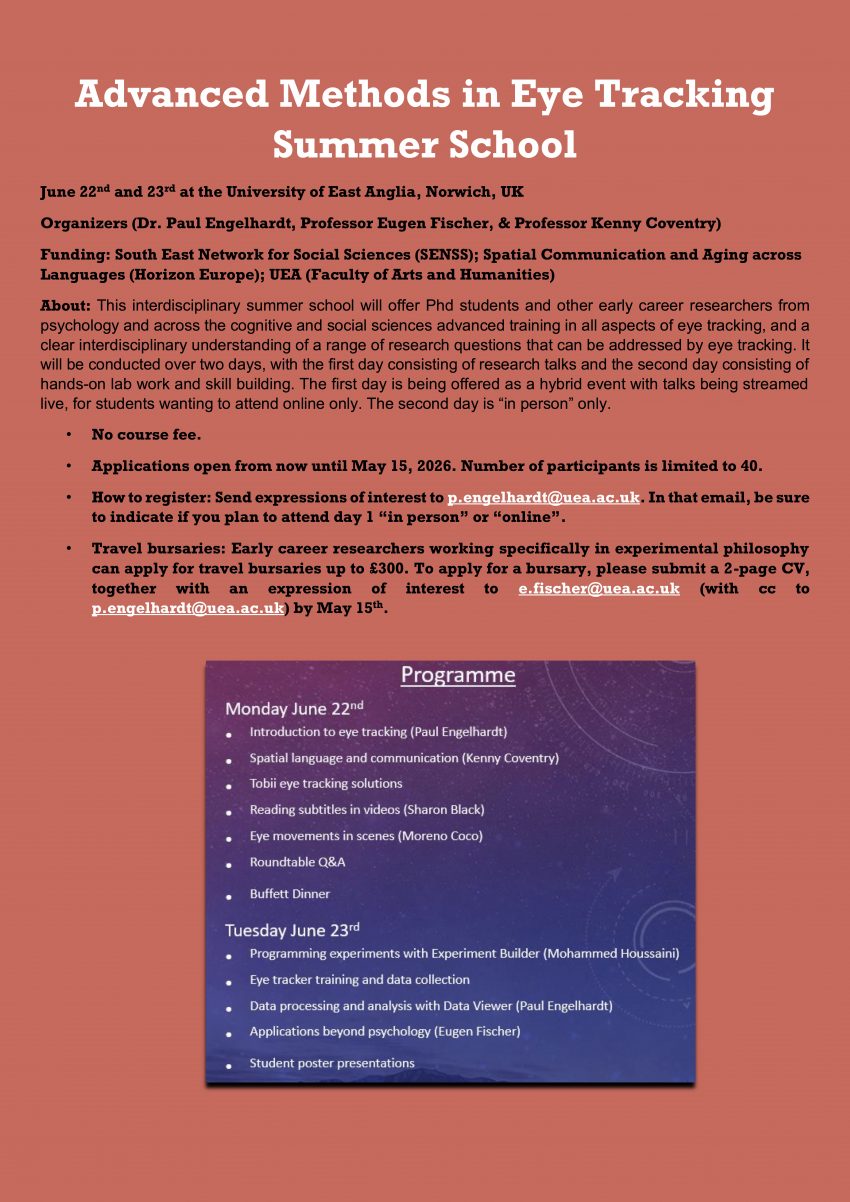
From June 22 to 23, 2026, the summer school “Advanced Methods in Eye Tracking” will take place at the University of East Anglia, UK.
See the poster for details. The announcement reads:
This interdisciplinary summer school will offer Phd students and other early career researchers from psychology and across the cognitive and social sciences advanced training in all aspects of eye tracking, and a clear interdisciplinary understanding of a range of research questions that can be addressed by eye tracking. It will be conducted over two days, with the first day consisting of research talks and the second day consisting of hands-on lab work and skill building. The first day is being offered as a hybrid event with talks being streamed live, for students wanting to attend online only. The second day is “in person” only.
From April 11 to 12, 2026, the conference “Social Ontology and Empirical Inquiry – Conflicts and Connections” will take place at the University of Pittsburgh. The conference page reads:
We are pleased to announce a two-day interdisciplinary workshop hosted by the Center for Philosophy of Science at the University of Pittsburgh, focusing on the intersection of social metaphysics and empirical research in the social sciences.
The workshop aims to foster dialogue between philosophers and social scientists who are interested in the nature of social reality and in how conceptual and empirical approaches to understanding it can be fruitfully integrated.
Social scientists and philosophers have long sought to clarify what it means for entities such as races, genders, institutions, and social structures to exist and to act. Meanwhile, empirically-oriented social scientists have developed increasingly sophisticated methods for measuring, modeling, and explaining such phenomena. This workshop will bring these conversations together to explore the conflicts and connections between conceptual–theoretical frameworks and empirical–methodological practices in the study of the social world.
Organizing Committee
- Kareem Khalifa, UCLA
- Edouard Machery, University of Pittsburgh
- Mark Risjord, Emory
- David Thorstad, Vanderbilt
Confirmed Keynotes
The program will include keynote talks and panels by both philosophers and social scientists, including scholars such as:
- Petri Ylikoski (University of Helsinki)
- Brian Epstein (Tufts University)
- Aliya Saperstein (Stanford University)
- Issa Kohler-Hausmann (Yale Law School)
Guiding Questions
- What kinds of things are social entities – individuals, groups, institutions, norms, and categories such as race and gender?
- How can such entities be both socially constructed and real?
- What is the relationship between social ontology and social measurement?
- How should metaphysical theories about the nature of the social world inform, or be informed by, empirical research designs?
- Do social explanations involve forms of causation, mechanism, or structure that differ from those in the natural sciences?
- How can philosophical analysis of social kinds enrich empirical debates about classification, comparability, and operationalization?
Format
The workshop will include:
- 30-minute contributed presentations (20 minutes presentation + 10 minutes Q&A)
- Keynote lectures by invited speakers
- A roundtable discussion on future directions in social ontology and empirical research
On April 15 from 18:00–20:00 (UTC+2), Franz Berto and Aybüke Özgün will give a talk titled “I wasn’t thinking about that!” as part of the PhiLang Seminars on Linguistics and Philosophy of Language at the University of Lodz. The session can be accessed via Teams after registration via the online form. The abstract reads:
Framing effects occur when someone believes only one of two necessarily equivalent propositions, P and Q. Framing is well known and widely studied in economics, the social sciences, cognitive psychology, etc. We want a logic of framing.
Of course, we often find ourselves framed because of the guise under which propositional contents are presented to us. But if one has a hyperintensional conception of propositions – one according to which P can sometimes differ from Q even if they are true in the same possible worlds – then one can think that sometimes we are framed because of a difference in content.
In this paper we argue that this kind of framing is structural and pervasive. It depends on the distinction between working memory and long-term memory – a structural one, accepted in psychology for decades. The basic idea: sometimes we believe P without believing a necessarily equivalent Q because, whereas P concerns a topic we have activated in working memory, Q concerns something else: a topic that we have left dormant in long-term memory.
We then introduce a simple propositional modal language with belief operators, a class of possible-worlds models supplemented with topics, and a sound and complete axiomatization with respect to this class, in order to represent reasoners who can be framed in the way described above.
As part of the Experimental Philosophy Talk Series, Joshua Knobe and Ivar Hannikainen will give a talk titled “Philosophical Thought Experiments Elicit Conflicting Intuitions” on April 2 from 16:00–18:00 (UTC+2). The session can be accessed via Zoom (Meeting ID: 680 676 8837, Code: xphi123). The abstract reads:
Existing research on intuitions about philosophical thought experiments typically finds that different participants give different answers. Some people say that the correct answer is A while others say it is B. One possible explanation of this finding is that individual participants actually have conflicting intuitions. That is, many of the participants who ultimately select option B may have an intuition drawing them toward option A, and vice versa. Two studies explored the possibility that people have such conflicting intuitions using self-report (Study 1) and mouse-tracking (Study 2) methods. Both studies found evidence for conflicting intuitions, and yet they also uncovered systematic variation: Across fifteen different thought experiments, the popularity of the answer one does not give predicts one’s tendency to feel conflicted. That is, the more common a particular answer, the more likely participants are to feel drawn to it intuitively – even if they ultimately decide it is incorrect.
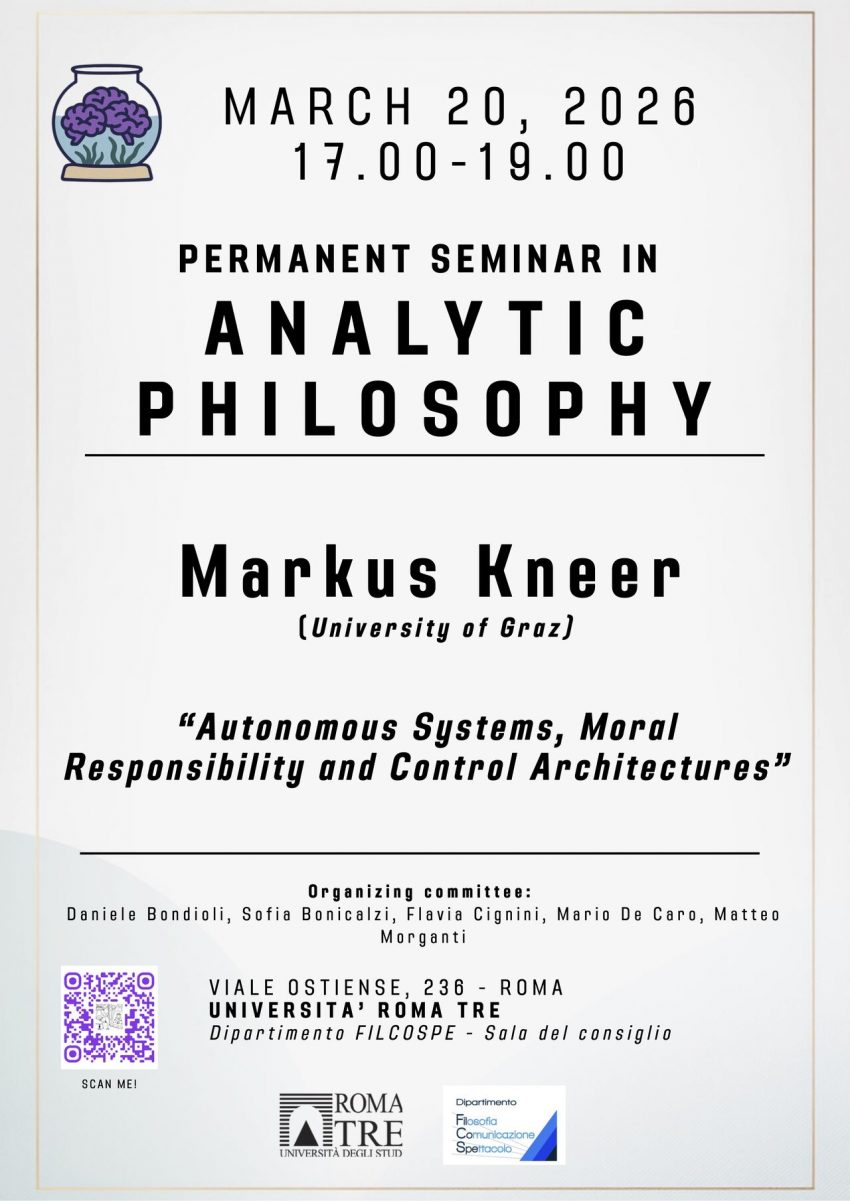
On March 20, from 17:00–19:00 (UTC+1), the Permanent Seminar in Analytic Philosophy (PSAP) of Università Roma Tre will host a talk by Markus Kneer about “Autonomous Systems, Moral Responsibility and Control Architectures.” The hybrid session can be accessed via Teams. The abstract reads:
Matthias (2004) and Sparrow (2007) have argued that the use of self-learning systems can engender “responsibility gaps” – situations in which nobody is morally responsible for a potential harm. In this talk, I will present empirical evidence as to whether laypeople are sensitive to such alleged “responsibility gaps” or whether their retributive dispositions might get in the way (see Danaher, 2016). I will also present new data concerning the question whether we can avoid such situations by imposing tight control architectures to ensure meaningful human control (see e.g. “human-in-the-loop v. on-the-loop,” Docherty, 2012; “tracking & tracing,” Santoni de Sio & van den Hoven, 2018).
As part of the IHPST’s Séminaire PhilSciCog at the Université Paris 1 Panthéon-Sorbonne, Véronique Izard will talk about “Cognitive Foundations of Geometry” on March 26, 2026, from 15:00–16:30 (UTC+1). The hybrid session can be accessed via Zoom (Meeting ID: 950 6108 6376, Code: 535047). The abstract reads:
From the first months of life, young children can perceive numeric quantities and perform additive or multiplicative operations on quantities. These abilities support the acquisition of number concepts later in life, and have been proposed to enable humans’ arithmetic cognition. What about geometry, another major branch of mathematics? In this talk, I will present two recent studies assessing the scope and the limits of human geometric intuition. The first study focused on Euclidean geometry, and found that children and adults encode a rich repertoire of geometric properties, at several levels of abstraction. The second study probed intuitions for non-Euclidean geometry and revealed the existence of a pervasive Euclidean bias in adults, identifying limits to the flexibility of human geometric intuition.