The Experimental Philosophy Blog

Philosophy Meets Empirical Research

Menu
  • Home
  • About
  • Guidelines for Comments
  • Labs and Organizations
  • Resources
Menu

Tag: Distributive Justice

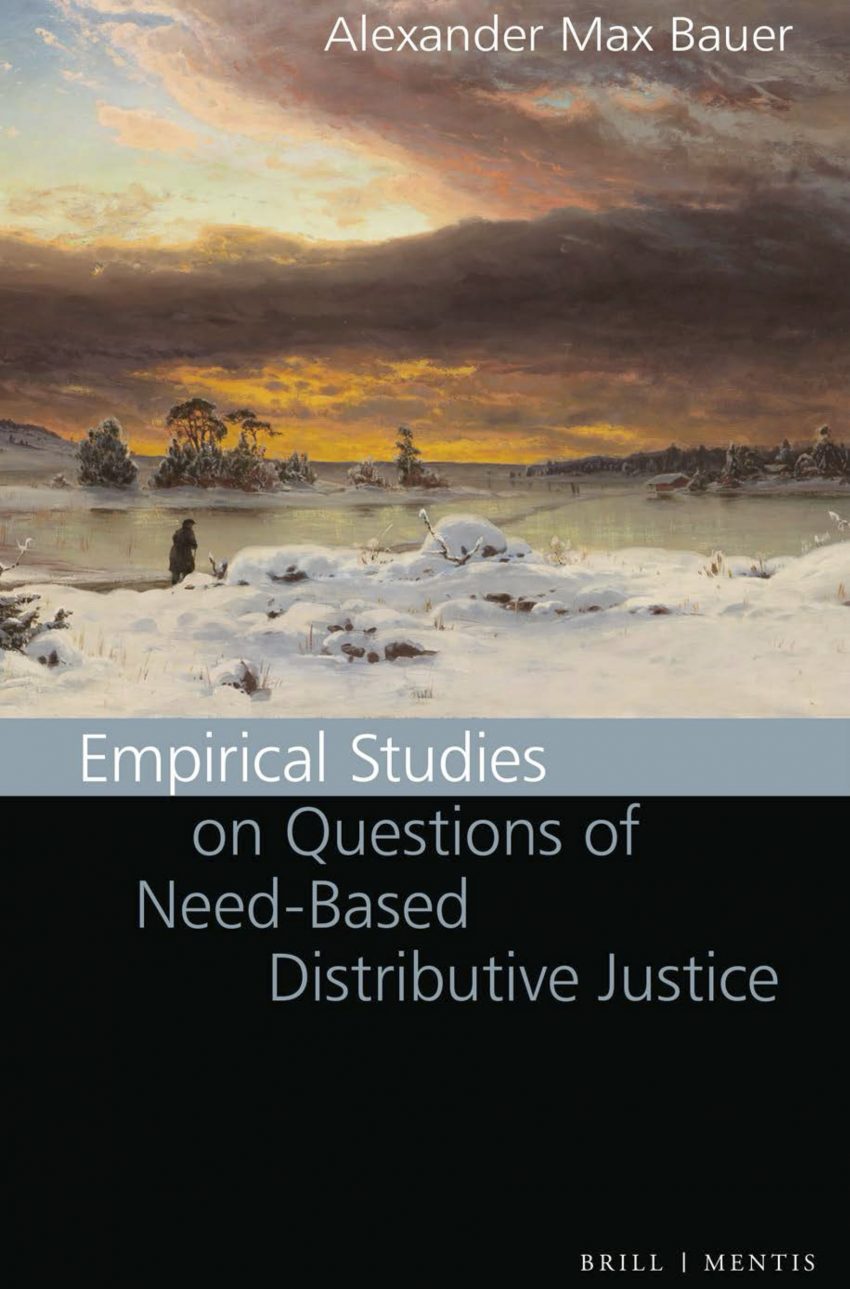
Hot Off The Press: “Empirical Studies on Questions of Need-Based Distributive Justice”

Posted on October 8, 2025October 8, 2025 by Alexander Max Bauer

In “Empirical Studies on Questions of Need-Based Distributive Justice” (the English translation of last year’s “Empirische Studien zu Fragen der Bedarfsgerechtigkeit”), I recap a series of vignette studies that examine the role that needs play in dealing with problems of distributive justice. As I summarised in last year’s post:

Among other things, the following becomes clear:

  1. Impartial observers make gradual assessments of the fairness of distributions.
  2. These assessments depend on how well an individual is supplied with a relevant good.
  3. If information on a need threshold is given, these assessments are made relative to this reference point. (Bauer et al. 2023a [later published as Bauer et al. 2025])
  4. Impartial decision-makers consider need, productivity, and accountability when making hypothetical distribution decisions.
  5. If an individual’s productivity is not sufficient to cover their needs, these higher needs are partially compensated for (at the expense of other individuals who are not so badly off)
  6. Willingness to compensate decreases if an individual is accountable for having produced less or for needing more. (Bauer et al. 2022)
  7. Both impartial observers and impartial decision-makers attribute different levels of importance to different kinds of needs.
  8. This reveals a hierarchy of needs in the following order: Survival, Decency, Belonging, Autonomy. (Bauer et al. 2023b)

Literature

Bauer, Alexander Max, Frauke Meyer, Jan Romann, Mark Siebel, and Stefan Traub (2022): “Need, Equity, and Accountability. Evidence on Third-Party Distribution Decisions from a Vignette Study,” Social Choice and Welfare 59, 769–814. (Link)

Bauer, Alexander Max, Adele Diederich, Stefan Traub, and Arne Robert Weiss (2023a): “When the Poorest Are Neglected. A Vignette Experiment on Need-Based Distributive Justice,” SSRN Working Paper 4503209. (Link)

Bauer, Alexander Max, Jan Romann, Mark Siebel, and Stefan Traub (2023b): “Winter is Coming. How Laypeople Think About Different Kinds of Needs,” PLoS ONE 18 (11), e0294572. (Link)

Bauer, Alexander Max (2024): Empirische Studien zu Fragen der Bedarfsgerechtigkeit, Oldenburg: University of Oldenburg Press. (Link)

Bauer, Alexander Max (2025): Empirical Studies on Questions of Need-Based Distributive Justice, Paderborn: mentis. (Link)

Bauer, Alexander Max, Adele Diederich, Stefan Traub, and Arne Robert Weiss (2025): “Thinking About Need. A Vignette Experiment on Need-Based Distributive Justice,” The Journal of Economic Inequality 23 (3), 667–693. (Link)

Conference: “Basel-Oxford-NUS BioXPhi Summit”

Posted on June 7, 2025June 8, 2025 by Alexander Max Bauer

The 2025 “Basel-Oxford-NUS BioXPhi Summit,” organized by Tenzin Wangmo, Brian D. Earp, Carme Isern, Christian Rodriguez Perez, Emilian Mihailov, Ivar Rodriguez Hannikainen, and Kathryn Francis, will take place from June 26 to 27 at the University of Basel, Switzerland.

The program consists of 15 talks and seven posters, framed by two keynotes.

June 26, 8:30–17:30 (UTC+2)

  • Matti Wilks (University of Edinburgh): “Who Has an Expansive Moral Circle? Understanding Variability in Ascriptions of Moral Concern”
  • Eliana Hadjiandreou (University of Texas at Austin): “The Stringent Moral Circle – Self-Other Discrepancies in the Perceived Expansion of Moral Concern”
  • Daniel Martín (University of Granada): “Mapping the Moral Circle with Choice and Reaction Time Data”
  • Neele Engelmann (Max Planck Institute for Human Development): “Understanding and Preventing Unethical Behavior in Delegation to AI”
  • Yuxin Liu (University of Edinburgh): “An Alternative Path to Moral Bioenhancement? AI Moral Enhancement Gains Approval but Undermines Moral Responsibility”
  • Faisal Feroz (National University of Singapore): “Outsourcing Authorship – How LLM-Assisted Writing Shapes Perceived Credit”
  • Jonathan Lewis (National University of Singapore): “How Should We Refer to Brain Organoids and Human Embryo Models? A Study of the Effects of Terminology on Moral Permissibility Judgments”
  • Sabine Salloch (Hannover Medical School): “Digital Bioethics – Theory, Methods and Research Practice”
  • Markus Kneer (University of Graz): “Partial Aggregation in Complex Moral Trade-Offs”

June 27, 8:30–16:30 (UTC+2)

  • Federico Burdman (Alberto Hurtado University) and Maria Fernanda Rangel (University of California, Riverside): “Not in Control but Still Responsible – Lay Views on Control and Moral Responsibility in the Context of Addiction”
  • Vilius Dranseika (Jagiellonian University): “Gender and Research Topic Choice in Bioethics and Philosophy of Medicine”
  • Jodie Russell (University of Birmingham): “Sartre and Psychosis – Doing Intersectional, Phenomenological Interviews with People with Experience of Mental Disorder”
  • Aníbal M. Astobiza (University of Granada): “Spanish Healthcare Professionals’ Trust in AI – A BioXPhi Study”
  • Nick Byrd (Geisinger College of Health Science): “Reducing Existential Risk by Reducing the Allure of Unwarranted Antibiotics – Two Low-Cost Interventions”
  • Rana Qarooni (University of Edinburgh; University of York): “Prevalence of Omnicidal Tendencies”
  • Lydia Tsiakiri (Aarhus University): “Responsibility-Sensitive Healthcare Allocation – Neutrally or Wrongfully Discriminatory?”
  • Edmond Awad (University of Exeter; University of Oxford): “Online Serious Games as a Tool to Study Value Disagreement”

For more information about the conference, visit https://ibmb.unibas.ch/en/public-outreach/projects-to-the-public/basel-oxford-nus-bioxphi-summit-2025/.

Hot Off The Press: “Priority of Needs?”

Posted on July 9, 2024January 3, 2025 by Alexander Max Bauer

Members of the interdisciplinary research group “Need-Based Justice and Distribution Procedures,” funded by the German Research Foundation, have summarized the results of more than six years of research in the volume “Priority of Needs? An Informed Theory of Need-Based Justice,” edited by Bernhard Kittel and Stefan Traub. The research group’s mission statement reads:

The objective of the research group “Need-Based Justice and Distribution Procedures” is to empirically contribute to establishing a positive and informed normative theory of need-based justice. This theory should provide answers to four questions: (i) How do individuals identify their needs and which distributions are considered sufficient for those needs? (ii) On the collective level, what is considered need-based justice and which processes lead to acceptance of those needs? (iii) Which collective dynamics unfold during this acceptance process in the context of (un-)stable political compromises? (iv) Which incentive-based effects of the collective level can be observed on the individual level, and is a need-based redistribution sustainable?

See below for the table of contents.

Part 1 – Identification of Needs

  • Adele Diederich: “Need as One Distribution Principle – Frames and Framing”
  • Alexander Max Bauer and Mark Siebel: “Measuring Need-Based Justice – Empirically and Formally”

Part 2 – Structures and Processes of the Recognition of Needs

  • Bernhard Kittel: “The Social Recognition of Needs”
  • Markus Tepe and Nils Springhorn: “The Political Recognition of Needs”
  • Tanja Pritzlaff-Scheele, Patricia F. Zauchner, and Frank Nullmeier: “Deliberation and Need-Based Distribution”

Part 3 – Welfare Consequences of Prioritizing Need-Based Distributions

  • Andreas Nicklisch: “Need-Based Justice and Social Utility – A Preference Approach”
  • Stefan Traub, Jan Philipp Krügel, and Meike Benker: “How Sustainable is Need-Based Redistribution?”

Part 4 – Differentiation

  • Kai-Uwe Schnapp: “Need and Street-Level Bureaucracy – How Street-Level Bureaucrats Understand and Prioritize Need”
  • Adele Diederich and Marc Wyszynski: “Justice Principles, Prioritization in the Healthcare Sector, and the Effect of Framing”

Literature

Kittel, Bernhard, and Stefan Traub (eds.) (2024): Priority of Needs? An Informed Theory of Need-Based Justice, Cham: Springer. (Link)

Hot Off The Press: “Oxford Studies in Experimental Philosophy”

Posted on July 6, 2024January 3, 2025 by Alexander Max Bauer

Volume 5 of the “Oxford Studies in Experimental Philosophy,” edited by Joshua Knobe and Shaun Nichols, just hit the shelves! It comprises a total of 16 chapters on no less than 480 pages. See below for the table of contents.

  • Alexander Max Bauer and Jan Romann: “Equal Deeds, Different Needs”
  • John Bronsteen, Brian Leiter, Jonathan Masur, and Kevin Tobia: “The Folk Theory of Well-Being”
  • Shannon Brick: “Deference to Moral Testimony and (In)Authenticity”
  • Florian Cova: “Calibrating Measures of Folk Objectivism”
  • Justin Sytsma: “Resituating the Influence of Relevant Alternatives”
  • Samuel Murray, Elise Dykhuis, and Thomas Nadelhoffer: “Do People Understand Determinism? The Tracking Problem for Measuring Free Will Beliefs”
  • Natalja Deng, Andrew J. Latham, Kristie Miller, and James Norton: “Investing the Three Ts of Present-Bias – Telic Attitudes, Temporal Preferences and Temporal Ontology”
  • Blake McAllister, Ian Church, Paul Rezkalla, and Long Nguyen: “Empirical Challenges to the Evidential Problem of Evil”
  • Eric Mandelbaum, Jennifer Ware, and Steven Young: “The Sound of Slurs – Bad Sounds for Bad Words”
  • Rebecca Zhu, Mariel Goddu, and Alison Gopnik: “Providing Explanations Shifts Preschoolers’ Metaphor Preferences”
  • Adrian Ziólkowski and Tomasz Zyglewicz: “Truth-Conditional Variability of Color Ascriptions”
  • Joshua Alexander and Jonathan M. Weinberg: “Practices Make Perfect – On Minding Methodology When Mooting Metaphilosophy”
  • Nat Hansen, Kathryn Francis, and Hamish Greening: “Socratic Questionnaires”
  • N. Ángel Pinillos: “Bank Cases, Stakes and Normative Facts”
  • Jon Bebb and Helen Beebee: “Causal Selection and Egalitarianism”
  • Kevin Reuter: “Experimental Philosophy of Consciousness”

Literature

Knobe, Joshua, and Shaun Nichols (eds.) (2024): Oxford Studies in Experimental Philosophy, volume 5, Oxford: Oxford University Press. (Link)

Hot Off The Press: “Empirische Studien zu Fragen der Bedarfsgerechtigkeit”

Posted on March 19, 2024October 8, 2025 by Alexander Max Bauer

Needs are something that fundamentally defines us as human beings. In “Empirische Studien zu Fragen der Bedarfsgerechtigkeit” (Empirical Studies on Questions of Need-Based Distributive Justice), I recap a series of vignette studies that examine the role that needs play in dealing with problems of distributive justice. While needs are often underrepresented in discussions of distributive justice, they are shown to have a fundamental importance in people’s thinking.

Among other things, the following becomes clear:

  1. Impartial observers make gradual assessments of the fairness of distributions.
  2. These assessments depend on how well an individual is supplied with a relevant good.
  3. If information on a need threshold is given, these assessments are made relative to this reference point. (Bauer et al. 2023a)
  4. Impartial decision-makers consider need, productivity, and accountability when making hypothetical distribution decisions.
  5. If an individual’s productivity is not sufficient to cover their needs, these higher needs are partially compensated for (at the expense of other individuals who are not so badly off)
  6. Willingness to compensate decreases if an individual is accountable for having produced less or for needing more. (Bauer et al. 2022)
  7. Both impartial observers and impartial decision-makers attribute different levels of importance to different kinds of needs.
  8. This reveals a hierarchy of needs in the following order: Survival, Decency, Belonging, Autonomy. (Bauer et al. 2023b)

Literature

Bauer, Alexander Max, Frauke Meyer, Jan Romann, Mark Siebel, and Stefan Traub (2022): “Need, Equity, and Accountability. Evidence on Third-Party Distribution Decisions from a Vignette Study,” Social Choice and Welfare 59, 769–814. (Link)

Bauer, Alexander Max, Adele Diederich, Stefan Traub, and Arne Robert Weiss (2023a): “When the Poorest Are Neglected. A Vignette Experiment on Need-Based Distributive Justice,” SSRN Working Paper 4503209. (Link)

Bauer, Alexander Max, Jan Romann, Mark Siebel, and Stefan Traub (2023b): “Winter is Coming. How Laypeople Think About Different Kinds of Needs,” PLoS ONE 18 (11), e0294572. (Link)

Bauer, Alexander Max (2024): Empirische Studien zu Fragen der Bedarfsgerechtigkeit, Oldenburg: University of Oldenburg Press. (Link)

Search

Categories

Tags

Agency Artificial Intelligence Basic Needs Behavior Beliefs Bias Bioethics Blame Causation Cognitive Science Consciousness Corpus Analysis Cross-Cultural Research Decisions Determinism Distributive Justice Emotions Essentialism Expertise Folk Morality Framing Free Will Gender Intention Intuition Jurisprudence Knowledge Large Language Models Moral Psychology Norms Pejoratives Problem of Evil Psycholinguistics Rationality Reasoning Replication Responsibility Self Side-Effect Effect Slurs Truth Valence Values Virtue Well-Being

Recent Posts

  • Call: “The Armchair on Trial”
  • Call: “Interdisciplinary Perspectives on Linguistic Justice”
  • Call: “6th European Experimental Philosophy Conference”
  • Talk: “Ethics in the Lab” (Pascale Willemsen)
  • Talk: “Normality and Norms” (Josh Knobe)

Recent Comments

  1. Nova Praxis on The Folk Concept of ArtJuly 11, 2025

    This article highlights an important point: everyday people don’t rely on rigid definitions to determine what qualifies as art. They’re…

  2. Koen Smets on Priming Effects Are Fake, but Framing Effects Are RealMay 27, 2025

    That is indeed exactly the question I have as well. I operationalize it as having de facto contradicting intuitions, in…

  3. Joshua Knobe on Priming Effects Are Fake, but Framing Effects Are RealMay 24, 2025

    Hi Koen, Thanks once again. This idea brings up all sorts of fascinating questions, but for the purposes of the…

  4. Koen Smets on Priming Effects Are Fake, but Framing Effects Are RealMay 24, 2025

    Great! In the meantime I thought of another potentially interesting example of framing—Arnold Kling’s Three Languages of Politics. Just about…

  5. Joshua Knobe on Priming Effects Are Fake, but Framing Effects Are RealMay 23, 2025

    Thanks Koen! This is all super helpful.

Archives

  • February 2026
  • January 2026
  • December 2025
  • November 2025
  • October 2025
  • September 2025
  • August 2025
  • July 2025
  • June 2025
  • May 2025
  • April 2025
  • March 2025
  • February 2025
  • January 2025
  • December 2024
  • November 2024
  • October 2024
  • September 2024
  • August 2024
  • July 2024
  • June 2024
  • May 2024
  • April 2024
  • March 2024

Meta

  • Log in
  • Entries feed
  • Comments feed
  • WordPress.org

Imprint • Disclaimer • Privacy Statement • Cookie Policy

© 2024 The Experimental Philosophy Blog
Manage Consent
To provide the best experiences, we use technologies like cookies to store and/or access device information. Consenting to these technologies will allow us to process data such as browsing behavior or unique IDs on this site. Not consenting or withdrawing consent, may adversely affect certain features and functions.
Functional Always active
The technical storage or access is strictly necessary for the legitimate purpose of enabling the use of a specific service explicitly requested by the subscriber or user, or for the sole purpose of carrying out the transmission of a communication over an electronic communications network.
Preferences
The technical storage or access is necessary for the legitimate purpose of storing preferences that are not requested by the subscriber or user.
Statistics
The technical storage or access that is used exclusively for statistical purposes. The technical storage or access that is used exclusively for anonymous statistical purposes. Without a subpoena, voluntary compliance on the part of your Internet Service Provider, or additional records from a third party, information stored or retrieved for this purpose alone cannot usually be used to identify you.
Marketing
The technical storage or access is required to create user profiles to send advertising, or to track the user on a website or across several websites for similar marketing purposes.
  • Manage options
  • Manage services
  • Manage {vendor_count} vendors
  • Read more about these purposes
View Preferences
  • {title}
  • {title}
  • {title}