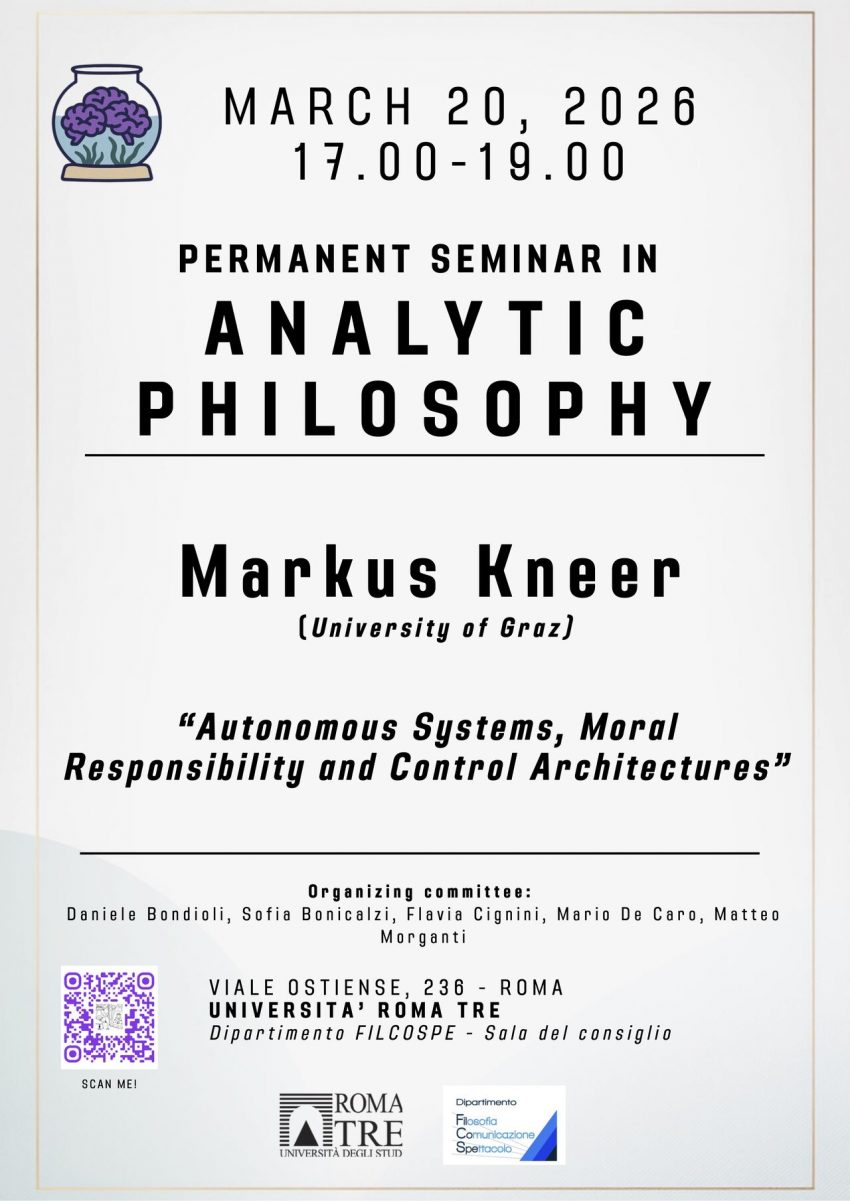
On March 20, from 17:00–19:00 (UTC+1), the Permanent Seminar in Analytic Philosophy (PSAP) of Università Roma Tre will host a talk by Markus Kneer about “Autonomous Systems, Moral Responsibility and Control Architectures.” The hybrid session can be accessed via Teams. The abstract reads:
Matthias (2004) and Sparrow (2007) have argued that the use of self-learning systems can engender “responsibility gaps” – situations in which nobody is morally responsible for a potential harm. In this talk, I will present empirical evidence as to whether laypeople are sensitive to such alleged “responsibility gaps” or whether their retributive dispositions might get in the way (see Danaher, 2016). I will also present new data concerning the question whether we can avoid such situations by imposing tight control architectures to ensure meaningful human control (see e.g. “human-in-the-loop v. on-the-loop,” Docherty, 2012; “tracking & tracing,” Santoni de Sio & van den Hoven, 2018).
In a previous post, I wrote about a course (which I taught together with Stephan Kornmesser in the summer term of 2024) for master’s students who had no previous contact with X-Phi at all. After learning some methodological and statistical basics and conducting their own small replication of Knobe (2003), they had the opportunity to develop their own questions and conduct their very own studies in small groups. Below, Frederike Lüttich and Jule Rüterbories present some results from their study on the perception of responsibility in accidents involving autonomous and human-controlled vehicles.
The Perception of Responsibility in Accidents Involving Autonomous and Human-Controlled Vehicles
Frederike Lüttich and Jule Rüterbories
The relevance of autonomous systems as potential moral agents is growing with their use in areas such as medicine, the military, and traffic, where they have – or will have – to make decisions in ethical contexts. The capacity of such systems to act has far-reaching legal and ethical implications. A frequently discussed example (see, e.g., Goodall 2014, Awad et al. 2018, Cecchini, Brantley, and Dubljević 2023) is this one: Although autonomous vehicles promise greater safety, they are not flawless. In the event of unavoidable accidents, they have to make decisions about which lives to protect. The programming of such systems is complex and raises key ethical questions. Below, we examine the perception of responsibility in accidents involving autonomous and human-controlled vehicles.
To investigate this, we created an online questionnaire in which we presented a vignette about a car and a pedestrian at a traffic light. Between subjects, we varied (a) whether the car was operated autonomously or was human-driven, (b) whether it hit the pedestrian or swerved and crashed into a wall (the outcome is deadly either for the pedestrian or for the driver), and (c) whether the pedestrian (rightfully) used a crosswalk or illegally crossed a red traffic light. This resulted in a total of eight different combinations, as shown in Table 1.
Behavior of Pedestrian / Car
Hits Pedestrian
Hits Wall
Legally Uses Crosswalk
1
2
Illegally Crosses Red Light
3
4
Table 1: Between-subjects variations (presented either with an autonomous or human-driven car)
Here is a translation of the vignette for variation 1 with a self-driving car:
Imagine standing on a foggy main road and observing the following scenario: A self-driving car is driving at approximately 50 km/h towards a traffic light, which is being crossed by a woman illegally on red. The self-driving car’s sensors notice the woman too late, and it is unable to brake. The self-driving car could swerve. In doing so, it would surely hit a house wall and be completely destroyed. The self-driving car does not swerve and hits the woman. The woman dies.
After reading the vignette, participants were asked to answer the following yes-or-no question: “Is the self-driving car [the person driving] morally responsible?” At the end of the survey, and after passing an attention check, participants provided socio-demographic data, including gender, age, and level of education.
420 participants successfully passed the attention check and completed the survey. 209 women, 210 men, and one non-binary person took part. Their age ranged from 18 to 74 years, averaging 52 years. According to their statements, two people had no school-leaving qualifications, 195 had a lower secondary school leaving certificate, 95 had a technical college or university entrance qualification, 113 had a university degree, seven had a doctorate, and eight were currently studying.
Let us compare cases with (a) autonomously or human-driven cars, (b) the pedestrian or the wall being hit, and (c) the pedestrian (legally) using a crosswalk or (illegally) crossing a red traffic light.
Regarding (a), 56% of participants do not attribute responsibility to the autonomous vehicle, while 42% consider the human driver not to be responsible (χ² ≈ 7.942, p < 0.01); see Figure 1.
Figure 1: Self-driving car vs. human-driven car
Regarding (b), if the pedestrian dies, 70% of participants say that the car or driver is responsible. If the driver dies, the attribution of responsibility drops to 34% (χ² ≈ 46.662, p < 0.001); see Figure 2.
Figure 2: Pedestrian dies vs. driver dies
And finally, regarding (c), in scenarios where the pedestrian illegally crosses the road at a red light, 54% do not think the car or driver is responsible. If the pedestrian legally uses a crosswalk, this drops to 43% (χ² ≈ 5.002, p < 0.05); see Figure 3.
Figure 3: Illegally crossing vs. legally crossing
The attribution of responsibility is complex and highly dependent on the situation. The results show that responsibility is attributed more often to human-controlled vehicles than autonomous ones. Factors such as compliance with traffic regulations and the person affected by the crash further influence this.
To gain more detailed insights in the future, open questions and alternative scenarios would be useful. Demographic data could have revealed additional differences in age, gender, and education. The study was limited to German participants, so possible cultural differences were not considered. Also, a basic understanding of machine ethics and automation levels is essential to grasp the ethical and technical challenges of autonomous vehicles fully. Further studies should explore these aspects in more depth.
Awad, Edmond, Sohan Dsouza, Richard Kim, Jonathan Schulz, Joseph Henrich, Azim Shariff, Jean-François Bonnefon, and Iyad Rahwan (2018): “The Moral Machine Experiment,” Nature 563, 59–64. (Link)
Cecchini, Dario, Sean Brantley, and Veljko Dubljević (2023): “Moral Judgment in Realistic Traffic Scenarios. Moving Beyond the Trolley Paradigm for Ethics of Autonomous Vehicles,” AI & Society. (Link)
Gogoll, Jan, and Julian Müller (2016): “Autonomous Cars. In Favor of a Mandatory Ethics Setting,” Science and Engineering Ethics 23 (3), 681–700. (Link)
Knobe, Joshua (2003): “Intentional Action and Side Effects in Ordinary Language,” Analysis 63 (3), 190–194. (Link)
From October 25 to 26, the workshop “Methodological Trends and Challenges in Contemporary Philosophy,” organized by Martin Justin, Maja Malec, Olga Markič, Nastja Tomat, and Borut Trpin, will take place at the University of Ljubljana, Slovenia. The announcement reads:
Contemporary analytic philosophers have expanded their methodological toolkit beyond traditional philosophical inquiry, embracing a wide array of approaches that intersect with various disciplines. These methods include (but are not limited to) experimental approaches, which involve empirical testing and data collection to inform philosophical hypotheses; non-idealized and naturalized epistemology, which considers the real-world complexities of knowledge acquisition and justification; computer simulations and probabilistic modeling, which enable philosophers to explore complex systems and uncertainties in reasoning; neuroscientific methods, which offer insights into the neural underpinnings of cognitive processes and decision-making; formal ontology, which provides rigorous frameworks for analyzing concepts and categories; conceptual engineering, which involves the deliberate design and modification of conceptual frameworks to address philosophical problems; evolutionary modeling, which investigates the emergence and evolution of cognitive capacities and norms; and feminist perspectives, which critically examine power dynamics and social structures in philosophical discourse.
The upcoming workshop aims to delve into these methodological trends, showcasing recent research that employs these diverse approaches and addressing the challenges and opportunities they present for contemporary philosophy. Over the course of two days, the workshop will feature a total of 14 talks, evenly distributed with 7 talks scheduled for each day. Each keynote talk will span 75 minutes, while contributed talks will be allocated 45 minutes. This workshop seeks to enrich our understanding of contemporary philosophical inquiry and inspire new avenues of research.
October 25, 9:00–17:30 (UTC+2)
Jan Sprenger (University of Turin): “Semantic Modeling between Empirical Data and Norms of Rationality”
Olga Markič (University of Ljubljana): “Roles of Philosopher in Interdisciplinary Research”
Timothy Tambassi (Ca’ Foscari University of Venice): “Is Extensible Markup Language Perspectivist?”
Thomas Engeland (University of Bonn): “What Would Methodological Naturalism in Ethics Be?”
Paweł Polak (Pontifical University of John Paul II in Krakow) and Roman Krzanowski (Pontifical University of John Paul II in Krakow): “Ethics in Silico – Computer Modeling of Ethical Concepts in Autonomous AI Systems”
Michal Hladky (University of Geneva): “End of Logical Positivism? #toosoon”
Rafal K. Stepien (Austrian Academy of Sciences): “The Absent Elephant – Non-Western Methods in Contemporary Philosophy”
October 26, 9:00–16:45 (UTC+2)
Borut Trpin (Ludwig Maximilian University of Munich, University of Maribor, and University of Ljubljana): “Revisiting Epistemic Coherence From A Posterior-Probability Perspective”
Martin Justin (University of Maribor): “The Value of Social Coherence in Science – An Agent-Based-Modelling Exploration”
Raimund Pils (University of Salzburg): “Integrating Empirical Research and Philosophical Theorizing on the Scientific Realism Debate for Science Reporting”
Juan de Jager (University of Ljubljana): “Making Porosity More Porous – An Open Call for Brainstorming After Tanya Luhrmann’s Recent Findings”
Danilo Šuster (University of Maribor): “Open-Mindedness and the Appeal to Ignorance”
Nastja Tomat (University of Ljubljana): “Bounded Epistemic Rationality as a Link Between the Normative and the Descriptive”
Dunja Šešelja (Ruhr University Bochum): “When Expert Judgment Fails – Epistemic Trespassing and Risks to Collective Inquiry”
Manage Consent
To provide the best experiences, we use technologies like cookies to store and/or access device information. Consenting to these technologies will allow us to process data such as browsing behavior or unique IDs on this site. Not consenting or withdrawing consent, may adversely affect certain features and functions.
Functional
Always active
The technical storage or access is strictly necessary for the legitimate purpose of enabling the use of a specific service explicitly requested by the subscriber or user, or for the sole purpose of carrying out the transmission of a communication over an electronic communications network.
Preferences
The technical storage or access is necessary for the legitimate purpose of storing preferences that are not requested by the subscriber or user.
Statistics
The technical storage or access that is used exclusively for statistical purposes.The technical storage or access that is used exclusively for anonymous statistical purposes. Without a subpoena, voluntary compliance on the part of your Internet Service Provider, or additional records from a third party, information stored or retrieved for this purpose alone cannot usually be used to identify you.
Marketing
The technical storage or access is required to create user profiles to send advertising, or to track the user on a website or across several websites for similar marketing purposes.