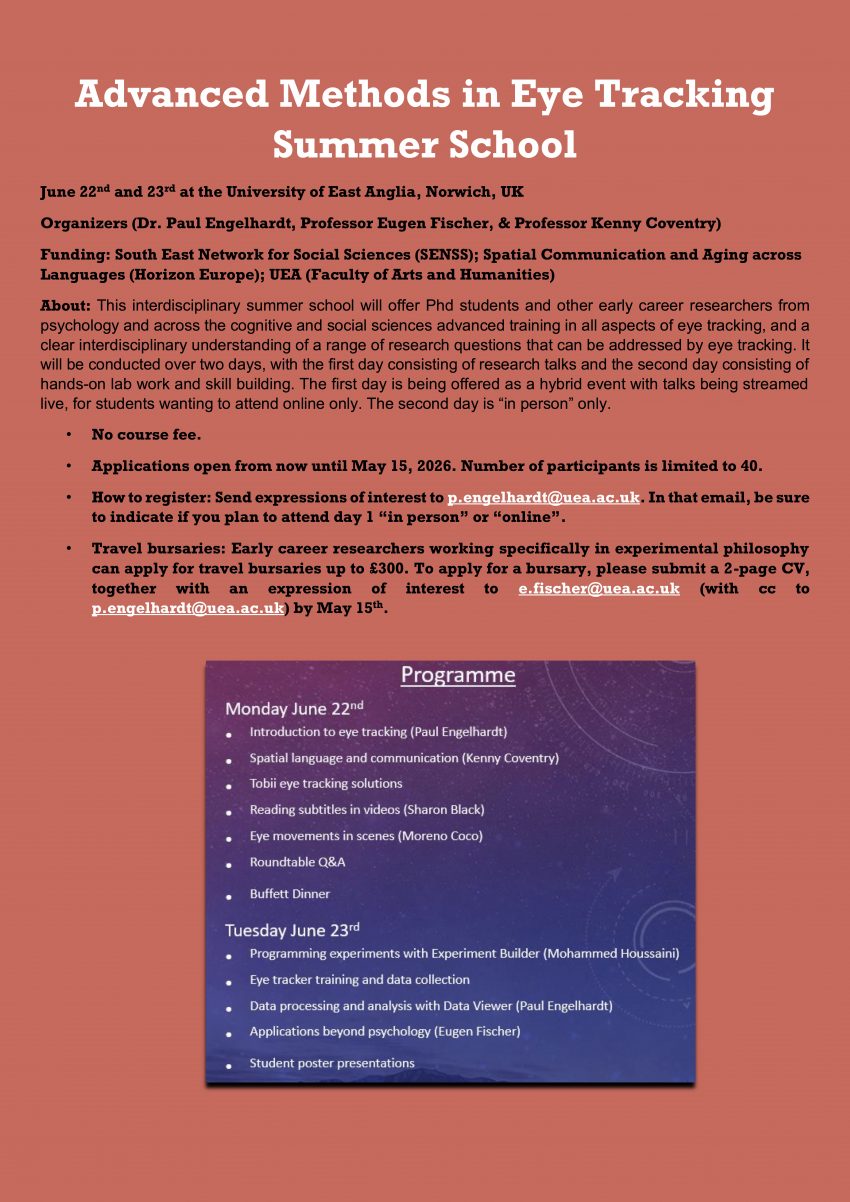
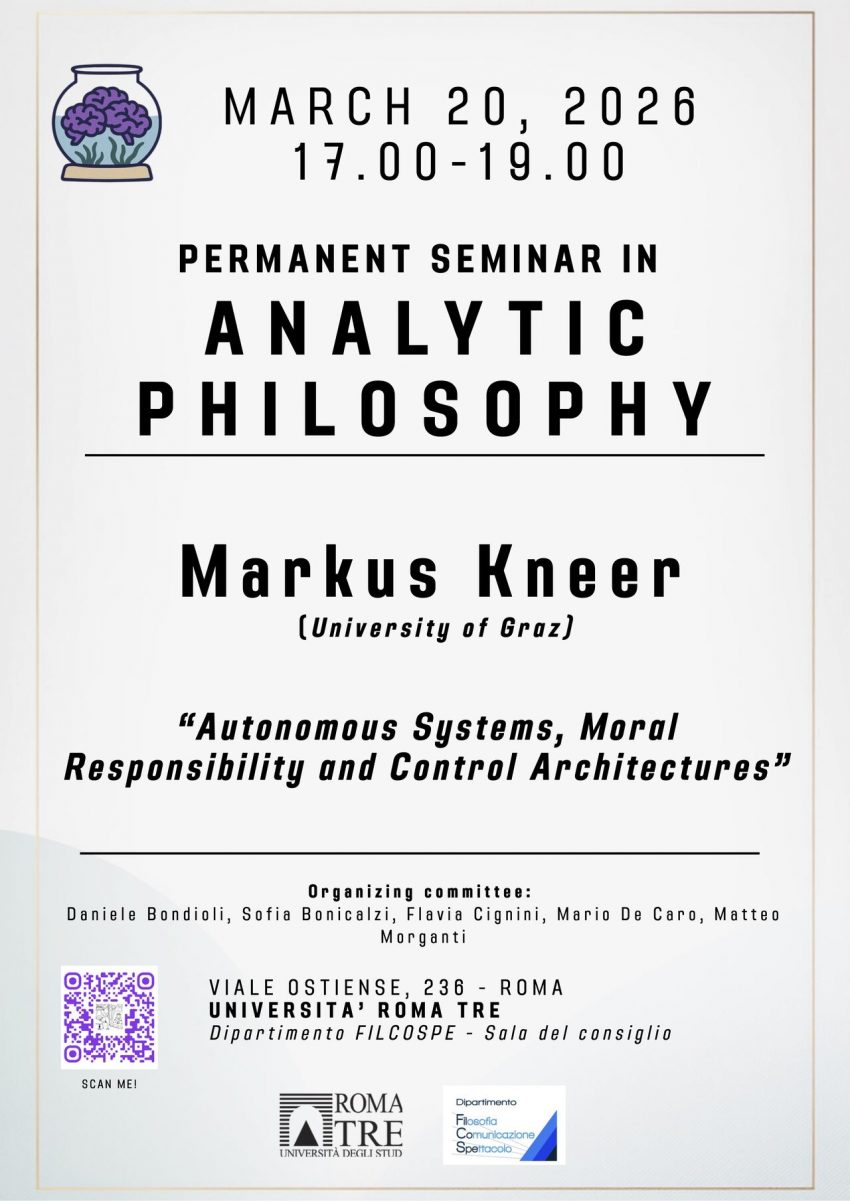
The “XPHI UK Work in Progress Workshop Series,” organized by James Andow and Eugen Fischer, continues. Anyone interested in presenting something can contact the organizers. They write:
We are delighted to announce the next series of our monthly online workshop devoted to discussion of work in progress in experimental philosophy. The workshop is usually held via Teams, the second Wednesday of each month, 16:00–18:00 UK time. Full details of 2025/26 season TBC.
The 2025 “Basel-Oxford-NUS BioXPhi Summit,” organized by Tenzin Wangmo, Brian D. Earp, Carme Isern, Christian Rodriguez Perez, Emilian Mihailov, Ivar Rodriguez Hannikainen, and Kathryn Francis, will take place from June 26 to 27 at the University of Basel, Switzerland.
The program consists of 15 talks and seven posters, framed by two keynotes.
June 26, 8:30–17:30 (UTC+2)
Matti Wilks (University of Edinburgh): “Who Has an Expansive Moral Circle? Understanding Variability in Ascriptions of Moral Concern”
Eliana Hadjiandreou (University of Texas at Austin): “The Stringent Moral Circle – Self-Other Discrepancies in the Perceived Expansion of Moral Concern”
Daniel Martín (University of Granada): “Mapping the Moral Circle with Choice and Reaction Time Data”
Neele Engelmann (Max Planck Institute for Human Development): “Understanding and Preventing Unethical Behavior in Delegation to AI”
Yuxin Liu (University of Edinburgh): “An Alternative Path to Moral Bioenhancement? AI Moral Enhancement Gains Approval but Undermines Moral Responsibility”
Faisal Feroz (National University of Singapore): “Outsourcing Authorship – How LLM-Assisted Writing Shapes Perceived Credit”
Jonathan Lewis (National University of Singapore): “How Should We Refer to Brain Organoids and Human Embryo Models? A Study of the Effects of Terminology on Moral Permissibility Judgments”
Sabine Salloch (Hannover Medical School): “Digital Bioethics – Theory, Methods and Research Practice”
Markus Kneer (University of Graz): “Partial Aggregation in Complex Moral Trade-Offs”
June 27, 8:30–16:30 (UTC+2)
Federico Burdman (Alberto Hurtado University) and Maria Fernanda Rangel (University of California, Riverside): “Not in Control but Still Responsible – Lay Views on Control and Moral Responsibility in the Context of Addiction”
Vilius Dranseika (Jagiellonian University): “Gender and Research Topic Choice in Bioethics and Philosophy of Medicine”
Jodie Russell (University of Birmingham): “Sartre and Psychosis – Doing Intersectional, Phenomenological Interviews with People with Experience of Mental Disorder”
Aníbal M. Astobiza (University of Granada): “Spanish Healthcare Professionals’ Trust in AI – A BioXPhi Study”
Nick Byrd (Geisinger College of Health Science): “Reducing Existential Risk by Reducing the Allure of Unwarranted Antibiotics – Two Low-Cost Interventions”
Rana Qarooni (University of Edinburgh; University of York): “Prevalence of Omnicidal Tendencies”
A five-horse race is about to start. The probabilities that each horse will win are:
Ajax: 40%
Benji: 38%
Cody: 18%
Dusty: 3%
Ember: 1%
Can you guess who will win?
There are several reasonable guesses you could make. For example, “Ajax” is a good guess, but “Ajax or Benji or Cody” is fine too. But some guesses, like “Cody or Ember,” are terrible.
What are the norms that govern guessing in this kind of context? Philosophers have become interested in that question recently (e.g., Holguín 2022, Dorst and Mandelkern 2022, Linnemann and Azhar 2025; our opening example is from Skipper 2023). It is a surprisingly rich question, because the answer does not obviously fall out of standard probability theory. For example, “Ajax or Ember” is a terrible guess, but the probability that either Ajax or Ember will win is higher than the probability that Ajax will win, and “Ajax” is a great guess.
With my colleagues Neil Bramley and Chris Lucas, I recently collected experimental data on how people guess. Our task was very simple. Participants looked at a box with colored balls, like this one:
Then we asked them to guess what color would come out if someone drew a ball at random. They could compose their guess by clicking on four buttons:
For example, to compose the guess “red or green,” you would click on “Red” and then “Green.” You could include any number of colors from one to four in your guess.
Here are the results! In this figure, each panel displays data for a different box. The numbers above the panel represent the proportion of colors – for example, “6 4 1 1” would correspond to the box shown above, with six red balls, four green balls, one blue, and one yellow ball.
We can see that for a box where all colors have equal proportions (3 3 3 3), almost all participants mention all colors (they guess, for example, “red or green or blue or yellow”). But for a box where one color dominates (9 1 1 1), most people only mention one color (for example, they guess “blue” if nine balls are blue). But between these two extremes, there is a lot of diversity in people’s guesses. For example, for the box “6 3 2 1,” about half of the participants mention one color, and half mention two colors.
Of course, the interesting question is whether theories of guessing proposed by philosophers can account for the data. We looked at an account by Kevin Dorst and Matt Mandelkern (2022). Abstracting from the mathematical details, their idea is that people want to make guesses that have a high probability of being true, but also do not mention too many possible outcomes. In other words, guessing is a trade-off between accuracy and specificity. The predictions from the theory are in green, alongside people’s data in white:
The theory fits the data pretty well.
Chris, Neil, and I also proposed another theory of how people might guess. Our idea is that a guess like “red or green” can be seen as implicitly encoding a probability distribution where red and green are both more probable outcomes than the other colors. And people make guesses that encode a distribution that is “close” to the actual distribution. So, if there are, for example, six red and four green balls in the box, the distribution encoded by “red and green” is close enough to the actual probability distribution that it is a good guess. The predictions from our theory are in purple:
The theory also gives a good account of the data. As you can see, the trade-off account and our account make fairly similar predictions. But there are some cases where they differ. For example, in the box “5 3 3 1,” we predict that people will either mention one color, or mention three colors. But the trade-off theory predicts that most people will mention two colors. Aligning with our prediction, people mostly mentioned either one or three colors. To see why this is an intuitive result, imagine a box with five red, three blue, and three yellow balls, as well as one green ball. It seems strange to guess “red or blue” in that context. According to our theory, this is because the guess “red or blue” encodes a distribution where blue is more likely than yellow, which isn’t the case here.
Of course, this is an active area of research, and other researchers might propose new theories of guessing in the future. Our data (freely available at https://osf.io/wz649/) give them a nice opportunity to see how their account compares with people’s intuitions.
Dorst, Kevin, and Matthew Mandelkern (2022): “Good Guesses,” Philosophy and Phenomenological Research 105(3), 581–618. (Link)
Holguín, Ben (2022): “Thinking, Guessing, and Believing,” Philosophers’ Imprint 22, 6. (Link)
Linnemann, Niels, and Feraz Azhar (2025): “Better Guesses,” Philosophy and Phenomenological Research 110(2), 661–686. (Link)
Quillien, Tadeg, Neil Bramley, and Christopher G. Lucas (forthcoming): “Lossy Encoding of Distributions in Judgment Under Uncertainty,” Cognitive Psychology. (Link)
A few decades ago, it was pretty common to mush together priming effects and framing effects and see them as two closely connected parts of a single Bigger Truth about the human mind. Of course, everyone understood that the effects themselves were a bit different, but one common view was that they were providing evidence for the same larger picture. That larger picture said: People’s judgments are radically unstable, easily pushed around by subtle and almost unnoticeable factors.
Things have changed so much since then. Priming research in social psychology has experienced a series of truly spectacular replication failures, while research on framing effects continues to look very solid. In light of this change, we should rethink our understanding of what framing effects show about human cognition. We shouldn’t see them as part of a larger picture that also includes priming. We need an understanding of framing that allows us to situate it within a larger picture, according to which priming effects are not real.
The priming literature seemed to be showing that people’s judgment and decision-making are highly unstable and can be easily shifted around by small manipulations of the external situation. The thought was that if you just happen to be holding a hot coffee, or sitting at a dirty desk, or in a room that includes a picture of dollar bills, your whole way of thinking about things will be shifted in some fundamental respect. For example, you will end up making deeply different moral judgments.
The key lesson of more recent research is simple: these priming effects do not occur. More generally, we cannot shift people’s moral judgments around in some radical way just by making subtle changes in their situation. Your moral judgments will not shift around completely if you are seated at a dirty desk. That is not how the human mind works.
Okay, with all of that in mind, let’s rethink framing effects. For concreteness, we can focus on a famous study from Tversky and Kahneman (1981). In this study, participants were randomly assigned to one of two conditions. Participants in the gain framing condition read the following case:
A disease is expected to kill 600 people. You can choose between two options:
If you choose the first option, 200 people will be saved.
If you choose the second option, there is one-third probability that 600 people will be saved and a two-thirds probability that 0 people will be saved.
Meanwhile, participants in the loss framing condition read:
A disease is expected to kill 600 people. You can choose between two options:
If you choose the first option, 400 people will die.
If you choose the second option, there is one-third probability that 0 people will die and a two-thirds probability that 600 people will die.
Clearly, the two descriptions are logically equivalent, but they tend to yield very different responses. Participants tend to be risk-averse in the first case, risk-seeking in the second.
During the heyday of priming research, many of us thought that this sort of effect should be understood within a larger picture of the mind that also included priming. Basically, the idea was something like this: “People’s judgments about a case can be shifted around but all sorts of little things, including everything from the decor in the room to the precise words used to describe it.” But in light of everything we know now, we need to revisit this view. Framing effects are very real, but that larger picture seems to be mistaken. We need to understand framing effects within a larger picture of the mind, according to which people’s judgments don’t just shift around randomly as a result of all sorts of little factors.
I’d be very open to different views about what the right picture is, but just as a first step in this direction, let’s consider a picture that emerges not from social psychology but rather from very traditional work in philosophy. This picture says that people often have a collection of different intuitions that are mutually inconsistent. These intuitions need not be unstable in any way. It might be that each individual intuition is completely stable; it’s just that the different intuitions contradict each other.
To illustrate, consider intuitions about free will. I might find myself having the following three intuitions: (a) All human behavior is completely explained by genes and environment, (b) If a person’s behavior is completely explained by genes and environment, that person’s behavior is not performed with free will, (c) Some human behaviors are performed with free will. These three intuitions are mutually inconsistent, so they cannot all be right. However, this does not mean that people’s free will intuitions have to be unstable in any way.
On the contrary, a single individual could easily have all three intuitions at the same time. For example, as a philosopher, I might start out a paper by explaining that each of these three claims seems intuitively to be true, that they are mutually inconsistent and hence cannot all be right, and that we therefore face an interesting philosophical problem. Alternatively, someone might simply have each of these three intuitions, but without noticing that they contradict each other. In such a case, the person would be failing to notice something important, but that would not mean that the person’s intuitions were unstable. Each of the three intuitions might be perfectly stable; it’s just that the three intuitions are not consistent.
Some philosophical problems seem to have very much the structure we see in framing effects. Consider the philosophical problem of moral luck. The problem starts with three intuitions: (a) An agent who doesn’t bring about any bad outcomes deserves relatively little blame, (b) An agent who performs the exact same behavior but who ends up bringing about a bad outcome deserves a lot of blame, (c) If the agent performs the exact same behavior in two cases and the only difference is in the outcome that ends up occurring, that difference by itself cannot be relevant to how much blame the agent deserves. I myself have all three of these intuitions. Since the intuitions are mutually inconsistent, they cannot all be right, but that does not mean that my intuitions are unstable. Each of the three intuitions is completely stable and emerges in all situations; it’s just that the three intuitions are in tension with each other.
Let’s now return to framing effects. In the days when it seemed like priming was real, I totally see why researchers would think that framing was a lot like priming. But in light of subsequent studies, maybe we should see it in a completely different way. Framing does not involve people’s judgments being unstable; it instead involves people having different intuitions that are mutually inconsistent.
Take the example described above. Looking at that example, I have the following three intuitions: (a) The correct answer in the first case is to take the non-risky option, (b) The correct answer in the second case is to take the risky option, and (c) It cannot possibly be the case that the correct answer in the first case is different from the correct answer in the second case. These three intuitions are mutually inconsistent, so they cannot all be right. However, each individual intuition can be perfectly stable. In fact, thinking about the problem right now, I find myself having all three intuitions at the same time.
Turning the traditional view about framing effects upside down, one might even see framing effects as an extreme case of stability. Just as we continue to experience a visual illusion even when we know that it is illusory, we continue to have the inconsistent intuitions that together constitute a framing effect even when we know that they cannot all be right.
[I discuss this issue in this paper, but please feel free to respond to this blog post even if you haven’t looked at the full paper.]
Barbara A. Spellman, Jennifer K. Robbennolt, Janice Nadler, and Tess Wilkinson-Ryan: “Psychology and Jurisprudence Across the Curriculum”
John Mikhail: “Holmes, Legal Realism, and Experimental Jurisprudence”
Frederick Schauer: “The Empirical Component of Analytic Jurisprudence”
Felipe Jiménez: “The Limits of Experimental Jurisprudence”
Jonathan Lewis: “Competing Conceptual Inferences and the Limits of Experimental Jurisprudence”
Joseph Avery, Alissa del Riego, and Patricia Sánchez Abril: “The Contours of Bias in Experimental Jurisprudence”
Christoph Bublitz: “Experimental Jurisprudence and Doctrinal Reasoning – A View from German Criminal Law”
Bert I. Huang: “Law and Morality”
Brian Sheppard: “Legal Constraint”
Part 2 – Introductions
Guilherme da Franca Couto Fernandes de Almeida, Noel Struchiner, and Ivar Hannikainen: “Rules”
James A. Macleod: “Surveys and Experiments in Statutory Interpretation”
Thomas R. Lee and Stephen C. Mouritsen: “Corpus Linguistics and Armchair Jurisprudence”
Meirav Furth-Matzkin: “Using Experiments to Inform the Regulation of Consumer Contracts”
Doron Dorfman: “Experimental Jurisprudence of Health and Disability Law”
Jessica Bregant, Jennifer K. Robbennolt, and Verity Winship: “Studying Public Perceptions of Settlement”
Benedikt Pirker, Izabela Skoczeń, and Veronika Fikfak: “Experimental Jurisprudence in International Law”
Heidi H. Liu: “The Law and Psychology of Gender Stereotyping”
Christian Mott: “The Experimental Jurisprudence of Persistence through Time”
Lukas Holste and Holger Spamann: “Experimental Investigations of Judicial Decision-Making”
Christoph Engel and Rima-Maria Rahal: “Eye-Tracking as a Method for Legal Research”
Jessica Bregant: “Intuitive Jurisprudence – What Experimental Jurisprudence Can Learn from Developmental Science”
Part 3 – Applications
Corey H. Allen, Thomas Nadelhoffer, Jason Shepard, and Eyal Aharoni: “Moral Judgments about Retributive Vigilantism”
Karolina M. Prochownik, Romy D. Feiertag, Joachim Horvath, and Alex Wiegmann: “How Much Harm Does It Take? An Experimental Study on Legal Expertise, the Severity Effect, and Intentionality Ascriptions”
Gabriel Lima and Meeyoung Cha: “Human Perceptions of AI-Caused Harm”
Christopher Brett Jaeger: “Reasonableness from an Experimental Jurisprudence Perspective”
Lucien Baumgartner and Markus Kneer: “The Meaning of ‘Reasonable’ – Evidence from a Corpus-Linguistic Study”
Roseanna Sommers: “Commonsense Consent and Action Representation – What is ‘Essential’ to Consent?”
Neele Engelmann and Lara Kirfel: “Who Caused It? Different Effects of Statistical and Prescriptive Abnormality on Causal Selection in Chains”
Ori Friedman: “Ownership for and Against Control”
Andrew Higgins and Inbar Levy: “Examining the Foundations of the Law of Judicial Bias – Expert versus Lay Perspectives on Judicial Recusal”
Jacqueline M. Chen and Teneille R. Brown: “The Promise and the Pitfalls of Mock Jury Studies – Testing the Psychology of Character Assessments”
Piotr Bystranowski, Ivar Hannikainen, and Kevin Tobia: “Legal Interpretation as Coordination”
Janet Randall and Lawrence Solan: “Legal Ambiguities – What Can Psycholinguistics Tell Us?”
Eric Martínez and Christoph Winter: “Cross-Cultural Perceptions of Rights for Future Generations”
Austin A. Baker and J. Remy Green: “The Right to Transgender Identity”
Enrique Cáceres, Christopher Stephens, Azalea Reyes-Aguilar, Daniel Atilano, Manuel García, Rosa Lidia López-Bejarano, Susana González, Carmen Patricia López-Olvera, Octavio Salvador-Ginez, and Margarita Palacios: “The Legal Conductome – The Complexity Behind Decisions”
Neil C. Thompson, Brian Flanagan, Edana Richardson, Brian McKenzie, and Xueyun Luo: “Trial by Internet – A Randomized Field Experiment on Wikipedia’s Influence on Judges’ Legal Reasoning”
Literature
Tobia, Kevin (ed.) (2025): The Cambridge Handbook of Experimental Jurisprudence, Cambridge and New York: Cambridge University Press. (Link)
Imagine a universe in which everything that happens is completely caused by the things that happened before. Suppose, for example, that Mia has a bagel for breakfast. Her act of having a bagel for breakfast would be caused by the way things were right before that, which would be caused by the way things were right before that… all the way back to the very beginning of the universe. In this universe, can anyone ever be morally responsible for anything they do?
If you just ask people this question, the overwhelming majority say “No.” This answer seems to align with the philosophical view called incompatibilism – the view that no one can ever be morally responsible for anything they do in a deterministic universe. So the most straightforward way of understanding this result is that people have an incompatibilist intuition.
But some of my fellow experimental philosophers reject this straightforward interpretation. They say that what’s really going on in this case is that people are misunderstanding the question. On this view, when people get a little story about a universe in which everything that happens is completely caused by what happened before, they don’t correctly understand what is going on in the story. So the take-home message is not that people have incompatibilist intuitions; it is that we need to change our experimental materials so that people understand them better.
The experimental philosophers who argue for this claim have conducted an impressive program of research. Basically, the key findings come from studies in which researchers present participants with a story about a deterministic universe and then ask questions about what life would be like in the universe. If you do this, you find that people give very extreme answers. People say that life in a deterministic universe would be radically different in all sorts of ways. Most philosophers think that these extreme answers are not true, meaning that people are going wrong in some important respect here.
Okay, so far, so good. If you give people a story about a deterministic universe and ask them what life would be like in that universe, they say some very extreme things that we have good reason to regard as false. But what does that show when it comes to the question about what people really think?
In my opinion, it does not show that we should switch over to different experimental materials. Instead, it suggests that people genuinely do have very extreme views about determinism. If we found a way to switch over to different materials that did not yield these extreme views, we would be switching over to materials that were less accurate in giving us an understanding of what people really think.
Let’s consider an analogy. Suppose we are running studies to understand people’s attitudes about abortion. Now suppose some of our participants say that abortion results in the fetus’s soul going straight to hell, to be tortured for all eternity. We might think that this is a catastrophically false understanding of what abortion is like, but we should not change our study materials to make people stop giving this response. This response is accurately revealing what some people believe about abortion. My point is that the results we get in studies about free will and determinism should be understood in much the same way.
Looking at the actual experimental results, what one sees is that when people are given a story about a deterministic universe, they think that nothing even approaching normal human agency would be possible in this universe. Most strikingly, if you ask them whether the actions of people in this universe depend on their beliefs and values, they explicitly say “No.” In other words, they seem to have a sense that a person living in a deterministic universe would do exactly the same thing even if she had different beliefs and values. (This is such an interesting result! It was first uncovered in the classic paper by Murray and Nahmias linked above, but it has subsequently been replicated in tons of further research.)
Importantly, people only apply this intuition to human actions and not to other types of objects. For example, suppose you instead tell them about a computer and ask whether the computer’s output depends on its data and code. You then get the opposite response. Although people say that a human being’s actions would not depend on her beliefs and values, they say that a computer’s output would depend on its data and code.
The most natural way to interpret this result is that people think that the processes underlying human action are radically different from the processes underlying a computer’s output. If everything were determined, the computer could still work fine, but human action would be fundamentally disrupted.
Further studies suggest that people think certain kinds of actions would be possible in a deterministic universe while others would not. For example, people think it would be possible in a deterministic universe for someone to have a craving for ice cream and then give into it and buy some ice cream, but people think it wouldn’t be possible for someone to have a craving but then resist it and not buy the ice cream.
The most natural way to understand this pattern of judgments is that people have a very extreme incompatibilist view. Not only do they think that determinism is incompatible with moral responsibility, they think that determinism is incompatible with the ordinary sort of human agency you might show in resisting a craving for ice cream. To really get to the bottom of this, we should be running further studies that help us understand why people see human agency in this way.
In saying this, I am departing from the usual view within my field. That usual view is that if we find people saying stuff like this, we must be making some kind of error in the way we are designing our studies. So the thought is that we should keep adjusting our experimental materials until we can get people to espouse a view about them that seems more philosophically kosher.
This reaction seems so mistaken to me! We are finding something super interesting here. It might not be what we expected to find when we first started working on these issues, but that just makes it all the more intriguing.
On Monday, May 26, from 14:30–16:00 (UTC+1), the “Slurring Terms Across Languages” (STAL) network will present Donna Jo Napoli’s talk “Creativity in Taboo Terms in Sign Languages” as part of the STAL seminar series. The abstract reads:
Deaf signing communities share many of the same language taboos that hearing speakers observe. Still, there are areas that are sticky in sign that are not in speech and vice versa. We will take a peek at how signers create taboo signs, looking at ASL and DGS (the sign language of Germany) and perhaps a couple of other languages, noting primarily morphological creativity but also syntactic creativity.
The talk can be joined using Zoom. Please write an email to stalnetwork@gmail.com for the invitation link.
Valentina Cuccio and Francesco Parisi will organize the conference “Cognitive Tools in Action” in Messina, Italy, from May 28 to 30. Marianna Bolognesi, Anna Ciaunica, Elena Cuffari, Lambros Malafouris, Erik Myin, Gerard Steen, Vittorio Gallese, and Michele Cometa have been confirmed as keynote speakers.
Abstracts can be submitted until March 30. The call reads:
The conference “Cognitive Tools in Action” aims to explore the diverse ways in which cognition is both shaped by tools and manifests itself as a dynamic interplay of strategies and embodied actions.
The term “cognitive tools” encompasses both external instruments (e.g., artworks, technologies, artifacts, and media) that modulate cognitive processes, and internal strategies (e.g., metaphor) employed in cognitive processing. By emphasizing “in action,” we seek to foreground the deeply embodied, sensorimotor, and interactive nature of cognition.
This conference invites scholars from a range of disciplines (including but not limited to anthropology, arts, literature, neuroscience, performance studies, philosophy, psychology), to reflect on the reciprocal relationship between cognitive tools and the environments, bodies, and contexts in which they operate.
What makes an object art? Many different answers may come to mind. Works of art are typically beautiful or possess different kinds of aesthetic value. We may seek them out when we want to satisfy our need for aesthetic experiences. Works of art are usually the result of creative actions guided by artistic intentions. Some of us would emphasize historical and institutional conventions in determining what is worthy of being called art. At other times, we engage with art to fulfill a need for emotional experiences, choosing objects that are emotionally expressive. Many would argue that a work of art must be intellectually challenging or convey complex meanings, or that it must demonstrate a high degree of skill on behalf of its creator. Others would emphasize certain formal qualities, such as complexity. The list of possible factors that make an object art is far from exhaustive.
Philosophers aiming to find the best definition of art defend one of two approaches. The first sees the concept of art as definable in terms of individually necessary and jointly sufficient conditions. These definitions often emphasize one condition that must be met for an object to be considered art – for instance, being intentionally created, being capable of providing people with aesthetic experiences, or being institutionally recognised by art critics or art historians. Philosophers who support this view offer essentialist theories of art.
The second approach denies that it is possible to define art through individually necessary conditions. It draws on the Wittgensteinian idea of open concepts, where members of a category are instead united by family resemblances. The list of properties that make an object art is seen either as a long disjunction, or a cluster where the list of properties may change over time. This second approach can be called non-essentialist theories of art.
Which of these approaches is more compatible with the folk concept of art? In our new paper, we present evidence that the folk concept of art resembles more the second type of art theories, that is, the folk concept of art is an open rather than closed concept.
Our Studies
Across two studies, we explored two questions. First, as already mentioned, we were interested in whether the folk concept of art is an open or a closed concept. We also examined the role of three factors – intentional creation, aesthetic value, and institutional recognition – in art categorisation judgments. These three factors are not only among the most frequently mentioned properties in the philosophical literature, but also have some support from psychological research.
In Study 1, which was a 2 × 2 × 2 between-subjects design study, we manipulated all three of the above-mentioned features: whether an object was created intentionally, whether it is beautiful, and whether it received institutional recognition. Each participant was assigned to one of eight conditions composed of the following elements (+ for presence, – for absence of each feature):
Intention
[+] A person decides to create a painting. She takes an empty canvas and applies paint onto it.
[–] A person accidentally brushes against some jars of paint that spill onto an empty canvas.
Beauty
[+] The resulting object looks beautiful, featuring an elegant interplay of different lines of paint. It captures the viewers’ attention and evokes awe and wonder.
[−] The resulting object looks ordinary and uninteresting. It leaves the viewers bored and unimpressed.
Recognition
[+] Soon this object gets recognized by art critics, finds its way into a museum and some years later it appears in art history books.
[−] This object never gets exhibited in art galleries or museums, and it never receives any attention from art critics.
We asked the participants the extent to which they agreed (on a Likert scale from 1 (completely disagree) to 7 (completely agree)) with the following statements:
“The object is art.” [Art]
“The object was made by an artist.” [Artist]
“The person wanted to make a painting.” [Desire]
“The person believed they were making a painting.” [Belief]
“The person intentionally made a painting.” [Intent]
We found that the presence of each of the three factors increased the likelihood that the painting would be called art. Beauty alone was considered a sufficient condition – that is, beautiful objects were considered art even if they were created accidentally and not institutionally recognised. Intentional creation alone was also considered sufficient by itself. Institutional recognition, however, was not.
People were more likely to consider the creator an artist if the painting was made intentionally rather than unintentionally; however, beauty or recognition did not have an influence on these judgments. We also found that all three mental states (intention, desire, and belief) correlated with both “art” and “artist” ratings.
In Study 2, we used an almost identical scenario, except that in this case, we explored people’s intuitions in the context of music. Vignettes were composed of the following elements:
Intention
[+] A person decides to compose a piece of music. She opens a blank stave sheet on a music notation software, writes notes on it, and carefully chooses instrumentation.
[−] A person uses a new music notation software for the first time. She opens a blank stave sheet, writes random notes on it, and chooses random instrumentation.
Beauty
[+] The result sounds beautiful, featuring an elegant interplay of parts. It captures the listeners’ attention and evokes awe and wonder.
[−] The result sounds ordinary and uninteresting. It leaves the listeners bored and unimpressed.
Recognition
[+] Soon the piece gets recognized by music critics, is performed in concert halls and some years later it appears in music history books.
[−] The piece never gets played in concert halls, and it never receives any attention from music critics.
The results of Study 2 were largely the same as before, except that in this study, institutional recognition by itself (in the absence of beauty or intention) was also considered sufficient for an object to be art. The presence of each of the three factors increased the likelihood that the creator would be considered an artist. Both intentional creation or beauty were sufficient for the creator to be called an artist.
Our results show that none of the three factors are considered by the folk to be individually necessary for an object to be art. However, each of them (with the exception of institutional recognition in the visual domain) was considered sufficient. Our results therefore suggest that the folk concept of art is a non-essentialist concept. We examined only three features in our studies – these results should be confirmed with a larger number of potential properties.
Surprisingly, our results go against a widely held position in aesthetics: the idea that artworks, just like other artifacts, must be intentionally created. We found that in some cases, people are willing to call objects art even if they came into being without intention. Moreover, they are sometimes willing to consider an object art even if they do not consider its creator an artist.
On Monday, March 10, from 14:30–16:00 (UTC+1), the “Slurring Terms Across Languages” (STAL) network will present Claire Horisk’s talk “Derogatory Speech – Conversations, Hearers, and Listeners” as part of the STAL seminar series. The abstract reads:
In discussions of how to mitigate political and cultural polarization, we are often told that we should listen to our opponents. But should we listen regardless of what they say – even to derogatory speech? From the standpoint of philosophy, the prescription to listen lacks subtlety, and we cannot reach greater subtlety without a philosophical account of listening itself. In my recent work, I distinguish between listening and hearing and argue that listening to derogatory speech in the context of a conversation is sometimes morally wrong. In this talk, I expand my account, particularly with respect to how power dynamics affect who counts as a conversational participant.
The talk can be joined using Zoom. Please write an email to stalnetwork@gmail.com for the invitation link.
To provide the best experiences, we use technologies like cookies to store and/or access device information. Consenting to these technologies will allow us to process data such as browsing behavior or unique IDs on this site. Not consenting or withdrawing consent, may adversely affect certain features and functions.
Functional
Always active
The technical storage or access is strictly necessary for the legitimate purpose of enabling the use of a specific service explicitly requested by the subscriber or user, or for the sole purpose of carrying out the transmission of a communication over an electronic communications network.
Preferences
The technical storage or access is necessary for the legitimate purpose of storing preferences that are not requested by the subscriber or user.
Statistics
The technical storage or access that is used exclusively for statistical purposes.The technical storage or access that is used exclusively for anonymous statistical purposes. Without a subpoena, voluntary compliance on the part of your Internet Service Provider, or additional records from a third party, information stored or retrieved for this purpose alone cannot usually be used to identify you.
Marketing
The technical storage or access is required to create user profiles to send advertising, or to track the user on a website or across several websites for similar marketing purposes.