The Experimental Philosophy Blog

Philosophy Meets Empirical Research

Menu
  • Home
  • About
  • Guidelines for Comments
  • Labs and Organizations
  • Resources
  • Newsletter
Menu

Author: Tadeg Quillien

A New R Package and Interactive App for Computational Models of Causal Judgment

Posted on October 10, 2026October 16, 2026 by Tadeg Quillien

In recent years, research on causation has increasingly made use of computational modeling. For example, classic questions about the causal status of omissions, the prospects of causal pluralism, or the influence of morality on causal judgment, are now being re-visited in the light of computational models of how people judged what caused an event. These models differ on the details, but at their core they assume that people make causal judgments by simulating different possible ways that things could have happened.

Unfortunately, the papers that describe the computational models can be a bit intimidating:
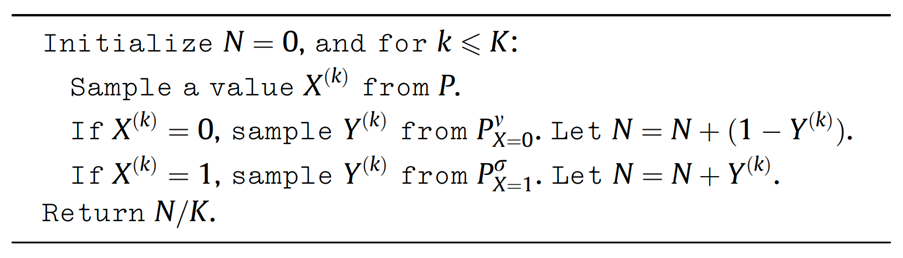
Not everyone has the technical background to implement a particular model from scratch on the basis of formulae like these. This means that the barrier to contributing to the new wave of research on causation inspired by computational modeling is relatively high.

I designed an R package that makes this barrier considerably lower. The package also comes with an interactive app, so you can use it even if you don’t do any R programming.

Here is an example of how you can use the app. Suppose you are interested in the causal judgments people would make about this story:

Billy and Suzy are freight train conductors. One day, they happen to approach an old two-way rail bridge from opposite directions at the same time. There are signals on either side of the bridge. Billy’s signal is red, so he is supposed to stop and wait. Suzy’s signal is green, so she is supposed to drive across immediately. Neither of them realizes that the bridge is on the verge of collapse. If they both drive their trains onto the bridge at the same time, it will collapse. Neither train is heavy enough on its own to break the bridge, but both together will be too heavy for it. Billy decides to ignore his signal and drives his train onto the bridge immediately at the same time that Suzy follows her signal and drives her train onto the bridge. Both trains move onto the bridge at the same time, and at that moment the bridge collapses.

Was it Billy’s or Suzy’s decision that caused the bridge to collapse?

It is easy to compute the predictions made by a computational model for this scenario.

  • Enter a description of the scenario that the app can understand. We first enter information about the ‘root variables’ whose own causes are not explicitly represented in the story. There is one variable for whether Billy decides to go, and one for whether Suzy decides to go:
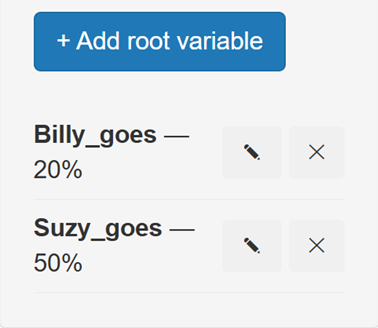
For each variable, we specify a ‘sampling probability.’ This probability tells the computational model how often it should simulate the possibility where the event described by the variable happens. For instance the sampling probability of ‘Billy_goes’ is the probability that the model simulates a possibility where Billy decides to drive his train onto the bridge. Here we have specified a lower sampling probability for Billy than for Suzy, because people are biased to think of possibilities where people follow social norms, and we want the model to reflect this.

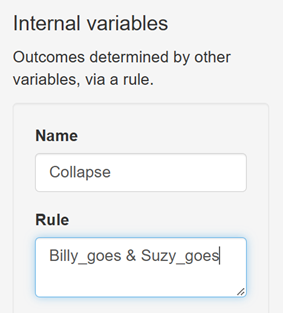
Then we define variables for the events that depend on other events defined in the story. Here we define a variable for whether the bridge collapses. We use the simple rule given in the story: the bridge collapses if Billy AND Susy drive their train onto the bridge:
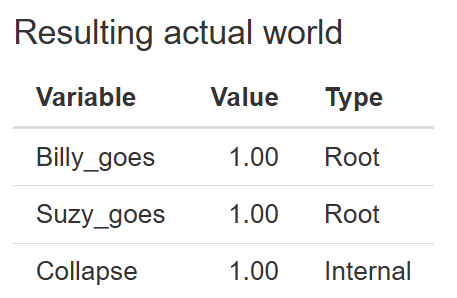
  • The next step is to specify what happened in the actual world: Billy goes, Suzy goes, and the bridge collapses. We do that simply by toggling the value of the root variables:
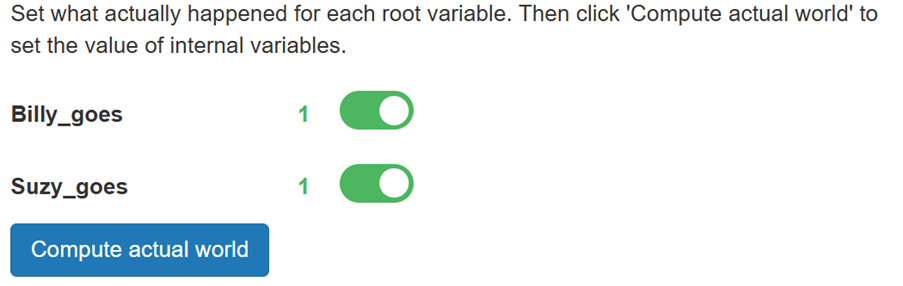
Clicking on ‘compute actual world’ lets the app automatically calculate what happens to the bridge (it collapses):
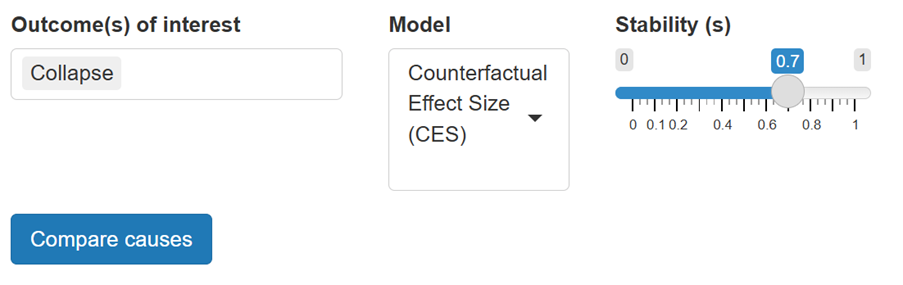
  • Finally, we ask for causal judgments. Here you can choose which computational model you want to use. For illustration I choose the Counterfactual Effect Size model. You can also modify the value of a ‘stability’ parameter that determines to what extent the model simulates possibilities that stay close to what happened in the actual world:
Clicking ‘Compare causes’ shows the relative contribution of Billy and Suzy to the bridge collapse:
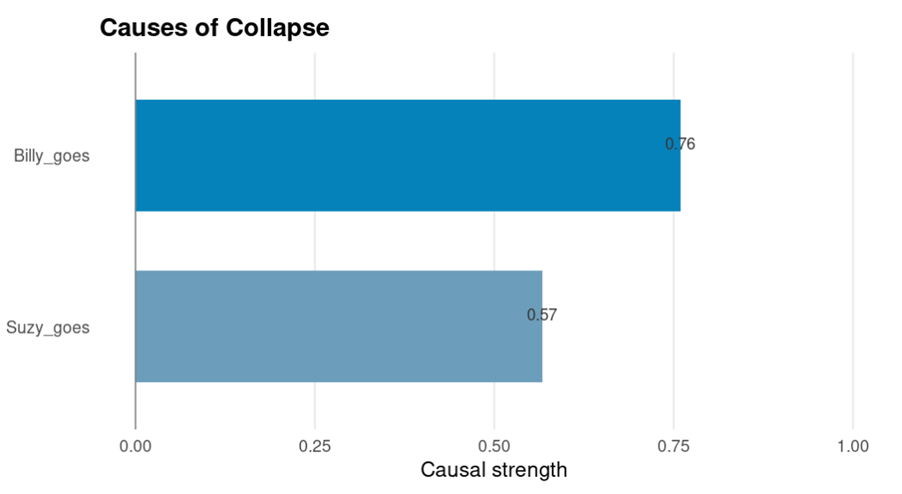
The model thinks that Billy’s decision to go is what caused the bridge to collapse. If you run the experiment, you will probably find that this is what people think too.

The power of computational models comes from their capacity to make surprising predictions. For example, you can modify the story slightly such that the bridge collapses if either Suzy OR Billy drives onto the bridge. Simply modify the rule for the ‘Collapse’ variable:
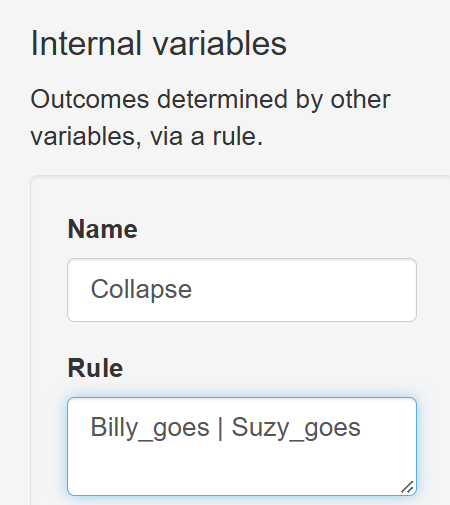
Now the model thinks that it was Suzy’s decision that caused the bridge to collapse:
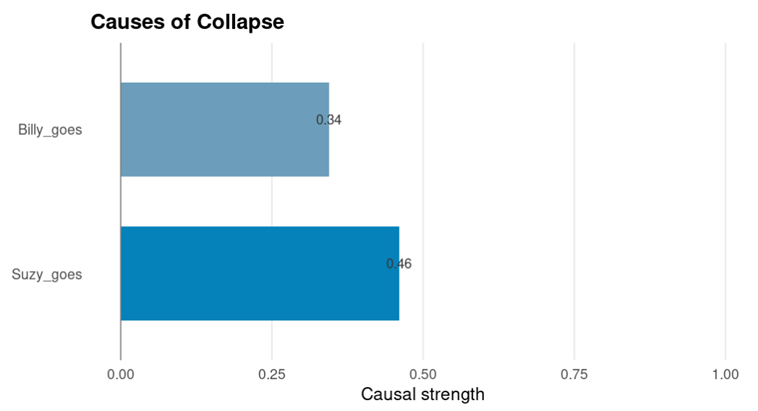
If you do the experiment, you will probably find that people think this too (see Icard, Kominsky, and Knobe, 2017). So, the model helped discover a surprising fact: sometimes the decisions of people who break social norms are judged as less causal rather than more.

Once you have created a causal model of a scenario, you can save it for future use:
And that’s it!

Currently the app implements two different computational models: the Counterfactual Effect Size (CES) and the Necessity-Sufficiency model (Quillien & Lucas, 2024; Icard, Kominsky, and Knobe, 2017). There are other models of causal judgment out there, and they might be implemented in a future version.

You can read more about the R package (which powers the app) here. The app is easiest to use, but for research purposes ultimately the R package offers more flexibility. For more background on the computational models themselves you can read the relevant papers (see References).

Hopefully this tool allows more people to contribute to the new wave of research on causation inspired by computational models. If you have questions about the app or the package I’m very happy to answer them either in the comments or by email.

Literature

Icard, Thomas, Jonathan Kominsky, and Joshua Knobe (2017): “Normality and Actual Causal Strength,” Cognition 161, 80–93. (Link)

Quillien, Tadeg, and and Christopher Lucas(2024): “Counterfactuals and the Logic of Causal Selection,” Psychological Review 131 (5), 1208–1234. (Link)

Quillien, Tadeg (2026): causaljudgment: Computational Models of Causal Judgment, R package version 0.1.0. (Link)

Experimenting With Guesses

Posted on June 3, 2025 by Tadeg Quillien

A five-horse race is about to start. The probabilities that each horse will win are:

  • Ajax: 40%
  • Benji: 38%
  • Cody: 18%
  • Dusty: 3%
  • Ember: 1%

Can you guess who will win?

There are several reasonable guesses you could make. For example, “Ajax” is a good guess, but “Ajax or Benji or Cody” is fine too. But some guesses, like “Cody or Ember,” are terrible.

What are the norms that govern guessing in this kind of context? Philosophers have become interested in that question recently (e.g., Holguín 2022, Dorst and Mandelkern 2022, Linnemann and Azhar 2025; our opening example is from Skipper 2023). It is a surprisingly rich question, because the answer does not obviously fall out of standard probability theory. For example, “Ajax or Ember” is a terrible guess, but the probability that either Ajax or Ember will win is higher than the probability that Ajax will win, and “Ajax” is a great guess.

With my colleagues Neil Bramley and Chris Lucas, I recently collected experimental data on how people guess. Our task was very simple. Participants looked at a box with colored balls, like this one:

Then we asked them to guess what color would come out if someone drew a ball at random. They could compose their guess by clicking on four buttons:

For example, to compose the guess “red or green,” you would click on “Red” and then “Green.” You could include any number of colors from one to four in your guess.

Here are the results! In this figure, each panel displays data for a different box. The numbers above the panel represent the proportion of colors – for example, “6 4 1 1” would correspond to the box shown above, with six red balls, four green balls, one blue, and one yellow ball.

We can see that for a box where all colors have equal proportions (3 3 3 3), almost all participants mention all colors (they guess, for example, “red or green or blue or yellow”). But for a box where one color dominates (9 1 1 1), most people only mention one color (for example, they guess “blue” if nine balls are blue). But between these two extremes, there is a lot of diversity in people’s guesses. For example, for the box “6 3 2 1,” about half of the participants mention one color, and half mention two colors.

Of course, the interesting question is whether theories of guessing proposed by philosophers can account for the data. We looked at an account by Kevin Dorst and Matt Mandelkern (2022). Abstracting from the mathematical details, their idea is that people want to make guesses that have a high probability of being true, but also do not mention too many possible outcomes. In other words, guessing is a trade-off between accuracy and specificity. The predictions from the theory are in green, alongside people’s data in white:

The theory fits the data pretty well.

Chris, Neil, and I also proposed another theory of how people might guess. Our idea is that a guess like “red or green” can be seen as implicitly encoding a probability distribution where red and green are both more probable outcomes than the other colors. And people make guesses that encode a distribution that is “close” to the actual distribution. So, if there are, for example, six red and four green balls in the box, the distribution encoded by “red and green” is close enough to the actual probability distribution that it is a good guess. The predictions from our theory are in purple:

The theory also gives a good account of the data. As you can see, the trade-off account and our account make fairly similar predictions. But there are some cases where they differ. For example, in the box “5 3 3 1,” we predict that people will either mention one color, or mention three colors. But the trade-off theory predicts that most people will mention two colors. Aligning with our prediction, people mostly mentioned either one or three colors. To see why this is an intuitive result, imagine a box with five red, three blue, and three yellow balls, as well as one green ball. It seems strange to guess “red or blue” in that context. According to our theory, this is because the guess “red or blue” encodes a distribution where blue is more likely than yellow, which isn’t the case here.

Of course, this is an active area of research, and other researchers might propose new theories of guessing in the future. Our data (freely available at https://osf.io/wz649/) give them a nice opportunity to see how their account compares with people’s intuitions.

For more details (and more experiments!), you can read our forthcoming paper at https://osf.io/preprints/psyarxiv/gy2fv_v3.

Literature

Dorst, Kevin, and Matthew Mandelkern (2022): “Good Guesses,” Philosophy and Phenomenological Research 105(3), 581–618. (Link)

Holguín, Ben (2022): “Thinking, Guessing, and Believing,” Philosophers’ Imprint 22, 6. (Link)

Linnemann, Niels, and Feraz Azhar (2025): “Better Guesses,” Philosophy and Phenomenological Research 110(2), 661–686. (Link)

Quillien, Tadeg, Neil Bramley, and Christopher G. Lucas (forthcoming): “Lossy Encoding of Distributions in Judgment Under Uncertainty,” Cognitive Psychology. (Link)

Skipper, Mattias (2023): “Good Guesses as Accuracy-Specificity Tradeoffs,” Philosophical Studies 180(7), 2025–2050. (Link)

Search

Categories

Tags

Agency Artificial Intelligence Basic Needs Behavior Beliefs Bias Bioethics Blame Causation Cognitive Science Consciousness Corpus Analysis Cross-Cultural Research Decisions Determinism Distributive Justice Emotions Essentialism Expertise Folk Morality Framing Free Will Intention Intuition Jurisprudence Knowledge Large Language Models Memory Moral Psychology Norms Pejoratives Pragmatics Psycholinguistics Psychology Reasoning Reflective Equilibrium Replication Responsibility Semantics Side-Effect Effect Slurs Thought Experiments Valence Values Virtue

Recent Posts

  • Survey: “Dualist And Physicalist Minds”
  • Workshop: “Experimental Philosophy Online Work-in-Progress Workshop”
  • A New R Package and Interactive App for Computational Models of Causal Judgment
  • Survey: Philosophers’ Views on Exploitation
  • Call: “Complutense Workshop on Intuitions and Experimental Philosophy”

Recent Comments

  1. Paul Henne on A New R Package and Interactive App for Computational Models of Causal JudgmentOctober 13, 2026

    Thank you for this contribution, Tadeg! I'm looking forward to seeing how future researchers will use this

  2. Joanna Demaree-Cotton on Where Should I Publish My X-Phi? A New ResourceApril 24, 2026

    Thanks for the comment, that's really useful. We'll definitely add AJP (missed you accidentally first time!), and that note.

  3. AJP Editor on Where Should I Publish My X-Phi? A New ResourceApril 24, 2026

    AJP is published by Taylor & Francis, and we have an member of the editorial team ('associate editor' in our…

  4. Nova Praxis on The Folk Concept of ArtJuly 11, 2025

    This article highlights an important point: everyday people don’t rely on rigid definitions to determine what qualifies as art. They’re…

  5. Koen Smets on Priming Effects Are Fake, but Framing Effects Are RealMay 27, 2025

    That is indeed exactly the question I have as well. I operationalize it as having de facto contradicting intuitions, in…

Archives

  • October 2026
  • September 2026
  • August 2026
  • July 2026
  • June 2026
  • May 2026
  • April 2026
  • March 2026
  • February 2026
  • January 2026
  • December 2025
  • November 2025
  • October 2025
  • September 2025
  • August 2025
  • July 2025
  • June 2025
  • May 2025
  • April 2025
  • March 2025
  • February 2025
  • January 2025
  • December 2024
  • November 2024
  • October 2024
  • September 2024
  • August 2024
  • July 2024
  • June 2024
  • May 2024
  • April 2024
  • March 2024

Meta

  • Log in
  • Entries feed
  • Comments feed
  • WordPress.org

Imprint • Disclaimer • Privacy Statement • Cookie Policy

© 2024 The Experimental Philosophy Blog
Manage Consent
To provide the best experiences, we use technologies like cookies to store and/or access device information. Consenting to these technologies will allow us to process data such as browsing behavior or unique IDs on this site. Not consenting or withdrawing consent, may adversely affect certain features and functions.
Functional Always active
The technical storage or access is strictly necessary for the legitimate purpose of enabling the use of a specific service explicitly requested by the subscriber or user, or for the sole purpose of carrying out the transmission of a communication over an electronic communications network.
Preferences
The technical storage or access is necessary for the legitimate purpose of storing preferences that are not requested by the subscriber or user.
Statistics
The technical storage or access that is used exclusively for statistical purposes. The technical storage or access that is used exclusively for anonymous statistical purposes. Without a subpoena, voluntary compliance on the part of your Internet Service Provider, or additional records from a third party, information stored or retrieved for this purpose alone cannot usually be used to identify you.
Marketing
The technical storage or access is required to create user profiles to send advertising, or to track the user on a website or across several websites for similar marketing purposes.
  • Manage options
  • Manage services
  • Manage {vendor_count} vendors
  • Read more about these purposes
View Preferences
  • {title}
  • {title}
  • {title}