The Experimental Philosophy Blog

Philosophy Meets Empirical Research

Menu
  • Home
  • About
  • Guidelines for Comments
  • Labs and Organizations
  • Resources
Menu

Category: Teaching

Teaching Experimental Philosophy to Beginners (Part 4)

Posted on January 9, 2025January 9, 2025 by Alexander Max Bauer

In a previous post, I wrote about a course (which I taught together with Stephan Kornmesser in the summer term of 2024) for master’s students who had no previous contact with X-Phi at all. After learning some methodological and statistical basics and conducting their own small replication of Knobe (2003), they had the opportunity to develop their own questions and conduct their very own studies in small groups. Below, Johannes Bavendiek, Marvin Jonas Laesecke, and Aileen Wiechmann present some results from their study on the perception of civil disobedience.

The Perception of Civil Disobedience

Johannes Bavendiek, Marvin Jonas Laesecke, and Aileen Wiechmann

Civil disobedience is a highly topical issue in light of current political events and protests. For example, groups of protesters like the “Letzte Generation” in Germany currently use this form of protest, fighting current climate change legislation. However, the legitimation of civil disobedience in their case was questioned by wider parts of society. Further, the definition of non-violence as an essential condition for civil disobedience turned out vague and unclear. In which cases is a protest violent in people’s eyes, and which kind of civil disobedience is considered legitimate? Does it make a difference who’s affected by the consequences of civil disobedience or does only the manner of the protest matter? These questions will be explored in this survey.

As a part of political philosophy, different philosophers over time have defined the term “civil disobedience” and discussed its potential influence on society, (in)justice, and democracy. Philosophers like Henry David Thoreau, John Rawls, Hannah Arendt, or Jürgen Habermas are some of them (see, e.g., Thoreau 1849, Rawls 1999, Arendt 2000, Habermas 1983). In the following, we focus on Jürgen Habermas’ definition. His work is one of the most recent ones focusing on civil disobedience as a part of modern democracy, and he refers to Rawls’ definition of the term. Focusing on Habermas seems fitting because the context of a modern democracy makes the definition most applicable to a survey addressed to people in Germany nowadays.

According to Jürgen Habermas (with reference to John Rawls), civil disobedience is a form of protest often aiming for a change in government policy and/or laws, and a protest has to meet four conditions to be classified as civil disobedience (cf. Habermas 1983, 34ff.). The protest has to be

  1. determined by conscience,
  2. a deliberate infringement,
  3. a public act, and
  4. non-violent.

We chose to approach this with an online questionnaire and created a number of vignettes in which a company intended to clear woodland and resettle a village in favor of coal mining. A protest group used (a) different variants of civil disobedience against (b) either police officers or civilians. All of the above-named conditions were always fulfilled except for the last one. Only the manner of protest as well as the group of affected people were varied.

Regarding the manner of civil disobedience (a), we created three different levels of (non)violence, ranging from nonviolent (peacefully not clearing the forest) to a more violent manner (blocking people on the street) to the most violent manner (throwing rocks at people). Changing the manners of protest allowed us to compare the perception of different levels of (non)violence and to evaluate which manners of protests were perceived as more or less violent and as more or less legitimate. Additionally, the variation of people affected by the protests (b) allowed us to investigate whether who’s affected by the consequences makes a difference in the judgement of (non)violence and (il)legitimacy. This leaves us with the five between-subjects variations displayed in Table 1.

Affected Group / Manner of Protest
PeacefulBlockingThrowing
Civilians123
Police145
Table 1: Between-subjects variations

Here is a translation of the vignette for variation 1:

A company plans to clear an old forest for coal mining and relocate a village in the process. The company complies with all legal standards, legally purchases the mining rights, and compensates the village’s inhabitants. However, a group of people filed a lawsuit against this deforestation, as they do not see coal mining as sustainable in terms of climate protection but rather as a threat to the future. The courts do not uphold this complaint. Even after long demonstrations, no change can be brought about at the company. The clearing of the forest comes closer, and the group decides to occupy the forest illegally by chaining themselves to the trees. They do this because it is not in their conscience for the forest to be cleared for coal mining or for the village to be relocated. The group also invites the press to draw public attention to their concerns. The group does not voluntarily comply with the eviction order but allows the police to remove them peacefully.

In variation 2, the last part is changed to the following:

The group does not voluntarily comply with the eviction order. When the eviction is announced, they also block the access roads to the forest to avoid the eviction. Civilians are blocked in their everyday lives.

In variation 3, it reads:

The group does not voluntarily comply with the eviction order. When the eviction is announced, they also block the access roads to the forest to avoid the eviction. Civilians are blocked in their everyday lives. When the civilians try to break up the blockade by carrying all kinds of objects and the now chained demonstrators to the side, the demonstrators take stones and throw them at the civilians.

In variations 4 and 5, “civilians” is simply replaced with “policemen.”

A total of 265 participants took part in our survey. Our findings are summarized in Figure 1, below, reporting the results of χ² tests between two variations for the yes-or-no questions “Is this kind of protest justified in a democracy?” (Justification) and “Would you classify this type of protest as violent?” (Violence).

Figure 1: Results of χ² tests between two variations for Justification and Violence

Comparing the manners of protest, we did not find a significant difference between peaceful protest and blocking civilians or policemen (neither regarding Justification nor Violence). However, the evaluation for throwing rocks significantly differs from peaceful protest and blocking people (regarding both Justification and Violence). This means that it didn’t matter to our participants whether the group protested peacefully or if they blocked someone; both of these manners were perceived as significantly less violent and more legitimate than throwing rocks.

Surprisingly, it didn’t make a difference (neither regarding Justification nor Violence) to our participants whether civilians or policemen were affected (“Blocking Civilians” vs. “Blocking Policemen” as well as “Throwing Rocks at Civilians” vs. “Throwing Rocks at Policemen” are not evaluated significantly different). Another surprising result is that about one-third of our participants didn’t consider throwing rocks violent in case civilians were affected. Also, one-third considered the peaceful protest to be illegitimate. About 38% even considered it to be violent.

Data

Data and do files for analysis with Stata are available from https://github.com/alephmembeth/course-x-phi-2024/tree/main/civil%20disobedience.

Literature

Arendt, Hannah (2000): In der Gegenwart. Übungen zum politischen Denken II, Munich: Piper.

Habermas, Jürgen (1983): “Ziviler Ungehorsam – Testfall für den demokratischen Rechtsstaat. Wider den autoritären Legalismus in der Bundesrepublik,” in Peter Glotz (ed.): Ziviler Ungehorsam im Rechtsstaat, Frankfurt am Main: Suhrkamp, 29–53.

Knobe, Joshua (2003): “Intentional Action and Side Effects in Ordinary Language,” Analysis 63 (3), 190–194.

Rawls, John (1999): A Theory of Justice, revised edition, Oxford and New York: Oxford University Press.

Thoreau, Henry David (1849): “Resistance to Civil Government,” in Elizabeth Palmer Peabody (ed.): Æsthetic Papers, Boston and New York: E. Peabody and G. P. Putnam, 189–211.

Teaching Experimental Philosophy to Beginners (Part 3)

Posted on January 3, 2025January 7, 2025 by Alexander Max Bauer

In a previous post, I wrote about a course (which I taught together with Stephan Kornmesser in the summer term of 2024) for master’s students who had no previous contact with X-Phi at all. After learning some methodological and statistical basics and conducting their own small replication of Knobe (2003), they had the opportunity to develop their own questions and conduct their very own studies in small groups. Below, Bastian Göbbels and Marina Hinkel present some results from their study on the perception of the moral obligation to help others.

The Perception of the Moral Obligation to Help Others

Bastian Göbbels and Marina Hinkel

The United Nations calculated a donation amount for development aid in the 1970s that wealthy countries could contribute to prevent the global consequences of absolute poverty – 70 cents per 100 earned dollars. In 2013, only Denmark, Luxembourg, Norway, and Sweden reached this donation target. At that time, Germany was at 0.38–0.43 cents (cf. Singer 2013, 344). The bottom line is that we could contain extreme global poverty and its consequences relatively easily, but the reality is different.

Peter Singer raises the question of whether we have an obligation to help those in need and to whom we have moral obligations (by “we,” Singer means individuals in wealthy industrialized countries – including himself). Singer argues that we should, for example, prevent a certain level of absolute poverty because absolute poverty is bad, because we could prevent a level of absolute poverty without having to make comparable sacrifices, and if we can prevent something bad without having to make a comparable sacrifice, we should do so (cf. Singer 2013, 356f.). Singer reinforces the last premise by pointing out that it only requires us to prevent bad things and not to promote good things (this corresponds to the consequentialism of utilitarianism; cf. Singer 2017, 36).

Singer illustrates the principle of the obligation to help with a thought experiment about a child in a pond that is in danger of drowning. Here is how Singer himself describes the “drowning child”:

To challenge my students to think about the ethics of what we owe to people in need, I ask them to imagine that their route to the university takes them past a shallow pond. One morning, I say to them, you notice a child has fallen in and appears to be drowning. To wade in and pull the child out would be easy but it will mean that you get your clothes wet and muddy, and by the time you go home and change you will have missed your first class.

I then ask the students: do you have any obligation to rescue the child? Unanimously, the students say they do. The importance of saving a child so far outweighs the cost of getting one’s clothes muddy and missing a class, that they refuse to consider it any kind of excuse for not saving the child. Does it make a difference, I ask, that there are other people walking past the pond who would equally be able to rescue the child but are not doing so? No, the students reply, the fact that others are not doing what they ought to do is no reason why I should not do what I ought to do. (Singer 1997, par. 1f.)

The principle should be applied equally to all cases, regardless of whether I am the only person potentially helping, e.g., by saving the child in the pond, or one of many, e.g., by donating (cf. Singer 2017, 37). Although Singer does not regard failure to help as intentional killing but as a moral challenge (cf. Singer 2013, 354), he emphasizes elsewhere that absolute poverty means a death sentence and that the diseases responsible for this are preventable (cf. Singer 2013, 341f.).

Under the premises of universalization, impartiality, and equality, the spatial aspect – distance or proximity to the person in need – should be obsolete, according to Singer. In light of globalization, with today’s improved communication and transport conditions, distance can no longer be an excuse for lack of assistance (cf. Singer 2017, 37f.). Singer concedes: “The fact that a person is physically close to us […] may increase the likelihood that we will help them, but this does not prove that we should help them rather than any other person who happens to be at a greater distance” (Singer 2017, 37).

Singer argues that there is a certain level of extreme poverty that we can prevent without sacrificing anything of comparable moral significance in figures. On the one hand, he uses the amount calculated by the United Nations, which would be sufficient for basic development aid: 70 cents per 100 dollars earned. According to the World Bank in 2008, this would correspond to 1.25 dollars per day for a person’s basic needs (note currency-dependent purchasing power; cf. Singer 2013, 341). In 2008, the wealthy industrialized countries donated 19–43 cents for every 100 dollars earned (cf. Singer 2013, 344).

Based on Singer’s above-outlined thoughts, we wanted to investigate how spatial and social distance or proximity, as well as personal cost, influence the perception of moral obligation. To do this, we developed a vignette in which a child needs help from our subject. Between subjects, we varied (a) whether the child needs a new kidney directly from the subject or money for the same medical purpose, (b) whether our subject is said to know the child or not, and (c) whether the child is from the same neighbourhood, the same federal state, or a far-away country from the Global South. This resulted in a total of twelve different scenarios.

As an example, here is a translation of the vignette where a child from the neighbourhood, which the subject is said to know, needs money:

Imagine the following situation: You are informed that a child you know has life-threatening problems with his only kidney and, therefore, needs a donor organ. The child lives in your neighbourhood. You could donate one-third of your monthly income for the next two years without being at risk of losing your livelihood. With your help, the child would be saved.

After reading the vignette, subjects were asked to answer two yes-or-no questions: “Would you donate your money [kidney]?” and “Regardless of whether you would donate your money [kidney] yourself, do you think that someone in such a situation should donate their money [kidney]?” In the following, we will only look at the former question.

The online survey was programmed with LimeSurvey, and 630 subjects from Bilendi successfully participated (i.e., they did not fail an attention check and completed the survey).

A surprising finding is that more participants said they would donate a kidney than money (χ² ≈ 5.620, p < 0.05); see Figure 1. This increased willingness could be due to the fact that donating a kidney is perceived as more immediate and life-saving, while donating money is often perceived as less urgent.

Figure 1: Kidney vs. money

At the same time, we found that the willingness to donate does not change between the neighbourhood and the federal state (χ² ≈ 0.030, p > 0.1) but between the federal state and the far-away country (χ² ≈ 7.608, p < 0.01); see Figure 2.

Figure 2: Neighborhood vs. federal state and federal state vs. far-away country

Lastly, we didn’t find a significant difference when it comes to knowing the child or not (χ² ≈ 3.414, p > 0.05); see Figure 3.

Figure 3: Known vs. unknown

Our results are partly consistent with Peter Singer’s assumptions. Nevertheless, they show that people’s willingness to help – at least in our hypothetical scenarios – seems to decrease with distance. Also, the type of aid (kidney vs. money) seems to play a role, while social proximity does not. Of course, these results need to be taken with a grain of salt, and further, more elaborate research is necessary. Interestingly enough, there is a discrepancy between given answers and actual behavior, as illustrated by the low numbers of organ donations in reality. While respondents signal a high willingness to help in hypothetical scenarios, practical implementation falls short of these expectations.

Data

Data and do files for analysis with Stata are available from https://github.com/alephmembeth/course-x-phi-2024/tree/main/autonomous%20systems.

Literature

Knobe, Joshua (2003): “Intentional Action and Side Effects in Ordinary Language,” Analysis 63 (3), 190–194. (Link)

Singer, Peter (1997): “The Drowning Child and the Expanding Circle,” New Internationalist 289. (Link)

Singer, Peter (2013): Praktische Ethik, translated by Oscar Bischoff, Jean-Claude Wolf, Dietrich Klose, and Susanne Lenz, 3rd edition, Stuttgart: Reclam. (Link)

Singer, Peter (2017): Hunger, Wohlstand und Moral, translated by Elsbeth Ranke, Hamburg: Hoffmann und Campe. (Link)

Teaching Experimental Philosophy to Beginners (Part 2)

Posted on January 2, 2025January 3, 2025 by Alexander Max Bauer

In a previous post, I wrote about a course (which I taught together with Stephan Kornmesser in the summer term of 2024) for master’s students who had no previous contact with X-Phi at all. After learning some methodological and statistical basics and conducting their own small replication of Knobe (2003), they had the opportunity to develop their own questions and conduct their very own studies in small groups. Below, Frederike Lüttich and Jule Rüterbories present some results from their study on the perception of responsibility in accidents involving autonomous and human-controlled vehicles.

The Perception of Responsibility in Accidents Involving Autonomous and Human-Controlled Vehicles

Frederike Lüttich and Jule Rüterbories

The relevance of autonomous systems as potential moral agents is growing with their use in areas such as medicine, the military, and traffic, where they have – or will have – to make decisions in ethical contexts. The capacity of such systems to act has far-reaching legal and ethical implications. A frequently discussed example (see, e.g., Goodall 2014, Awad et al. 2018, Cecchini, Brantley, and Dubljević 2023) is this one: Although autonomous vehicles promise greater safety, they are not flawless. In the event of unavoidable accidents, they have to make decisions about which lives to protect. The programming of such systems is complex and raises key ethical questions. Below, we examine the perception of responsibility in accidents involving autonomous and human-controlled vehicles.

To investigate this, we created an online questionnaire in which we presented a vignette about a car and a pedestrian at a traffic light. Between subjects, we varied (a) whether the car was operated autonomously or was human-driven, (b) whether it hit the pedestrian or swerved and crashed into a wall (the outcome is deadly either for the pedestrian or for the driver), and (c) whether the pedestrian (rightfully) used a crosswalk or illegally crossed a red traffic light. This resulted in a total of eight different combinations, as shown in Table 1.

Behavior of Pedestrian / Car
Hits PedestrianHits Wall
Legally Uses Crosswalk12
Illegally Crosses Red Light34
Table 1: Between-subjects variations (presented either with an autonomous or human-driven car)

Here is a translation of the vignette for variation 1 with a self-driving car:

Imagine standing on a foggy main road and observing the following scenario: A self-driving car is driving at approximately 50 km/h towards a traffic light, which is being crossed by a woman illegally on red. The self-driving car’s sensors notice the woman too late, and it is unable to brake. The self-driving car could swerve. In doing so, it would surely hit a house wall and be completely destroyed. The self-driving car does not swerve and hits the woman. The woman dies.

After reading the vignette, participants were asked to answer the following yes-or-no question: “Is the self-driving car [the person driving] morally responsible?” At the end of the survey, and after passing an attention check, participants provided socio-demographic data, including gender, age, and level of education.

420 participants successfully passed the attention check and completed the survey. 209 women, 210 men, and one non-binary person took part. Their age ranged from 18 to 74 years, averaging 52 years. According to their statements, two people had no school-leaving qualifications, 195 had a lower secondary school leaving certificate, 95 had a technical college or university entrance qualification, 113 had a university degree, seven had a doctorate, and eight were currently studying.

Let us compare cases with (a) autonomously or human-driven cars, (b) the pedestrian or the wall being hit, and (c) the pedestrian (legally) using a crosswalk or (illegally) crossing a red traffic light.

Regarding (a), 56% of participants do not attribute responsibility to the autonomous vehicle, while 42% consider the human driver not to be responsible (χ² ≈ 7.942, p < 0.01); see Figure 1.

Figure 1: Self-driving car vs. human-driven car

Regarding (b), if the pedestrian dies, 70% of participants say that the car or driver is responsible. If the driver dies, the attribution of responsibility drops to 34% (χ² ≈ 46.662, p < 0.001); see Figure 2.

Figure 2: Pedestrian dies vs. driver dies

And finally, regarding (c), in scenarios where the pedestrian illegally crosses the road at a red light, 54% do not think the car or driver is responsible. If the pedestrian legally uses a crosswalk, this drops to 43% (χ² ≈ 5.002, p < 0.05); see Figure 3.

Figure 3: Illegally crossing vs. legally crossing

The attribution of responsibility is complex and highly dependent on the situation. The results show that responsibility is attributed more often to human-controlled vehicles than autonomous ones. Factors such as compliance with traffic regulations and the person affected by the crash further influence this.

To gain more detailed insights in the future, open questions and alternative scenarios would be useful. Demographic data could have revealed additional differences in age, gender, and education. The study was limited to German participants, so possible cultural differences were not considered. Also, a basic understanding of machine ethics and automation levels is essential to grasp the ethical and technical challenges of autonomous vehicles fully. Further studies should explore these aspects in more depth.

Data

Data and do files for analysis with Stata are available from https://github.com/alephmembeth/course-x-phi-2024/tree/main/autonomous%20systems.

Literature

Awad, Edmond, Sohan Dsouza, Richard Kim, Jonathan Schulz, Joseph Henrich, Azim Shariff, Jean-François Bonnefon, and Iyad Rahwan (2018): “The Moral Machine Experiment,” Nature 563, 59–64. (Link)

Cecchini, Dario, Sean Brantley, and Veljko Dubljević (2023): “Moral Judgment in Realistic Traffic Scenarios. Moving Beyond the Trolley Paradigm for Ethics of Autonomous Vehicles,” AI & Society. (Link)

Gogoll, Jan, and Julian Müller (2016): “Autonomous Cars. In Favor of a Mandatory Ethics Setting,” Science and Engineering Ethics 23 (3), 681–700. (Link)

Knobe, Joshua (2003): “Intentional Action and Side Effects in Ordinary Language,” Analysis 63 (3), 190–194. (Link)

Hot Off The Press: “Experimental Philosophy for Beginners”

Posted on September 2, 2024January 3, 2025 by Alexander Max Bauer

“Experimental Philosophy for Beginners,” a new entry into the “Springer Graduate Texts in Philosophy” series, just hit the shelves. It provides an essential extension of x-phi-tailored introductions to methods and guides readers through the whole research process using different case studies. The book offers online materials so readers can immediately apply what they have read. See below for the table of contents.

  • Stephan Kornmesser, Alexander Max Bauer, Mark Alfano, Aurélien Allard, Lucien Baumgartner, Florian Cova, Paul Engelhardt, Eugen Fischer, Henrike Meyer, Kevin Reuter, Justin Sytsma, Kyle Thompson, and Marc Wyszynski: “Introduction – Setting Out for New Shores”
  • Alexander Max Bauer, Stephan Kornmesser, and Henrike Meyer: “Quantitative Vignette Studies – χ2 Tests – Empirically Reconsidering the Constative–Performative Distinction”
  • Justin Sytsma: “Quantitative Vignette Studies – t-Tests – Case Studies on Judgments About Unfelt Pains”
  • Florian Cova and Aurélien Allard: “Quantitative Vignette Studies – Correlations, Regressions, and Structural Equation Modeling – An Application to Experimental Philosophy of Free Will”
  • Marc Wyszynski: “Interactive and Incentivized Online Experiments – Noncooperation in Give-Some and Take-Some Dilemmas”
  • Kevin Reuter and Lucien Baumgartner: “Corpus Analysis – Building and Using Corpora – A Case Study on the Use of ‘Conspiracy Theory’”
  • Mark Alfano: “Corpus Analysis – Lexical Dispersion, Semantic Time Series, and Semantic Network Analysis – An R Studio Pipeline”
  • Eugen Fischer and Paul E. Engelhardt: “Psycholinguistic Experiments – A Case Study on Default Inferences in Philosophical Arguments – Analysing the Argument from Illusion”
  • Kyle Thompson: “Qualitative Interview Studies – Constructing an Interview Study Based on a Paradigm Example in ‘Ought Implies Can’”

Literature

Kornmesser, Stephan, Alexander Max Bauer, Mark Alfano, Aurélien Allard, Lucien Baumgartner, Florian Cova, Paul Engelhardt, Eugen Fischer, Henrike Meyer, Kevin Reuter, Justin Sytsma, Kyle Thompson, and Marc Wyszynski (2024): Experimental Philosophy for Beginners. A Gentle Introduction to Methods and Tools, Cham: Springer. (Link)

Teaching Experimental Philosophy to Beginners (Part 1)

Posted on April 29, 2024January 3, 2025 by Alexander Max Bauer

This term at the University of Oldenburg, Stephan Kornmesser and I are teaching a course for master’s students who had no previous contact with x phi.1 We decided to try a hands-on approach rather than just discussing results, debates, and ideas from the field. For this purpose, we divided the course into two parts. In the first half, loosely based on Kornmesser et al. (forthcoming), we introduced some basics of experimental design and statistical analysis. Also, as a paradigmatic example of an early x phi study, we read Knobe (2003). In my opinion, this paper has the advantage of being both short and accessible; the experimental design is simple and the data collected (primarily the nominal yes-or-no responses) can be analyzed quite straightforwardly.

Thereafter, the course was divided into three groups,2 and students were instructed to replicate Knobe’s first study step by step. First, we reconstructed the questionnaire, using a German translation of the vignette (taken from Knobe 2014). Everyone probably knows the vignette, but to refresh your memory, here is the original once again (variations between Harm and Help Condition are indicated by square brackets):

The vice-president of a company went to the chairman of the board and said, “We are thinking of starting a new program. It will help us increase profits, but [and] it will also harm [help] the environment.”

The chairman of the board answered, “I don’t care at all about harming [helping] the environment. I just want to make as much profit as I can. Let’s start the new program.”

They started the new program. Sure enough, the environment was harmed [helped].

Knobe (2003, 190)

Afterwards, students used the questionnaire to ask people on campus whether the chairman brought about the side effect intentionally. Finally, we calculated and interpreted χ2 tests for each group. To foster an understanding of how the χ2 test actually works, we calculated them by hand one step at a time instead of using software.

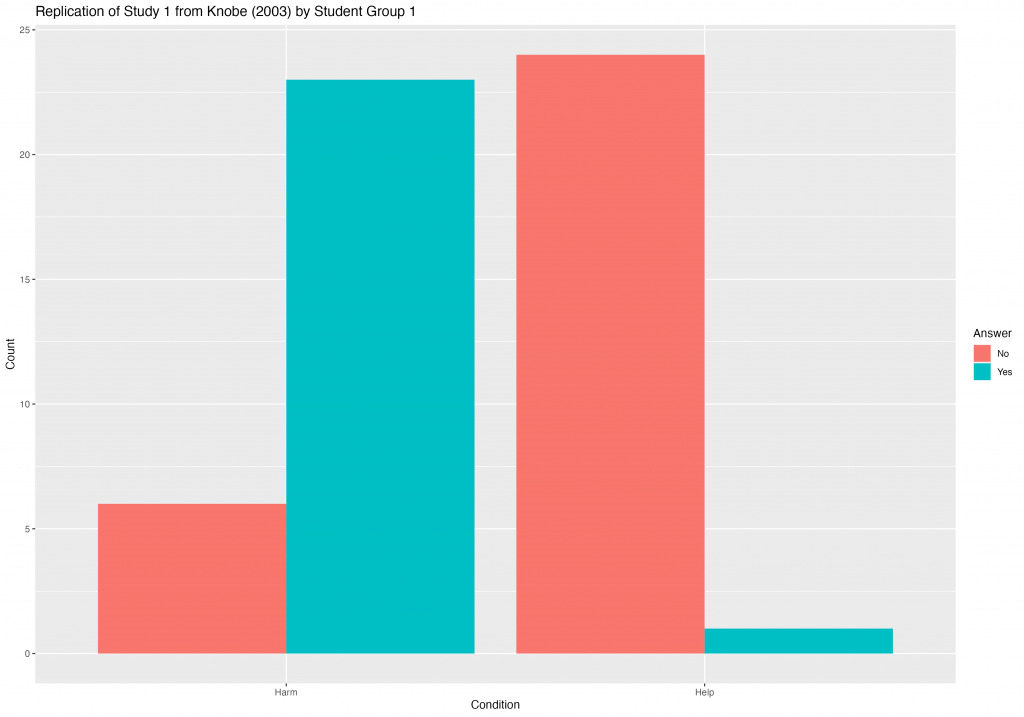
As can be seen in the picture below, showing the results from Group 1, Knobe’s original findings were perfectly replicated.3 In the Harm Condition, most subjects said that the chairman brought about the side effect intentionally, while in the Help Condition, most subjects said that he did not.4

Replication of Study 1 from Knobe (2003) by Student Group 1

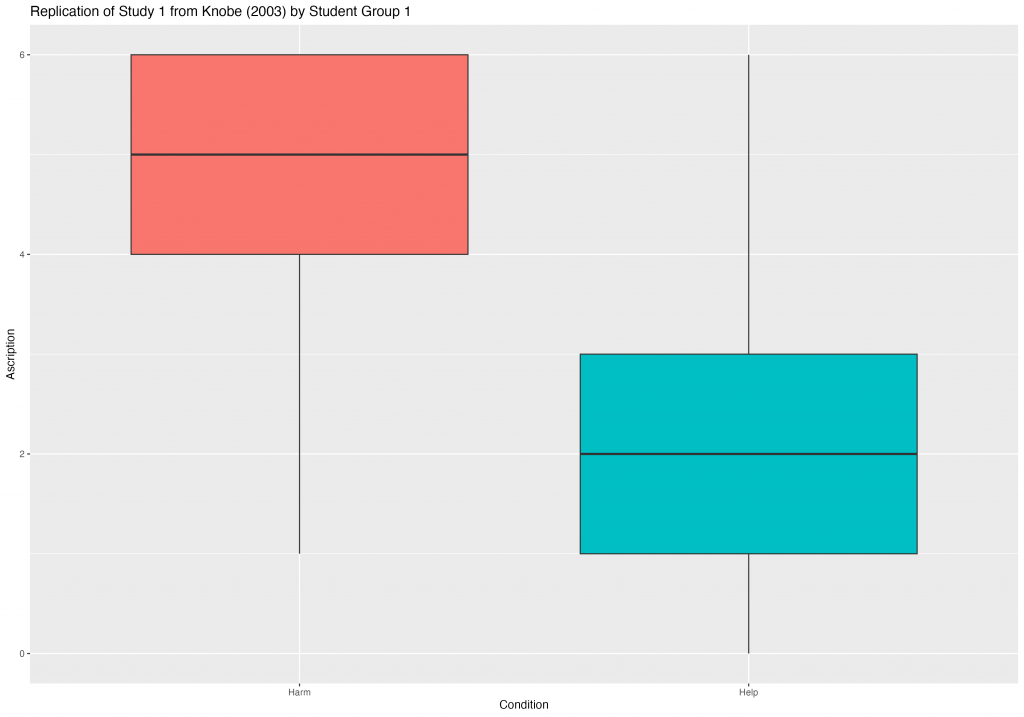
As did Knobe (2003), people were also asked how much praise or blame the chairman deserves. Using the results from Group 1 again as an example, shown in the picture below, the mean of ascribed blame was 4.90 (SD = 1.26), while the mean of ascribed praise was 2.32 (SD = 1.63), which also fits in very well with Knobe’s results.5

Replication of Study 1 from Knobe (2003) by Student Group 1

Where do we go from here? In the second half of our course, the three groups are encouraged to develop their own research questions based on their philosophical interests. They will learn how to design an online survey and set one up themselves. Luckily, we have got a grant for research-based learning instructional projects from the university’s initiative forschen@studium,6 which will be used to recruit subjects from an online panel provider. Hence, learning panel integration will also be on our schedule. This is followed by guided data analysis and interpretation. Finally, the groups present their results to each other and document them in term papers. This means that, in the end, an entire research process is experienced.

Literature

De Cruz, Helen (2019): “Unconventional Teaching Ideas That Work. Teaching Experimental Philosophy to Undergraduate Students,” The Philosophers’ Cocoon, https://philosopherscocoon.typepad.com/blog/2019/02/unconventional-teaching-ideas-that-work-teaching-experimental-philosophy-to-undergraduate-students-h.html.

Kornmesser, Stephan, Alexander Max Bauer, Mark Alfano, Aurélien Allard, Lucien Baumgartner, Florian Cova, Paul Engelhardt, Eugen Fischer, Henrike Meyer, Kevin Reuter, Justin Sytsma, Kyle Thompson, and Marc Wyszynski (forthcoming): Experimental Philosophy for Beginners. A Gentle Introduction to Methods and Tools, Cham: Springer. (Link)

Knobe, Joshua (2003): “Intentional Action and Side Effects in Ordinary Language,” Analysis 63 (3), 190–194. (Link)

Knobe, Joshua (2014): “Absichtliches Handeln und Nebeneffekte in der Alltagssprache,” translated by Jürgen Schröder, in: Thomas Grundmann, Joachim Horvath, and Jens Kipper (eds.): Die Experimentelle Philosophie in der Diskussion, Berlin: Suhrkamp, 96–101. (Link)

Endnotes

  1. If you are interested in teaching x phi to beginners, you should also take a look at De Cruz (2019). In her blog post, she describes a teaching approach to third-year undergraduates at Oxford Brookes University. ↩︎
  2. Of course, the great students of our course deserve credit! Group 1: Johannes Bavendiek, Marvin Jonas Laesecke, and Aileen Wiechmann; Group 2: Rebecca Kratzer, Frederike Lüttich, and Jule Rüterbories; Group 3: Bastian Göbbels, Finn Ove Gronotte, Marina Hinkel, and Riduan Schwarz. ↩︎
  3. Data and materials can be found at https://github.com/alephmembeth/course-x-phi-2024. ↩︎
  4. χ2(1, 54) = 27.865, p < 0.001. For comparison: Knobe (2003, 192) reports χ2(1, 78) = 27.2, p < 0.001. ↩︎
  5. t(54) = 6.43, p < 0.001. For comparison: Knobe (2003, 193) reports – pooled for both of his studies – a mean of 4.8 in the harm condition and of 1.4 in the help condition; t(120) = 8.4, p < 0.001. ↩︎
  6. See https://uol.de/en/forschen-at-studium. ↩︎

Search

Categories

Tags

Agency Artificial Intelligence Basic Needs Behavior Beliefs Bias Bioethics Blame Causation Cognitive Science Consciousness Corpus Analysis Cross-Cultural Research Decisions Determinism Distributive Justice Emotions Essentialism Expertise Folk Morality Framing Free Will Gender Intention Intuition Jurisprudence Knowledge Large Language Models Moral Psychology Norms Pejoratives Problem of Evil Psycholinguistics Rationality Reasoning Replication Responsibility Self Side-Effect Effect Slurs Truth Valence Values Virtue Well-Being

Recent Posts

  • Call: “The Armchair on Trial”
  • Call: “Interdisciplinary Perspectives on Linguistic Justice”
  • Call: “6th European Experimental Philosophy Conference”
  • Talk: “Ethics in the Lab” (Pascale Willemsen)
  • Talk: “Normality and Norms” (Josh Knobe)

Recent Comments

  1. Nova Praxis on The Folk Concept of ArtJuly 11, 2025

    This article highlights an important point: everyday people don’t rely on rigid definitions to determine what qualifies as art. They’re…

  2. Koen Smets on Priming Effects Are Fake, but Framing Effects Are RealMay 27, 2025

    That is indeed exactly the question I have as well. I operationalize it as having de facto contradicting intuitions, in…

  3. Joshua Knobe on Priming Effects Are Fake, but Framing Effects Are RealMay 24, 2025

    Hi Koen, Thanks once again. This idea brings up all sorts of fascinating questions, but for the purposes of the…

  4. Koen Smets on Priming Effects Are Fake, but Framing Effects Are RealMay 24, 2025

    Great! In the meantime I thought of another potentially interesting example of framing—Arnold Kling’s Three Languages of Politics. Just about…

  5. Joshua Knobe on Priming Effects Are Fake, but Framing Effects Are RealMay 23, 2025

    Thanks Koen! This is all super helpful.

Archives

  • February 2026
  • January 2026
  • December 2025
  • November 2025
  • October 2025
  • September 2025
  • August 2025
  • July 2025
  • June 2025
  • May 2025
  • April 2025
  • March 2025
  • February 2025
  • January 2025
  • December 2024
  • November 2024
  • October 2024
  • September 2024
  • August 2024
  • July 2024
  • June 2024
  • May 2024
  • April 2024
  • March 2024

Meta

  • Log in
  • Entries feed
  • Comments feed
  • WordPress.org

Imprint • Disclaimer • Privacy Statement • Cookie Policy

© 2024 The Experimental Philosophy Blog
Manage Consent
To provide the best experiences, we use technologies like cookies to store and/or access device information. Consenting to these technologies will allow us to process data such as browsing behavior or unique IDs on this site. Not consenting or withdrawing consent, may adversely affect certain features and functions.
Functional Always active
The technical storage or access is strictly necessary for the legitimate purpose of enabling the use of a specific service explicitly requested by the subscriber or user, or for the sole purpose of carrying out the transmission of a communication over an electronic communications network.
Preferences
The technical storage or access is necessary for the legitimate purpose of storing preferences that are not requested by the subscriber or user.
Statistics
The technical storage or access that is used exclusively for statistical purposes. The technical storage or access that is used exclusively for anonymous statistical purposes. Without a subpoena, voluntary compliance on the part of your Internet Service Provider, or additional records from a third party, information stored or retrieved for this purpose alone cannot usually be used to identify you.
Marketing
The technical storage or access is required to create user profiles to send advertising, or to track the user on a website or across several websites for similar marketing purposes.
  • Manage options
  • Manage services
  • Manage {vendor_count} vendors
  • Read more about these purposes
View Preferences
  • {title}
  • {title}
  • {title}