The Experimental Philosophy Blog

Philosophy Meets Empirical Research

Menu
  • Home
  • About
  • Guidelines for Comments
  • Labs and Organizations
  • Resources
Menu

Category: Philosophy of Science

Call: “Theory and Practice After the Practice Turn”

Posted on January 10, 2026January 10, 2026 by Alexander Max Bauer

On April 17, 2026, the Research Center Normative Orders at Goethe University Frankfurt will host an online workshop titled “Theory and Practice After the Practice Turn – Where Social Theory and Empirical Philosophy Meet.”

Proposals for contributions can be submitted until February 14. The call reads:

Sociology and philosophy have always shared a close relationship. Critical Theory famously tied the two disciplines together to unravel societal phenomena, and feminist philosophers regularly borrow sociological concepts to understand domination and power asymmetries. Similarly, sociologists often draw on philosophical concepts to sharpen their analyses. In recent years, this dialogue has gained new momentum through the so-called “practice turn” in epistemology and philosophy of science. Contemporary philosophy of science and applied epistemology increasingly incorporate empirical methods originally developed within the social sciences such as interviews and ethnographic studies. But while empirical approaches from sociology are frequently adopted, social-theoretical concepts remain rarely integrated within epistemology and philosophy of science.

It is the goal of this workshop to explore the potential of social theory for empirical approaches in philosophy of science and epistemology. What are instances of fruitful applications of social theory to philosophy of science and epistemological scholarship? How does social theory transform when it is resituated in a different disciplinary setting? What are caveats and best practices when using social theory as a philosopher of science/epistemologist?

We are looking for workshop contributions that are focused on but not limited to:

  • Examples of using social theory along with empirical methods in philosophy of science and
    epistemology.
  • Reflections on methodological and conceptual challenges when transferring social-theoretical
    concepts into philosophical work.

Workshop contributions will also be considered for publication in a special issue (target journal: Synthese) on social theory in empirical philosophy of science & epistemology.

Send submissions to: sophie.juliane.veigl@univie.ac.at; riegler@em.uni-frankfurt.de

Conference: “Basel-Oxford-NUS BioXPhi Summit”

Posted on June 7, 2025June 8, 2025 by Alexander Max Bauer

The 2025 “Basel-Oxford-NUS BioXPhi Summit,” organized by Tenzin Wangmo, Brian D. Earp, Carme Isern, Christian Rodriguez Perez, Emilian Mihailov, Ivar Rodriguez Hannikainen, and Kathryn Francis, will take place from June 26 to 27 at the University of Basel, Switzerland.

The program consists of 15 talks and seven posters, framed by two keynotes.

June 26, 8:30–17:30 (UTC+2)

  • Matti Wilks (University of Edinburgh): “Who Has an Expansive Moral Circle? Understanding Variability in Ascriptions of Moral Concern”
  • Eliana Hadjiandreou (University of Texas at Austin): “The Stringent Moral Circle – Self-Other Discrepancies in the Perceived Expansion of Moral Concern”
  • Daniel Martín (University of Granada): “Mapping the Moral Circle with Choice and Reaction Time Data”
  • Neele Engelmann (Max Planck Institute for Human Development): “Understanding and Preventing Unethical Behavior in Delegation to AI”
  • Yuxin Liu (University of Edinburgh): “An Alternative Path to Moral Bioenhancement? AI Moral Enhancement Gains Approval but Undermines Moral Responsibility”
  • Faisal Feroz (National University of Singapore): “Outsourcing Authorship – How LLM-Assisted Writing Shapes Perceived Credit”
  • Jonathan Lewis (National University of Singapore): “How Should We Refer to Brain Organoids and Human Embryo Models? A Study of the Effects of Terminology on Moral Permissibility Judgments”
  • Sabine Salloch (Hannover Medical School): “Digital Bioethics – Theory, Methods and Research Practice”
  • Markus Kneer (University of Graz): “Partial Aggregation in Complex Moral Trade-Offs”

June 27, 8:30–16:30 (UTC+2)

  • Federico Burdman (Alberto Hurtado University) and Maria Fernanda Rangel (University of California, Riverside): “Not in Control but Still Responsible – Lay Views on Control and Moral Responsibility in the Context of Addiction”
  • Vilius Dranseika (Jagiellonian University): “Gender and Research Topic Choice in Bioethics and Philosophy of Medicine”
  • Jodie Russell (University of Birmingham): “Sartre and Psychosis – Doing Intersectional, Phenomenological Interviews with People with Experience of Mental Disorder”
  • Aníbal M. Astobiza (University of Granada): “Spanish Healthcare Professionals’ Trust in AI – A BioXPhi Study”
  • Nick Byrd (Geisinger College of Health Science): “Reducing Existential Risk by Reducing the Allure of Unwarranted Antibiotics – Two Low-Cost Interventions”
  • Rana Qarooni (University of Edinburgh; University of York): “Prevalence of Omnicidal Tendencies”
  • Lydia Tsiakiri (Aarhus University): “Responsibility-Sensitive Healthcare Allocation – Neutrally or Wrongfully Discriminatory?”
  • Edmond Awad (University of Exeter; University of Oxford): “Online Serious Games as a Tool to Study Value Disagreement”

For more information about the conference, visit https://ibmb.unibas.ch/en/public-outreach/projects-to-the-public/basel-oxford-nus-bioxphi-summit-2025/.

Call: “ESPP 2025”

Posted on February 11, 2025February 11, 2025 by Alexander Max Bauer

The 2025 conference of the European Society for Philosophy and Psychology will take place in Warsaw, Poland, from September 2 to 5, hosted by the Polish Academy of Sciences. As keynote speakers, Emma Borg, Cameron Buckner, Nora Newcombe, and Petra Schumacher are confirmed.

Abstracts for papers, posters, and symposia can be submitted until March 3. The call reads:

The Society invites the submission of papers, posters and symposia. Submissions are refereed and selected on the basis of quality and relevance to psychologists, philosophers and linguists. If you have any questions, contact us by writing an email to espp2025@gmail.com.

Travel scholarships for PhD Students

Thanks to support from IFiS/GSSR, via the NAWA grant PROM Short-term academic exchange (in Polish, PROM Krótkookresowa wymiana akademicka; BPI/PRO/2024/1/00020/DEC/1), we can award up to 10 travel grants for PhD students at universities outside Poland to attend the conference and present a talk or poster. Please see the Call for Applications for these scholarships, which promotes equal opportunity for people with disabilities, and adequate gender representation. Successful applications will be selected on the basis of: (i) quality of the proposed talk or poster, as judged by the ESPP expert reviewers’ report on the anonymised abstract you submit when applying to present at the conference; (ii) NAWA PROM’s eligibility rules (see the Call for Applications).

Submission instructions for papers, posters and symposia

The deadline for all submissions is 3rd March 2025. Submissions should be made online via EasyChair.

Papers should be designed to be presentable within 20 minutes (for a total 30 minutes session). Submissions should consist of a long abstract of up to 1000 words (excluding bibliography). If required, an additional page of tables and/or graphs may be included. A submission for a poster presentation should consist of a 500-word abstract.

When submitting your paper or poster online, please first indicate the primary discipline of your paper (philosophy, psychology, or linguistics) and whether your submission is intended as a paper or a poster. Submitted papers may also be considered for presentation as a poster if space constraints prevent acceptance as a paper or if the submission is thought more suitable for presentation as a poster. All paper and poster submissions (whether abstracts or full papers) should be in DOC or PDF format and should be properly anonymized in order to allow for blind refereeing.

Each person may present only one paper during the conference’s parallel sessions, though you may be a co-author of more than one paper. If you submit multiple single-authored papers only one will be accepted. This includes contributions to submitted symposia.

Symposia are allocated a two-hour slot and consist of a set of four linked papers on a common theme or three linked papers with an introduction. Symposia should include perspectives from at least two of the three disciplines represented in the society (philosophy, psychology and linguistics). Submissions should be made by symposium organizers (not speakers).

When submitting a symposium proposal online, your submissions should include the following three elements in a single PDF:

  1. A list of 3 or 4 speakers which indicates representation of at least two disciplines (individual speakers may also represent multiple disciplines).
  2. A general abstract of up to 500 words, laying out the topics to be addressed and indicating connections among the talks.
  3. Individual abstracts of up to 500 words and provisional titles for each talk. Please do not submit more than one PDF file per symposium.

General Aim

The aim of the European Society for Philosophy and Psychology is to promote interaction between philosophers and psychologists on issues of common concern. Psychologists, neuroscientists, linguists, computer scientists and biologists are encouraged to report experimental, theoretical and clinical work that they judge to have philosophical significance; and philosophers are encouraged to engage with the fundamental issues addressed by and arising out of such work. In recent years ESPP sessions have covered such topics as theory of mind, attention, reference, problems of consciousness, introspection and self-report, emotion, perception, early numerical cognition, spatial concepts, infants’ understanding of intentionality, memory and time, motor imagery, counterfactuals, the semantics/pragmatics distinction, comparative cognition, minimalism in linguistic theory, reasoning, vagueness, mental causation, action and agency, thought without language, externalism, hypnosis, and the interpretation of neuropsychological results.

Call: “EPSA25”

Posted on January 15, 2025January 15, 2025 by Alexander Max Bauer

The 10th biennial meeting of the European Philosophy of Science Association will take place at the University of Groningen from August 27 to 30.

Abstracts for presentations, symposia, and posters can be submitted until January 31. The call reads:

Call for papers, symposia and posters

The European Philosophy of Science Association invites submissions for its 10th biennial meeting, EPSA25, to be held in Groningen (Netherlands) on 27-30 August 2025.

The conference will feature contributed talks, symposia, and posters covering all subfields of the philosophy of science and will bring together a large number of philosophers of science from Europe and overseas.

We also welcome philosophically minded scientists and investigators from areas outside the philosophy of science, for example, as symposium participants; and we particularly welcome submissions from women, ethnic minorities, and other under-represented groups in the profession. Childcare facilities will be provided.

The conference has ten sections:

  1. General Philosophy of Science
  2. Philosophy of the Physical Sciences
  3. Philosophy of the Life Sciences
  4. Philosophy of the Cognitive Sciences
  5. Philosophy of the Social Sciences
  6. Philosophy of Technology and Philosophy of Interdisciplinary Research
  7. Philosophy of Science in Practice
  8. Formal Philosophy of Science
  9. Ethical and Political Issues Concerning Science
  10. Integrated History, Philosophy, and Social Studies of Science

The EPSA25 Programme Committee, headed by Marie I. Kaiser (Bielefeld) and Olivier Sartenaer (Namur), will strive for quality, variety, and diversity on the programme. A selection of accepted contributed and symposium papers will appear in the European Journal of Philosophy of Science (EJPS).

Submission Categories

We invite submissions in any of the following three categories:

1. Contributed Papers

Submissions of proposals for contributed papers to be presented at the conference must contain a short abstract (max. 1000 characters) as well as an extended abstract (max. 1000 words).

The short abstract must be copied or typed into the abstract field in the conference management system EasyChair (https://easychair.org/my/conference?conf=epsa25). The short abstract will be used for assigning reviewers. Please include the number and title of the most relevant section at the end of the abstract. In addition, please tick up to 4 sections that apply to the submission in the topic section of the submission form in EasyChair. This information will be used to optimize the schedule of the conference.

The extended abstract must start with the title of the paper as it is also typed into the submission form. The extended abstract serves as the basis for the review. Please prepare it for blind review and submit it as a PDF file.

Please tick whether you want your submission to be considered for the poster session in case of non-acceptance as a talk, or whether the submission should be considered only as a talk.

The allocated time for delivering contributed papers as talks at the conference will be 30 minutes, including discussion. Presenters are expected to be present at the conference.

2. Symposia

Submission of proposals for symposia to be presented at the conference must contain a short abstract (max. 1000 characters) as well as a full proposal (max. 3000 words).

The short abstract must be typed into the abstract form in the conference management system EasyChair (https://easychair.org/my/conference?conf=epsa25). The short abstract will be used for assigning reviewers. Please include the number and title of the most relevant section at the end of the abstract. In addition, please tick all sections that apply to the submission in the topic section of the submission form in EasyChair. This information will be used to optimize the schedule of the conference.

The full symposium proposal must start with the title of the symposium as it is also typed into the submission form. In addition, it must include the contact details of the organizer(s), who may or may not be speaker(s), the names and short CVs of all speakers (max. 1 page in total), a general description of the topic, its significance and how the individual talks contribute to the topic and relate to each other (max. 1500 words), as well as titles and abstracts of all talks (max. 300 words for each). The full symposium proposal serves as the basis for the review. Please submit it as a PDF file.

Accepted symposia will be allocated 120 minutes, including discussions. They can have any format, but the maximum number of speakers is five. If a symposium has a classical format (successive talks & discussions) we encourage the organizers to include four talks (each 30 min) to fall in with the rhythm of contributed talks.

Symposium proposals that explore connections between different areas or research programmes in philosophy of science or between philosophy of science and sciences are especially encouraged. Online presentation will be allowed in symposia, but they should be exceptions and well justified. Plans for online presentation must be described in the symposium proposal.

3. Posters

We invite contributions of posters, which will be presented in a dedicated poster session. Posters can be submitted either specifically for the poster session or as a second option for papers that are also submitted as contributed talks.

Submissions of proposals for posters must contain a short abstract (max. 1000 characters) as well as an extended abstract (max. 1000 words). For poster submissions, please follow the guidelines for contributed papers and select the submission category “poster” (or “contributed paper” and poster option “yes”).

Submission Guidelines and Rules

The deadline for all submissions is by 31 January 2025, 11.55pm GMT.

All submissions should be made through the conference management system EasyChair at https://easychair.org/my/conference?conf=epsa25

Authors can simultaneously make one submission for each of the three above types (contributed paper, symposium, poster), but any author can appear on the programme only once as a presenter. In case of acceptance of multiple submissions by one author, the programme committee will give symposium participation priority over contributed talks and contributed talks over posters.

For co-authored contributed papers, symposium papers, and posters, only one presenter of the paper or poster must be chosen and identified as such in EasyChair. Accordingly, authors presenting at EPSA25 may also appear as co-authors of other papers that are part of the programme, but not as first author/presenter.

Decisions on the acceptance of submissions will be made by the end of April 2025.

To present at the conference, the conference fee must be paid before 31 May 2025. In addition, presenters must be active and paying members of the EPSA.

The final program of the conference will be released in June 2025.

Contact us

For all enquiries related to EPSA25 submissions, please contact the following mailbox: epsa.pc@philsci.eu
Call (Extended): “The Many Faces of Expertise”

Posted on January 1, 2025January 1, 2025 by Alexander Max Bauer

This year’s “Jornadas Novatores” conference will take place at the University of Salamanca from February 27 to 28. This time, it will be all about expertise, and experimental philosophy will also be considered (see below). Invited speakers are Reiner Grundmann (University of Nottingham) and Michel Croce (University of Genoa).

Abstracts for presentations can be submitted before January 7. The call reads:

Jornadas Novatores is an annual 2-day conference dedicated to topics in philosophy of science and technology, but also open to contributions in related branches of philosophy, including epistemology, argumentation theory, philosophy of language and mind, feminist philosophy etc. The next edition of “Jornadas Novatores” invites contributions that advance research on the topic of expertise and its relation to a broad range of issues of social relevance.

The topic of expertise and expert knowledge has gained momentum in the last decade, and it now occupies a central position in philosophy. Many important issues related to the nature and social function of experts have been discussed in depth. The analysis of the concept has led to identifying levels of expert knowledge, and the debate about its nature has distinguished objective (knowledge-based) approaches from reputational or functional approaches, for which the credentials and social role are essential to the attribution of expertise. From an epistemological perspective, expertise is generally understood as a combination of theoretical knowledge, skills and experience, but the exact relation between them is still under discussion. In argumentation theory, the appeal to expert opinion is treated as a special kind of argument, the evaluation criteria and strength of which is a matter of dispute. The many social and political dimensions of the impact of expertise on democratic societies have also been addressed, including the intricate problem of the asymmetry of power and responsibility that comes with the distribution of expertise in society.

These discussions have also brought to light questions about expertise and expert knowledge that have received less attention. The main aim of our 2-day conference is to advance these discussions by including questions and methods of research that have remained peripheral to the central debates on expertise, as well as to build bridges between philosophical research on the topic and other perspectives. We seek proposals that critically examine topics such as, but not limited to, the following:

  • Gender bias and expertise
  • Cultural and social factors that influence the adscription of expertise
  • Experimental approaches to study of the nature of expertise and its attribution
  • Experts’ disagreement in the context of scientific and technological public controversies
  • Expertise and critical thinking
  • Testimonial injustice and trust in experts
  • The many forms of pseudo-expertise
  • Trust in experts and trust in social institutions
  • The relation between trust, expertise and regulatory science.

Participation

We invite abstract submissions for 30-minute talks (with 10 minutes for discussion in a 40-minute slot). Please send your proposals (around 1000 words long, excluding bibliography, and prepared for blind review) to jornadasnovatores@usal.es before 7th of January.

Call: “Method and Convergence 2025”

Posted on January 1, 2025January 1, 2025 by Alexander Max Bauer

Organized by the research project “Appearance and Reality in Physics and Beyond,” this year’s “Method and Convergence” conference will take place at the University of Helsinki from June 25 to 27, bringing “together thinkers exploring philosophical methodology from different viewpoints. The focus is on the question of what kind of methodology could foster progress in philosophy, and on the question of how philosophy could foster progress in science.” Experimental philosophy is also taken into account (see below).

Abstracts for presentations can be submitted until March 15. The call reads:

Method and Convergence 2025 conference brings together thinkers exploring philosophical methodology from different viewpoints. The focus is on the question of what kind of methodology could foster progress in philosophy, and on the question of how philosophy could foster progress in science, as characterized below, after the sumission instructions. However, we welcome contributions about all important aspects of philosophical methodology.

Abstract submission

Submit your max. 1 page abstract using this template (link can also be found below).

Send your abstract to avril.styrman(at)helsinki.fi by March 15 2025. You will be informed of the approval of your speech in the conference by March 31. After the conference, each speaker may submit an article to the conference proceedings.

The conference team will arrange the peer review process of the articles. The articles accepted by the conference team will be submitted to Acta Philosophica Fennica, whose editors will review the articles independently of the conference team.

  • Download the abstract template here

How can philosophy foster progress in science?

We invite case studies about ways in which philosophy has fostered progress in special sciences, and about ways in which philosophy could foster scientific progress.

How can scientific methods foster progress in philosophy?

The 20th and 21st century philosophical literature and the PhilPapers 2009 and 2020 surveys show that philosophy lacks processes that efficiently yield consensus on solutions to long-standing problems and preferences among competing theories (Chalmers 2009; Slezak 2018; Dellsén et al. 2024). In this sense, philosophy differs significantly from the special sciences. Sometimes the non-convergence into consensus stems not from the topics themselves, but from the methods of analysis. This raises the question of whether scientific methods could foster science-like convergence in philosophy, enabling more systematic accumulation of results and increasingly complete answers to fundamental questions, much like sciences where historical debates become irrelevant (Gutting 2016, pp. 323–5). This leads us to strongly interrelated naturalist themes.

Methodology and progress of philosophy

We invite case studies about what kind of progress has taken place in philosophy, and what kind of progress has been absent, and what kinds of methods, alone or together, could foster progress in the field. Although the focus is on the interplay of philosophy and science, we welcome insights about any known (and yet unknown) philosophical methods such as phenomenology, pragmatism, conceptual analysis, hermeneutics, analysis of language, discourse analysis, transcendental method, and thought experiments.

– Evaluation criteria of philosophical theories. We seek contributions that examine criteria for philosophical theories, preferably with case examples demonstrating how such criteria guide theory selection. From the naturalist viewpoint, we may ask whether science provides criteria that could make the selection between rival philosophical theories with the same function more objective and unequivocal than, for instance, plain intuition and reflecting equilibrium? The frequently cited virtues of scientific theories include accuracy, explanatory depth, internal consistency, ontological simplicity and unity, diachronic virtues (or fruitfulness over time), and external coherence (consistency and inferential relations with background knowledge or other well-regarded theories) (Kuhn 1977; McMullin 1982, 2014; Keas 2018). Brenner’s (2017) defense of simplicity as a criterion in metaphysics exemplifies this approach.

– Invention of ontological commitments. Ontological commitments are indispensable in the buildup of metaphysical theories, and we need the element of discovery if we want new sciences to emerge from philosophy. We invite contributions examining the invention or induction of new ontological commitments (Norton 2021; Schurz and Hütteman 2024; Arenhart and Arroyo 2021), as well as those addressing how strongly philosophers should adhere to ontological commitments of contemporary scientific theories, given Kuhn’s view that science advances through paradigm shifts.

– From pluralism to syntheses. The Vienna Circle Pamphlet dictates: “The goal ahead is unified science. The endeavor is to link and harmonize the achievements of individual investigators in their various fields of science.” However, the opposite trend has dominated philosophy since logical positivism: system-building has given way to analyzing details. In contrast, in many other areas of science and life, it is considered natural to build functional totalities out of parts. We invite submissions exploring how to better leverage the wealth of detailed philosophical investigations by counterbalancing specialization with unification. For instance, Ingthorsson (2019) argues that multiple theories of truth can be considered complementary views instead of considering them as rivals. Can you make a similar argument concerning other sets of theories or views that are typically considered as rivals?

– Philosophical theories as axiomatic systems. We invite submissions exploring ways to clarify concepts and to unify detailed aspects of topics by formulating metaphysical theories as axiomatic systems (De Jong and Betti 2010), with ontological commitments as primitive axioms/postulates, concepts defined in terms of them, and semantics mapped to them. In logic, an axiomatic system is expressed in a formal language and typically coupled with a proof system. However, a philosophical theory does not always need to be formal and typically does not require an explicit proof system, no more than Euclid’s Elements and Newton’s Principia did.

– Causal-mechanical explanations in philosophy. Mechanisms are entities and activities organized such that they are productive of regular changes from start or set-up to finish or termination conditions (Machamer et al. 2000). The core idea of mechanistic accounts is that causation is the activities of compound parts of organized wholes that produce changes in either whole and/or parts (Ingthorsson 2024). Causal-mechanical explanation and the axiomatic method play together very well. For instance, Newtonian mechanics is an axiomatic system that postulates hypothetical laws of nature that function in the context of an overall mechanism, namely, Keplerian Solar System. We invite contributions about the role of causal-mechanical explanations in metaphysics, or similar non-causal-mechanical explanations in metaphysics, such as in Trogdon (2018).

– Experimental philosophy typically investigates philosophical questions through methods of behavioral and social science. What kind of progress has taken place in different domains of experimental philosophy, such as rational thinking and moral judgment, mean? For instance, has experimental philosophy enhanced conceptual analysis and how? How has experimental philosophy influenced non-experimental philosophy? Are empiricists overlooking any philosophical tools that could enrich their interpretation of experimental results?

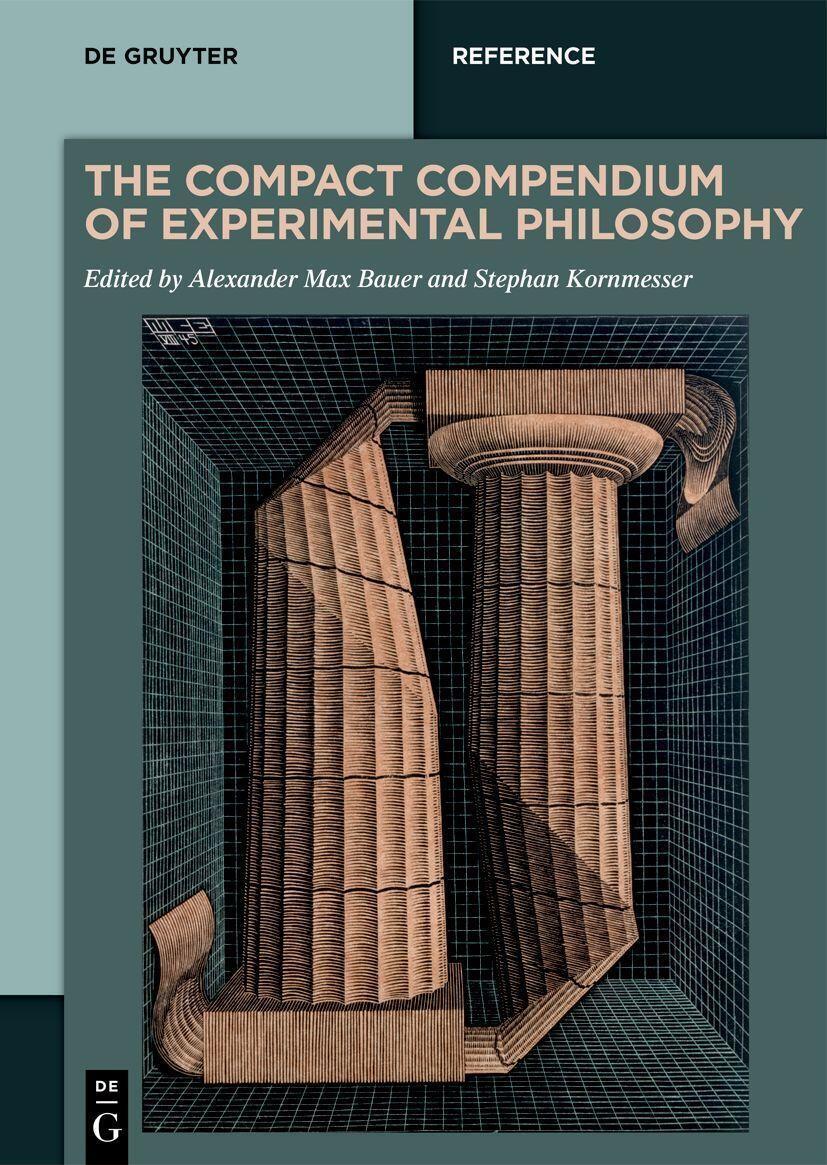
Hot Off The Press: “The Compact Compendium of Experimental Philosophy”

Posted on March 7, 2024January 3, 2025 by Alexander Max Bauer

“The Compact Compendium of Experimental Philosophy,” a new entry into the “De Gruyter Reference” series, brings together experimental philosophers from around the globe to provide interested readers with insights into many topics currently researched in X-Phi. See below for the table of contents.

Part 1 – The Philosophy of Experimental Philosophy

  • Justin Sytsma, Joseph Ulatowski, and Chad Gonnerman: “History and Philosophy of Experimental Philosophy – All in the Family”
  • Eugen Fischer and Justin Sytsma: “Projects and Methods of Experimental Philosophy”
  • Joachim Horvath: “Intuitions in Experimental Philosophy”
  • Theodore Bach: “Limitations and Criticism of Experimental Philosophy”

Part 2 – Topics from Theoretical Philosophy

  • Paul Henne: “Experimental Metaphysics – Causation”
  • James R. Beebe: “Experimental Epistemology – Knowledge and Gettier Cases”
  • Edouard Machery: “Experimental Philosophy of Language – Proper Names and Predicates”
  • Igor Douven, Shira Elqayam, and Karolina Krzyżanowska: “The Experimental Philosophy of Logic and Formal Epistemology – Conditionals”
  • Jonathan Waskan: “Experimental Philosophy of Science – Scientific Explanation”
  • Mark Phelan: “Experimental Philosophy of Mind – Conscious State Attribution”

Part 3 – Topics from Practical Philosophy

  • Justin Bruner: “Experimental Political Philosophy – Social Contract”
  • Raff Donelson: “Experimental Legal Philosophy – General Jurisprudence”
  • Thomas Nadelhoffer: “Experimental Philosophy of Action – Free Will and Moral Responsibility”
  • Rodrigo Díaz: “Experimental Philosophy of Emotion – Emotion Theory”
  • Ian M. Church: “Experimental Philosophy of Religion – Problem of Evil”
  • Florian Cova: “Experimental Philosophy of Aesthetics – Aesthetic Judgment”

Literature

Bauer, Alexander Max, and Stephan Kornmesser (eds.) (2023): The Compact Compendium of Experimental Philosophy, Berlin and Boston: Walter de Gruyter. (Link)

Search

Categories

Tags

Agency Artificial Intelligence Basic Needs Behavior Beliefs Bias Bioethics Blame Causation Cognitive Science Consciousness Corpus Analysis Cross-Cultural Research Decisions Determinism Distributive Justice Emotions Essentialism Expertise Folk Morality Framing Free Will Gender Intention Intuition Jurisprudence Knowledge Large Language Models Moral Psychology Norms Pejoratives Problem of Evil Psycholinguistics Rationality Reasoning Replication Responsibility Self Side-Effect Effect Slurs Truth Valence Values Virtue Well-Being

Recent Posts

  • Call: “The Armchair on Trial”
  • Call: “Interdisciplinary Perspectives on Linguistic Justice”
  • Call: “6th European Experimental Philosophy Conference”
  • Talk: “Ethics in the Lab” (Pascale Willemsen)
  • Talk: “Normality and Norms” (Josh Knobe)

Recent Comments

  1. Nova Praxis on The Folk Concept of ArtJuly 11, 2025

    This article highlights an important point: everyday people don’t rely on rigid definitions to determine what qualifies as art. They’re…

  2. Koen Smets on Priming Effects Are Fake, but Framing Effects Are RealMay 27, 2025

    That is indeed exactly the question I have as well. I operationalize it as having de facto contradicting intuitions, in…

  3. Joshua Knobe on Priming Effects Are Fake, but Framing Effects Are RealMay 24, 2025

    Hi Koen, Thanks once again. This idea brings up all sorts of fascinating questions, but for the purposes of the…

  4. Koen Smets on Priming Effects Are Fake, but Framing Effects Are RealMay 24, 2025

    Great! In the meantime I thought of another potentially interesting example of framing—Arnold Kling’s Three Languages of Politics. Just about…

  5. Joshua Knobe on Priming Effects Are Fake, but Framing Effects Are RealMay 23, 2025

    Thanks Koen! This is all super helpful.

Archives

  • February 2026
  • January 2026
  • December 2025
  • November 2025
  • October 2025
  • September 2025
  • August 2025
  • July 2025
  • June 2025
  • May 2025
  • April 2025
  • March 2025
  • February 2025
  • January 2025
  • December 2024
  • November 2024
  • October 2024
  • September 2024
  • August 2024
  • July 2024
  • June 2024
  • May 2024
  • April 2024
  • March 2024

Meta

  • Log in
  • Entries feed
  • Comments feed
  • WordPress.org

Imprint • Disclaimer • Privacy Statement • Cookie Policy

© 2024 The Experimental Philosophy Blog
Manage Consent
To provide the best experiences, we use technologies like cookies to store and/or access device information. Consenting to these technologies will allow us to process data such as browsing behavior or unique IDs on this site. Not consenting or withdrawing consent, may adversely affect certain features and functions.
Functional Always active
The technical storage or access is strictly necessary for the legitimate purpose of enabling the use of a specific service explicitly requested by the subscriber or user, or for the sole purpose of carrying out the transmission of a communication over an electronic communications network.
Preferences
The technical storage or access is necessary for the legitimate purpose of storing preferences that are not requested by the subscriber or user.
Statistics
The technical storage or access that is used exclusively for statistical purposes. The technical storage or access that is used exclusively for anonymous statistical purposes. Without a subpoena, voluntary compliance on the part of your Internet Service Provider, or additional records from a third party, information stored or retrieved for this purpose alone cannot usually be used to identify you.
Marketing
The technical storage or access is required to create user profiles to send advertising, or to track the user on a website or across several websites for similar marketing purposes.
  • Manage options
  • Manage services
  • Manage {vendor_count} vendors
  • Read more about these purposes
View Preferences
  • {title}
  • {title}
  • {title}