The Experimental Philosophy Blog

Philosophy Meets Empirical Research

Menu
  • Home
  • About
  • Guidelines for Comments
  • Labs and Organizations
  • Resources
Menu

Tag: Intention

Hot Off The Press: “The Cambridge Handbook of Experimental Jurisprudence”

Posted on May 16, 2025May 16, 2025 by Alexander Max Bauer

Recently, “The Cambridge Handbook of Experimental Jurisprudence,” a new entry in the “Cambridge Law Handbooks” series, has been published. It was edited by Kevin Tobia and contains no fewer than 38 chapters. See below for the table of contents.

Part 1 – Foundations and Theory

  • Kevin Tobia: “Introduction”
  • Barbara A. Spellman, Jennifer K. Robbennolt, Janice Nadler, and Tess Wilkinson-Ryan: “Psychology and Jurisprudence Across the Curriculum”
  • John Mikhail: “Holmes, Legal Realism, and Experimental Jurisprudence”
  • Frederick Schauer: “The Empirical Component of Analytic Jurisprudence”
  • Felipe Jiménez: “The Limits of Experimental Jurisprudence”
  • Jonathan Lewis: “Competing Conceptual Inferences and the Limits of Experimental Jurisprudence”
  • Joseph Avery, Alissa del Riego, and Patricia Sánchez Abril: “The Contours of Bias in Experimental Jurisprudence”
  • Christoph Bublitz: “Experimental Jurisprudence and Doctrinal Reasoning – A View from German Criminal Law”
  • Bert I. Huang: “Law and Morality”
  • Brian Sheppard: “Legal Constraint”

Part 2 – Introductions

  • Guilherme da Franca Couto Fernandes de Almeida, Noel Struchiner, and Ivar Hannikainen: “Rules”
  • James A. Macleod: “Surveys and Experiments in Statutory Interpretation”
  • Thomas R. Lee and Stephen C. Mouritsen: “Corpus Linguistics and Armchair Jurisprudence”
  • Meirav Furth-Matzkin: “Using Experiments to Inform the Regulation of Consumer Contracts”
  • Doron Dorfman: “Experimental Jurisprudence of Health and Disability Law”
  • Jessica Bregant, Jennifer K. Robbennolt, and Verity Winship: “Studying Public Perceptions of Settlement”
  • Benedikt Pirker, Izabela Skoczeń, and Veronika Fikfak: “Experimental Jurisprudence in International Law”
  • Heidi H. Liu: “The Law and Psychology of Gender Stereotyping”
  • Christian Mott: “The Experimental Jurisprudence of Persistence through Time”
  • Lukas Holste and Holger Spamann: “Experimental Investigations of Judicial Decision-Making”
  • Christoph Engel and Rima-Maria Rahal: “Eye-Tracking as a Method for Legal Research”
  • Jessica Bregant: “Intuitive Jurisprudence – What Experimental Jurisprudence Can Learn from Developmental Science”

Part 3 – Applications

  • Corey H. Allen, Thomas Nadelhoffer, Jason Shepard, and Eyal Aharoni: “Moral Judgments about Retributive Vigilantism”
  • Karolina M. Prochownik, Romy D. Feiertag, Joachim Horvath, and Alex Wiegmann: “How Much Harm Does It Take? An Experimental Study on Legal Expertise, the Severity Effect, and Intentionality Ascriptions”
  • Gabriel Lima and Meeyoung Cha: “Human Perceptions of AI-Caused Harm”
  • Christopher Brett Jaeger: “Reasonableness from an Experimental Jurisprudence Perspective”
  • Lucien Baumgartner and Markus Kneer: “The Meaning of ‘Reasonable’ – Evidence from a Corpus-Linguistic Study”
  • Roseanna Sommers: “Commonsense Consent and Action Representation – What is ‘Essential’ to Consent?”
  • Neele Engelmann and Lara Kirfel: “Who Caused It? Different Effects of Statistical and Prescriptive Abnormality on Causal Selection in Chains”
  • Ori Friedman: “Ownership for and Against Control”
  • Andrew Higgins and Inbar Levy: “Examining the Foundations of the Law of Judicial Bias – Expert versus Lay Perspectives on Judicial Recusal”
  • Jacqueline M. Chen and Teneille R. Brown: “The Promise and the Pitfalls of Mock Jury Studies – Testing the Psychology of Character Assessments”
  • Piotr Bystranowski, Ivar Hannikainen, and Kevin Tobia: “Legal Interpretation as Coordination”
  • Janet Randall and Lawrence Solan: “Legal Ambiguities – What Can Psycholinguistics Tell Us?”
  • Eric Martínez and Christoph Winter: “Cross-Cultural Perceptions of Rights for Future Generations”
  • Austin A. Baker and J. Remy Green: “The Right to Transgender Identity”
  • Enrique Cáceres, Christopher Stephens, Azalea Reyes-Aguilar, Daniel Atilano, Manuel García, Rosa Lidia López-Bejarano, Susana González, Carmen Patricia López-Olvera, Octavio Salvador-Ginez, and Margarita Palacios: “The Legal Conductome – The Complexity Behind Decisions”
  • Neil C. Thompson, Brian Flanagan, Edana Richardson, Brian McKenzie, and Xueyun Luo: “Trial by Internet – A Randomized Field Experiment on Wikipedia’s Influence on Judges’ Legal Reasoning”

Literature

Tobia, Kevin (ed.) (2025): The Cambridge Handbook of Experimental Jurisprudence, Cambridge and New York: Cambridge University Press. (Link)

Call: “ESPP 2025”

Posted on February 11, 2025February 11, 2025 by Alexander Max Bauer

The 2025 conference of the European Society for Philosophy and Psychology will take place in Warsaw, Poland, from September 2 to 5, hosted by the Polish Academy of Sciences. As keynote speakers, Emma Borg, Cameron Buckner, Nora Newcombe, and Petra Schumacher are confirmed.

Abstracts for papers, posters, and symposia can be submitted until March 3. The call reads:

The Society invites the submission of papers, posters and symposia. Submissions are refereed and selected on the basis of quality and relevance to psychologists, philosophers and linguists. If you have any questions, contact us by writing an email to espp2025@gmail.com.

Travel scholarships for PhD Students

Thanks to support from IFiS/GSSR, via the NAWA grant PROM Short-term academic exchange (in Polish, PROM Krótkookresowa wymiana akademicka; BPI/PRO/2024/1/00020/DEC/1), we can award up to 10 travel grants for PhD students at universities outside Poland to attend the conference and present a talk or poster. Please see the Call for Applications for these scholarships, which promotes equal opportunity for people with disabilities, and adequate gender representation. Successful applications will be selected on the basis of: (i) quality of the proposed talk or poster, as judged by the ESPP expert reviewers’ report on the anonymised abstract you submit when applying to present at the conference; (ii) NAWA PROM’s eligibility rules (see the Call for Applications).

Submission instructions for papers, posters and symposia

The deadline for all submissions is 3rd March 2025. Submissions should be made online via EasyChair.

Papers should be designed to be presentable within 20 minutes (for a total 30 minutes session). Submissions should consist of a long abstract of up to 1000 words (excluding bibliography). If required, an additional page of tables and/or graphs may be included. A submission for a poster presentation should consist of a 500-word abstract.

When submitting your paper or poster online, please first indicate the primary discipline of your paper (philosophy, psychology, or linguistics) and whether your submission is intended as a paper or a poster. Submitted papers may also be considered for presentation as a poster if space constraints prevent acceptance as a paper or if the submission is thought more suitable for presentation as a poster. All paper and poster submissions (whether abstracts or full papers) should be in DOC or PDF format and should be properly anonymized in order to allow for blind refereeing.

Each person may present only one paper during the conference’s parallel sessions, though you may be a co-author of more than one paper. If you submit multiple single-authored papers only one will be accepted. This includes contributions to submitted symposia.

Symposia are allocated a two-hour slot and consist of a set of four linked papers on a common theme or three linked papers with an introduction. Symposia should include perspectives from at least two of the three disciplines represented in the society (philosophy, psychology and linguistics). Submissions should be made by symposium organizers (not speakers).

When submitting a symposium proposal online, your submissions should include the following three elements in a single PDF:

  1. A list of 3 or 4 speakers which indicates representation of at least two disciplines (individual speakers may also represent multiple disciplines).
  2. A general abstract of up to 500 words, laying out the topics to be addressed and indicating connections among the talks.
  3. Individual abstracts of up to 500 words and provisional titles for each talk. Please do not submit more than one PDF file per symposium.

General Aim

The aim of the European Society for Philosophy and Psychology is to promote interaction between philosophers and psychologists on issues of common concern. Psychologists, neuroscientists, linguists, computer scientists and biologists are encouraged to report experimental, theoretical and clinical work that they judge to have philosophical significance; and philosophers are encouraged to engage with the fundamental issues addressed by and arising out of such work. In recent years ESPP sessions have covered such topics as theory of mind, attention, reference, problems of consciousness, introspection and self-report, emotion, perception, early numerical cognition, spatial concepts, infants’ understanding of intentionality, memory and time, motor imagery, counterfactuals, the semantics/pragmatics distinction, comparative cognition, minimalism in linguistic theory, reasoning, vagueness, mental causation, action and agency, thought without language, externalism, hypnosis, and the interpretation of neuropsychological results.

Hot Off The Press: “Advances in Experimental Philosophy of Law”

Posted on February 7, 2025 by Alexander Max Bauer

Edited by Karolina Prochownik and Stefan Magen, “Advances in Experimental Philosophy of Law,” a new entry into Bloomsbury’s “Advances in Experimental Philosophy” series, has recently been published. See below for the table of contents.

Part 1 – Topics in Experimental General Jurisprudence

  • Raff Donelson: “Experimental Approaches to General Jurisprudence”
  • Guilherme de Almeida, Noel Struchiner, and Ivar Hannikainen: “The Experimental Jurisprudence of the Concept of Rule – Implications for the Hart-Fuller Debate”

Part 2 – Topics in Experimental Particular Jurisprudence

  • Kevin Tobia: “Legislative Intent and Acting Intentionally”
  • Lara Kirfel and Ivar Hannikainen: Why Blame the Ostrich? Understanding Culpability for Willful Ignorance”
  • Paulo Sousa and Gary Lavery: “Culpability and Liability in the Law of Homicide – Do Lay Moral Intuitions Accord with Legal Distinctions?”
  • Levin Güver and Markus Kneer: “Causation and the Silly Norm Effect”

Part 3 – (New) Methods and Topics in Experimental Jurisprudence

  • Justin Sytsma: “Ordinary Meaning and Consilience of Evidence”
  • Pascale Willemsen, Lucien Baumgartner, Severin Frohofer, and Kevin Reuter: “Examining Evaluativity in Legal Discourse – A Comparative Corpus-Linguistic Study of Thick Concepts”
  • Leonard Hoeft: “A Case for Behavioral Studies in Experimental Jurisprudence”
  • Eric Martínez and Christoph Winter: “Experimental Longtermist Jurisprudence”

Literature

Prochownik, Karolina, and Stefan Magen (eds.) (2024): Advances in Experimental Philosophy of Law, London, New York, and Dublin: Bloomsbury. (Link)

Hot Off The Press: “Advances in Experimental Philosophy of Action”

Posted on February 7, 2025February 7, 2025 by Alexander Max Bauer

Edited by Paul Henne and Samuel Murray, “Advances in Experimental Philosophy of Action,” a new entry into Bloomsbury’s “Advances in Experimental Philosophy” series, has recently been published. See below for the table of contents.

  • Justin Sytsma and Melissa Snater: “Consciousness, Phenomenal Consciousness, and Free Will”
  • Myrto Mylopoulos: “Skilled Action and Metacognitive Control”
  • Samuel Murray: “Bringing Self-Control into the Future”
  • Walter Sinnott-Armstrong: “Who is Responsible? Split Brains, Dissociative Identity Disorder, and Implicit Attitudes”
  • Paul Noordhof and Ema Sullivan-Bissett: “The Everyday Irrationality of Monothematic Delusion”
  • John Turri: “Truth, Perspective, and Norms of Assertion – New Findings and Theoretical Advances”
  • Joanna Korman: “The Distinct Functions of Belief and Desire in Intentional Action Explanation”
  • Cory J. Clark, Heather M. Maranges, Brian B. Boutwell, and Roy F. Baumeister: “Free Enough – Human Cognition (and Cultural Interests) Warrant Responsibility”
  • Edouard Machery, Markus Kneer, Pascale Willemsen, and Albert Newen: “Beyond the Courtroom – Agency and the Perception of Free Will”
  • Katrina L. Sifferd: “Do Rape Cases Sit in a Moral Blindspot? The Dual Process Theory of Moral Judgment and Rape”
  • Shane Timmons and Ruth M. J. Byrne: “How People Think About Moral Excellence – The Role of Counterfactual Thoughts in Reasoning about Morally Good Actions”
  • Caroline T. Arruda and Daniel J. Povinelli Index: “Why Idealized Agency Gets Animal (and Human) Agency Wrong”

Literature

Henne, Paul, and Samuel Murray (eds.) (2024): Advances in Experimental Philosophy of Action, London, New York, and Dublin: Bloomsbury. (Link)

Call: “Agency and Intentions in Language”

Posted on October 1, 2024January 1, 2025 by Alexander Max Bauer

The fifth instalment of “Agency and Intentions in Language” (AIL) is coming. Hosted by the University of Göttingen, it will take place online from January 29 to 31, 2025.

Abstracts for presentations can be submitted until December 18, 2025. The call reads:

Call for Papers

On the linguistic side, we welcome submissions examining any grammatical phenomena sensitive to the degree of agency or interpretation of an action as intentional versus accidental, such as controller choice, subjunctive obviation, licensing of polarity items, aspect choice in Slavic, case marking in ergative split languages and ‘out-of-control’ morphology. Topics of interest include, but are not restricted to, the following: ways in which natural languages manifest different degrees of agency or the distinction between intentional and accidental actions (morphological marking, syntactic structures, semantic denotations of verbs and adverbials, pragmatic and contextual differences); connections between agency, intentions, and event structure; relations between agency, intentions, and causation.

On the side of philosophy, we welcome submissions addressing any aspect related to philosophy of action, philosophy of mind, the nature of agency, intentions, and acting intentionally. Both theoretical and empirical research are welcome as they contribute to debates on various theories of action, free will, moral responsibility, nature of reasons, and practical rationality.

On the side of psychology, we welcome submissions that deal with agency, intentions, moral responsibility, and other related topics, broadly construed. Topics of interest include, but are not restricted to, the following: issues in developmental psychology, psycholinguistics, clinical psychology (the sense of agency in individuals with schizophrenia, OCD, etc.), and adults’ perception of agency and responsibility.

Submissions

Anonymous abstracts, not exceeding 2 pages (including references and examples), with font no less than 11 Times New Roman, and 2 cm margins, should be uploaded on AIL5 OpenReview site.

If you are not registered on OpenReview, we recommend you use your institutional email for registration – in this case, your profile will be activated automatically. If you decide to use your non-institutional email, please allow two weeks for the profile to be activated.

We expect to notify authors of their acceptance in early January 2025. Presentations will be allotted 30 minute slots with 15 minutes for questions and discussion.

Teaching Experimental Philosophy to Beginners (Part 1)

Posted on April 29, 2024January 3, 2025 by Alexander Max Bauer

This term at the University of Oldenburg, Stephan Kornmesser and I are teaching a course for master’s students who had no previous contact with x phi.1 We decided to try a hands-on approach rather than just discussing results, debates, and ideas from the field. For this purpose, we divided the course into two parts. In the first half, loosely based on Kornmesser et al. (forthcoming), we introduced some basics of experimental design and statistical analysis. Also, as a paradigmatic example of an early x phi study, we read Knobe (2003). In my opinion, this paper has the advantage of being both short and accessible; the experimental design is simple and the data collected (primarily the nominal yes-or-no responses) can be analyzed quite straightforwardly.

Thereafter, the course was divided into three groups,2 and students were instructed to replicate Knobe’s first study step by step. First, we reconstructed the questionnaire, using a German translation of the vignette (taken from Knobe 2014). Everyone probably knows the vignette, but to refresh your memory, here is the original once again (variations between Harm and Help Condition are indicated by square brackets):

The vice-president of a company went to the chairman of the board and said, “We are thinking of starting a new program. It will help us increase profits, but [and] it will also harm [help] the environment.”

The chairman of the board answered, “I don’t care at all about harming [helping] the environment. I just want to make as much profit as I can. Let’s start the new program.”

They started the new program. Sure enough, the environment was harmed [helped].

Knobe (2003, 190)

Afterwards, students used the questionnaire to ask people on campus whether the chairman brought about the side effect intentionally. Finally, we calculated and interpreted χ2 tests for each group. To foster an understanding of how the χ2 test actually works, we calculated them by hand one step at a time instead of using software.

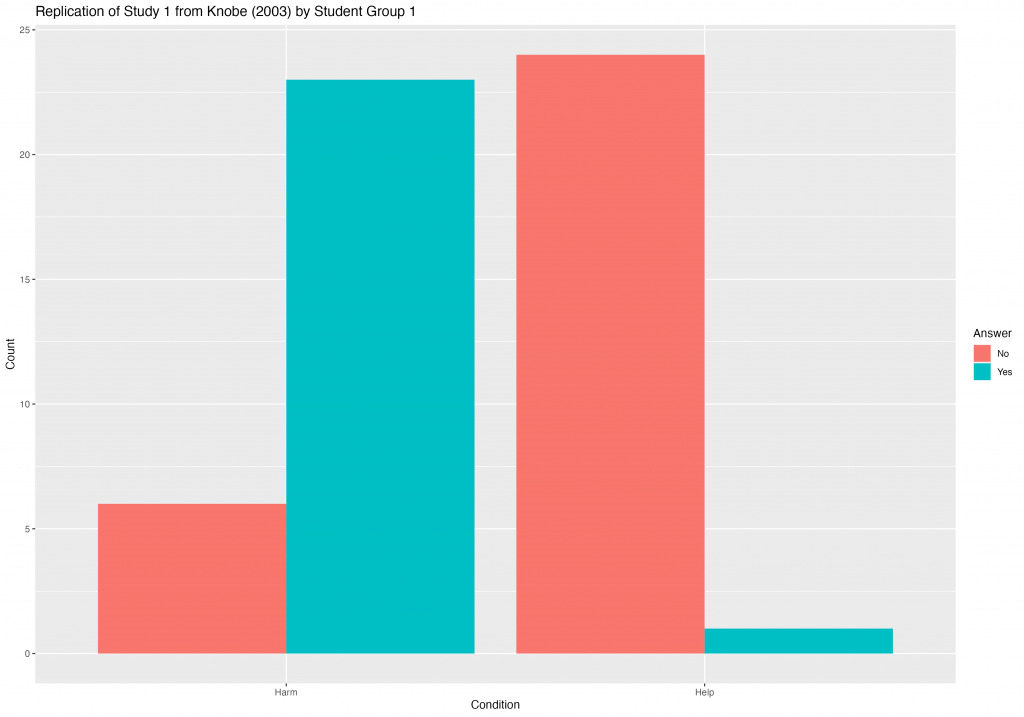
As can be seen in the picture below, showing the results from Group 1, Knobe’s original findings were perfectly replicated.3 In the Harm Condition, most subjects said that the chairman brought about the side effect intentionally, while in the Help Condition, most subjects said that he did not.4

Replication of Study 1 from Knobe (2003) by Student Group 1

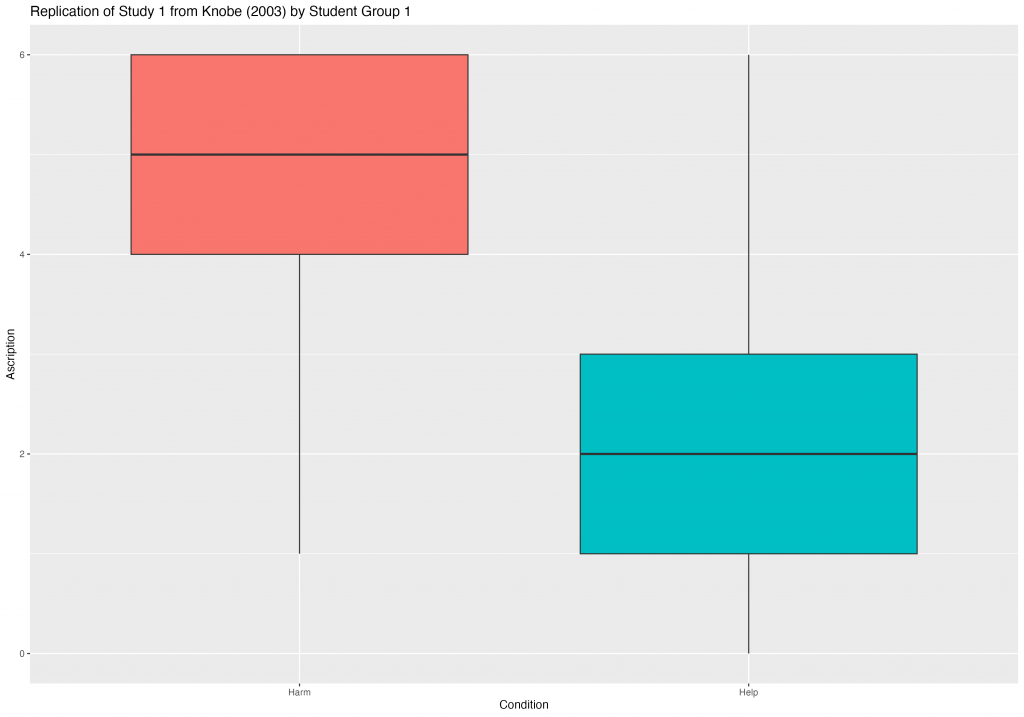
As did Knobe (2003), people were also asked how much praise or blame the chairman deserves. Using the results from Group 1 again as an example, shown in the picture below, the mean of ascribed blame was 4.90 (SD = 1.26), while the mean of ascribed praise was 2.32 (SD = 1.63), which also fits in very well with Knobe’s results.5

Replication of Study 1 from Knobe (2003) by Student Group 1

Where do we go from here? In the second half of our course, the three groups are encouraged to develop their own research questions based on their philosophical interests. They will learn how to design an online survey and set one up themselves. Luckily, we have got a grant for research-based learning instructional projects from the university’s initiative forschen@studium,6 which will be used to recruit subjects from an online panel provider. Hence, learning panel integration will also be on our schedule. This is followed by guided data analysis and interpretation. Finally, the groups present their results to each other and document them in term papers. This means that, in the end, an entire research process is experienced.

Literature

De Cruz, Helen (2019): “Unconventional Teaching Ideas That Work. Teaching Experimental Philosophy to Undergraduate Students,” The Philosophers’ Cocoon, https://philosopherscocoon.typepad.com/blog/2019/02/unconventional-teaching-ideas-that-work-teaching-experimental-philosophy-to-undergraduate-students-h.html.

Kornmesser, Stephan, Alexander Max Bauer, Mark Alfano, Aurélien Allard, Lucien Baumgartner, Florian Cova, Paul Engelhardt, Eugen Fischer, Henrike Meyer, Kevin Reuter, Justin Sytsma, Kyle Thompson, and Marc Wyszynski (forthcoming): Experimental Philosophy for Beginners. A Gentle Introduction to Methods and Tools, Cham: Springer. (Link)

Knobe, Joshua (2003): “Intentional Action and Side Effects in Ordinary Language,” Analysis 63 (3), 190–194. (Link)

Knobe, Joshua (2014): “Absichtliches Handeln und Nebeneffekte in der Alltagssprache,” translated by Jürgen Schröder, in: Thomas Grundmann, Joachim Horvath, and Jens Kipper (eds.): Die Experimentelle Philosophie in der Diskussion, Berlin: Suhrkamp, 96–101. (Link)

Endnotes

  1. If you are interested in teaching x phi to beginners, you should also take a look at De Cruz (2019). In her blog post, she describes a teaching approach to third-year undergraduates at Oxford Brookes University. ↩︎
  2. Of course, the great students of our course deserve credit! Group 1: Johannes Bavendiek, Marvin Jonas Laesecke, and Aileen Wiechmann; Group 2: Rebecca Kratzer, Frederike Lüttich, and Jule Rüterbories; Group 3: Bastian Göbbels, Finn Ove Gronotte, Marina Hinkel, and Riduan Schwarz. ↩︎
  3. Data and materials can be found at https://github.com/alephmembeth/course-x-phi-2024. ↩︎
  4. χ2(1, 54) = 27.865, p < 0.001. For comparison: Knobe (2003, 192) reports χ2(1, 78) = 27.2, p < 0.001. ↩︎
  5. t(54) = 6.43, p < 0.001. For comparison: Knobe (2003, 193) reports – pooled for both of his studies – a mean of 4.8 in the harm condition and of 1.4 in the help condition; t(120) = 8.4, p < 0.001. ↩︎
  6. See https://uol.de/en/forschen-at-studium. ↩︎

Talk: “Experimental Philosophy of Law – Biases in Mens Rea Attribution & How to Address Them” (Markus Kneer)

Posted on April 9, 2024December 30, 2024 by Alexander Max Bauer

On Wednesday, April 10, from 16:00–18:00 (UTC-5), Markus Kneer will be talking about “Biases in Mens Rea Attribution & How to Address Them” at the University of the Andes (Hemiciclo 001) in Bogotá, Colombia. Markus writes:

In this talk I aim to do three things: First, I’ll briefly introduce the new subdiscipline of Experimental Philosophy of Law. Second, I will explore legal conceptions of certain inculpating mental states (mens rea), in particular intention and negligence. To do so, I’ll show how experimental philosophy of law can help elucidate bias in their attribution and potential mismatch between legal and folk conceptions thereof. Third, I will discuss how biases in mens rea attribution could be alleviated.

Search

Categories

Tags

Agency Artificial Intelligence Basic Needs Behavior Beliefs Bias Bioethics Blame Causation Cognitive Science Consciousness Corpus Analysis Cross-Cultural Research Decisions Determinism Distributive Justice Emotions Essentialism Expertise Folk Morality Framing Free Will Gender Intention Intuition Jurisprudence Knowledge Large Language Models Moral Psychology Norms Pejoratives Problem of Evil Psycholinguistics Rationality Reasoning Replication Responsibility Self Side-Effect Effect Slurs Truth Valence Values Virtue Well-Being

Recent Posts

  • Call: “The Armchair on Trial”
  • Call: “Interdisciplinary Perspectives on Linguistic Justice”
  • Call: “6th European Experimental Philosophy Conference”
  • Talk: “Ethics in the Lab” (Pascale Willemsen)
  • Talk: “Normality and Norms” (Josh Knobe)

Recent Comments

  1. Nova Praxis on The Folk Concept of ArtJuly 11, 2025

    This article highlights an important point: everyday people don’t rely on rigid definitions to determine what qualifies as art. They’re…

  2. Koen Smets on Priming Effects Are Fake, but Framing Effects Are RealMay 27, 2025

    That is indeed exactly the question I have as well. I operationalize it as having de facto contradicting intuitions, in…

  3. Joshua Knobe on Priming Effects Are Fake, but Framing Effects Are RealMay 24, 2025

    Hi Koen, Thanks once again. This idea brings up all sorts of fascinating questions, but for the purposes of the…

  4. Koen Smets on Priming Effects Are Fake, but Framing Effects Are RealMay 24, 2025

    Great! In the meantime I thought of another potentially interesting example of framing—Arnold Kling’s Three Languages of Politics. Just about…

  5. Joshua Knobe on Priming Effects Are Fake, but Framing Effects Are RealMay 23, 2025

    Thanks Koen! This is all super helpful.

Archives

  • February 2026
  • January 2026
  • December 2025
  • November 2025
  • October 2025
  • September 2025
  • August 2025
  • July 2025
  • June 2025
  • May 2025
  • April 2025
  • March 2025
  • February 2025
  • January 2025
  • December 2024
  • November 2024
  • October 2024
  • September 2024
  • August 2024
  • July 2024
  • June 2024
  • May 2024
  • April 2024
  • March 2024

Meta

  • Log in
  • Entries feed
  • Comments feed
  • WordPress.org

Imprint • Disclaimer • Privacy Statement • Cookie Policy

© 2024 The Experimental Philosophy Blog
Manage Consent
To provide the best experiences, we use technologies like cookies to store and/or access device information. Consenting to these technologies will allow us to process data such as browsing behavior or unique IDs on this site. Not consenting or withdrawing consent, may adversely affect certain features and functions.
Functional Always active
The technical storage or access is strictly necessary for the legitimate purpose of enabling the use of a specific service explicitly requested by the subscriber or user, or for the sole purpose of carrying out the transmission of a communication over an electronic communications network.
Preferences
The technical storage or access is necessary for the legitimate purpose of storing preferences that are not requested by the subscriber or user.
Statistics
The technical storage or access that is used exclusively for statistical purposes. The technical storage or access that is used exclusively for anonymous statistical purposes. Without a subpoena, voluntary compliance on the part of your Internet Service Provider, or additional records from a third party, information stored or retrieved for this purpose alone cannot usually be used to identify you.
Marketing
The technical storage or access is required to create user profiles to send advertising, or to track the user on a website or across several websites for similar marketing purposes.
  • Manage options
  • Manage services
  • Manage {vendor_count} vendors
  • Read more about these purposes
View Preferences
  • {title}
  • {title}
  • {title}