The Experimental Philosophy Blog

Philosophy Meets Empirical Research

Menu
  • Home
  • About
  • Guidelines for Comments
  • Labs and Organizations
  • Resources
Menu

Category: Jobs

Job: ERC Starting Grant 2027 with the Interdisciplinary Centre for Ethics (Kraków, Poland)

Posted on June 20, 2026June 20, 2026 by Alexander Max Bauer

The Interdisciplinary Centre for Ethics at Jagiellonian University in Kraków is welcoming proposals for ERC Starting Grants.

Expressions of interest are possible until July 10, 2026. The announcement reads:

The Interdisciplinary Centre for Ethics (INCET), a research centre within the Faculty of Philosophy at Jagiellonian University in Kraków, Poland, invites expressions of interest from researchers intending to apply for an ERC Starting Grant in the 2027 call.

We welcome proposals in philosophy, bioethics, philosophy of medicine, political philosophy, experimental philosophy, and related interdisciplinary fields, including projects at the intersection of philosophy and the social sciences, medicine, psychology, law, or data science.

INCET offers a vibrant international research environment and extensive experience in hosting and managing European research grants, including an ERC Starting Grant and multiple Horizon Europe MSCA projects.

Researchers interested in applying with INCET as their host institution are invited to send:

  1. CV, including a list of publications;
  2. short description of the proposed ERC project (1-2 pages).

Expression of interests should be sent no later than July 10, 2026, and will be reviewed on a rolling basis. Early contact is strongly encouraged to allow sufficient time for proposal development and institutional preparation.

Support for Candidates

If selected, candidates will receive support from experienced grant specialists at Jagiellonian University throughout the ERC application process. They will also have an opportunity to obtain detailed feedback on their proposals from INCET researchers. In addition, we plan to organise a dedicated workshop for ERC Starting Grant candidates.

Why INCET?

  • Internationally recognised research centre in ethics and practical philosophy;
  • strong record of success in securing European research funding;
  • dedicated support for ERC proposal development and grant management;
  • interdisciplinary collaborations across philosophy, medicine, psychology, and other fields;
  • full integration into the research community of Jagiellonian University, one of the leading research universities in Central Europe;
  • a dynamic academic environment in Kraków, a historic university city and one of the most attractive cultural destinations in Central Europe.

ERC Starting Grant 2027

ERC Starting Grants support outstanding early-career researchers of all nationalities who are establishing their own independent research programmes. To be eligible for an ERC Starting Grant in the 2027 call for proposals, the applicant must have defended their PhD no more than 10 years before 1 January 2027. More information about eligibility: https://erc.europa.eu/apply-grant/starting-grant

Timeline

  • Expression of interest submission deadline: 10 July 2026
  • Review results: 17 July 2026
  • A workshop for candidates: August 2026
  • Proposal development and internal review (including possible visits to Kraków): July–October 2026
  • Internal submission of the first draft: 31 August 2026
  • Call deadline: 14 October, 2026
  • Publication of the MSCA PF results: Summer 2027
  • Estimated project start (if funded): From October 2027

For informal enquiries and applications, please contact: incet@uj.edu.pl

Job: “Aesthetics for Biological Conservation” (Florence, Italy)

Posted on June 11, 2026June 11, 2026 by Alexander Max Bauer

Mariagrazia Portera is offering a fully funded PhD position at the University of Florence, Italy.

The announcement reads:

Are you passionate about bridging the gap between philosophy and the natural sciences? Do you want to investigate how aesthetic values, ecological concepts, and scientific practices intersect to shape our understanding of the living world? We are looking for a highly motivated, brilliant candidate to join our research team at the University of Florence for a fully funded PhD position starting in November 2026.

This PhD project sits at the cutting edge of contemporary philosophical and ecological debate, focusing on Aesthetics and Biodiversity. While the specific dissertation topic will be refined and tailored in collaboration with the selected candidate, the research will explore how aesthetic appreciation, valuation, and representation impact biodiversity conservation, ecological theories, and environmental policy. By joining our lab, you will benefit from an interdisciplinary ecosystem: You will work closely with the ABC-Lab (Aesthetics for Biological Conservation – Interdepartmental Lab), integrating philosophical inquiry with empirical insights.

Your research will be conducted within the framework of active, strategic agreements with the UniFi Department of Biology, offering access to cross-disciplinary expertise, seminars, and scientific networks. We welcome expressions of interest from candidates holding (or about to complete) a Master’s Degree (or equivalent) in Philosophy, Environmental Humanities, or related fields. Ideal candidates should demonstrate strong competencies or a solid background in one or more of the following areas: Aesthetics (Environmental, Evolutionary, or Empirical Aesthetics), Philosophy of Biodiversity / Environmental Philosophy, Philosophy of Biology / Philosophy of Science (with a particular focus on the relationship between “Sciences and Values”).

Fluency in English, excellent writing skills, and a strong propensity for interdisciplinary teamwork are essential. For inquiries and details about the application procedures (call for application will be officially open between the beginning of July and the beginning of August), please reach out to Mariagrazia Portera, mariagrazia.portera@unifi.it.

Job: “Center for Logic, Language, and Cognition” (Turin, Italy)

Posted on June 11, 2026June 11, 2026 by Alexander Max Bauer

The Center for Logic, Language, and Cognition at the University of Turin invites expressions of interest regarding applications for this year’s Marie Skłodowska-Curie Postdoctoral Fellowship call.

Applications are possible until September 9, 2026. The announcement reads:

The Center for Logic, Language, and Cognition (LLC) at the University of Turin invites expressions of interest from postdoctoral researchers wishing to apply for a Marie Skłodowska-Curie Postdoctoral Fellowship (2026 call).

LLC is an interdisciplinary research center that brings together philosophers, logicians, linguists, psychologists, and computer scientists working on reasoning, language, and cognition. Most of its members belong to the Department of Philosophy and Education, ranked among the top 50 philosophy departments worldwide (QS World University Rankings).

We welcome proposals across the full range of the Center’s research, and especially in the following areas (potential supervisors in brackets):

  • Experimental philosophy, scientometrics, social epistemology (Marsili, Petrovich, Sprenger)
  • Formal epistemology, game and decision theory, philosophy of science (Crupi, Petrovich, Sprenger)
  • History of philosophy and history of science (Biagioli, Giovanelli)
  • Logic, philosophy of logic, and philosophy of mathematics (Genco, Iacona, Plebani, Rossi)
  • Philosophy of art, philosophy of literature, and aesthetics (in the analytic tradition) (Barbero, Caldarola, Di Bona, Kobau, Marsili, Voltolini)
  • Philosophy of language, semantics, and pragmatics (including online communication) (Barbero, Iacona, Marsili, Plebani, Voltolini)
  • Philosophy of mind, perception, and the cognitive sciences (Calzavarini, Di Bona, Voltolini)

A full list of faculty and their research is available at https://www.llc-philosophy.unito.it/people.

The Center currently hosts two grants that offer a particularly active environment for postdoctoral work: COST-X (ERC Starting, PI Neri Marsili), on communicative norms and online misinformation, and HeaR (FIS, PI Elvira Di Bona), on auditory perception and memory.

Interested candidates are invited to send:

  • a CV, including a list of publications;
  • the name of one or two potential supervisors among the LLC faculty;
  • a description of the proposed project (length at the candidate’s discretion; please indicate whether you intend to apply for a Global Fellowship).

Please send these materials to Luca Borgonovo (luca.borgonovo@unito.it) by 20 June 2026 (soft deadline). The official EC deadline for full proposals is 9 September 2026; we will support selected candidates throughout the process.

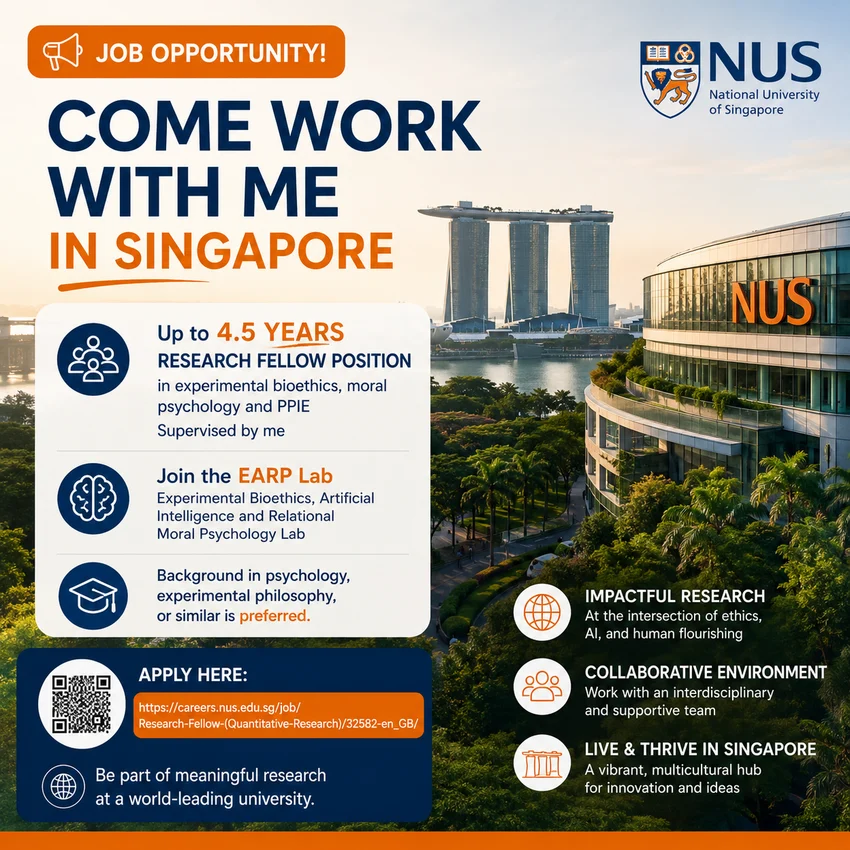
Job: “Collective Reflective Equilibrium for Science Translation” (Singapore)

Posted on June 11, 2026June 11, 2026 by Alexander Max Bauer

The Dean-Med-Centre for Biomedical Ethics at the National University of Singapore is looking for a research fellow specialized in quantitative methods.

The job announcement reads:

Job Description

The Centre for Biomedical Ethics (CBmE) at the Yong Loo Lin School of Medicine, National University of Singapore, invites applications for a Research Fellow (Quantitative Research) position for CREST-SG (Collective Reflective Equilibrium for Science Translation – Singapore). The role is based in Singapore.

CREST-SG is a major national programme focused on empirically grounded, policy-relevant bioethics research across Healthy Longevity, Precision Medicine, Pandemics, and Artificial Intelligence, supported by a cross-cutting legal stream. The programme is led by Prof Julian Savulescu and Dr Sumytra Menon, working with Co-PIs A/P Michael Dunn, A/P Brian Earp, and Asst Prof Owen Schaefer. The successful applicant will report to A/P Brian Earp.

We are seeking an experienced and motivated postdoctoral researcher with expertise in quantitative research and ethical analysis to contribute to research, publications, and policy/practice-oriented outputs, while also supporting programme activities. This is an excellent opportunity for motivated postdoctoral researchers who are able to work independently, manage multiple workstreams, and thrive in an interdisciplinary environment.

Key responsibilities

  • Design, conduct, and analyse quantitative and mixed-methods research, including surveys and questionnaire-based studies
  • Integrate primary quantitative research data with practical ethical analysis
  • Lead the drafting of literature reviews, study materials, analysis, manuscripts, and reports
  • Prepare applications for research ethics review, amendments, and progress reporting, as required
  • Manage own research and administrative activities and coordinate multiple aspects of the work to meet internal deadlines
  • Support the organisation of workshops and meetings, including liaison with the programme administrator on logistics, communications, and event planning

Qualifications

  • PhD specialising in bioethics, or a discipline related to bioethics (e.g., philosophy, sociology, psychology); applicants holding a professional degree in medicine or law must also possess a PhD, together with formal training and demonstrated research experience in bioethics, from a reputable university
  • Strong track record in quantitative research
  • Ability to integrate empirical work with ethical, legal, or policy analysis
  • Peer-reviewed academic publications as sole or first author, relative to career stage
  • Excellent written and oral communication skills in English
  • Strong organisation and project management skills
  • Ability to work both collaboratively and independently

Contract

  • Full-time appointment commencing 1 Oct 2026
  • Initial appointment of 2 years, with the possibility of extension subject to satisfactory performance and funding availability up to 4.5 years

Application

Please submit

  • Cover letter
  • Curriculum vitae with contact details of three referees
  • One writing sample
  • Current and expected salary

Applications will be reviewed on a rolling basis until the position is filled.

Job: “Valence Asymmetries” (Barcelona, Spain)

Posted on May 17, 2026May 17, 2026 by Alexander Max Bauer

The Universitat Pompeu Fabra in Barcelona, Spain, is hiring two postdocs to work on the research project “Valence Asymmetries.”

Applications are possible until May 29, 2026. The job announcement reads:

There is an open call for applications, with a deadline set at 29 May 2026, for two postdoctoral researchers.

The successful candidates will conduct tasks that are transversal to the different work packages of the project. Their research will seek to understand how emotion and affect impact and underlie cognitive processes such as belief formation, decision making, conceptual representation, as well as language production and interpretation. They will work in very close collaboration with Prof. Isidora Stojanovic (project PI) and the entire team.

This is a full-time research position, without any teaching requirements, with a gross annual salary of 31.196,40 €, in a dynamic interdisciplinary team, funded by Prof. Stojanovic’s ERC Advanced grant VALENCE ASYMMETRIES GA N. 101142133.

For further details and in order to apply, consult this offer through Interfolio. The official call, specifying all legal requirement, in Catalan, can be consulted at the Deparment’s website.

Job: “Experimental Argument Analysis” (Norwich, UK)

Posted on October 27, 2025June 20, 2026 by Alexander Max Bauer

The University of East Anglia is hiring a Research Associate to work from January 8 to June 30, 2026, on a research project in experimental philosophy.

Applications are possible until November 25. The job announcement reads:

Salary on appointment will be £31,236 per annum (pro rata), with an annual increment up to 37,694 per annum (pro rata).

An exciting opportunity has arisen for a Research Associate join the School of Psychology to conduct studies in experimental philosophy, as part of the research project “Experimental argument analysis: Reasoning with stereotypes” which is hosted by the UEA Experimental Philosophy Group.

As a Research Associate you will contribute to the research programme, analyse and interpret data, write up results and present information on research progress and outcomes.

You will have a graduate level qualification, equivalent qualification or experience and be able to work in a proactive and results driven manner in a high paced environment. You will also have strong interpersonal and communication skills, the ability to analyse and interpret data and work effectively as part of a team. Advanced skills directly relating to this research area and previous research experience would be advantageous.

This part-time (0.9 FTE) post is available from 8 January 2026 on a fixed-term basis until 30 June 2026.

UEA offers a variety of flexible working options and we encourage applications from individuals who would prefer a flexible working pattern including annualised hours, compressed working hours, part time, job share, term-time only and/or hybrid working. Details of preferred hours should be stated in the personal statement and will be discussed further at interview.

Benefits include:

  • 44 days annual leave inclusive of Bank Holidays and University Customary days (pro rata for part-time).
  • Family and Work-life balance policies including hybrid working and considerable maternity, paternity, shared parental leave and adoption leave.
  • Generous pension scheme with life cover for dependants, plus incapacity cover.
  • Health and Wellbeing: discounted access to Sportspark facilities, relaxation rooms, 320 acres of rolling parkland, wellbeing walks, Wellbeing Ambassador network, on-campus medical centre including NHS Dentist, Occupational Health and a 24/7 Employee Assistance Programme.
  • Campus Facilities: Sportspark, library, nursery, supermarket, post office, bars and catering outlets.
  • Exclusive shopping discounts to help cut the cost of household bills, childcare salary sacrifice scheme, Cycle to Work scheme and public transport discounts.
  • Personal Development: unlimited access to LinkedIn Learning courses, specialist advice and training from our Organisational Development and Professional Learning Team.

Closing date: 25 November 2025

The University holds an Athena Swan Silver Institutional Award in recognition of our advancement towards gender equality.

Further Information

For further information, including the Job Description and Person Specification, please see the attached Candidate Brochure.

For an informal discussion about the post please contact the PI, Professor Eugen Fischer via e.fischer@uea.ac.uk

Job: “PhD Scholarships in Neurophilosophy” (Munich, Germany)

Posted on January 7, 2025October 27, 2025 by Alexander Max Bauer

The Graduate School of Systemic Neuroscience (GSN) at the University of Munich offers PhD scholarships in neurophilosophy.

Applications are possible until November 25. The job announcement reads:

PhD scholarship at GSN

You can apply for a neurophilosophy PhD scholarship in an annually recurring call for scholarships (application period from early December to mid-February). The GSN offers a structured doctoral program with an independent PhD (GSN Doctoral Program), in which you can choose from a wide range of interdisciplinary courses together with your TAC (Thesis Advisory Board) to put together an interdisciplinary study program tailored to your individual research interests. This gives you a sound neuroscientific insight into the (natural) scientific contexts that are important for your neurophilosophical doctoral project. In addition, there is an extensive range of “soft skills” and an attractive social program.

Call for PhD scholarships in Neurophilosophy

The application round for 2024/25 is now open and will close on 17 February 2025 (12:00 noon CET).

The Graduate School of Systemic Neurosciences (GSN) at LMU Munich invites applications for several PhD scholarships in Neurophilosophy. The GSN is the teaching entity for the Munich Center of Neurosciences – Brain & Mind (MCN). By creating an interdisciplinary network of research, the GSN provides a stimulating environment for students and faculty to produce novel formulations of current concepts and theories. Successful applicants will be affiliated with the Research Center for Neurophilosophy and Ethics of Neurosciences at the GSN.

Projects in the research center fall in the following areas:

  • philosophy of cognitive neuroscience (explanation, reduction)
  • philosophy and cognitive science of agency (mental causation, free will, moral psychology, abilities)
  • philosophy and cognitive science of reasoning (e.g. deductive and non-deductive reasoning, logic and neural networks, decision making)
  • ethics of neuroscience (research ethics, enhancement)
  • philosophy of perception
  • philosophy and social cognition

In the new application round we encourage applications in smaller focus areas in order to build research groups. In the 2024/25 round the focus areas are:

  • human agency (esp. mental causation, complex action, multi-tasking, attention, reductive and non-reductive explanation of agency)
  • metacognition (esp. metacognition in perception, self-evaluation and sense of self)
  • group cognition (group epistemology, collective decisions and group responsibility)

However, single exceptional and independent projects in one of the other areas are also encouraged.

Applicants should have advanced training in philosophy (typically a Master’s degree in philosophy) and a genuine interest in the neurosciences. This includes the willingness to acquire substantial knowledge of empirical work relevant to their philosophical project. Cooperative projects with empirical scientists in the network of the MCN are strongly encouraged.

The application period will open on 1 December 2024 and will close on 17 February 2025 (12:00 noon CET). Please check our website and the GSN website for details concerning the application procedure. The application includes an outline of your proposed research project, a CV, an official transcript of your academic work (list of attended courses; grades), diplomas and two separate academic reference letters. Please also name two potential supervisors (possibly including one non-philosopher) from the core or affiliated neurophilosophy faculty of the GSN.

How to apply for a GSN PhD scholarship

Please follow the standard application process for GSN PhD applications:

  • Details of the process and application form

In addition to the application form, please submit a short exposé (max. 3000 words) that

  • gives an outline of your main project
  • explains how your project fits with the focus topic or one of the other topics listed in the call for applications
  • names two or three potential supervisors (at least two in the GSN faculty)
  • sketches an interdisciplinary cooperation project (an empirical study that relates to your theoretical work)

Search

Categories

Tags

Agency Artificial Intelligence Basic Needs Behavior Beliefs Bias Bioethics Blame Causation Cognitive Science Consciousness Corpus Analysis Cross-Cultural Research Decisions Determinism Distributive Justice Emotions Essentialism Expertise Folk Morality Framing Free Will Intention Intuition Jurisprudence Knowledge Large Language Models Moral Psychology Norms Pejoratives Pragmatics Psycholinguistics Psychology Reasoning Reflective Equilibrium Replication Responsibility Self Semantics Side-Effect Effect Slurs Thought Experiments Valence Values Virtue

Recent Posts

  • Job: ERC Starting Grant 2027 with the Interdisciplinary Centre for Ethics (Kraków, Poland)
  • Call: “XPHI UK Work in Progress Workshop Series”
  • What Journals Publish Experimental Philosophy?
  • Job: “Aesthetics for Biological Conservation” (Florence, Italy)
  • Job: “Center for Logic, Language, and Cognition” (Turin, Italy)

Recent Comments

  1. Joanna Demaree-Cotton on Where Should I Publish My X-Phi? A New ResourceApril 24, 2026

    Thanks for the comment, that's really useful. We'll definitely add AJP (missed you accidentally first time!), and that note.

  2. AJP Editor on Where Should I Publish My X-Phi? A New ResourceApril 24, 2026

    AJP is published by Taylor & Francis, and we have an member of the editorial team ('associate editor' in our…

  3. Nova Praxis on The Folk Concept of ArtJuly 11, 2025

    This article highlights an important point: everyday people don’t rely on rigid definitions to determine what qualifies as art. They’re…

  4. Koen Smets on Priming Effects Are Fake, but Framing Effects Are RealMay 27, 2025

    That is indeed exactly the question I have as well. I operationalize it as having de facto contradicting intuitions, in…

  5. Joshua Knobe on Priming Effects Are Fake, but Framing Effects Are RealMay 24, 2025

    Hi Koen, Thanks once again. This idea brings up all sorts of fascinating questions, but for the purposes of the…

Archives

  • June 2026
  • May 2026
  • April 2026
  • March 2026
  • February 2026
  • January 2026
  • December 2025
  • November 2025
  • October 2025
  • September 2025
  • August 2025
  • July 2025
  • June 2025
  • May 2025
  • April 2025
  • March 2025
  • February 2025
  • January 2025
  • December 2024
  • November 2024
  • October 2024
  • September 2024
  • August 2024
  • July 2024
  • June 2024
  • May 2024
  • April 2024
  • March 2024

Meta

  • Log in
  • Entries feed
  • Comments feed
  • WordPress.org

Imprint • Disclaimer • Privacy Statement • Cookie Policy

© 2024 The Experimental Philosophy Blog
Manage Consent
To provide the best experiences, we use technologies like cookies to store and/or access device information. Consenting to these technologies will allow us to process data such as browsing behavior or unique IDs on this site. Not consenting or withdrawing consent, may adversely affect certain features and functions.
Functional Always active
The technical storage or access is strictly necessary for the legitimate purpose of enabling the use of a specific service explicitly requested by the subscriber or user, or for the sole purpose of carrying out the transmission of a communication over an electronic communications network.
Preferences
The technical storage or access is necessary for the legitimate purpose of storing preferences that are not requested by the subscriber or user.
Statistics
The technical storage or access that is used exclusively for statistical purposes. The technical storage or access that is used exclusively for anonymous statistical purposes. Without a subpoena, voluntary compliance on the part of your Internet Service Provider, or additional records from a third party, information stored or retrieved for this purpose alone cannot usually be used to identify you.
Marketing
The technical storage or access is required to create user profiles to send advertising, or to track the user on a website or across several websites for similar marketing purposes.
  • Manage options
  • Manage services
  • Manage {vendor_count} vendors
  • Read more about these purposes
View Preferences
  • {title}
  • {title}
  • {title}