The Experimental Philosophy Blog

Philosophy Meets Empirical Research

Menu
  • Home
  • About
  • Guidelines for Comments
  • Labs and Organizations
  • Resources
Menu

Category: Political Philosophy

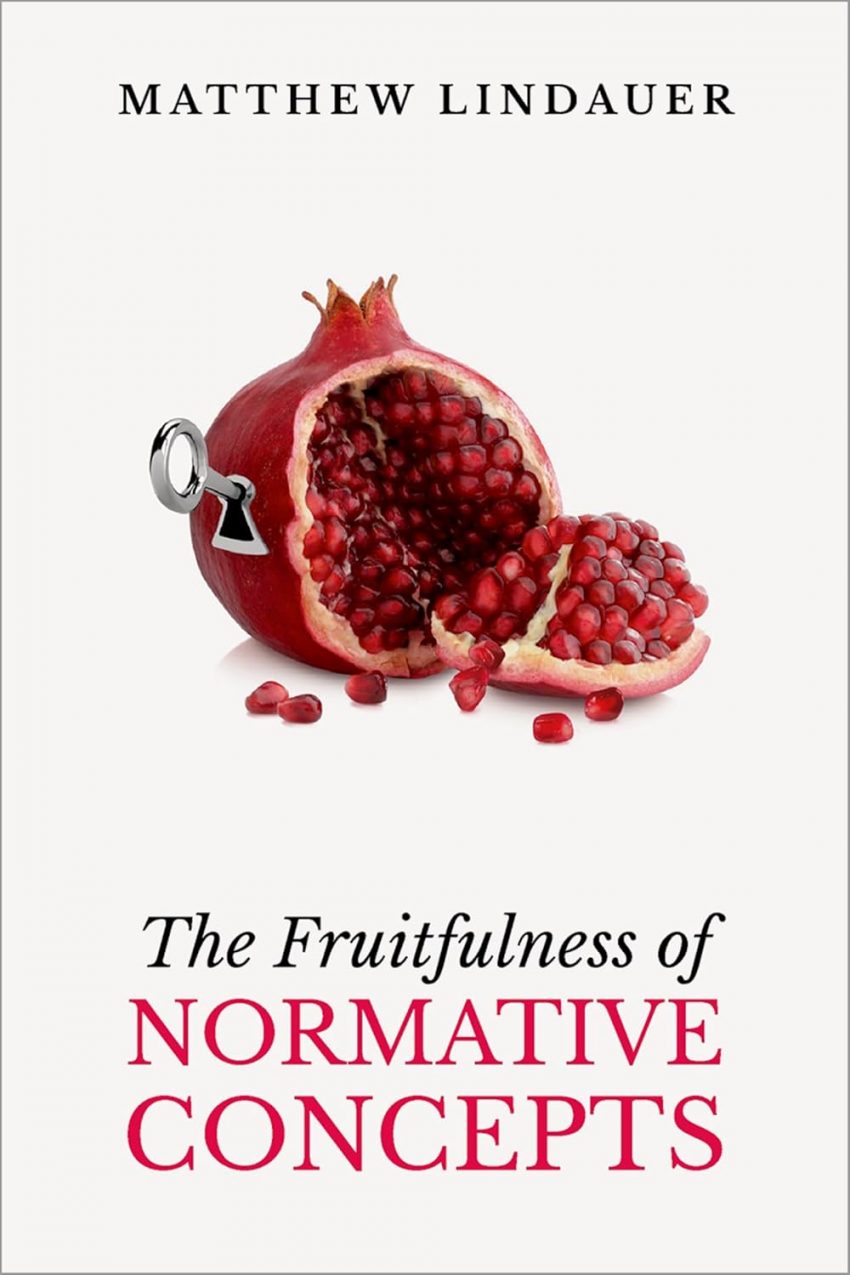
Hot Off The Press: “The Fruitfulness of Normative Concepts”

Posted on January 10, 2026January 10, 2026 by Alexander Max Bauer

In “The Fruitfulness of Normative Concepts,” Matt Lindauer argues for a strong connection between philosophical theory and its real-world applicability, also drawing on moral psychology and adjacent fields. The book’s summary reads:

Can philosophical concepts do real work in improving our world? Should we, when evaluating competing understandings of concepts like “justice,” “empowerment,” and “solidarity,” take into account whether these different understandings can actually help us to fight injustice, empower the oppressed, and promote solidarity between people? The Fruitfulness of Normative Concepts is the first book-length attempt to argue that the answer to both of these questions is an emphatic “yes.” In doing so, it provides a bold new defense of a tight relationship between philosophical theory and practice. The book advances the view that moral and political philosophers should be interested in the “fruitfulness” of normative concepts – how well they help us to solve practical problems that we inevitably face as human beings interacting with one another. This view has broad implications for a number of important contemporary philosophical debates that the book examines, including debates over the nature of moral motivation, the duties of the global affluent to the global poor, the nature of justice in diverse multicultural societies, ideal versus non-ideal theory in political philosophy, and conceptual engineering. Drawing on cutting-edge research in moral psychology and adjacent fields, the book also demonstrates that we now have the scientific tools to concretely evaluate the practical value of moral and political concepts. It issues an important call to continue developing the use of these tools and methods to produce more philosophically and scientifically significant work on the distinctive value of normative thought and practice.

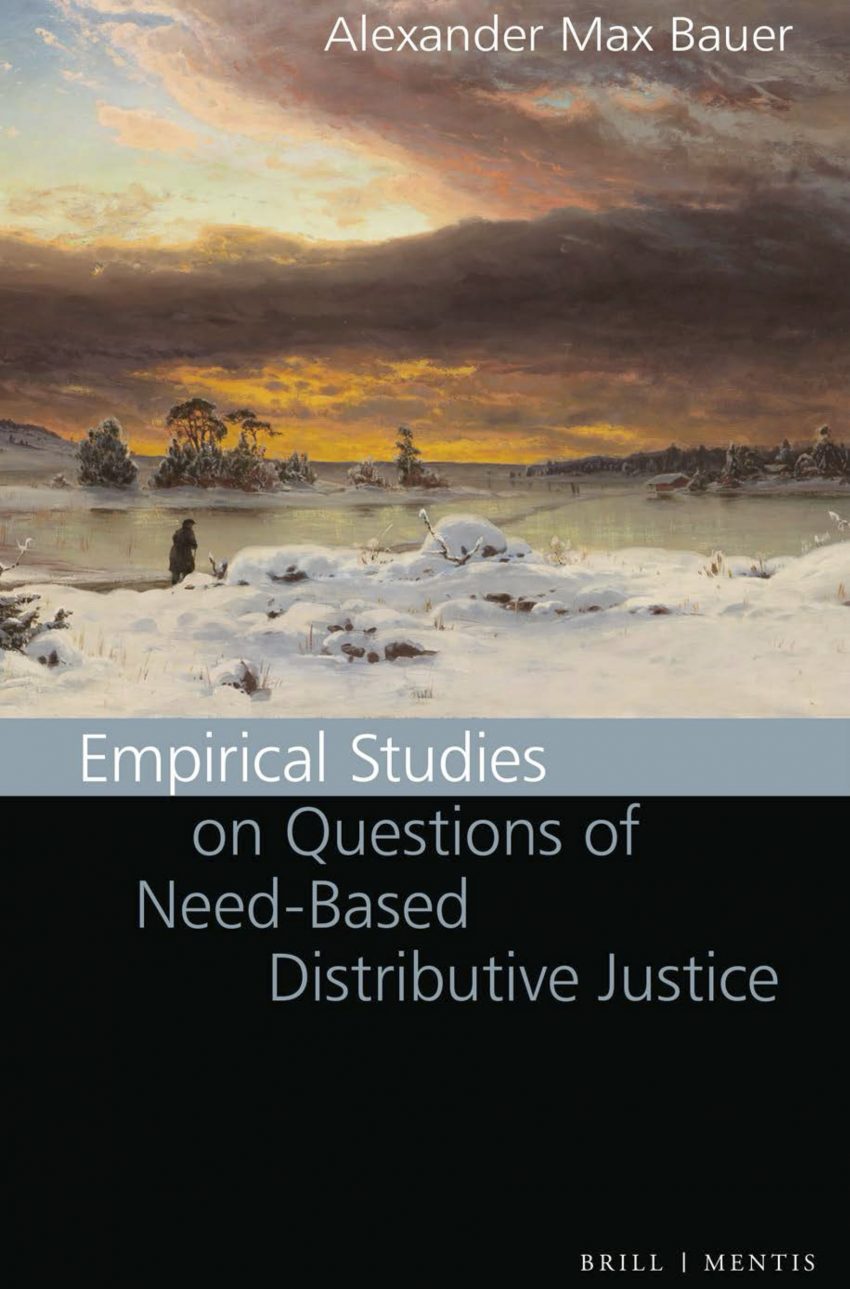
Hot Off The Press: “Empirical Studies on Questions of Need-Based Distributive Justice”

Posted on October 8, 2025October 8, 2025 by Alexander Max Bauer

In “Empirical Studies on Questions of Need-Based Distributive Justice” (the English translation of last year’s “Empirische Studien zu Fragen der Bedarfsgerechtigkeit”), I recap a series of vignette studies that examine the role that needs play in dealing with problems of distributive justice. As I summarised in last year’s post:

Among other things, the following becomes clear:

  1. Impartial observers make gradual assessments of the fairness of distributions.
  2. These assessments depend on how well an individual is supplied with a relevant good.
  3. If information on a need threshold is given, these assessments are made relative to this reference point. (Bauer et al. 2023a [later published as Bauer et al. 2025])
  4. Impartial decision-makers consider need, productivity, and accountability when making hypothetical distribution decisions.
  5. If an individual’s productivity is not sufficient to cover their needs, these higher needs are partially compensated for (at the expense of other individuals who are not so badly off)
  6. Willingness to compensate decreases if an individual is accountable for having produced less or for needing more. (Bauer et al. 2022)
  7. Both impartial observers and impartial decision-makers attribute different levels of importance to different kinds of needs.
  8. This reveals a hierarchy of needs in the following order: Survival, Decency, Belonging, Autonomy. (Bauer et al. 2023b)

Literature

Bauer, Alexander Max, Frauke Meyer, Jan Romann, Mark Siebel, and Stefan Traub (2022): “Need, Equity, and Accountability. Evidence on Third-Party Distribution Decisions from a Vignette Study,” Social Choice and Welfare 59, 769–814. (Link)

Bauer, Alexander Max, Adele Diederich, Stefan Traub, and Arne Robert Weiss (2023a): “When the Poorest Are Neglected. A Vignette Experiment on Need-Based Distributive Justice,” SSRN Working Paper 4503209. (Link)

Bauer, Alexander Max, Jan Romann, Mark Siebel, and Stefan Traub (2023b): “Winter is Coming. How Laypeople Think About Different Kinds of Needs,” PLoS ONE 18 (11), e0294572. (Link)

Bauer, Alexander Max (2024): Empirische Studien zu Fragen der Bedarfsgerechtigkeit, Oldenburg: University of Oldenburg Press. (Link)

Bauer, Alexander Max (2025): Empirical Studies on Questions of Need-Based Distributive Justice, Paderborn: mentis. (Link)

Bauer, Alexander Max, Adele Diederich, Stefan Traub, and Arne Robert Weiss (2025): “Thinking About Need. A Vignette Experiment on Need-Based Distributive Justice,” The Journal of Economic Inequality 23 (3), 667–693. (Link)

Hot Off The Press: “Experiments in Moral and Political Philosophy”

Posted on July 29, 2024January 9, 2025 by Alexander Max Bauer

“Experiments in Moral and Political Philosophy,” a new entry into the “Routledge Studies in Ethics and Moral Theory” series, edited by Hugo Viciana, Antonio Gaitán, and Fernando Aguiar, comprises 17 chapters. See below for the table of contents.

  • Antonio Gaitán, Fernando Aguiar, and Hugo Viciana: “The Experimental Turn in Moral and Political Philosophy”

Part 1 – Methods and Foundations

  • Ivar R. Hannikainen, Brian Flanagan, and Karolina Prochownik: “The Natural Law Thesis Under Empirical Scrutiny”
  • Philipp Schoenegger and Ben Grodeck: “Concrete Over Abstract – Experimental Evidence of Reflective Equilibrium in Population Ethics”
  • Dana Kay Nelkin, Craig R. M. McKenzie, Samuel C. Rickless, and Arseny Ryazanov: “Trolley Problems Reimagined – Sensitivity to Ratio, Risk, and Comparisons”
  • Lieuwe Zijlstra: “The Psychology of Metaethics – Evidence For and Against Folk Moral Objectivism”
  • Thomas Pölzler: “The Explanatory Redundancy Challenge to Moral Properties”
  • Cuizhu Wang: “Belief Distributions and the Measure of Social Norms”
  • Mariìa Jimeìnez Buedo: “Coming Full Circle – Incentives, Reactivity, and the Experimental Turn”

Part 2 – Normative Ethics and Legal and Political Philosophy

  • Stefan Schubert and Lucius Caviola: “Virtues for Real-World Utilitarians”
  • Aurélien Allard and Florian Cova: “What Experiments Can Teach Us About Justice and Impartiality – Vindicating Experimental Political Philosophy”
  • Hadar Dancig-Rosenberg and Yuval Feldman: “A Behavioral Ethics Perspective on the Theory of Criminal Law and Punishment”
  • Douglas Husak: “Behavioral Ethics and the Extent of Responsibility”
  • François Jaquet: “Against Moorean Defences of Speciesism”

Part 3: Applied Issues

  • Blanca Rodrìguez: “Experimental Bioethics and the Case for Human Enhancement”
  • Norbert Paulo, Leonie Alina Möck, and Lando Kirchmair: “The Use and Abuse of Moral Preferences in the Ethics of Self-Driving Cars”
  • Urna Chakrabarty, Romy Feiertag, Anne-Marie McCallion, Brain McNiff, Jesse Prinz, Montaque Reynolds, Sukhvinder Shahi, Maya von Ziegesar, and Angella Yamamoto: “Adaptive Preferences – An Empirical Investigation of Feminist Perspectives”
  • Anastasia Chan, Marinus Ferreira, and Mark Alfano: “Reactionary Attitudes – Strawson, Twitter, and the Black Lives Matter Movement”

Literature

Viciana, Hugo, Antonio Gaitán, and Fernando Aguiar (eds.) (2023): Experiments in Moral and Political Philosophy, New York: Routledge. (Link)

Hot Off The Press: “Priority of Needs?”

Posted on July 9, 2024January 3, 2025 by Alexander Max Bauer

Members of the interdisciplinary research group “Need-Based Justice and Distribution Procedures,” funded by the German Research Foundation, have summarized the results of more than six years of research in the volume “Priority of Needs? An Informed Theory of Need-Based Justice,” edited by Bernhard Kittel and Stefan Traub. The research group’s mission statement reads:

The objective of the research group “Need-Based Justice and Distribution Procedures” is to empirically contribute to establishing a positive and informed normative theory of need-based justice. This theory should provide answers to four questions: (i) How do individuals identify their needs and which distributions are considered sufficient for those needs? (ii) On the collective level, what is considered need-based justice and which processes lead to acceptance of those needs? (iii) Which collective dynamics unfold during this acceptance process in the context of (un-)stable political compromises? (iv) Which incentive-based effects of the collective level can be observed on the individual level, and is a need-based redistribution sustainable?

See below for the table of contents.

Part 1 – Identification of Needs

  • Adele Diederich: “Need as One Distribution Principle – Frames and Framing”
  • Alexander Max Bauer and Mark Siebel: “Measuring Need-Based Justice – Empirically and Formally”

Part 2 – Structures and Processes of the Recognition of Needs

  • Bernhard Kittel: “The Social Recognition of Needs”
  • Markus Tepe and Nils Springhorn: “The Political Recognition of Needs”
  • Tanja Pritzlaff-Scheele, Patricia F. Zauchner, and Frank Nullmeier: “Deliberation and Need-Based Distribution”

Part 3 – Welfare Consequences of Prioritizing Need-Based Distributions

  • Andreas Nicklisch: “Need-Based Justice and Social Utility – A Preference Approach”
  • Stefan Traub, Jan Philipp Krügel, and Meike Benker: “How Sustainable is Need-Based Redistribution?”

Part 4 – Differentiation

  • Kai-Uwe Schnapp: “Need and Street-Level Bureaucracy – How Street-Level Bureaucrats Understand and Prioritize Need”
  • Adele Diederich and Marc Wyszynski: “Justice Principles, Prioritization in the Healthcare Sector, and the Effect of Framing”

Literature

Kittel, Bernhard, and Stefan Traub (eds.) (2024): Priority of Needs? An Informed Theory of Need-Based Justice, Cham: Springer. (Link)

Hot Off The Press: “Empirische Studien zu Fragen der Bedarfsgerechtigkeit”

Posted on March 19, 2024October 8, 2025 by Alexander Max Bauer

Needs are something that fundamentally defines us as human beings. In “Empirische Studien zu Fragen der Bedarfsgerechtigkeit” (Empirical Studies on Questions of Need-Based Distributive Justice), I recap a series of vignette studies that examine the role that needs play in dealing with problems of distributive justice. While needs are often underrepresented in discussions of distributive justice, they are shown to have a fundamental importance in people’s thinking.

Among other things, the following becomes clear:

  1. Impartial observers make gradual assessments of the fairness of distributions.
  2. These assessments depend on how well an individual is supplied with a relevant good.
  3. If information on a need threshold is given, these assessments are made relative to this reference point. (Bauer et al. 2023a)
  4. Impartial decision-makers consider need, productivity, and accountability when making hypothetical distribution decisions.
  5. If an individual’s productivity is not sufficient to cover their needs, these higher needs are partially compensated for (at the expense of other individuals who are not so badly off)
  6. Willingness to compensate decreases if an individual is accountable for having produced less or for needing more. (Bauer et al. 2022)
  7. Both impartial observers and impartial decision-makers attribute different levels of importance to different kinds of needs.
  8. This reveals a hierarchy of needs in the following order: Survival, Decency, Belonging, Autonomy. (Bauer et al. 2023b)

Literature

Bauer, Alexander Max, Frauke Meyer, Jan Romann, Mark Siebel, and Stefan Traub (2022): “Need, Equity, and Accountability. Evidence on Third-Party Distribution Decisions from a Vignette Study,” Social Choice and Welfare 59, 769–814. (Link)

Bauer, Alexander Max, Adele Diederich, Stefan Traub, and Arne Robert Weiss (2023a): “When the Poorest Are Neglected. A Vignette Experiment on Need-Based Distributive Justice,” SSRN Working Paper 4503209. (Link)

Bauer, Alexander Max, Jan Romann, Mark Siebel, and Stefan Traub (2023b): “Winter is Coming. How Laypeople Think About Different Kinds of Needs,” PLoS ONE 18 (11), e0294572. (Link)

Bauer, Alexander Max (2024): Empirische Studien zu Fragen der Bedarfsgerechtigkeit, Oldenburg: University of Oldenburg Press. (Link)

Hot Off The Press: “The Compact Compendium of Experimental Philosophy”

Posted on March 7, 2024January 3, 2025 by Alexander Max Bauer

“The Compact Compendium of Experimental Philosophy,” a new entry into the “De Gruyter Reference” series, brings together experimental philosophers from around the globe to provide interested readers with insights into many topics currently researched in X-Phi. See below for the table of contents.

Part 1 – The Philosophy of Experimental Philosophy

  • Justin Sytsma, Joseph Ulatowski, and Chad Gonnerman: “History and Philosophy of Experimental Philosophy – All in the Family”
  • Eugen Fischer and Justin Sytsma: “Projects and Methods of Experimental Philosophy”
  • Joachim Horvath: “Intuitions in Experimental Philosophy”
  • Theodore Bach: “Limitations and Criticism of Experimental Philosophy”

Part 2 – Topics from Theoretical Philosophy

  • Paul Henne: “Experimental Metaphysics – Causation”
  • James R. Beebe: “Experimental Epistemology – Knowledge and Gettier Cases”
  • Edouard Machery: “Experimental Philosophy of Language – Proper Names and Predicates”
  • Igor Douven, Shira Elqayam, and Karolina Krzyżanowska: “The Experimental Philosophy of Logic and Formal Epistemology – Conditionals”
  • Jonathan Waskan: “Experimental Philosophy of Science – Scientific Explanation”
  • Mark Phelan: “Experimental Philosophy of Mind – Conscious State Attribution”

Part 3 – Topics from Practical Philosophy

  • Justin Bruner: “Experimental Political Philosophy – Social Contract”
  • Raff Donelson: “Experimental Legal Philosophy – General Jurisprudence”
  • Thomas Nadelhoffer: “Experimental Philosophy of Action – Free Will and Moral Responsibility”
  • Rodrigo Díaz: “Experimental Philosophy of Emotion – Emotion Theory”
  • Ian M. Church: “Experimental Philosophy of Religion – Problem of Evil”
  • Florian Cova: “Experimental Philosophy of Aesthetics – Aesthetic Judgment”

Literature

Bauer, Alexander Max, and Stephan Kornmesser (eds.) (2023): The Compact Compendium of Experimental Philosophy, Berlin and Boston: Walter de Gruyter. (Link)

Search

Categories

Tags

Agency Artificial Intelligence Autonomous Systems Basic Needs Behavior Beliefs Bias Bioethics Blame Causation Cognitive Science Consciousness Corpus Analysis Cross-Cultural Research Decisions Determinism Distributive Justice Emotions Essentialism Expertise Folk Morality Framing Free Will Gender Intention Intuition Jurisprudence Knowledge Large Language Models Moral Psychology Norms Pejoratives Psycholinguistics Rationality Reasoning Replication Responsibility Self Side-Effect Effect Slurs Thought Experiments Truth Valence Values Virtue

Recent Posts

  • Call: “Artificial Life as Experimental Philosophy”
  • Conference: “Social Ontology and Empirical Inquiry”
  • Talk: “I wasn’t thinking about that!” (Franz Berto and Aybüke Özgün)
  • Call: “Measuring the Mind”
  • Talk: “Philosophical Thought Experiments Elicit Conflicting Intuitions” (Joshua Knobe and Ivar Hannikainen)

Recent Comments

  1. Nova Praxis on The Folk Concept of ArtJuly 11, 2025

    This article highlights an important point: everyday people don’t rely on rigid definitions to determine what qualifies as art. They’re…

  2. Koen Smets on Priming Effects Are Fake, but Framing Effects Are RealMay 27, 2025

    That is indeed exactly the question I have as well. I operationalize it as having de facto contradicting intuitions, in…

  3. Joshua Knobe on Priming Effects Are Fake, but Framing Effects Are RealMay 24, 2025

    Hi Koen, Thanks once again. This idea brings up all sorts of fascinating questions, but for the purposes of the…

  4. Koen Smets on Priming Effects Are Fake, but Framing Effects Are RealMay 24, 2025

    Great! In the meantime I thought of another potentially interesting example of framing—Arnold Kling’s Three Languages of Politics. Just about…

  5. Joshua Knobe on Priming Effects Are Fake, but Framing Effects Are RealMay 23, 2025

    Thanks Koen! This is all super helpful.

Archives

  • April 2026
  • March 2026
  • February 2026
  • January 2026
  • December 2025
  • November 2025
  • October 2025
  • September 2025
  • August 2025
  • July 2025
  • June 2025
  • May 2025
  • April 2025
  • March 2025
  • February 2025
  • January 2025
  • December 2024
  • November 2024
  • October 2024
  • September 2024
  • August 2024
  • July 2024
  • June 2024
  • May 2024
  • April 2024
  • March 2024

Meta

  • Log in
  • Entries feed
  • Comments feed
  • WordPress.org

Imprint • Disclaimer • Privacy Statement • Cookie Policy

© 2024 The Experimental Philosophy Blog
Manage Consent
To provide the best experiences, we use technologies like cookies to store and/or access device information. Consenting to these technologies will allow us to process data such as browsing behavior or unique IDs on this site. Not consenting or withdrawing consent, may adversely affect certain features and functions.
Functional Always active
The technical storage or access is strictly necessary for the legitimate purpose of enabling the use of a specific service explicitly requested by the subscriber or user, or for the sole purpose of carrying out the transmission of a communication over an electronic communications network.
Preferences
The technical storage or access is necessary for the legitimate purpose of storing preferences that are not requested by the subscriber or user.
Statistics
The technical storage or access that is used exclusively for statistical purposes. The technical storage or access that is used exclusively for anonymous statistical purposes. Without a subpoena, voluntary compliance on the part of your Internet Service Provider, or additional records from a third party, information stored or retrieved for this purpose alone cannot usually be used to identify you.
Marketing
The technical storage or access is required to create user profiles to send advertising, or to track the user on a website or across several websites for similar marketing purposes.
  • Manage options
  • Manage services
  • Manage {vendor_count} vendors
  • Read more about these purposes
View Preferences
  • {title}
  • {title}
  • {title}