The Experimental Philosophy Blog

Philosophy Meets Empirical Research

Menu
  • Home
  • About
  • Guidelines for Comments
  • Labs and Organizations
  • Resources
Menu

Category: Philosophy of Language

Workshop: “Methodological Trends and Challenges in Contemporary Philosophy”

Posted on October 23, 2024December 30, 2024 by Alexander Max Bauer

From October 25 to 26, the workshop “Methodological Trends and Challenges in Contemporary Philosophy,” organized by Martin Justin, Maja Malec, Olga Markič, Nastja Tomat, and Borut Trpin, will take place at the University of Ljubljana, Slovenia. The announcement reads:

Contemporary analytic philosophers have expanded their methodological toolkit beyond traditional philosophical inquiry, embracing a wide array of approaches that intersect with various disciplines. These methods include (but are not limited to) experimental approaches, which involve empirical testing and data collection to inform philosophical hypotheses; non-idealized and naturalized epistemology, which considers the real-world complexities of knowledge acquisition and justification; computer simulations and probabilistic modeling, which enable philosophers to explore complex systems and uncertainties in reasoning; neuroscientific methods, which offer insights into the neural underpinnings of cognitive processes and decision-making; formal ontology, which provides rigorous frameworks for analyzing concepts and categories; conceptual engineering, which involves the deliberate design and modification of conceptual frameworks to address philosophical problems; evolutionary modeling, which investigates the emergence and evolution of cognitive capacities and norms; and feminist perspectives, which critically examine power dynamics and social structures in philosophical discourse.

The upcoming workshop aims to delve into these methodological trends, showcasing recent research that employs these diverse approaches and addressing the challenges and opportunities they present for contemporary philosophy. Over the course of two days, the workshop will feature a total of 14 talks, evenly distributed with 7 talks scheduled for each day. Each keynote talk will span 75 minutes, while contributed talks will be allocated 45 minutes. This workshop seeks to enrich our understanding of contemporary philosophical inquiry and inspire new avenues of research.

October 25, 9:00–17:30 (UTC+2)

  • Jan Sprenger (University of Turin): “Semantic Modeling between Empirical Data and Norms of Rationality”
  • Olga Markič (University of Ljubljana): “Roles of Philosopher in Interdisciplinary Research”
  • Timothy Tambassi (Ca’ Foscari University of Venice): “Is Extensible Markup Language Perspectivist?”
  • Thomas Engeland (University of Bonn): “What Would Methodological Naturalism in Ethics Be?”
  • Paweł Polak (Pontifical University of John Paul II in Krakow) and Roman Krzanowski (Pontifical University of John Paul II in Krakow): “Ethics in Silico – Computer Modeling of Ethical Concepts in Autonomous AI Systems”
  • Michal Hladky (University of Geneva): “End of Logical Positivism? #toosoon”
  • Rafal K. Stepien (Austrian Academy of Sciences): “The Absent Elephant – Non-Western Methods in Contemporary Philosophy”

October 26, 9:00–16:45 (UTC+2)

  • Borut Trpin (Ludwig Maximilian University of Munich, University of Maribor, and University of Ljubljana): “Revisiting Epistemic Coherence From A Posterior-Probability Perspective”
  • Martin Justin (University of Maribor): “The Value of Social Coherence in Science – An Agent-Based-Modelling Exploration”
  • Raimund Pils (University of Salzburg): “Integrating Empirical Research and Philosophical Theorizing on the Scientific Realism Debate for Science Reporting”
  • Juan de Jager (University of Ljubljana): “Making Porosity More Porous – An Open Call for Brainstorming After Tanya Luhrmann’s Recent Findings”
  • Danilo Šuster (University of Maribor): “Open-Mindedness and the Appeal to Ignorance”
  • Nastja Tomat (University of Ljubljana): “Bounded Epistemic Rationality as a Link Between the Normative and the Descriptive”
  • Dunja Šešelja (Ruhr University Bochum): “When Expert Judgment Fails – Epistemic Trespassing and Risks to Collective Inquiry”

Talk: “In the Thick of It” (Matteo Colombo and Giovanni Cassani)

Posted on October 10, 2024January 1, 2025 by Alexander Max Bauer

On Monday, October 14, from 14:30–16:00 (UTC+2), the “Slurring Terms Across Languages” (STAL) network will present Matteo Colombo and Giovanni Cassani’s talk “In the Thick of It – Do Thick Terms Constitute a Distinctive Class of Affectively-Charged Language?” as part of the STAL seminar series. The abstract reads:

Words like “courageous”, “clever”, “gullible”, “smelly” and “tasty” are examples of what philosophers call thick terms, which have a significant degree of descriptive content and are evaluatively loaded, too. Thick terms have been contrasted with purely evaluative terms like “good”, “bad”, “positive” and “negative”, and descriptive terms like “Dutch”, “tall” and “pink”. Despite the amount of attention thick terms have received in philosophy, however, it is unclear whether they constitute a homogeneous class of evaluative terms with characteristic psycholinguistic properties, and whether the psycholinguistic properties of thick terms are reducible to their “valence norms” (i.e., the degree of pleasantness/unpleasantness elicited by a word). In this talk, we explore these two questions based on computational modelling and behavioural data in English, Dutch and Italian. Our results indicate that, compared to other affectively-charged words, thick terms have characteristic psycholinguistic and information properties irreducible to valence norms.

The talk can be joined using Zoom. Please write an email to stalnetwork@gmail.com for the invitation link.

Call: “Agency and Intentions in Language”

Posted on October 1, 2024January 1, 2025 by Alexander Max Bauer

The fifth instalment of “Agency and Intentions in Language” (AIL) is coming. Hosted by the University of Göttingen, it will take place online from January 29 to 31, 2025.

Abstracts for presentations can be submitted until December 18, 2025. The call reads:

Call for Papers

On the linguistic side, we welcome submissions examining any grammatical phenomena sensitive to the degree of agency or interpretation of an action as intentional versus accidental, such as controller choice, subjunctive obviation, licensing of polarity items, aspect choice in Slavic, case marking in ergative split languages and ‘out-of-control’ morphology. Topics of interest include, but are not restricted to, the following: ways in which natural languages manifest different degrees of agency or the distinction between intentional and accidental actions (morphological marking, syntactic structures, semantic denotations of verbs and adverbials, pragmatic and contextual differences); connections between agency, intentions, and event structure; relations between agency, intentions, and causation.

On the side of philosophy, we welcome submissions addressing any aspect related to philosophy of action, philosophy of mind, the nature of agency, intentions, and acting intentionally. Both theoretical and empirical research are welcome as they contribute to debates on various theories of action, free will, moral responsibility, nature of reasons, and practical rationality.

On the side of psychology, we welcome submissions that deal with agency, intentions, moral responsibility, and other related topics, broadly construed. Topics of interest include, but are not restricted to, the following: issues in developmental psychology, psycholinguistics, clinical psychology (the sense of agency in individuals with schizophrenia, OCD, etc.), and adults’ perception of agency and responsibility.

Submissions

Anonymous abstracts, not exceeding 2 pages (including references and examples), with font no less than 11 Times New Roman, and 2 cm margins, should be uploaded on AIL5 OpenReview site.

If you are not registered on OpenReview, we recommend you use your institutional email for registration – in this case, your profile will be activated automatically. If you decide to use your non-institutional email, please allow two weeks for the profile to be activated.

We expect to notify authors of their acceptance in early January 2025. Presentations will be allotted 30 minute slots with 15 minutes for questions and discussion.

Workshop: “XPHI UK Work in Progress Workshop Series”

Posted on September 21, 2024January 1, 2025 by Alexander Max Bauer

The “XPHI UK Work in Progress Workshop Series,” organized by James Andow and Eugen Fischer, continues. They write:

We are looking forward to the next series of our monthly online workshop devoted to discussion of work in progress in experimental philosophy. The workshop is held via Teams, the second Wednesday of each month, 16:00–18:00 UK time. Except for the opening keynote session, all sessions will have two presentations. Please email to register and receive the links (by the day before the session you hope to attend would be ideal).

October 9, 16:00–18:00 (UTC+1)

  • Shaun Nichols (Cornell University): “The PSR and the Folk Metaphysics of Explanation”

November 13, 16:00–18:00 (UTC±0)

  • Monica Ding (King’s College London): “Non-Factive Understanding – Evidence from English, Cantonese, and Mandarin”
  • María Alejandra Petino Zappala (German Cancer Research Center), Phuc Nguyen (German Cancer Research Center), Andrea Quint (German Cancer Research Center), and Nora Heinzelmann (University of Erlangen-Nuremberg): “Digital Interventions to Boost Vaccination Intention – A Report”

December 11, 16:00–18:00 (UTC±0)

  • Elis Jones (Konrad Lorenz Institute for Evolution and Cognition Research): “The Problem of Baselining – Philosophy, History, and Coral Reef Science”
  • April H. Bailey (University of Edinburgh) and Nicholas DiMaggio (University of Chicago Booth School of Business): “Of Minds and Men”

January 8, 16:00–18:00 (UTC±0)

  • Ajinkya Deshmukh (The University of Manchester) and Frederique Janssen-Lauret (The University of Manchester): “Reincarnation and Anti-Essentialism – An Argument Against the Essentiality of Material Origins”
  • Ethan Landes (University of Kent) and Justin Sytsma (Victoria University of Wellington): “LLM Simulated Data – The Good, the Bad, and the Ugly”

February 12, 16:00–18:00 (UTC±0)

  • Elzė Sigutė Mikalonytė (University of Cambridge), Jasmina Stevanov (University of Cambridge), Ryan P. Doran (University of Cambridge), Katherine A. Symons (University of Cambridge), and Simone Schnall (University of Cambridge): “Transformed by Beauty – Exploring the Influence of Aesthetic Appreciation on Abstract Thinking”
  • Poppy Mankowitz (University of Bristol): “Experimenting With ‘Good’”

March 12, 16:00–18:00 (UTC±0)

  • Kathryn Francis (University of Leeds), Maria Ioannidou (University of Bradford), and Matti Wilks (University of Edinburgh): “Does Dietary Identity Influence Moral Anthropocentrism?”
  • Jonathan Lewis (University of Manchester), James Toomey (University of Iowa), Ivar Hannikainen (University of Granada), and Brian D. Earp (National University of Singapore): “Normative Authority, Epistemic Access, and the True Self”

Talk: “Slurs Across Syntactic Realizations” (Bianca Cepollaro, Filippo Domaneschi, and Isidora Stojanovic)

Posted on September 21, 2024January 1, 2025 by Alexander Max Bauer

On Monday, September 23, from 14:30–16:00 (UTC+2), the “Slurring Terms Across Languages” (STAL) network will present Bianca Cepollaro, Filippo Domaneschi, and Isidora Stojanovic’s talk “Slurs Across Syntactic Realizations – Experimental Evidence on Predicative vs. Ad-Nominal Uses of Slurs” as part of the STAL seminar series. The abstract reads:

The research on slurs has been largely striving to understand how slurs encode their pejorative meaning – whether via truth-conditional meaning, or conventional implicature, or presupposition, or otherwise. Less attention has been paid to the question of what kind of pejorative content slurs express or convey. It is the latter question that we undertake in the present talk, and we do so by means of an experimental study conducted over slurring terms in Italian, in line with our earlier studies on pejoratives in Italian (“When is it ok to call someone a jerk? An experimental investigation of expressives”, Synthese 2020, and “Literally ‘a jerk’: an experimental investigation of expressives in predicative position”, Language and Cognition, forthcoming). We explore three options: (1) pejorative content is agent-oriented, that is, reflects the negative attitudes of some salient agent, typically the speaker; (2) pejorative content is target-oriented, that is, brings to salience the negative properties of the person(s) referred to with the slur; (3) pejorative content is intersubjective, that is, reflects the negative attitudes of not only the agent but further conversational participants, or even a larger linguistic community. Crucially, we look at slurs both in predicative position (X is a -slur-) and adnominal position (That -slur- X is Y). Our results show that the agent-oriented option is the preferred one for adnominal uses, while the target-oriented option, for predicative uses: this suggests that the pejorative content encoded by slurs is not uniform but varies along a syntactic dimension.

The talk can be joined using Zoom. Please write an email to stalnetwork@gmail.com for the invitation link.

Hot Off The Press: “Oxford Studies in Experimental Philosophy”

Posted on July 6, 2024January 3, 2025 by Alexander Max Bauer

Volume 5 of the “Oxford Studies in Experimental Philosophy,” edited by Joshua Knobe and Shaun Nichols, just hit the shelves! It comprises a total of 16 chapters on no less than 480 pages. See below for the table of contents.

  • Alexander Max Bauer and Jan Romann: “Equal Deeds, Different Needs”
  • John Bronsteen, Brian Leiter, Jonathan Masur, and Kevin Tobia: “The Folk Theory of Well-Being”
  • Shannon Brick: “Deference to Moral Testimony and (In)Authenticity”
  • Florian Cova: “Calibrating Measures of Folk Objectivism”
  • Justin Sytsma: “Resituating the Influence of Relevant Alternatives”
  • Samuel Murray, Elise Dykhuis, and Thomas Nadelhoffer: “Do People Understand Determinism? The Tracking Problem for Measuring Free Will Beliefs”
  • Natalja Deng, Andrew J. Latham, Kristie Miller, and James Norton: “Investing the Three Ts of Present-Bias – Telic Attitudes, Temporal Preferences and Temporal Ontology”
  • Blake McAllister, Ian Church, Paul Rezkalla, and Long Nguyen: “Empirical Challenges to the Evidential Problem of Evil”
  • Eric Mandelbaum, Jennifer Ware, and Steven Young: “The Sound of Slurs – Bad Sounds for Bad Words”
  • Rebecca Zhu, Mariel Goddu, and Alison Gopnik: “Providing Explanations Shifts Preschoolers’ Metaphor Preferences”
  • Adrian Ziólkowski and Tomasz Zyglewicz: “Truth-Conditional Variability of Color Ascriptions”
  • Joshua Alexander and Jonathan M. Weinberg: “Practices Make Perfect – On Minding Methodology When Mooting Metaphilosophy”
  • Nat Hansen, Kathryn Francis, and Hamish Greening: “Socratic Questionnaires”
  • N. Ángel Pinillos: “Bank Cases, Stakes and Normative Facts”
  • Jon Bebb and Helen Beebee: “Causal Selection and Egalitarianism”
  • Kevin Reuter: “Experimental Philosophy of Consciousness”

Literature

Knobe, Joshua, and Shaun Nichols (eds.) (2024): Oxford Studies in Experimental Philosophy, volume 5, Oxford: Oxford University Press. (Link)

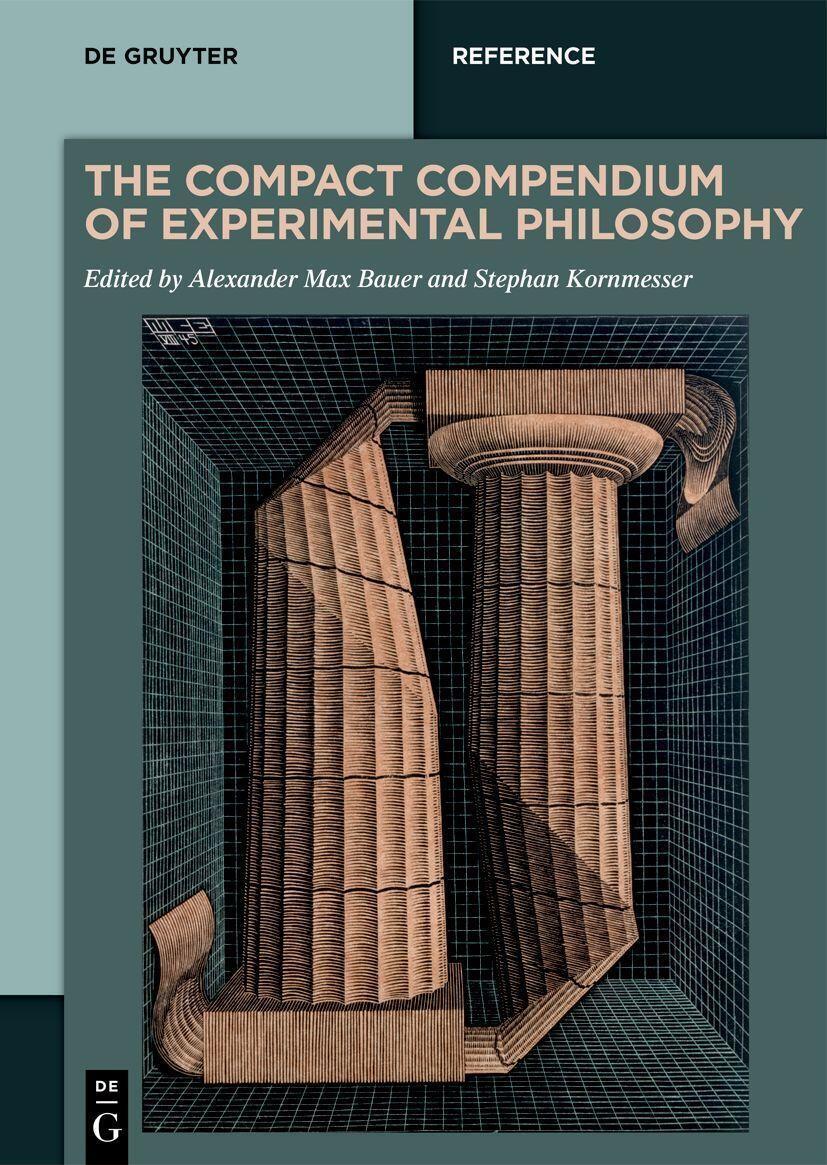
Hot Off The Press: “The Compact Compendium of Experimental Philosophy”

Posted on March 7, 2024January 3, 2025 by Alexander Max Bauer

“The Compact Compendium of Experimental Philosophy,” a new entry into the “De Gruyter Reference” series, brings together experimental philosophers from around the globe to provide interested readers with insights into many topics currently researched in X-Phi. See below for the table of contents.

Part 1 – The Philosophy of Experimental Philosophy

  • Justin Sytsma, Joseph Ulatowski, and Chad Gonnerman: “History and Philosophy of Experimental Philosophy – All in the Family”
  • Eugen Fischer and Justin Sytsma: “Projects and Methods of Experimental Philosophy”
  • Joachim Horvath: “Intuitions in Experimental Philosophy”
  • Theodore Bach: “Limitations and Criticism of Experimental Philosophy”

Part 2 – Topics from Theoretical Philosophy

  • Paul Henne: “Experimental Metaphysics – Causation”
  • James R. Beebe: “Experimental Epistemology – Knowledge and Gettier Cases”
  • Edouard Machery: “Experimental Philosophy of Language – Proper Names and Predicates”
  • Igor Douven, Shira Elqayam, and Karolina Krzyżanowska: “The Experimental Philosophy of Logic and Formal Epistemology – Conditionals”
  • Jonathan Waskan: “Experimental Philosophy of Science – Scientific Explanation”
  • Mark Phelan: “Experimental Philosophy of Mind – Conscious State Attribution”

Part 3 – Topics from Practical Philosophy

  • Justin Bruner: “Experimental Political Philosophy – Social Contract”
  • Raff Donelson: “Experimental Legal Philosophy – General Jurisprudence”
  • Thomas Nadelhoffer: “Experimental Philosophy of Action – Free Will and Moral Responsibility”
  • Rodrigo Díaz: “Experimental Philosophy of Emotion – Emotion Theory”
  • Ian M. Church: “Experimental Philosophy of Religion – Problem of Evil”
  • Florian Cova: “Experimental Philosophy of Aesthetics – Aesthetic Judgment”

Literature

Bauer, Alexander Max, and Stephan Kornmesser (eds.) (2023): The Compact Compendium of Experimental Philosophy, Berlin and Boston: Walter de Gruyter. (Link)

  • Previous
  • 1
  • 2
  • 3

Search

Categories

Tags

Agency Artificial Intelligence Basic Needs Behavior Beliefs Bias Bioethics Blame Causation Cognitive Science Consciousness Corpus Analysis Cross-Cultural Research Decisions Determinism Distributive Justice Emotions Essentialism Expertise Folk Morality Framing Free Will Gender Intention Intuition Jurisprudence Knowledge Large Language Models Moral Psychology Norms Pejoratives Problem of Evil Psycholinguistics Rationality Reasoning Replication Responsibility Self Side-Effect Effect Slurs Truth Valence Values Virtue Well-Being

Recent Posts

  • Call: “The Armchair on Trial”
  • Call: “Interdisciplinary Perspectives on Linguistic Justice”
  • Call: “6th European Experimental Philosophy Conference”
  • Talk: “Ethics in the Lab” (Pascale Willemsen)
  • Talk: “Normality and Norms” (Josh Knobe)

Recent Comments

  1. Nova Praxis on The Folk Concept of ArtJuly 11, 2025

    This article highlights an important point: everyday people don’t rely on rigid definitions to determine what qualifies as art. They’re…

  2. Koen Smets on Priming Effects Are Fake, but Framing Effects Are RealMay 27, 2025

    That is indeed exactly the question I have as well. I operationalize it as having de facto contradicting intuitions, in…

  3. Joshua Knobe on Priming Effects Are Fake, but Framing Effects Are RealMay 24, 2025

    Hi Koen, Thanks once again. This idea brings up all sorts of fascinating questions, but for the purposes of the…

  4. Koen Smets on Priming Effects Are Fake, but Framing Effects Are RealMay 24, 2025

    Great! In the meantime I thought of another potentially interesting example of framing—Arnold Kling’s Three Languages of Politics. Just about…

  5. Joshua Knobe on Priming Effects Are Fake, but Framing Effects Are RealMay 23, 2025

    Thanks Koen! This is all super helpful.

Archives

  • February 2026
  • January 2026
  • December 2025
  • November 2025
  • October 2025
  • September 2025
  • August 2025
  • July 2025
  • June 2025
  • May 2025
  • April 2025
  • March 2025
  • February 2025
  • January 2025
  • December 2024
  • November 2024
  • October 2024
  • September 2024
  • August 2024
  • July 2024
  • June 2024
  • May 2024
  • April 2024
  • March 2024

Meta

  • Log in
  • Entries feed
  • Comments feed
  • WordPress.org

Imprint • Disclaimer • Privacy Statement • Cookie Policy

© 2024 The Experimental Philosophy Blog
Manage Consent
To provide the best experiences, we use technologies like cookies to store and/or access device information. Consenting to these technologies will allow us to process data such as browsing behavior or unique IDs on this site. Not consenting or withdrawing consent, may adversely affect certain features and functions.
Functional Always active
The technical storage or access is strictly necessary for the legitimate purpose of enabling the use of a specific service explicitly requested by the subscriber or user, or for the sole purpose of carrying out the transmission of a communication over an electronic communications network.
Preferences
The technical storage or access is necessary for the legitimate purpose of storing preferences that are not requested by the subscriber or user.
Statistics
The technical storage or access that is used exclusively for statistical purposes. The technical storage or access that is used exclusively for anonymous statistical purposes. Without a subpoena, voluntary compliance on the part of your Internet Service Provider, or additional records from a third party, information stored or retrieved for this purpose alone cannot usually be used to identify you.
Marketing
The technical storage or access is required to create user profiles to send advertising, or to track the user on a website or across several websites for similar marketing purposes.
  • Manage options
  • Manage services
  • Manage {vendor_count} vendors
  • Read more about these purposes
View Preferences
  • {title}
  • {title}
  • {title}