James Andow and Eugen Fischer have announced the first talks for this season’s “XPHI UK Work in Progress Workshop Series.” Talks will be held on Microsoft Teams. Anyone interested in joining can email james.andow@manchester.ac.uk.
November 26, 16:00–18:00 (UTC±0)
Qianyi Qin (CUNY Graduate Centre): “Imaginative Tendencies and Virtuality Tolerance – Re-Examining the Experience Machine”
Jumbly Grindrod (University of Reading): “Word Meanings in Transformer Language Models”
December 10, 16:00–18:00 (UTC±0)
Juan-Pablo Bermúdez (University of Southampton) and Gino Carmona (Universidad Externado de Colombia): “Goals and Plans in the Wild – The Effects of Poverty on Planning Agency”
Miklós Kürthy (University of Graz): “Care for Consistency”
January 14, 16:00–18:00 (UTC±0)
Monika Jovanović and Andrija Šoć (University of Belgrade): “A Matter of Taste? Toward Deliberative Experimental Aesthetics”
What makes an object art? Many different answers may come to mind. Works of art are typically beautiful or possess different kinds of aesthetic value. We may seek them out when we want to satisfy our need for aesthetic experiences. Works of art are usually the result of creative actions guided by artistic intentions. Some of us would emphasize historical and institutional conventions in determining what is worthy of being called art. At other times, we engage with art to fulfill a need for emotional experiences, choosing objects that are emotionally expressive. Many would argue that a work of art must be intellectually challenging or convey complex meanings, or that it must demonstrate a high degree of skill on behalf of its creator. Others would emphasize certain formal qualities, such as complexity. The list of possible factors that make an object art is far from exhaustive.
Philosophers aiming to find the best definition of art defend one of two approaches. The first sees the concept of art as definable in terms of individually necessary and jointly sufficient conditions. These definitions often emphasize one condition that must be met for an object to be considered art – for instance, being intentionally created, being capable of providing people with aesthetic experiences, or being institutionally recognised by art critics or art historians. Philosophers who support this view offer essentialist theories of art.
The second approach denies that it is possible to define art through individually necessary conditions. It draws on the Wittgensteinian idea of open concepts, where members of a category are instead united by family resemblances. The list of properties that make an object art is seen either as a long disjunction, or a cluster where the list of properties may change over time. This second approach can be called non-essentialist theories of art.
Which of these approaches is more compatible with the folk concept of art? In our new paper, we present evidence that the folk concept of art resembles more the second type of art theories, that is, the folk concept of art is an open rather than closed concept.
Our Studies
Across two studies, we explored two questions. First, as already mentioned, we were interested in whether the folk concept of art is an open or a closed concept. We also examined the role of three factors – intentional creation, aesthetic value, and institutional recognition – in art categorisation judgments. These three factors are not only among the most frequently mentioned properties in the philosophical literature, but also have some support from psychological research.
In Study 1, which was a 2 × 2 × 2 between-subjects design study, we manipulated all three of the above-mentioned features: whether an object was created intentionally, whether it is beautiful, and whether it received institutional recognition. Each participant was assigned to one of eight conditions composed of the following elements (+ for presence, – for absence of each feature):
Intention
[+] A person decides to create a painting. She takes an empty canvas and applies paint onto it.
[–] A person accidentally brushes against some jars of paint that spill onto an empty canvas.
Beauty
[+] The resulting object looks beautiful, featuring an elegant interplay of different lines of paint. It captures the viewers’ attention and evokes awe and wonder.
[−] The resulting object looks ordinary and uninteresting. It leaves the viewers bored and unimpressed.
Recognition
[+] Soon this object gets recognized by art critics, finds its way into a museum and some years later it appears in art history books.
[−] This object never gets exhibited in art galleries or museums, and it never receives any attention from art critics.
We asked the participants the extent to which they agreed (on a Likert scale from 1 (completely disagree) to 7 (completely agree)) with the following statements:
“The object is art.” [Art]
“The object was made by an artist.” [Artist]
“The person wanted to make a painting.” [Desire]
“The person believed they were making a painting.” [Belief]
“The person intentionally made a painting.” [Intent]
We found that the presence of each of the three factors increased the likelihood that the painting would be called art. Beauty alone was considered a sufficient condition – that is, beautiful objects were considered art even if they were created accidentally and not institutionally recognised. Intentional creation alone was also considered sufficient by itself. Institutional recognition, however, was not.
People were more likely to consider the creator an artist if the painting was made intentionally rather than unintentionally; however, beauty or recognition did not have an influence on these judgments. We also found that all three mental states (intention, desire, and belief) correlated with both “art” and “artist” ratings.
In Study 2, we used an almost identical scenario, except that in this case, we explored people’s intuitions in the context of music. Vignettes were composed of the following elements:
Intention
[+] A person decides to compose a piece of music. She opens a blank stave sheet on a music notation software, writes notes on it, and carefully chooses instrumentation.
[−] A person uses a new music notation software for the first time. She opens a blank stave sheet, writes random notes on it, and chooses random instrumentation.
Beauty
[+] The result sounds beautiful, featuring an elegant interplay of parts. It captures the listeners’ attention and evokes awe and wonder.
[−] The result sounds ordinary and uninteresting. It leaves the listeners bored and unimpressed.
Recognition
[+] Soon the piece gets recognized by music critics, is performed in concert halls and some years later it appears in music history books.
[−] The piece never gets played in concert halls, and it never receives any attention from music critics.
The results of Study 2 were largely the same as before, except that in this study, institutional recognition by itself (in the absence of beauty or intention) was also considered sufficient for an object to be art. The presence of each of the three factors increased the likelihood that the creator would be considered an artist. Both intentional creation or beauty were sufficient for the creator to be called an artist.
Our results show that none of the three factors are considered by the folk to be individually necessary for an object to be art. However, each of them (with the exception of institutional recognition in the visual domain) was considered sufficient. Our results therefore suggest that the folk concept of art is a non-essentialist concept. We examined only three features in our studies – these results should be confirmed with a larger number of potential properties.
Surprisingly, our results go against a widely held position in aesthetics: the idea that artworks, just like other artifacts, must be intentionally created. We found that in some cases, people are willing to call objects art even if they came into being without intention. Moreover, they are sometimes willing to consider an object art even if they do not consider its creator an artist.
The “XPHI UK Work in Progress Workshop Series,” organized by James Andow and Eugen Fischer, continues. They write:
We are looking forward to the next series of our monthly online workshop devoted to discussion of work in progress in experimental philosophy. The workshop is held via Teams, the second Wednesday of each month, 16:00–18:00 UK time. Except for the opening keynote session, all sessions will have two presentations. Please email to register and receive the links (by the day before the session you hope to attend would be ideal).
October 9, 16:00–18:00 (UTC+1)
Shaun Nichols (Cornell University): “The PSR and the Folk Metaphysics of Explanation”
November 13, 16:00–18:00 (UTC±0)
Monica Ding (King’s College London): “Non-Factive Understanding – Evidence from English, Cantonese, and Mandarin”
María Alejandra Petino Zappala (German Cancer Research Center), Phuc Nguyen (German Cancer Research Center), Andrea Quint (German Cancer Research Center), and Nora Heinzelmann (University of Erlangen-Nuremberg): “Digital Interventions to Boost Vaccination Intention – A Report”
December 11, 16:00–18:00 (UTC±0)
Elis Jones (Konrad Lorenz Institute for Evolution and Cognition Research): “The Problem of Baselining – Philosophy, History, and Coral Reef Science”
April H. Bailey (University of Edinburgh) and Nicholas DiMaggio (University of Chicago Booth School of Business): “Of Minds and Men”
January 8, 16:00–18:00 (UTC±0)
Ajinkya Deshmukh (The University of Manchester) and Frederique Janssen-Lauret (The University of Manchester): “Reincarnation and Anti-Essentialism – An Argument Against the Essentiality of Material Origins”
Ethan Landes (University of Kent) and Justin Sytsma (Victoria University of Wellington): “LLM Simulated Data – The Good, the Bad, and the Ugly”
February 12, 16:00–18:00 (UTC±0)
Elzė Sigutė Mikalonytė (University of Cambridge), Jasmina Stevanov (University of Cambridge), Ryan P. Doran (University of Cambridge), Katherine A. Symons (University of Cambridge), and Simone Schnall (University of Cambridge): “Transformed by Beauty – Exploring the Influence of Aesthetic Appreciation on Abstract Thinking”
Poppy Mankowitz (University of Bristol): “Experimenting With ‘Good’”
March 12, 16:00–18:00 (UTC±0)
Kathryn Francis (University of Leeds), Maria Ioannidou (University of Bradford), and Matti Wilks (University of Edinburgh): “Does Dietary Identity Influence Moral Anthropocentrism?”
Jonathan Lewis (University of Manchester), James Toomey (University of Iowa), Ivar Hannikainen (University of Granada), and Brian D. Earp (National University of Singapore): “Normative Authority, Epistemic Access, and the True Self”
Today, the “XPHI UK Work in Progress Workshop Series,” organized by James Andow and Eugen Fischer, starts. They write:
We are delighted to announce the next series of our monthly online workshop devoted to discussion of work in progress in experimental philosophy. The worshop is held via Teams, the second Wednesday of each month, 16:00–18:00 UK time. The link to the Teams meetings is below.
February 14, 16:00–18:00 (UTC±0)
Renato Turco (University of Genoa): “An Experimental Approach to Empty Definite Descriptions”
Lucien Baumgartner (University of Zurich), Paul Rehren (Utrecht University), and Krzysztof Sękowski (University of Warsaw): “Measuring (Un)Intentional Conceptual Change in Philosophy – A Corpus Study”
March 13, 16:00–18:00 (UTC±0)
Isabelle Keßels (University of Düsseldorf), Paul Hasselkuß (University of Düsseldorf), and Daian Bica (University of Düsseldorf): “The Safety Dilemma Put to the Test”
José V. Hernández-Conde (University of Valladolid) and Agustín Vicente (University of the Basque Country; Ikerbasque): “A Comparative Analysis of the Knobe Effect – Assessing Moral, Aesthetic, and Alethic Reasoning in Autistic and Neurotypical Populations”
April 10, 16:00–18:00 (UTC+1)
Tingting Sui (Peking University), Sebastian Sunday (Peking University): “A Confucian Algorithm for Autonomous Vehicles”
Ryan Doran (University of Barcelona; University of Cambridge): “True Beauty”
May 8, 16:00–18:00 (UTC+1)
William Gopal (University of Glasgow): “Identifying & Rectifying the Instrumentalist Bias in Analytic Social Epistemology”
Giuseppe Ricciardi (Harvard University) and Kevin Reuter (University of Zurich): “Exploring the Agent-Relativity of Truth”
June 12, 16:00–18:00 (UTC+1)
Federico Burdman (Alberto Hurtado University), Gino Marttelo Carmona Díaz (University of the Andes), and María Fernanda Rangel Carrillo (University of the Andes): “Lay Perceptions of Control and Moral Responsibility in Addiction”
Phuc Nguyen (German Cancer Research Center), Andrea Quint (German Cancer Research Center), María Alejandra Petino Zappala (German Cancer Research Center), and Nora Heinzelmann (University of Erlangen-Nuremberg): “A Cross-Cultural Study on the Ethics and Moral Psychology of HPV Vaccination”
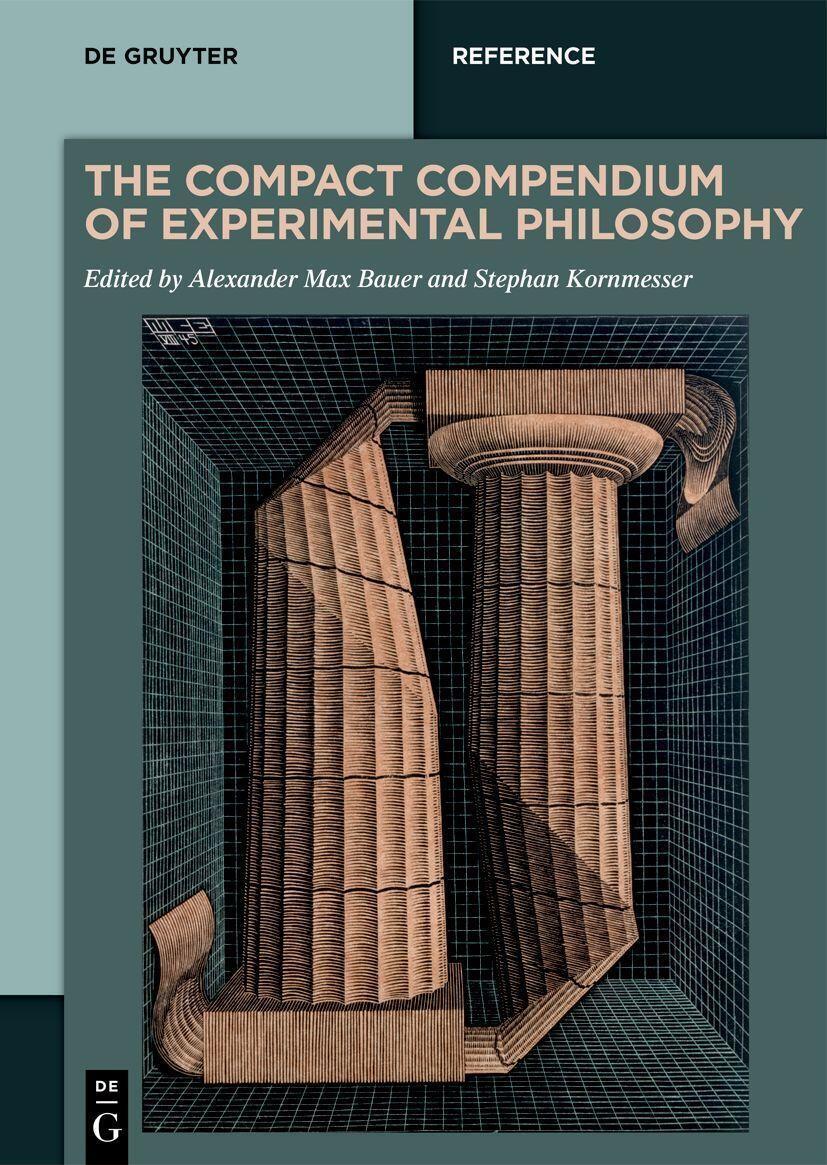
“The Compact Compendium of Experimental Philosophy,” a new entry into the “De Gruyter Reference” series, brings together experimental philosophers from around the globe to provide interested readers with insights into many topics currently researched in X-Phi. See below for the table of contents.
Part 1 – The Philosophy of Experimental Philosophy
Bauer, Alexander Max, and Stephan Kornmesser (eds.) (2023): The Compact Compendium of Experimental Philosophy, Berlin and Boston: Walter de Gruyter. (Link)
Manage Consent
To provide the best experiences, we use technologies like cookies to store and/or access device information. Consenting to these technologies will allow us to process data such as browsing behavior or unique IDs on this site. Not consenting or withdrawing consent, may adversely affect certain features and functions.
Functional
Always active
The technical storage or access is strictly necessary for the legitimate purpose of enabling the use of a specific service explicitly requested by the subscriber or user, or for the sole purpose of carrying out the transmission of a communication over an electronic communications network.
Preferences
The technical storage or access is necessary for the legitimate purpose of storing preferences that are not requested by the subscriber or user.
Statistics
The technical storage or access that is used exclusively for statistical purposes.The technical storage or access that is used exclusively for anonymous statistical purposes. Without a subpoena, voluntary compliance on the part of your Internet Service Provider, or additional records from a third party, information stored or retrieved for this purpose alone cannot usually be used to identify you.
Marketing
The technical storage or access is required to create user profiles to send advertising, or to track the user on a website or across several websites for similar marketing purposes.