The Experimental Philosophy Blog

Philosophy Meets Empirical Research

Menu
  • Home
  • About
  • Guidelines for Comments
  • Labs and Organizations
  • Resources
Menu

Category: Hot Off The Press

Hot Off The Press: “Health and Disease”

Posted on January 10, 2026January 10, 2026 by Alexander Max Bauer

With “Health and Disease,” Somogy Varga, Andrew James Latham, and Edouard Machery deliver a deep dive into Experimental Philosophy of Medicine. The summary reads:

The concepts of health and disease are fundamental to medical research, healthcare, and public health, and philosophers have long sought to clarify their meaning and implications. Increasingly, it is suggested that progress in this area could be advanced by integrating empirical methods with philosophical reflection. This Element explores the emerging field of experimental philosophy of medicine (XPhiMed), which takes this approach by applying empirical methods to longstanding philosophical debates. It begins with an overview of the philosophical debates and their methodological challenges, followed by an exploration of experimental findings on health, disease, and disorder, along with their implications for philosophy and other fields.

Hot Off The Press: “The Fruitfulness of Normative Concepts”

Posted on January 10, 2026January 10, 2026 by Alexander Max Bauer

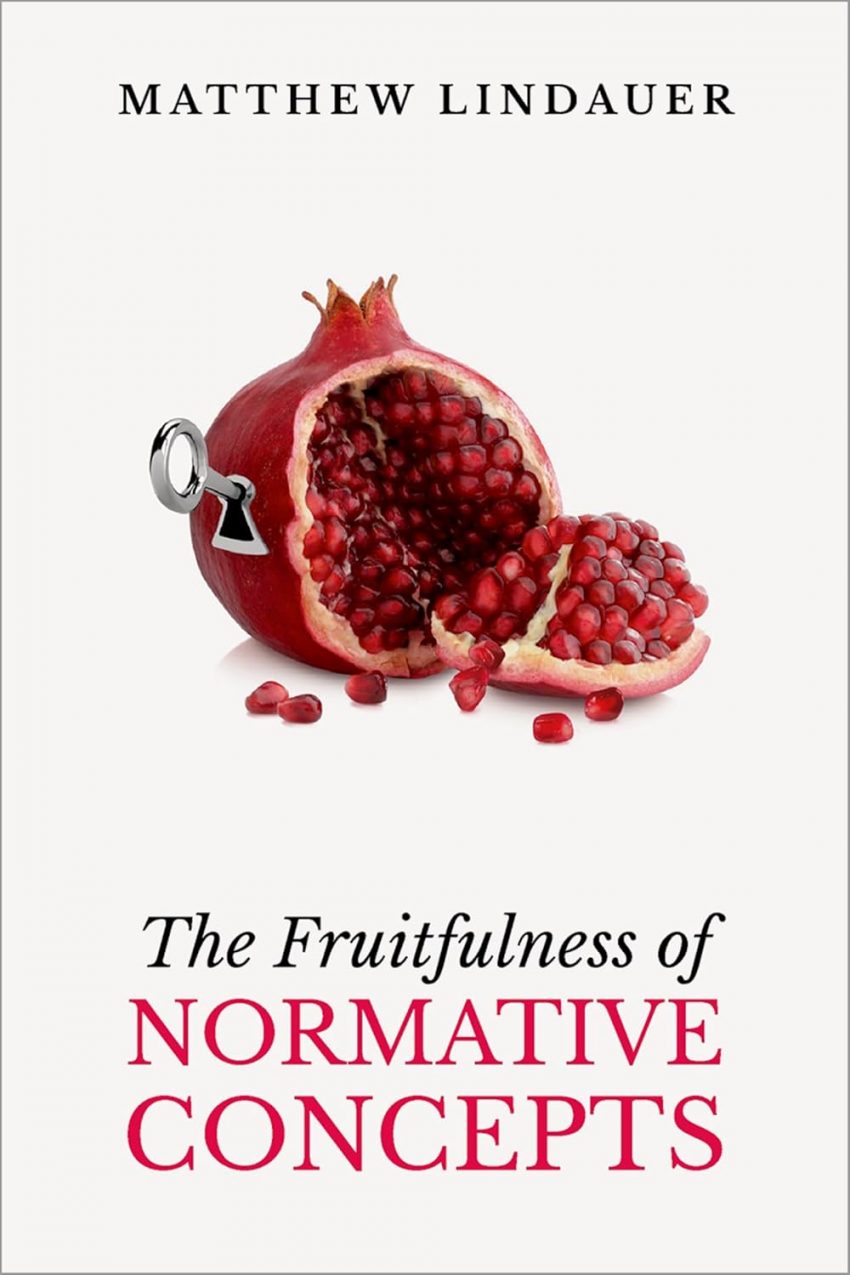
In “The Fruitfulness of Normative Concepts,” Matt Lindauer argues for a strong connection between philosophical theory and its real-world applicability, also drawing on moral psychology and adjacent fields. The book’s summary reads:

Can philosophical concepts do real work in improving our world? Should we, when evaluating competing understandings of concepts like “justice,” “empowerment,” and “solidarity,” take into account whether these different understandings can actually help us to fight injustice, empower the oppressed, and promote solidarity between people? The Fruitfulness of Normative Concepts is the first book-length attempt to argue that the answer to both of these questions is an emphatic “yes.” In doing so, it provides a bold new defense of a tight relationship between philosophical theory and practice. The book advances the view that moral and political philosophers should be interested in the “fruitfulness” of normative concepts – how well they help us to solve practical problems that we inevitably face as human beings interacting with one another. This view has broad implications for a number of important contemporary philosophical debates that the book examines, including debates over the nature of moral motivation, the duties of the global affluent to the global poor, the nature of justice in diverse multicultural societies, ideal versus non-ideal theory in political philosophy, and conceptual engineering. Drawing on cutting-edge research in moral psychology and adjacent fields, the book also demonstrates that we now have the scientific tools to concretely evaluate the practical value of moral and political concepts. It issues an important call to continue developing the use of these tools and methods to produce more philosophically and scientifically significant work on the distinctive value of normative thought and practice.

Hot Off The Press: “Indirect Freedom”

Posted on January 10, 2026January 10, 2026 by Alexander Max Bauer

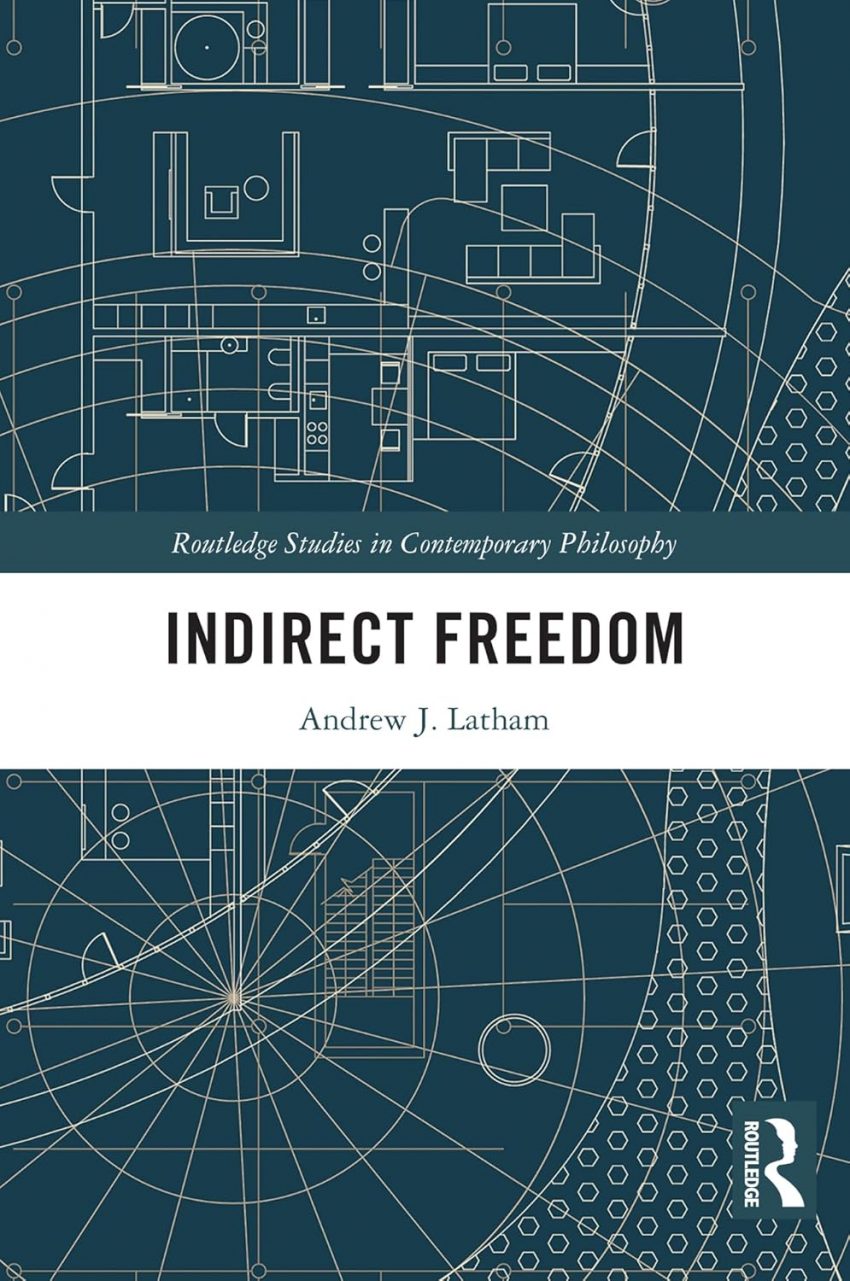
Andrew James Latham published a book on indirect compatibilism, a new compatibilist account of free will that also takes into account experimental philosophy and cognitive neuroscience. The summary reads:

This book advances a new kind of compatibilist account of free will: indirect compatibilism. It is the first sustained philosophical analysis of the idea that the ordinary concept of free will is a conditional one.

Indirect compatibilism is the combination of two theses. The first is that the best understanding of our concept of free will is that it is a conditional concept – that indeterminism or libertarian powers are necessary if they are actual, but not if they are not. The second is indirection – that actions are free either when they are caused by standard conscious psychological processes, or else by sub-personal-level processes influenced in various ways by conscious psychological processes. The book combines traditional philosophical analysis with empirical work – in particular, experimental philosophy and cognitive neuroscience – to produce a detailed description and defence of indirect compatibilism. Indirect compatibilism resolves two important problems in the free will literature: that people as a matter of fact do not accept that free actions can exist in a deterministic universe, and that some simple actions are under the direct control of conscious psychological processes.

Indirect Freedom will appeal to researchers and graduate students interested in the metaphysics of free will, experimental philosophy, philosophy of mind, and cognitive neuroscience.

Hot Off The Press: “Experimental Philosophy”

Posted on November 15, 2025January 10, 2026 by Alexander Max Bauer

There’s a new journal in town: Experimental Philosophy. Founded by Editors-in-Chief Alex Wiegmann, Ivar Hannikainen, and Pascale Willemsen, run by Managing Editor Nikolai Shurakov, and supported by a broad team of Section Editors, it’s a journal dedicated entirely to, well, experimental philosophy.

The editors write:

Experimental Philosophy is an open-access journal founded to enable authors to publish work in experimental philosophy without having to compromise on either the empirical or the philosophical side. The journal welcomes submissions relevant to the field of experimental philosophy, broadly interpreted to include experimental-philosophy studies, empirically informed philosophy, and discussions of methods and empirically informed and experimental philosophy, meta-studies, and critical responses to empirical work. Submissions are expected to make a significant contribution to philosophical discourse.

Experimental Philosophy is proud to be a completely fee-free journal. We do not collect any publication or processing charges under any circumstances, including from researchers unaffiliated with universities or research institutions. This policy reflects our firm commitment to social justice, equity, and the democratization of knowledge. We seek to ensure that the ability to contribute to and access philosophical research depends solely on the quality of ideas – not on institutional privilege or financial means.

Hot Off The Press: “Empirical Studies on Questions of Need-Based Distributive Justice”

Posted on October 8, 2025October 8, 2025 by Alexander Max Bauer

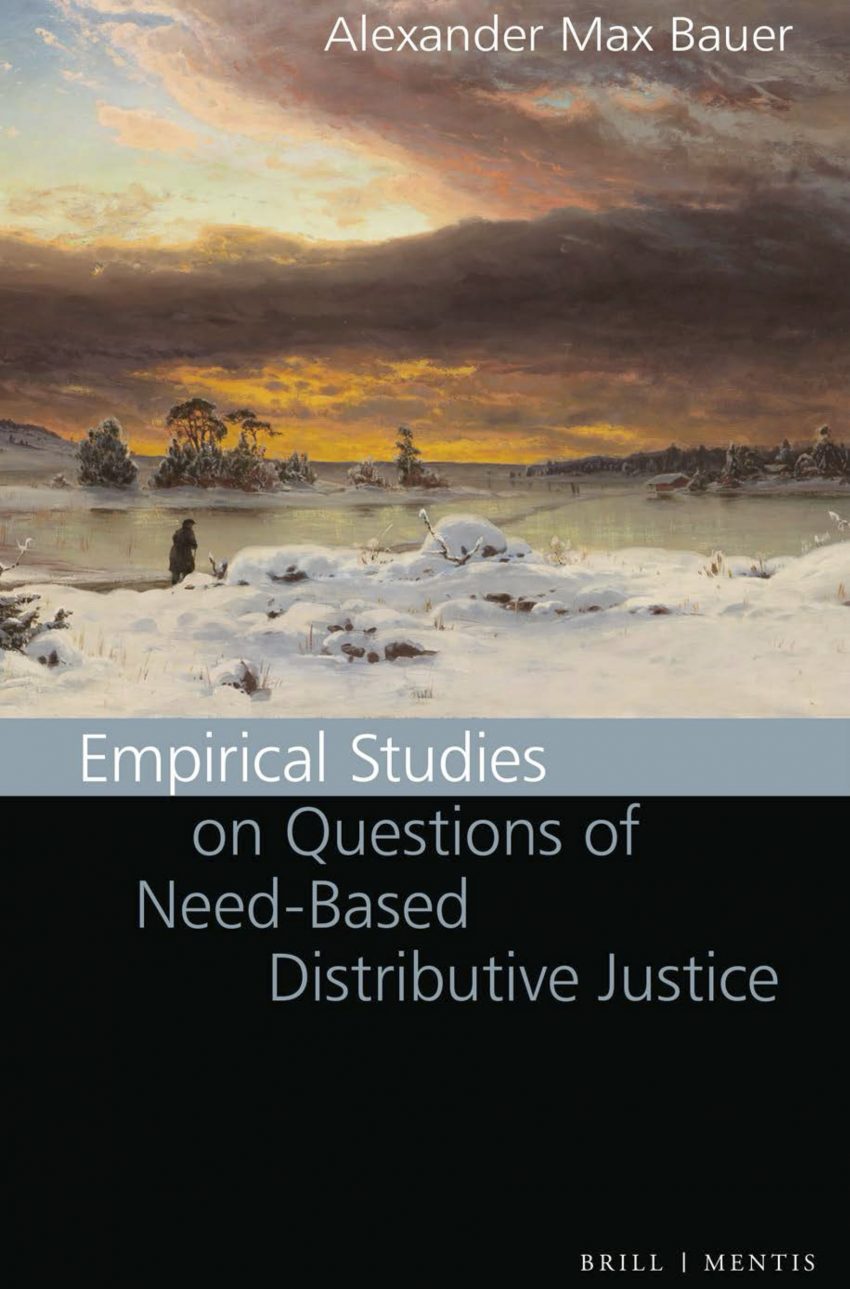
In “Empirical Studies on Questions of Need-Based Distributive Justice” (the English translation of last year’s “Empirische Studien zu Fragen der Bedarfsgerechtigkeit”), I recap a series of vignette studies that examine the role that needs play in dealing with problems of distributive justice. As I summarised in last year’s post:

Among other things, the following becomes clear:

  1. Impartial observers make gradual assessments of the fairness of distributions.
  2. These assessments depend on how well an individual is supplied with a relevant good.
  3. If information on a need threshold is given, these assessments are made relative to this reference point. (Bauer et al. 2023a [later published as Bauer et al. 2025])
  4. Impartial decision-makers consider need, productivity, and accountability when making hypothetical distribution decisions.
  5. If an individual’s productivity is not sufficient to cover their needs, these higher needs are partially compensated for (at the expense of other individuals who are not so badly off)
  6. Willingness to compensate decreases if an individual is accountable for having produced less or for needing more. (Bauer et al. 2022)
  7. Both impartial observers and impartial decision-makers attribute different levels of importance to different kinds of needs.
  8. This reveals a hierarchy of needs in the following order: Survival, Decency, Belonging, Autonomy. (Bauer et al. 2023b)

Literature

Bauer, Alexander Max, Frauke Meyer, Jan Romann, Mark Siebel, and Stefan Traub (2022): “Need, Equity, and Accountability. Evidence on Third-Party Distribution Decisions from a Vignette Study,” Social Choice and Welfare 59, 769–814. (Link)

Bauer, Alexander Max, Adele Diederich, Stefan Traub, and Arne Robert Weiss (2023a): “When the Poorest Are Neglected. A Vignette Experiment on Need-Based Distributive Justice,” SSRN Working Paper 4503209. (Link)

Bauer, Alexander Max, Jan Romann, Mark Siebel, and Stefan Traub (2023b): “Winter is Coming. How Laypeople Think About Different Kinds of Needs,” PLoS ONE 18 (11), e0294572. (Link)

Bauer, Alexander Max (2024): Empirische Studien zu Fragen der Bedarfsgerechtigkeit, Oldenburg: University of Oldenburg Press. (Link)

Bauer, Alexander Max (2025): Empirical Studies on Questions of Need-Based Distributive Justice, Paderborn: mentis. (Link)

Bauer, Alexander Max, Adele Diederich, Stefan Traub, and Arne Robert Weiss (2025): “Thinking About Need. A Vignette Experiment on Need-Based Distributive Justice,” The Journal of Economic Inequality 23 (3), 667–693. (Link)

Hot Off The Press: “The Cambridge Handbook of Experimental Jurisprudence”

Posted on May 16, 2025May 16, 2025 by Alexander Max Bauer

Recently, “The Cambridge Handbook of Experimental Jurisprudence,” a new entry in the “Cambridge Law Handbooks” series, has been published. It was edited by Kevin Tobia and contains no fewer than 38 chapters. See below for the table of contents.

Part 1 – Foundations and Theory

  • Kevin Tobia: “Introduction”
  • Barbara A. Spellman, Jennifer K. Robbennolt, Janice Nadler, and Tess Wilkinson-Ryan: “Psychology and Jurisprudence Across the Curriculum”
  • John Mikhail: “Holmes, Legal Realism, and Experimental Jurisprudence”
  • Frederick Schauer: “The Empirical Component of Analytic Jurisprudence”
  • Felipe Jiménez: “The Limits of Experimental Jurisprudence”
  • Jonathan Lewis: “Competing Conceptual Inferences and the Limits of Experimental Jurisprudence”
  • Joseph Avery, Alissa del Riego, and Patricia Sánchez Abril: “The Contours of Bias in Experimental Jurisprudence”
  • Christoph Bublitz: “Experimental Jurisprudence and Doctrinal Reasoning – A View from German Criminal Law”
  • Bert I. Huang: “Law and Morality”
  • Brian Sheppard: “Legal Constraint”

Part 2 – Introductions

  • Guilherme da Franca Couto Fernandes de Almeida, Noel Struchiner, and Ivar Hannikainen: “Rules”
  • James A. Macleod: “Surveys and Experiments in Statutory Interpretation”
  • Thomas R. Lee and Stephen C. Mouritsen: “Corpus Linguistics and Armchair Jurisprudence”
  • Meirav Furth-Matzkin: “Using Experiments to Inform the Regulation of Consumer Contracts”
  • Doron Dorfman: “Experimental Jurisprudence of Health and Disability Law”
  • Jessica Bregant, Jennifer K. Robbennolt, and Verity Winship: “Studying Public Perceptions of Settlement”
  • Benedikt Pirker, Izabela Skoczeń, and Veronika Fikfak: “Experimental Jurisprudence in International Law”
  • Heidi H. Liu: “The Law and Psychology of Gender Stereotyping”
  • Christian Mott: “The Experimental Jurisprudence of Persistence through Time”
  • Lukas Holste and Holger Spamann: “Experimental Investigations of Judicial Decision-Making”
  • Christoph Engel and Rima-Maria Rahal: “Eye-Tracking as a Method for Legal Research”
  • Jessica Bregant: “Intuitive Jurisprudence – What Experimental Jurisprudence Can Learn from Developmental Science”

Part 3 – Applications

  • Corey H. Allen, Thomas Nadelhoffer, Jason Shepard, and Eyal Aharoni: “Moral Judgments about Retributive Vigilantism”
  • Karolina M. Prochownik, Romy D. Feiertag, Joachim Horvath, and Alex Wiegmann: “How Much Harm Does It Take? An Experimental Study on Legal Expertise, the Severity Effect, and Intentionality Ascriptions”
  • Gabriel Lima and Meeyoung Cha: “Human Perceptions of AI-Caused Harm”
  • Christopher Brett Jaeger: “Reasonableness from an Experimental Jurisprudence Perspective”
  • Lucien Baumgartner and Markus Kneer: “The Meaning of ‘Reasonable’ – Evidence from a Corpus-Linguistic Study”
  • Roseanna Sommers: “Commonsense Consent and Action Representation – What is ‘Essential’ to Consent?”
  • Neele Engelmann and Lara Kirfel: “Who Caused It? Different Effects of Statistical and Prescriptive Abnormality on Causal Selection in Chains”
  • Ori Friedman: “Ownership for and Against Control”
  • Andrew Higgins and Inbar Levy: “Examining the Foundations of the Law of Judicial Bias – Expert versus Lay Perspectives on Judicial Recusal”
  • Jacqueline M. Chen and Teneille R. Brown: “The Promise and the Pitfalls of Mock Jury Studies – Testing the Psychology of Character Assessments”
  • Piotr Bystranowski, Ivar Hannikainen, and Kevin Tobia: “Legal Interpretation as Coordination”
  • Janet Randall and Lawrence Solan: “Legal Ambiguities – What Can Psycholinguistics Tell Us?”
  • Eric Martínez and Christoph Winter: “Cross-Cultural Perceptions of Rights for Future Generations”
  • Austin A. Baker and J. Remy Green: “The Right to Transgender Identity”
  • Enrique Cáceres, Christopher Stephens, Azalea Reyes-Aguilar, Daniel Atilano, Manuel García, Rosa Lidia López-Bejarano, Susana González, Carmen Patricia López-Olvera, Octavio Salvador-Ginez, and Margarita Palacios: “The Legal Conductome – The Complexity Behind Decisions”
  • Neil C. Thompson, Brian Flanagan, Edana Richardson, Brian McKenzie, and Xueyun Luo: “Trial by Internet – A Randomized Field Experiment on Wikipedia’s Influence on Judges’ Legal Reasoning”

Literature

Tobia, Kevin (ed.) (2025): The Cambridge Handbook of Experimental Jurisprudence, Cambridge and New York: Cambridge University Press. (Link)

Hot Off The Press: “Advances in Experimental Philosophy of Lying”

Posted on March 3, 2025March 3, 2025 by Alexander Max Bauer

Alex Wiegmann has edited a new volume on “Advances in Experimental Philosophy of Lying,” a further entry into Bloomsbury’s “Advances in Experimental Philosophy” series. See below for the table of contents.

  • Emanuel Viebahn: “What Does it Take to Tell a Lie?”
  • Romy Jaster and David Lanius: “The Concept of Fake News”
  • Jörg Meibauer: “The Concept of Bullshit”
  • Markus Kneer: “The Truth About Assertion and Retraction – A Review of the Empirical Literature”
  • Shirly Orr: “Truth Evaluators – A Different Point of View in the Lying/Misleading Distinction”
  • Alejandro Erut: “Cross-Cultural Studies on Concepts of Lying – Methodological Approaches and Their Findings”
  • Mailin Antomo: “Lying With Gestures”
  • Louisa Reins: “The Impact of Modality and Presentation Time on Judgments of Deceptive Implicatures as Cases of Lying – An Empirical Investigation”
  • Izabela Skoczeń: “From Lying to Blaming and Perjury – Deceptive Implicatures in the Courtroom and the Materiality Requirement”
  • Neele Engelmann: “Murderer at the Door! To Lie or to Mislead?”

Hot Off The Press: “Advances in Experimental Philosophy of Law”

Posted on February 7, 2025 by Alexander Max Bauer

Edited by Karolina Prochownik and Stefan Magen, “Advances in Experimental Philosophy of Law,” a new entry into Bloomsbury’s “Advances in Experimental Philosophy” series, has recently been published. See below for the table of contents.

Part 1 – Topics in Experimental General Jurisprudence

  • Raff Donelson: “Experimental Approaches to General Jurisprudence”
  • Guilherme de Almeida, Noel Struchiner, and Ivar Hannikainen: “The Experimental Jurisprudence of the Concept of Rule – Implications for the Hart-Fuller Debate”

Part 2 – Topics in Experimental Particular Jurisprudence

  • Kevin Tobia: “Legislative Intent and Acting Intentionally”
  • Lara Kirfel and Ivar Hannikainen: Why Blame the Ostrich? Understanding Culpability for Willful Ignorance”
  • Paulo Sousa and Gary Lavery: “Culpability and Liability in the Law of Homicide – Do Lay Moral Intuitions Accord with Legal Distinctions?”
  • Levin Güver and Markus Kneer: “Causation and the Silly Norm Effect”

Part 3 – (New) Methods and Topics in Experimental Jurisprudence

  • Justin Sytsma: “Ordinary Meaning and Consilience of Evidence”
  • Pascale Willemsen, Lucien Baumgartner, Severin Frohofer, and Kevin Reuter: “Examining Evaluativity in Legal Discourse – A Comparative Corpus-Linguistic Study of Thick Concepts”
  • Leonard Hoeft: “A Case for Behavioral Studies in Experimental Jurisprudence”
  • Eric Martínez and Christoph Winter: “Experimental Longtermist Jurisprudence”

Literature

Prochownik, Karolina, and Stefan Magen (eds.) (2024): Advances in Experimental Philosophy of Law, London, New York, and Dublin: Bloomsbury. (Link)

Hot Off The Press: “Advances in Experimental Philosophy of Action”

Posted on February 7, 2025February 7, 2025 by Alexander Max Bauer

Edited by Paul Henne and Samuel Murray, “Advances in Experimental Philosophy of Action,” a new entry into Bloomsbury’s “Advances in Experimental Philosophy” series, has recently been published. See below for the table of contents.

  • Justin Sytsma and Melissa Snater: “Consciousness, Phenomenal Consciousness, and Free Will”
  • Myrto Mylopoulos: “Skilled Action and Metacognitive Control”
  • Samuel Murray: “Bringing Self-Control into the Future”
  • Walter Sinnott-Armstrong: “Who is Responsible? Split Brains, Dissociative Identity Disorder, and Implicit Attitudes”
  • Paul Noordhof and Ema Sullivan-Bissett: “The Everyday Irrationality of Monothematic Delusion”
  • John Turri: “Truth, Perspective, and Norms of Assertion – New Findings and Theoretical Advances”
  • Joanna Korman: “The Distinct Functions of Belief and Desire in Intentional Action Explanation”
  • Cory J. Clark, Heather M. Maranges, Brian B. Boutwell, and Roy F. Baumeister: “Free Enough – Human Cognition (and Cultural Interests) Warrant Responsibility”
  • Edouard Machery, Markus Kneer, Pascale Willemsen, and Albert Newen: “Beyond the Courtroom – Agency and the Perception of Free Will”
  • Katrina L. Sifferd: “Do Rape Cases Sit in a Moral Blindspot? The Dual Process Theory of Moral Judgment and Rape”
  • Shane Timmons and Ruth M. J. Byrne: “How People Think About Moral Excellence – The Role of Counterfactual Thoughts in Reasoning about Morally Good Actions”
  • Caroline T. Arruda and Daniel J. Povinelli Index: “Why Idealized Agency Gets Animal (and Human) Agency Wrong”

Literature

Henne, Paul, and Samuel Murray (eds.) (2024): Advances in Experimental Philosophy of Action, London, New York, and Dublin: Bloomsbury. (Link)

Hot Off The Press: “Experimental Philosophy for Beginners”

Posted on September 2, 2024January 3, 2025 by Alexander Max Bauer

“Experimental Philosophy for Beginners,” a new entry into the “Springer Graduate Texts in Philosophy” series, just hit the shelves. It provides an essential extension of x-phi-tailored introductions to methods and guides readers through the whole research process using different case studies. The book offers online materials so readers can immediately apply what they have read. See below for the table of contents.

  • Stephan Kornmesser, Alexander Max Bauer, Mark Alfano, Aurélien Allard, Lucien Baumgartner, Florian Cova, Paul Engelhardt, Eugen Fischer, Henrike Meyer, Kevin Reuter, Justin Sytsma, Kyle Thompson, and Marc Wyszynski: “Introduction – Setting Out for New Shores”
  • Alexander Max Bauer, Stephan Kornmesser, and Henrike Meyer: “Quantitative Vignette Studies – χ2 Tests – Empirically Reconsidering the Constative–Performative Distinction”
  • Justin Sytsma: “Quantitative Vignette Studies – t-Tests – Case Studies on Judgments About Unfelt Pains”
  • Florian Cova and Aurélien Allard: “Quantitative Vignette Studies – Correlations, Regressions, and Structural Equation Modeling – An Application to Experimental Philosophy of Free Will”
  • Marc Wyszynski: “Interactive and Incentivized Online Experiments – Noncooperation in Give-Some and Take-Some Dilemmas”
  • Kevin Reuter and Lucien Baumgartner: “Corpus Analysis – Building and Using Corpora – A Case Study on the Use of ‘Conspiracy Theory’”
  • Mark Alfano: “Corpus Analysis – Lexical Dispersion, Semantic Time Series, and Semantic Network Analysis – An R Studio Pipeline”
  • Eugen Fischer and Paul E. Engelhardt: “Psycholinguistic Experiments – A Case Study on Default Inferences in Philosophical Arguments – Analysing the Argument from Illusion”
  • Kyle Thompson: “Qualitative Interview Studies – Constructing an Interview Study Based on a Paradigm Example in ‘Ought Implies Can’”

Literature

Kornmesser, Stephan, Alexander Max Bauer, Mark Alfano, Aurélien Allard, Lucien Baumgartner, Florian Cova, Paul Engelhardt, Eugen Fischer, Henrike Meyer, Kevin Reuter, Justin Sytsma, Kyle Thompson, and Marc Wyszynski (2024): Experimental Philosophy for Beginners. A Gentle Introduction to Methods and Tools, Cham: Springer. (Link)

  • 1
  • 2
  • Next

Search

Categories

Tags

Agency Artificial Intelligence Basic Needs Behavior Beliefs Bias Bioethics Blame Causation Cognitive Science Consciousness Corpus Analysis Cross-Cultural Research Decisions Determinism Distributive Justice Emotions Essentialism Expertise Folk Morality Framing Free Will Gender Intention Intuition Jurisprudence Knowledge Large Language Models Moral Psychology Norms Pejoratives Problem of Evil Psycholinguistics Rationality Reasoning Replication Responsibility Self Side-Effect Effect Slurs Truth Valence Values Virtue Well-Being

Recent Posts

  • Call: “The Armchair on Trial”
  • Call: “Interdisciplinary Perspectives on Linguistic Justice”
  • Call: “6th European Experimental Philosophy Conference”
  • Talk: “Ethics in the Lab” (Pascale Willemsen)
  • Talk: “Normality and Norms” (Josh Knobe)

Recent Comments

  1. Nova Praxis on The Folk Concept of ArtJuly 11, 2025

    This article highlights an important point: everyday people don’t rely on rigid definitions to determine what qualifies as art. They’re…

  2. Koen Smets on Priming Effects Are Fake, but Framing Effects Are RealMay 27, 2025

    That is indeed exactly the question I have as well. I operationalize it as having de facto contradicting intuitions, in…

  3. Joshua Knobe on Priming Effects Are Fake, but Framing Effects Are RealMay 24, 2025

    Hi Koen, Thanks once again. This idea brings up all sorts of fascinating questions, but for the purposes of the…

  4. Koen Smets on Priming Effects Are Fake, but Framing Effects Are RealMay 24, 2025

    Great! In the meantime I thought of another potentially interesting example of framing—Arnold Kling’s Three Languages of Politics. Just about…

  5. Joshua Knobe on Priming Effects Are Fake, but Framing Effects Are RealMay 23, 2025

    Thanks Koen! This is all super helpful.

Archives

  • February 2026
  • January 2026
  • December 2025
  • November 2025
  • October 2025
  • September 2025
  • August 2025
  • July 2025
  • June 2025
  • May 2025
  • April 2025
  • March 2025
  • February 2025
  • January 2025
  • December 2024
  • November 2024
  • October 2024
  • September 2024
  • August 2024
  • July 2024
  • June 2024
  • May 2024
  • April 2024
  • March 2024

Meta

  • Log in
  • Entries feed
  • Comments feed
  • WordPress.org

Imprint • Disclaimer • Privacy Statement • Cookie Policy

© 2024 The Experimental Philosophy Blog
Manage Consent
To provide the best experiences, we use technologies like cookies to store and/or access device information. Consenting to these technologies will allow us to process data such as browsing behavior or unique IDs on this site. Not consenting or withdrawing consent, may adversely affect certain features and functions.
Functional Always active
The technical storage or access is strictly necessary for the legitimate purpose of enabling the use of a specific service explicitly requested by the subscriber or user, or for the sole purpose of carrying out the transmission of a communication over an electronic communications network.
Preferences
The technical storage or access is necessary for the legitimate purpose of storing preferences that are not requested by the subscriber or user.
Statistics
The technical storage or access that is used exclusively for statistical purposes. The technical storage or access that is used exclusively for anonymous statistical purposes. Without a subpoena, voluntary compliance on the part of your Internet Service Provider, or additional records from a third party, information stored or retrieved for this purpose alone cannot usually be used to identify you.
Marketing
The technical storage or access is required to create user profiles to send advertising, or to track the user on a website or across several websites for similar marketing purposes.
  • Manage options
  • Manage services
  • Manage {vendor_count} vendors
  • Read more about these purposes
View Preferences
  • {title}
  • {title}
  • {title}