The Experimental Philosophy Blog

Philosophy Meets Empirical Research

Menu
  • Home
  • About
  • Guidelines for Comments
  • Labs and Organizations
  • Resources
Menu

Category: Academia

Talk: “Autonomous Systems, Moral Responsibility and Control Architectures” (Markus Kneer)

Posted on March 19, 2026April 17, 2026 by Alexander Max Bauer

On March 20, from 17:00–19:00 (UTC+1), the Permanent Seminar in Analytic Philosophy (PSAP) of Università Roma Tre will host a talk by Markus Kneer about “Autonomous Systems, Moral Responsibility and Control Architectures.” The hybrid session can be accessed via Teams. The abstract reads:

Matthias (2004) and Sparrow (2007) have argued that the use of self-learning systems can engender “responsibility gaps” – situations in which nobody is morally responsible for a potential harm. In this talk, I will present empirical evidence as to whether laypeople are sensitive to such alleged “responsibility gaps” or whether their retributive dispositions might get in the way (see Danaher, 2016). I will also present new data concerning the question whether we can avoid such situations by imposing tight control architectures to ensure meaningful human control (see e.g. “human-in-the-loop v. on-the-loop,” Docherty, 2012; “tracking & tracing,” Santoni de Sio & van den Hoven, 2018).

Talk: “Cognitive Foundations of Geometry” (Véronique Izard)

Posted on March 19, 2026April 17, 2026 by Alexander Max Bauer

As part of the IHPST’s Séminaire PhilSciCog at the Université Paris 1 Panthéon-Sorbonne, Véronique Izard will talk about “Cognitive Foundations of Geometry” on March 26, 2026, from 15:00–16:30 (UTC+1). The hybrid session can be accessed via Zoom (Meeting ID: 950 6108 6376, Code: 535047). The abstract reads:

From the first months of life, young children can perceive numeric quantities and perform additive or multiplicative operations on quantities. These abilities support the acquisition of number concepts later in life, and have been proposed to enable humans’ arithmetic cognition. What about geometry, another major branch of mathematics? In this talk, I will present two recent studies assessing the scope and the limits of human geometric intuition. The first study focused on Euclidean geometry, and found that children and adults encode a rich repertoire of geometric properties, at several levels of abstraction. The second study probed intuitions for non-Euclidean geometry and revealed the existence of a pervasive Euclidean bias in adults, identifying limits to the flexibility of human geometric intuition.

Call: “Toronto Workshop on Moral Psychology and Moral Theory”

Posted on March 19, 2026March 19, 2026 by Alexander Max Bauer

Organized by Andrew Sepielli, the “Toronto Workshop on Moral Psychology and Moral Theory” will take place at the University of Toronto from November 7 to 8, 2026.

Submissions for contributions can be submitted until July 1, 2026. The call reads:

The workshop aims to bring together philosophers, psychologists, and legal scholars working on questions about the relationship between empirical research on moral cognition and the foundations of moral theory. The goal is to foster interdisciplinary discussion about how empirical work in fields such as psychology, neuroscience, and evolutionary theory bears on moral judgment and the evaluation of moral beliefs.

Invited speakers include:

  • Paul Bloom (Psychology, University of Toronto / Yale University)
  • Joshua Knobe (Philosophy and Psychology, Yale University)
  • Liane Young (Psychology, Boston College)
  • Roseanna Sommers (Law and Psychology, University of Michigan)
  • Brendan de Kenessey (Philosophy, University of Toronto)

We invite submissions addressing topics at the intersection of empirical research and moral theory. Relevant topics include, but are not limited to:

  • experimental philosophy
  • the psychology of moral cognition
  • causal cognition and moral judgment
  • the neuroscience of moral judgment
  • evolutionary approaches to morality
  • empirical work bearing on normative ethics or metaethics
  • methodological questions about the role of empirical research in moral theory
  • debunking arguments and related challenges to moral belief

Five contributed papers will be selected. Contributed talks will consist of a 45-minute presentation followed by 45 minutes of discussion. The workshop is designed to be discussion-focused, with substantial time devoted to questions and conversation about each paper.

We welcome submissions from scholars in philosophy, psychology, law, and related disciplines. Submissions from early-career scholars are especially encouraged.

Submission Guidelines:

Please submit an abstract of 750–1000 words, along with a brief CV, to: torontomoralpsych@gmail.com 

Submissions should not be anonymized.

Important Dates:

Submission deadline: July 1, 2026

Notification of decisions: August 1, 2026

Limited support for travel and accommodation may be available.

Questions about the workshop may be directed to the conference organizer, Andrew Sepielli (Philosophy, University of Toronto), at: torontomoralpsych@gmail.com

Call: “Folk Epistemology and Science Skepticism”

Posted on March 8, 2026March 8, 2026 by Alexander Max Bauer

From August 10 to 14, 2026, the Cologne Summer School will take place at the University of Cologne. This year’s topic will be “Folk Epistemology and Science Skepticism,” with special guest Mikkel Gerken.

Proposals for brief presentations on Gerken’s work can be submitted until April 15, 2026. The call reads:

The Cologne Summer School is an annual, week-long, event at which leading epistemologists present their current work in a series of lectures, defend their views against critical comments, and discuss their work with participants. The Summer School mainly aims at professional philosophers and graduate students, but anyone is welcome to apply. In 2026 our special guest will be Mikkel Gerken (University of Southern Denmark).

Gerken works in epistemology, philosophy of science, and philosophy of mind. In Epistemic Reasoning and the Mental (Palgrave 2013), Gerken considers how externalism in philosophy of mind bears on the nature of the epistemology of inference. In On Folk Epistemology (OUP 2017), he argues that folk epistemological heuristics explain patterns of intuitive judgments that have mistakenly been taken to motivate epistemic contextualism, pragmatic encroachment, and knowledge-first epistemology. Doing so involves engagement with cognitive psychology as well as methodological considerations about the relationship between folk epistemological intuitions and epistemological theorizing. In Scientific Testimony (OUP 2022), Gerken argues that testimony is a vital part of science and articulates epistemic norms governing it. Furthermore, he considers scientific testimony to the lay public and empirically informed science communication strategies for addressing science skepticism. In addition to the monographs, Gerken has published on epistemic injustice, epistemic norms of action and assertion, transcendental arguments, the necessary a posteriori, philosophical skepticism, philosophical methodology etc.

Cologne Summer School Themes: The 2026 Summer School will address a range of issues from foundational to applied social epistemology. Many of the discussions will revolve around an important real-life problem – namely, science skepticism. For example, we will examine how science skepticism is related to varieties of philosophical skepticism. Furthermore, we will consider how folk epistemological heuristics and conversational norms may fuel public skepticism about science. We will also consider ways in which epistemologists and philosophers of science may play a role in combating science skepticism. Thus, some of the discussions overlap with issues in philosophy of science. Throughout, there will be an emphasis on philosophical methodology and epistemology’s relationship to empirical research in the social and cognitive sciences.

Topics will include

  • Philosophical skepticism and real-life (science) skepticism
  • Folk epistemology and its relation to epistemology
  • Epistemic norms of assertion and science communication
  • Internalism and externalism in epistemology and mind
  • Intuitive judgments and philosophical methodology
  • The epistemic roles of science in society

The Summer School is free but limited to 50 participants. Online application is possible through April 15. Please supply a short letter that sketches your academic background and main motivation for participating in the Summer School. If you are interested in giving a brief presentation (approx. 20 minutes) related to Gerken’s work, please also send an abstract of no more than 1,000 words.

Apply via email to:
summerschoolphilosophy@uni-koeln.de

Call: “The Armchair on Trial”

Posted on February 22, 2026February 22, 2026 by Alexander Max Bauer

From July 9 to 11, 2026, the Vienna Forum for Analytic Philosophy (WFAP) will host its 15th annual graduate conference, titled “The Armchair on Trial – A Graduate Conference on Philosophical Methodology.” Hilary Kornblith, Jennifer Nagel, and Christian Nimtz are confirmed as keynote speakers.

Proposals for presentations can be submitted until February 28, 2026. The call reads:

This year’s annual WFAP graduate conference is devoted to debates around philosophical methodology. It is centered around the question of whether philosophy is best done from the philosophical armchair or whether it can and should be done using empirical methods. The conference is focused on the extent to which the emergence of naturalistic approaches and of experimental philosophy (“X-Phi”) pose a problem to ‘traditional’ armchair methods (e.g. consulting intuitions, conceptual analysis, reflective equilibrium, conceptual engineering). We are interested both in work that focuses on individual methods or on the relations between them (e.g. their compatibility).

We aim to bring together early career and advanced researchers in order to discuss questions such as:

  • What is the role of intuition in philosophy?
  • What is the role of a priori knowledge in philosophy?
  • What is the role of X-Phi in philosophy?
  • What is the role of conceptual analysis in philosophy?
  • What is the role of conceptual engineering in philosophy?
  • What is the role of linguistic and conceptual competence in philosophy?
  • What is the role of formal methods in philosophy?
  • Is philosophy importantly distinct from other sciences?
  • How can advocates of armchair methods best respond to the challenges raised by X-Phi?
  • Are armchair philosophy and X-Phi reconcilable?
  • Considering the methodological discussions listed above, are professional philosophers epistemically better positioned for answering philosophical questions than lay people? E.g. Do they have better conceptual competence? Are they expert intuiters?

We welcome submissions that apply these methodological issues to other philosophical debates as case studies.

Call: “Interdisciplinary Perspectives on Linguistic Justice”

Posted on February 22, 2026February 22, 2026 by Alexander Max Bauer

On September 8, 2026, the satellite workshop “Interdisciplinary Perspectives on Linguistic Justice” will accompany the 6th European Experimental Philosophy Conference at the University of Cagliari, Italy.

Proposals for talks can be submitted until May 1, 2026. The call reads:

The Conference will be accompanied by a Satellite Workshop on “Interdisciplinary Perspectives on Linguistic Justice” (IPLJ), to be held on 8 September 2026. The IPLJ Workshop will be held in collaboration with the Linguistic Justice Society (LJS). The IPLJ Workshop welcomes experimental and empirically informed contributions on linguistic justice broadly construed, to include linguistic diversity, accent bias and related topics. For the Workshop, we welcome only contributions in the form of talks. There will be no fees for those wishing to take part in the IPLJ Satellite Workshop, which will also be online-accessible.

Deadline: May 1st, 2026

https://openreview.net/group?id=EXPhi/2026/Conference/Workshop/IPLJ

Decisions expected by June 1st, 2026

Submitting authors will have or create a profile on OpenReview. Whereas new profiles with an institutional email will be activated automatically, new profiles created without an institutional email will go through a moderation process that can take up to two weeks. Abstracts for talks should be anonymized for review and not exceed 500 words. References and figure captions do not count towards the word limit. Please make sure all materials for review are anonymized.

Call: “6th European Experimental Philosophy Conference”

Posted on February 22, 2026February 22, 2026 by Alexander Max Bauer

From September 9 to 11, 2026, the 6th European Experimental Philosophy Conference will take place at the University of Cagliari, Italy. Barbara Konat, Masaharu Mizumoto, Shaun Nichols, and Francesca Panzeri are confirmed as keynote speakers.

Note that there’s a separate call for a satellite workshop on “Interdisciplinary Perspectives on Linguistic Justice,” that will be held on September 8.

Proposals for talks, posters, and symposia can be submitted until May 1, 2026. The call reads:

The conference welcomes contributions from all areas of experimental philosophy and of its study. We welcome three kinds of contributions: talks, posters, and symposia.

Talks will be allocated 40-minute slots and should leave 20 minutes for discussion.

Posters will be allocated dedicated poster exhibit times.

Symposia will be allocated 2 hours and consist of three talks and a panel discussion involving the three speakers and possibly up to two further discussants, all addressing one overarching question or topic from different perspectives.

Deadline: May 1st, 2026

https://openreview.net/group?id=EXPhi/2026/Conference

Decisions expected by June 1st, 2026

Submitting authors will have or create a profile on OpenReview. Whereas new profiles with an institutional email will be activated automatically, new profiles created without an institutional email will go through a moderation process that can take up to two weeks. Please make sure all materials for review are anonymised. Abstracts for talks and posters should be anonymized for review and not exceed 500 words. References and figure captions do not count towards the word limit. Please make sure all materials for review are anonymized.

Abstracts for symposia should name the symposiasts and consist of a 500-word introduction that sets out the questions and rationale of the symposium as well as 500-word abstracts for each talk. References and figure captions do not count towards the word limit. Please make sure all materials for review are anonymized.

Submitted symposia contributions will automatically be considered for inclusion as regular talks, if the symposium submission cannot be accepted. Submitted talks will be automatically considered for poster presentations, if they cannot be accepted as talks.

The number of submissions for talks is capped at one per corresponding author. For joint papers, the submitting/corresponding author should always be the first author. A corresponding author may be named as a co-author of joint papers submitted for talks by other corresponding authors. For accepted talks, the submitting/corresponding author should be the main presenter of the talk at the conference.

Talk: “Normality and Norms” (Josh Knobe)

Posted on January 27, 2026January 27, 2026 by Alexander Max Bauer

The Center for Philosophy and the Health Sciences at Aarhus University is hosting a lecture by Joshua Knobe. It will take place on Thursday, January 29, 15:15–16:45 (UTC+1) via Zoom. The abstract reads:

The notion of normality plays a role in the way people understand many different scientifically important concepts. For example, normality figures in people’s understanding of what it is for a trait to be innate, what it is for one event to cause another, and what it is for the state to count as a disease. I will be presenting a theory about ordinary attributions of normality and then exploring the application of this theory to all three of these types of judgments. The theory is that ordinary attributions of normality involve a mixture of statistical judgments (how frequent something is) and evaluative judgments (how good something is). Thus, the key claim is that both statistical and evaluative judgments play a role in people’s ordinary understanding of innateness, causation and disease.

Call: “Theory and Practice After the Practice Turn”

Posted on January 10, 2026January 10, 2026 by Alexander Max Bauer

On April 17, 2026, the Research Center Normative Orders at Goethe University Frankfurt will host an online workshop titled “Theory and Practice After the Practice Turn – Where Social Theory and Empirical Philosophy Meet.”

Proposals for contributions can be submitted until February 14. The call reads:

Sociology and philosophy have always shared a close relationship. Critical Theory famously tied the two disciplines together to unravel societal phenomena, and feminist philosophers regularly borrow sociological concepts to understand domination and power asymmetries. Similarly, sociologists often draw on philosophical concepts to sharpen their analyses. In recent years, this dialogue has gained new momentum through the so-called “practice turn” in epistemology and philosophy of science. Contemporary philosophy of science and applied epistemology increasingly incorporate empirical methods originally developed within the social sciences such as interviews and ethnographic studies. But while empirical approaches from sociology are frequently adopted, social-theoretical concepts remain rarely integrated within epistemology and philosophy of science.

It is the goal of this workshop to explore the potential of social theory for empirical approaches in philosophy of science and epistemology. What are instances of fruitful applications of social theory to philosophy of science and epistemological scholarship? How does social theory transform when it is resituated in a different disciplinary setting? What are caveats and best practices when using social theory as a philosopher of science/epistemologist?

We are looking for workshop contributions that are focused on but not limited to:

  • Examples of using social theory along with empirical methods in philosophy of science and
    epistemology.
  • Reflections on methodological and conceptual challenges when transferring social-theoretical
    concepts into philosophical work.

Workshop contributions will also be considered for publication in a special issue (target journal: Synthese) on social theory in empirical philosophy of science & epistemology.

Send submissions to: sophie.juliane.veigl@univie.ac.at; riegler@em.uni-frankfurt.de

Talk: “Expressivity Cross-Linguistically” (Xavier Villalba)

Posted on December 14, 2025December 14, 2025 by Alexander Max Bauer

On Monday, December 15, from 14:30–16:00 (UTC+1), the “Slurring Terms Across Languages” (STAL) network will present Xavier Villalba’s talk “Expressivity Cross-Linguistically – A Corpus Study of Expressive and Evaluative Adjectives in Romance and Germanic” as part of the STAL seminar series. The abstract reads:

In this presentation, I argue that pure expressive adjectives (such as English fucking and damn) represent the final stage in a process of intersubjectivization (Traugott 2010; Traugott & Dasher 2002). This process begins with a descriptive qualifying adjective, moves through a stage of subjectivization – typical of both evaluative adjectives (e.g., pathetic, horrible) and mixed expressive adjectives (bloody, shitty) – and culminates in the pure expressives. This pragmatic shift is linked to semantic bleaching as well as syntactic changes traceable in our corpora. These changes involve features like gradation, function (modifier vs. predicative), and position (postnominal vs. prenominal modification). To support this claim, I will present two corpus studies: 1. A synchronic study designed to identify the most useful features for distinguishing each adjective class in Germanic and Romance languages; 2. A diachronic study, focused on English and Catalan, to trace the historical emergence of these features. The results of these studies will provide a more accurate and comprehensive cross-linguistic understanding of expressive adjectives. Furthermore, they will offer insights into the patterns of change involved and how the speed of this evolution varies across different items and languages.

The talk can be joined using Zoom. Please write an email to stalnetwork@gmail.com for the invitation link.

  • Previous
  • 1
  • 2
  • 3
  • 4
  • 5
  • …
  • 7
  • Next

Search

Categories

Tags

Agency Artificial Intelligence Autonomous Systems Basic Needs Behavior Beliefs Bias Bioethics Blame Causation Cognitive Science Consciousness Corpus Analysis Cross-Cultural Research Decisions Determinism Distributive Justice Emotions Essentialism Expertise Folk Morality Framing Free Will Gender Intention Intuition Jurisprudence Knowledge Large Language Models Moral Psychology Norms Pejoratives Psycholinguistics Rationality Reasoning Replication Responsibility Self Side-Effect Effect Slurs Thought Experiments Truth Valence Values Virtue

Recent Posts

  • Where should I publish my X-Phi? A new resource
  • Call: “The New Measurement Heretics”
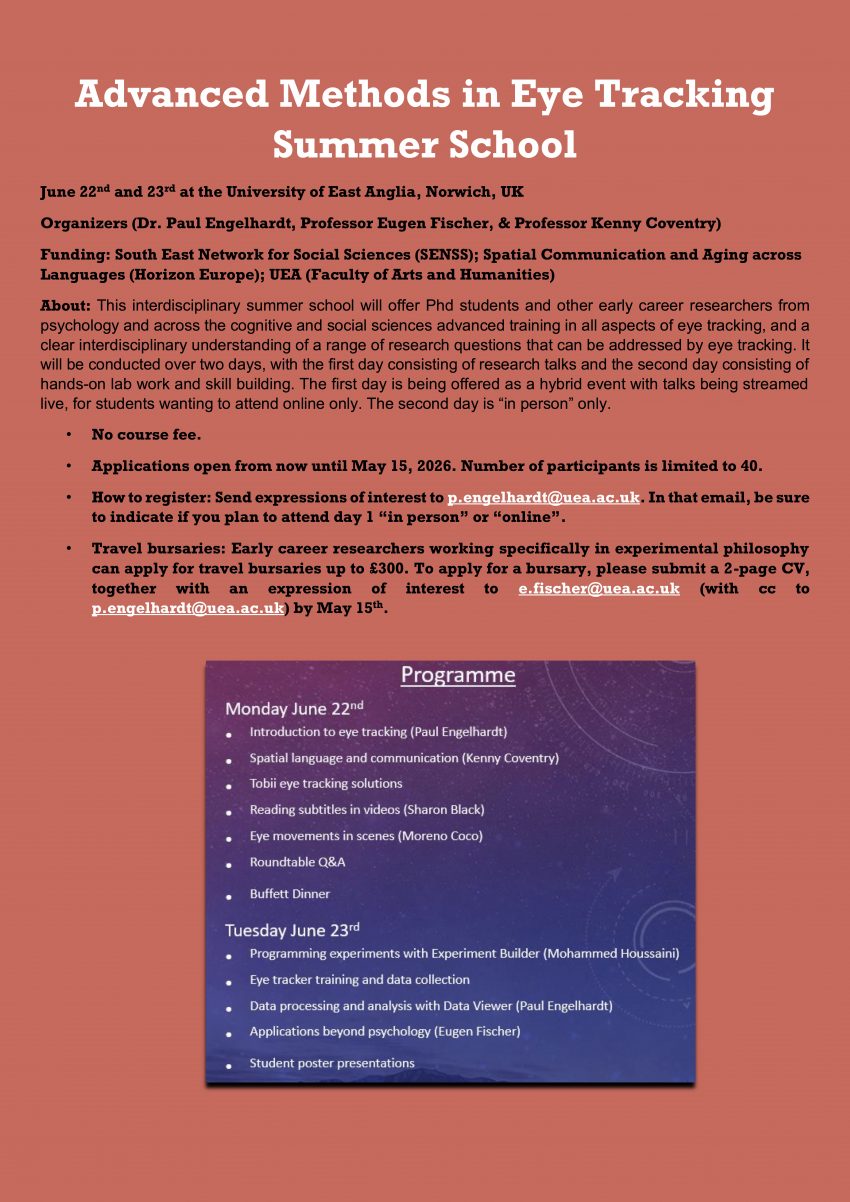
  • Summer School: “Advanced Methods in Eye Tracking”
  • Call: “New Methods in Semantics of Artefacts”
  • Call: “Law Observed”

Recent Comments

  1. Nova Praxis on The Folk Concept of ArtJuly 11, 2025

    This article highlights an important point: everyday people don’t rely on rigid definitions to determine what qualifies as art. They’re…

  2. Koen Smets on Priming Effects Are Fake, but Framing Effects Are RealMay 27, 2025

    That is indeed exactly the question I have as well. I operationalize it as having de facto contradicting intuitions, in…

  3. Joshua Knobe on Priming Effects Are Fake, but Framing Effects Are RealMay 24, 2025

    Hi Koen, Thanks once again. This idea brings up all sorts of fascinating questions, but for the purposes of the…

  4. Koen Smets on Priming Effects Are Fake, but Framing Effects Are RealMay 24, 2025

    Great! In the meantime I thought of another potentially interesting example of framing—Arnold Kling’s Three Languages of Politics. Just about…

  5. Joshua Knobe on Priming Effects Are Fake, but Framing Effects Are RealMay 23, 2025

    Thanks Koen! This is all super helpful.

Archives

  • April 2026
  • March 2026
  • February 2026
  • January 2026
  • December 2025
  • November 2025
  • October 2025
  • September 2025
  • August 2025
  • July 2025
  • June 2025
  • May 2025
  • April 2025
  • March 2025
  • February 2025
  • January 2025
  • December 2024
  • November 2024
  • October 2024
  • September 2024
  • August 2024
  • July 2024
  • June 2024
  • May 2024
  • April 2024
  • March 2024

Meta

  • Log in
  • Entries feed
  • Comments feed
  • WordPress.org

Imprint • Disclaimer • Privacy Statement • Cookie Policy

© 2024 The Experimental Philosophy Blog
Manage Consent
To provide the best experiences, we use technologies like cookies to store and/or access device information. Consenting to these technologies will allow us to process data such as browsing behavior or unique IDs on this site. Not consenting or withdrawing consent, may adversely affect certain features and functions.
Functional Always active
The technical storage or access is strictly necessary for the legitimate purpose of enabling the use of a specific service explicitly requested by the subscriber or user, or for the sole purpose of carrying out the transmission of a communication over an electronic communications network.
Preferences
The technical storage or access is necessary for the legitimate purpose of storing preferences that are not requested by the subscriber or user.
Statistics
The technical storage or access that is used exclusively for statistical purposes. The technical storage or access that is used exclusively for anonymous statistical purposes. Without a subpoena, voluntary compliance on the part of your Internet Service Provider, or additional records from a third party, information stored or retrieved for this purpose alone cannot usually be used to identify you.
Marketing
The technical storage or access is required to create user profiles to send advertising, or to track the user on a website or across several websites for similar marketing purposes.
  • Manage options
  • Manage services
  • Manage {vendor_count} vendors
  • Read more about these purposes
View Preferences
  • {title}
  • {title}
  • {title}