The Experimental Philosophy Blog

Philosophy Meets Empirical Research

Menu
  • Home
  • About
  • Guidelines for Comments
  • Labs and Organizations
  • Resources
Menu

Category: Announcements

Talk: “Normality and Norms” (Josh Knobe)

Posted on January 27, 2026January 27, 2026 by Alexander Max Bauer

The Center for Philosophy and the Health Sciences at Aarhus University is hosting a lecture by Joshua Knobe. It will take place on Thursday, January 29, 15:15–16:45 (UTC+1) via Zoom. The abstract reads:

The notion of normality plays a role in the way people understand many different scientifically important concepts. For example, normality figures in people’s understanding of what it is for a trait to be innate, what it is for one event to cause another, and what it is for the state to count as a disease. I will be presenting a theory about ordinary attributions of normality and then exploring the application of this theory to all three of these types of judgments. The theory is that ordinary attributions of normality involve a mixture of statistical judgments (how frequent something is) and evaluative judgments (how good something is). Thus, the key claim is that both statistical and evaluative judgments play a role in people’s ordinary understanding of innateness, causation and disease.

Talk: “Expressivity Cross-Linguistically” (Xavier Villalba)

Posted on December 14, 2025December 14, 2025 by Alexander Max Bauer

On Monday, December 15, from 14:30–16:00 (UTC+1), the “Slurring Terms Across Languages” (STAL) network will present Xavier Villalba’s talk “Expressivity Cross-Linguistically – A Corpus Study of Expressive and Evaluative Adjectives in Romance and Germanic” as part of the STAL seminar series. The abstract reads:

In this presentation, I argue that pure expressive adjectives (such as English fucking and damn) represent the final stage in a process of intersubjectivization (Traugott 2010; Traugott & Dasher 2002). This process begins with a descriptive qualifying adjective, moves through a stage of subjectivization – typical of both evaluative adjectives (e.g., pathetic, horrible) and mixed expressive adjectives (bloody, shitty) – and culminates in the pure expressives. This pragmatic shift is linked to semantic bleaching as well as syntactic changes traceable in our corpora. These changes involve features like gradation, function (modifier vs. predicative), and position (postnominal vs. prenominal modification). To support this claim, I will present two corpus studies: 1. A synchronic study designed to identify the most useful features for distinguishing each adjective class in Germanic and Romance languages; 2. A diachronic study, focused on English and Catalan, to trace the historical emergence of these features. The results of these studies will provide a more accurate and comprehensive cross-linguistic understanding of expressive adjectives. Furthermore, they will offer insights into the patterns of change involved and how the speed of this evolution varies across different items and languages.

The talk can be joined using Zoom. Please write an email to stalnetwork@gmail.com for the invitation link.

Workshop: “XPHI UK Work in Progress Workshop Series”

Posted on November 15, 2025November 15, 2025 by Alexander Max Bauer

James Andow and Eugen Fischer have announced the first talks for this season’s “XPHI UK Work in Progress Workshop Series.” Talks will be held on Microsoft Teams. Anyone interested in joining can email james.andow@manchester.ac.uk.

November 26, 16:00–18:00 (UTC±0)

  • Qianyi Qin (CUNY Graduate Centre): “Imaginative Tendencies and Virtuality Tolerance – Re-Examining the Experience Machine”
  • Jumbly Grindrod (University of Reading): “Word Meanings in Transformer Language Models”

December 10, 16:00–18:00 (UTC±0)

  • Juan-Pablo Bermúdez (University of Southampton) and Gino Carmona (Universidad Externado de Colombia): “Goals and Plans in the Wild – The Effects of Poverty on Planning Agency”
  • Miklós Kürthy (University of Graz): “Care for Consistency”

January 14, 16:00–18:00 (UTC±0)

  • Monika Jovanović and Andrija Šoć (University of Belgrade): “A Matter of Taste? Toward Deliberative Experimental Aesthetics”
  • Markus Werning (Ruhr-Universität Bochum): t.b.a.

Talk: “Philosophical Arguments Can Boost Charitable Giving” (Eric Schwitzgebel and Kirstan Brodie)

Posted on October 25, 2025October 25, 2025 by Alexander Max Bauer

On Thursday, October 30, the first talk in the Experimental Philosophy Journal Series will take place on Zoom.

Celso de Oliveira Vieira, Alex Wiegmann, and Rodrigo Díaz write:

We are pleased to invite you to the first talk in the Experimental Philosophy Journal Series, the new journal dedicated to X-Phi.

In this session, Eric Schwitzgebel (California) and Kirstan Brodie (Cornell) will present their paper, “Philosophical arguments can boost charitable giving,” co-authored with Nemirow and Cushman. The preprint, in which the authors identify the elements of a range of philosophical arguments that boost charitable giving, is available here. The presentation will be followed by a commentary from Rodrigo Díaz (CSIC). He wrote “Do Moral Beliefs Motivate Action?,” accessible here. After that, the floor will be open for discussion. The authors will speak first, but the audience will be able to participate as well.

The session will take place online on October 30th at 10 AM PDT/6 PM CET.
Here is the Zoom link: http://tiny.cc/xphij1
For inquiries, please contact Celso Vieira at celso.deoliveiravieira@rub.de.

See you soon,
Celso, Alex, and Rodrigo

Talk: “Intentionality and Discrimination” (Nicole Gotzner and Kevin Reuter)

Posted on August 31, 2025October 25, 2025 by Alexander Max Bauer

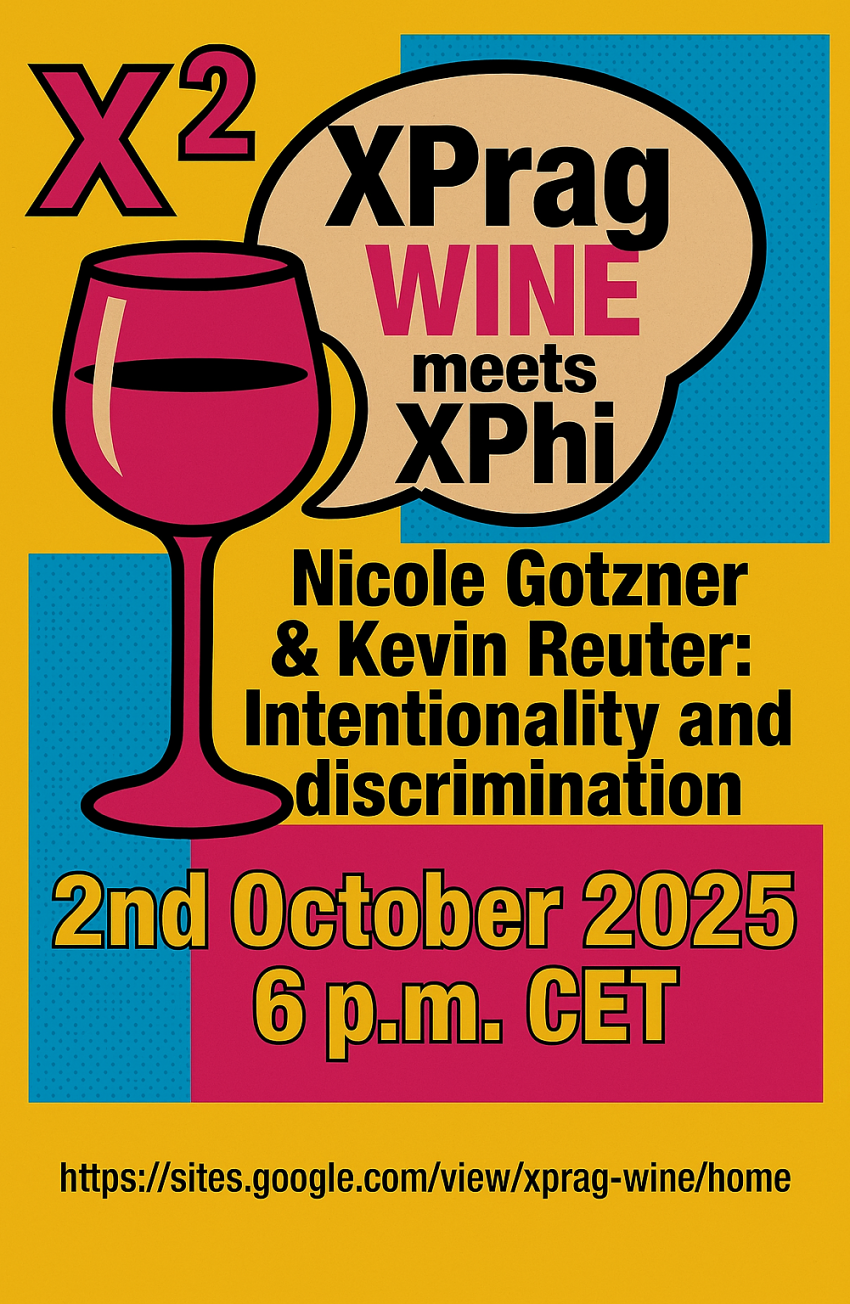
On Tuesday, October 2, the XPRAG Wine Gatherings welcome Nicole Gotzner and Kevin Reuter to talk about “Intentionality and Discrimination” on Zoom. Kevin writes:

Experimental Pragmatics (XPrag) and Experimental Philosophy (XPhi) share a common vision: whenever our assumptions can be empirically tested against the world, we should rise to the occasion. On October 2nd, 2025, don’t miss a talk on “intentionality and discrimination” by Nicole Gotzner (University of Osnabrück) and Kevin Reuter (University of Gothenburg), followed by a discussion on how our communities can exchange ideas and spark new collaborations. We can’t wait to see you there!

The Zoom link and more information are available at the XPRAG Wine Gatherings’ website.

Hackathon: “Data-Driven Methods in Philosophy”

Posted on August 21, 2025August 21, 2025 by Alexander Max Bauer

Gregor Bös and Max Noichl organize a hackathon on “Data-Driven Methods in Philosophy,” which will take place in Utrech from October 16 to 18. Before and after, hybrid meetings will also take place.

Their announcement reads:

Computational methods have transformed academic research, including in the humanities. Philosophers have been comparatively slow to adopt them, but as contemporary language modelling techniques now enable much more sophisticated analyses, they are seeing increasing interest. We want to explore techniques from the digital humanities, linguistics and AI research (Betz 2022) that can support the study of philosophical and scientific corpora, with applications for philosophy of science (Lean, Rivelli & Pence 2021; Noichl 2023. See also the contributions to Pence & Rivelli 2022), the history of philosophy (Petrovich, Verhaegh, Bös et al. 2024; Verhaegh, Petrovich & Bös forthcoming), and metaphilosophy (Petrovich, 2022).

This activity is built around a “hackathon” – an extended period of collaborative programming and discussion. During the three-day in-person event, the participants develop their own projects, either individually or in small groups. The first two days start with keynote lectures that present state-of-the-art research. In the lead-up to the event, we organize two hybrid seminars, in which participants present recent research to each other, to get an idea of what’s possible in this space. During the seminars, participants brainstorm research ideas and discuss with seminar leaders how to apply digital methods, identify appropriate data sources, and determine which digital skills to develop. During the event, our keynote speakers Charles Pence and Gregor Betz contribute their expertise in argument representation, LLMs, digital methods for history and philosophy of science. They will also be available during the event to discuss research ideas, share practical knowledge, and support the seminar participants.

As an additional help for participants without programming experience or who have not yet used data-driven methods in their research, the organizers prepare coding templates and assist in using LLMs for writing code. More experienced participants can focus on exchanging ideas and developing their own projects. A few weeks after the hackathon, we reconvene in a hybrid event to discuss the results of the projects and avenues for further work.

The aim of the course is to offer an introduction to data-driven methods for philosophy and focuses on participant-designed research projects. At the end of the course, participants:

a) Know examples of state-of-the-art data-driven research methods in philosophy and are in a
good position to apply them.
b) Have gained experience in starting their own computational philosophy project
In the best case, the hackathon can be the starting point for a research project in the participants’
domain of expertise.
Workshop: “Data-Driven Methods for Philosophy”

Posted on August 21, 2025August 21, 2025 by Alexander Max Bauer

Gregor Bös and Max Noichl organize the Satellite workshop “Data-Driven Methods for Philosophy” at this year’s conference of the Gesellschaft für Analytische Philosophie (GAP). The workshop will take place at the University of Düsseldorf from September 12 to 13.

Their announcement reads:

Computational methods have revolutionized most fields of academic research, including the humanities. More recently, they have also been put to use in the philosophy of science, history of philosophy, and metaphilosophy. In this satellite workshop, we discuss techniques from the digital humanities, network science, and artificial intelligence that can support the study of philosophical corpora.

The workshop comprises keynote lectures by Prof. Catherine Herfeld and Prof. Adrian Wüthrich that showcase computational methods in philosophical research. After these showcases, Gregor Bös and Max Noichl will assist the participants in developing their own initial research questions that make use of digital methods and explore first implementations. The organizers have prepared templates to support participants without programming experience or who have not yet used computational methods in their research. More experienced participants can use the sessions to exchange ideas and develop their own projects, presenting the state of their progress in the concluding session.

If participants already have project ideas when signing up, we encourage them to get in contact with the organizers to discuss potential data sources and methods. Participants are also very welcome to sign up to continue working on existing digital projects and to contribute to the exchange of approaches.

Conference: “Basel-Oxford-NUS BioXPhi Summit”

Posted on June 7, 2025June 8, 2025 by Alexander Max Bauer

The 2025 “Basel-Oxford-NUS BioXPhi Summit,” organized by Tenzin Wangmo, Brian D. Earp, Carme Isern, Christian Rodriguez Perez, Emilian Mihailov, Ivar Rodriguez Hannikainen, and Kathryn Francis, will take place from June 26 to 27 at the University of Basel, Switzerland.

The program consists of 15 talks and seven posters, framed by two keynotes.

June 26, 8:30–17:30 (UTC+2)

  • Matti Wilks (University of Edinburgh): “Who Has an Expansive Moral Circle? Understanding Variability in Ascriptions of Moral Concern”
  • Eliana Hadjiandreou (University of Texas at Austin): “The Stringent Moral Circle – Self-Other Discrepancies in the Perceived Expansion of Moral Concern”
  • Daniel Martín (University of Granada): “Mapping the Moral Circle with Choice and Reaction Time Data”
  • Neele Engelmann (Max Planck Institute for Human Development): “Understanding and Preventing Unethical Behavior in Delegation to AI”
  • Yuxin Liu (University of Edinburgh): “An Alternative Path to Moral Bioenhancement? AI Moral Enhancement Gains Approval but Undermines Moral Responsibility”
  • Faisal Feroz (National University of Singapore): “Outsourcing Authorship – How LLM-Assisted Writing Shapes Perceived Credit”
  • Jonathan Lewis (National University of Singapore): “How Should We Refer to Brain Organoids and Human Embryo Models? A Study of the Effects of Terminology on Moral Permissibility Judgments”
  • Sabine Salloch (Hannover Medical School): “Digital Bioethics – Theory, Methods and Research Practice”
  • Markus Kneer (University of Graz): “Partial Aggregation in Complex Moral Trade-Offs”

June 27, 8:30–16:30 (UTC+2)

  • Federico Burdman (Alberto Hurtado University) and Maria Fernanda Rangel (University of California, Riverside): “Not in Control but Still Responsible – Lay Views on Control and Moral Responsibility in the Context of Addiction”
  • Vilius Dranseika (Jagiellonian University): “Gender and Research Topic Choice in Bioethics and Philosophy of Medicine”
  • Jodie Russell (University of Birmingham): “Sartre and Psychosis – Doing Intersectional, Phenomenological Interviews with People with Experience of Mental Disorder”
  • Aníbal M. Astobiza (University of Granada): “Spanish Healthcare Professionals’ Trust in AI – A BioXPhi Study”
  • Nick Byrd (Geisinger College of Health Science): “Reducing Existential Risk by Reducing the Allure of Unwarranted Antibiotics – Two Low-Cost Interventions”
  • Rana Qarooni (University of Edinburgh; University of York): “Prevalence of Omnicidal Tendencies”
  • Lydia Tsiakiri (Aarhus University): “Responsibility-Sensitive Healthcare Allocation – Neutrally or Wrongfully Discriminatory?”
  • Edmond Awad (University of Exeter; University of Oxford): “Online Serious Games as a Tool to Study Value Disagreement”

For more information about the conference, visit https://ibmb.unibas.ch/en/public-outreach/projects-to-the-public/basel-oxford-nus-bioxphi-summit-2025/.

Talk: “Creativity in Taboo Terms in Sign Languages” (Donna Jo Napoli)

Posted on April 18, 2025April 18, 2025 by Alexander Max Bauer

On Monday, May 26, from 14:30–16:00 (UTC+1), the “Slurring Terms Across Languages” (STAL) network will present Donna Jo Napoli’s talk “Creativity in Taboo Terms in Sign Languages” as part of the STAL seminar series. The abstract reads:

Deaf signing communities share many of the same language taboos that hearing speakers observe. Still, there are areas that are sticky in sign that are not in speech and vice versa. We will take a peek at how signers create taboo signs, looking at ASL and DGS (the sign language of Germany) and perhaps a couple of other languages, noting primarily morphological creativity but also syntactic creativity.

The talk can be joined using Zoom. Please write an email to stalnetwork@gmail.com for the invitation link.

Talk: “Derogatory Speech – Conversations, Hearers, and Listeners” (Claire Horisk)

Posted on March 3, 2025March 3, 2025 by Alexander Max Bauer

On Monday, March 10, from 14:30–16:00 (UTC+1), the “Slurring Terms Across Languages” (STAL) network will present Claire Horisk’s talk “Derogatory Speech – Conversations, Hearers, and Listeners” as part of the STAL seminar series. The abstract reads:

In discussions of how to mitigate political and cultural polarization, we are often told that we should listen to our opponents. But should we listen regardless of what they say – even to derogatory speech? From the standpoint of philosophy, the prescription to listen lacks subtlety, and we cannot reach greater subtlety without a philosophical account of listening itself. In my recent work, I distinguish between listening and hearing and argue that listening to derogatory speech in the context of a conversation is sometimes morally wrong. In this talk, I expand my account, particularly with respect to how power dynamics affect who counts as a conversational participant.

The talk can be joined using Zoom. Please write an email to stalnetwork@gmail.com for the invitation link.

  • 1
  • 2
  • 3
  • Next

Search

Categories

Tags

Agency Artificial Intelligence Basic Needs Behavior Beliefs Bias Bioethics Blame Causation Cognitive Science Consciousness Corpus Analysis Cross-Cultural Research Decisions Determinism Distributive Justice Emotions Essentialism Expertise Folk Morality Framing Free Will Gender Intention Intuition Jurisprudence Knowledge Large Language Models Moral Psychology Norms Pejoratives Problem of Evil Psycholinguistics Rationality Reasoning Replication Responsibility Self Side-Effect Effect Slurs Truth Valence Values Virtue Well-Being

Recent Posts

  • Call: “The Armchair on Trial”
  • Call: “Interdisciplinary Perspectives on Linguistic Justice”
  • Call: “6th European Experimental Philosophy Conference”
  • Talk: “Ethics in the Lab” (Pascale Willemsen)
  • Talk: “Normality and Norms” (Josh Knobe)

Recent Comments

  1. Nova Praxis on The Folk Concept of ArtJuly 11, 2025

    This article highlights an important point: everyday people don’t rely on rigid definitions to determine what qualifies as art. They’re…

  2. Koen Smets on Priming Effects Are Fake, but Framing Effects Are RealMay 27, 2025

    That is indeed exactly the question I have as well. I operationalize it as having de facto contradicting intuitions, in…

  3. Joshua Knobe on Priming Effects Are Fake, but Framing Effects Are RealMay 24, 2025

    Hi Koen, Thanks once again. This idea brings up all sorts of fascinating questions, but for the purposes of the…

  4. Koen Smets on Priming Effects Are Fake, but Framing Effects Are RealMay 24, 2025

    Great! In the meantime I thought of another potentially interesting example of framing—Arnold Kling’s Three Languages of Politics. Just about…

  5. Joshua Knobe on Priming Effects Are Fake, but Framing Effects Are RealMay 23, 2025

    Thanks Koen! This is all super helpful.

Archives

  • February 2026
  • January 2026
  • December 2025
  • November 2025
  • October 2025
  • September 2025
  • August 2025
  • July 2025
  • June 2025
  • May 2025
  • April 2025
  • March 2025
  • February 2025
  • January 2025
  • December 2024
  • November 2024
  • October 2024
  • September 2024
  • August 2024
  • July 2024
  • June 2024
  • May 2024
  • April 2024
  • March 2024

Meta

  • Log in
  • Entries feed
  • Comments feed
  • WordPress.org

Imprint • Disclaimer • Privacy Statement • Cookie Policy

© 2024 The Experimental Philosophy Blog
Manage Consent
To provide the best experiences, we use technologies like cookies to store and/or access device information. Consenting to these technologies will allow us to process data such as browsing behavior or unique IDs on this site. Not consenting or withdrawing consent, may adversely affect certain features and functions.
Functional Always active
The technical storage or access is strictly necessary for the legitimate purpose of enabling the use of a specific service explicitly requested by the subscriber or user, or for the sole purpose of carrying out the transmission of a communication over an electronic communications network.
Preferences
The technical storage or access is necessary for the legitimate purpose of storing preferences that are not requested by the subscriber or user.
Statistics
The technical storage or access that is used exclusively for statistical purposes. The technical storage or access that is used exclusively for anonymous statistical purposes. Without a subpoena, voluntary compliance on the part of your Internet Service Provider, or additional records from a third party, information stored or retrieved for this purpose alone cannot usually be used to identify you.
Marketing
The technical storage or access is required to create user profiles to send advertising, or to track the user on a website or across several websites for similar marketing purposes.
  • Manage options
  • Manage services
  • Manage {vendor_count} vendors
  • Read more about these purposes
View Preferences
  • {title}
  • {title}
  • {title}