The 4th “European Experimental Philosophy Conference,” organized by Izabela Skoczeń, Tomasz Żuradzki, Piotr Bystranowski, Bartosz Janik, Maciej Próchnicki, and Vilius Dranseika, will take place from May 30 to July 2 at Jagiellonian University in Krakow, Poland.
On May 30, there’s a pre-conference symposium on “LLMs for xPhi”. The conference program from May 31 to June 2, then, spans a total of 19 sessions and is complemented by three keynotes:
May 31, 9:30–10:45 (UTC+2)
Ivar Rodriguez Hannikainen (University of Granada): “Letter Versus Spirit – An Overview of Experimental General Jurisprudence”
June 1, 9:30–10:45 (UTC+2)
Katarzyna Paprzycka-Hausman and her team (University of Warsaw): “Reflecting on the Knobe Effect and the Epistemic Side-Effect Effect”
June 2, 13:00–14:15 (UTC+2)
Thomas Nadelhoffer (College of Charleston): “Measuring Free Will Beliefs – What Have We Learned?”
This term at the University of Oldenburg, Stephan Kornmesser and I are teaching a course for master’s students who had no previous contact with x phi.1 We decided to try a hands-on approach rather than just discussing results, debates, and ideas from the field. For this purpose, we divided the course into two parts. In the first half, loosely based on Kornmesser et al. (forthcoming), we introduced some basics of experimental design and statistical analysis. Also, as a paradigmatic example of an early x phi study, we read Knobe (2003). In my opinion, this paper has the advantage of being both short and accessible; the experimental design is simple and the data collected (primarily the nominal yes-or-no responses) can be analyzed quite straightforwardly.
Thereafter, the course was divided into three groups,2 and students were instructed to replicate Knobe’s first study step by step. First, we reconstructed the questionnaire, using a German translation of the vignette (taken from Knobe 2014). Everyone probably knows the vignette, but to refresh your memory, here is the original once again (variations between Harm and Help Condition are indicated by square brackets):
The vice-president of a company went to the chairman of the board and said, “We are thinking of starting a new program. It will help us increase profits, but [and] it will also harm [help] the environment.”
The chairman of the board answered, “I don’t care at all about harming [helping] the environment. I just want to make as much profit as I can. Let’s start the new program.”
They started the new program. Sure enough, the environment was harmed [helped].
Knobe (2003, 190)
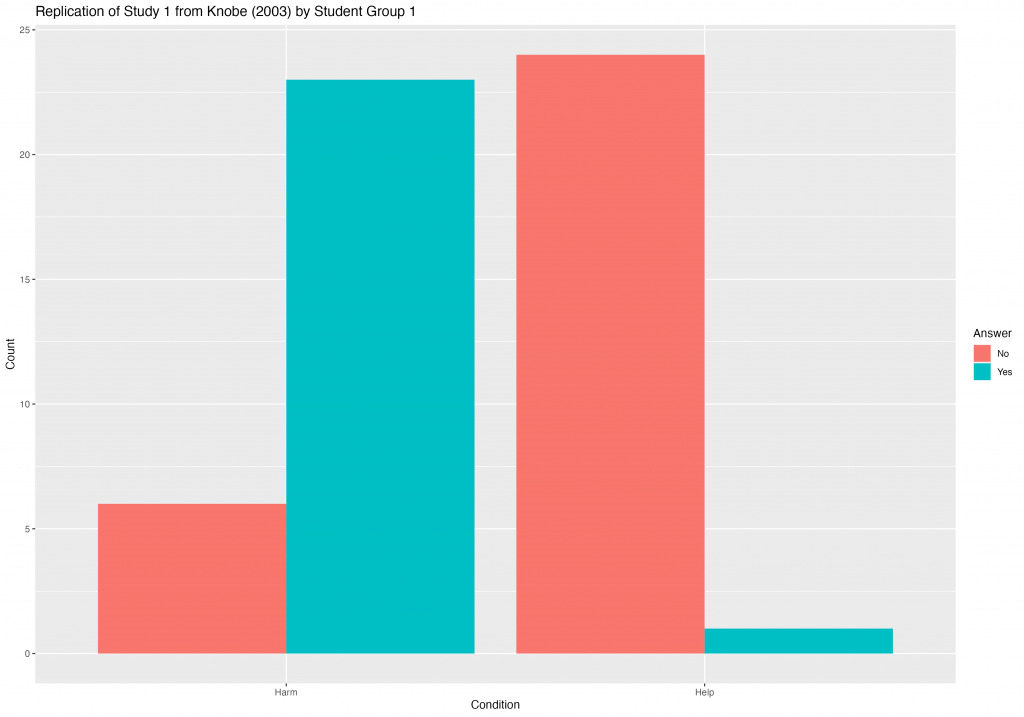
Afterwards, students used the questionnaire to ask people on campus whether the chairman brought about the side effect intentionally. Finally, we calculated and interpreted χ2 tests for each group. To foster an understanding of how the χ2 test actually works, we calculated them by hand one step at a time instead of using software.
As can be seen in the picture below, showing the results from Group 1, Knobe’s original findings were perfectly replicated.3 In the Harm Condition, most subjects said that the chairman brought about the side effect intentionally, while in the Help Condition, most subjects said that he did not.4
Replication of Study 1 from Knobe (2003) by Student Group 1
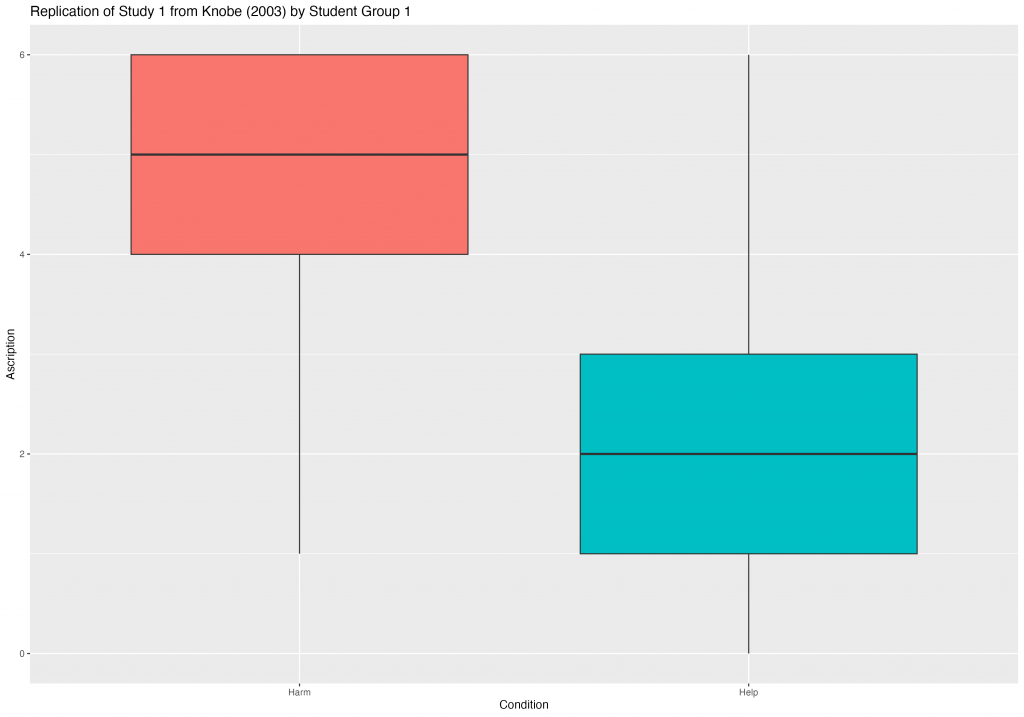
As did Knobe (2003), people were also asked how much praise or blame the chairman deserves. Using the results from Group 1 again as an example, shown in the picture below, the mean of ascribed blame was 4.90 (SD = 1.26), while the mean of ascribed praise was 2.32 (SD = 1.63), which also fits in very well with Knobe’s results.5
Replication of Study 1 from Knobe (2003) by Student Group 1
Where do we go from here? In the second half of our course, the three groups are encouraged to develop their own research questions based on their philosophical interests. They will learn how to design an online survey and set one up themselves. Luckily, we have got a grant for research-based learning instructional projects from the university’s initiative forschen@studium,6 which will be used to recruit subjects from an online panel provider. Hence, learning panel integration will also be on our schedule. This is followed by guided data analysis and interpretation. Finally, the groups present their results to each other and document them in term papers. This means that, in the end, an entire research process is experienced.
Kornmesser, Stephan, Alexander Max Bauer, Mark Alfano, Aurélien Allard, Lucien Baumgartner, Florian Cova, Paul Engelhardt, Eugen Fischer, Henrike Meyer, Kevin Reuter, Justin Sytsma, Kyle Thompson, and Marc Wyszynski (forthcoming): Experimental Philosophy for Beginners. A Gentle Introduction to Methods and Tools, Cham: Springer. (Link)
Knobe, Joshua (2003): “Intentional Action and Side Effects in Ordinary Language,” Analysis 63 (3), 190–194. (Link)
Knobe, Joshua (2014): “Absichtliches Handeln und Nebeneffekte in der Alltagssprache,” translated by Jürgen Schröder, in: Thomas Grundmann, Joachim Horvath, and Jens Kipper (eds.): Die Experimentelle Philosophie in der Diskussion, Berlin: Suhrkamp, 96–101. (Link)
Endnotes
If you are interested in teaching x phi to beginners, you should also take a look at De Cruz (2019). In her blog post, she describes a teaching approach to third-year undergraduates at Oxford Brookes University. ↩︎
Of course, the great students of our course deserve credit! Group 1: Johannes Bavendiek, Marvin Jonas Laesecke, and Aileen Wiechmann; Group 2: Rebecca Kratzer, Frederike Lüttich, and Jule Rüterbories; Group 3: Bastian Göbbels, Finn Ove Gronotte, Marina Hinkel, and Riduan Schwarz. ↩︎
χ2(1, 54) = 27.865, p < 0.001. For comparison: Knobe (2003, 192) reports χ2(1, 78) = 27.2, p < 0.001. ↩︎
t(54) = 6.43, p < 0.001. For comparison: Knobe (2003, 193) reports – pooled for both of his studies – a mean of 4.8 in the harm condition and of 1.4 in the help condition; t(120) = 8.4, p < 0.001. ↩︎
Today, the “XPHI UK Work in Progress Workshop Series,” organized by James Andow and Eugen Fischer, starts. They write:
We are delighted to announce the next series of our monthly online workshop devoted to discussion of work in progress in experimental philosophy. The worshop is held via Teams, the second Wednesday of each month, 16:00–18:00 UK time. The link to the Teams meetings is below.
February 14, 16:00–18:00 (UTC±0)
Renato Turco (University of Genoa): “An Experimental Approach to Empty Definite Descriptions”
Lucien Baumgartner (University of Zurich), Paul Rehren (Utrecht University), and Krzysztof Sękowski (University of Warsaw): “Measuring (Un)Intentional Conceptual Change in Philosophy – A Corpus Study”
March 13, 16:00–18:00 (UTC±0)
Isabelle Keßels (University of Düsseldorf), Paul Hasselkuß (University of Düsseldorf), and Daian Bica (University of Düsseldorf): “The Safety Dilemma Put to the Test”
José V. Hernández-Conde (University of Valladolid) and Agustín Vicente (University of the Basque Country; Ikerbasque): “A Comparative Analysis of the Knobe Effect – Assessing Moral, Aesthetic, and Alethic Reasoning in Autistic and Neurotypical Populations”
April 10, 16:00–18:00 (UTC+1)
Tingting Sui (Peking University), Sebastian Sunday (Peking University): “A Confucian Algorithm for Autonomous Vehicles”
Ryan Doran (University of Barcelona; University of Cambridge): “True Beauty”
May 8, 16:00–18:00 (UTC+1)
William Gopal (University of Glasgow): “Identifying & Rectifying the Instrumentalist Bias in Analytic Social Epistemology”
Giuseppe Ricciardi (Harvard University) and Kevin Reuter (University of Zurich): “Exploring the Agent-Relativity of Truth”
June 12, 16:00–18:00 (UTC+1)
Federico Burdman (Alberto Hurtado University), Gino Marttelo Carmona Díaz (University of the Andes), and María Fernanda Rangel Carrillo (University of the Andes): “Lay Perceptions of Control and Moral Responsibility in Addiction”
Phuc Nguyen (German Cancer Research Center), Andrea Quint (German Cancer Research Center), María Alejandra Petino Zappala (German Cancer Research Center), and Nora Heinzelmann (University of Erlangen-Nuremberg): “A Cross-Cultural Study on the Ethics and Moral Psychology of HPV Vaccination”
To provide the best experiences, we use technologies like cookies to store and/or access device information. Consenting to these technologies will allow us to process data such as browsing behavior or unique IDs on this site. Not consenting or withdrawing consent, may adversely affect certain features and functions.
Functional
Always active
The technical storage or access is strictly necessary for the legitimate purpose of enabling the use of a specific service explicitly requested by the subscriber or user, or for the sole purpose of carrying out the transmission of a communication over an electronic communications network.
Preferences
The technical storage or access is necessary for the legitimate purpose of storing preferences that are not requested by the subscriber or user.
Statistics
The technical storage or access that is used exclusively for statistical purposes.The technical storage or access that is used exclusively for anonymous statistical purposes. Without a subpoena, voluntary compliance on the part of your Internet Service Provider, or additional records from a third party, information stored or retrieved for this purpose alone cannot usually be used to identify you.
Marketing
The technical storage or access is required to create user profiles to send advertising, or to track the user on a website or across several websites for similar marketing purposes.