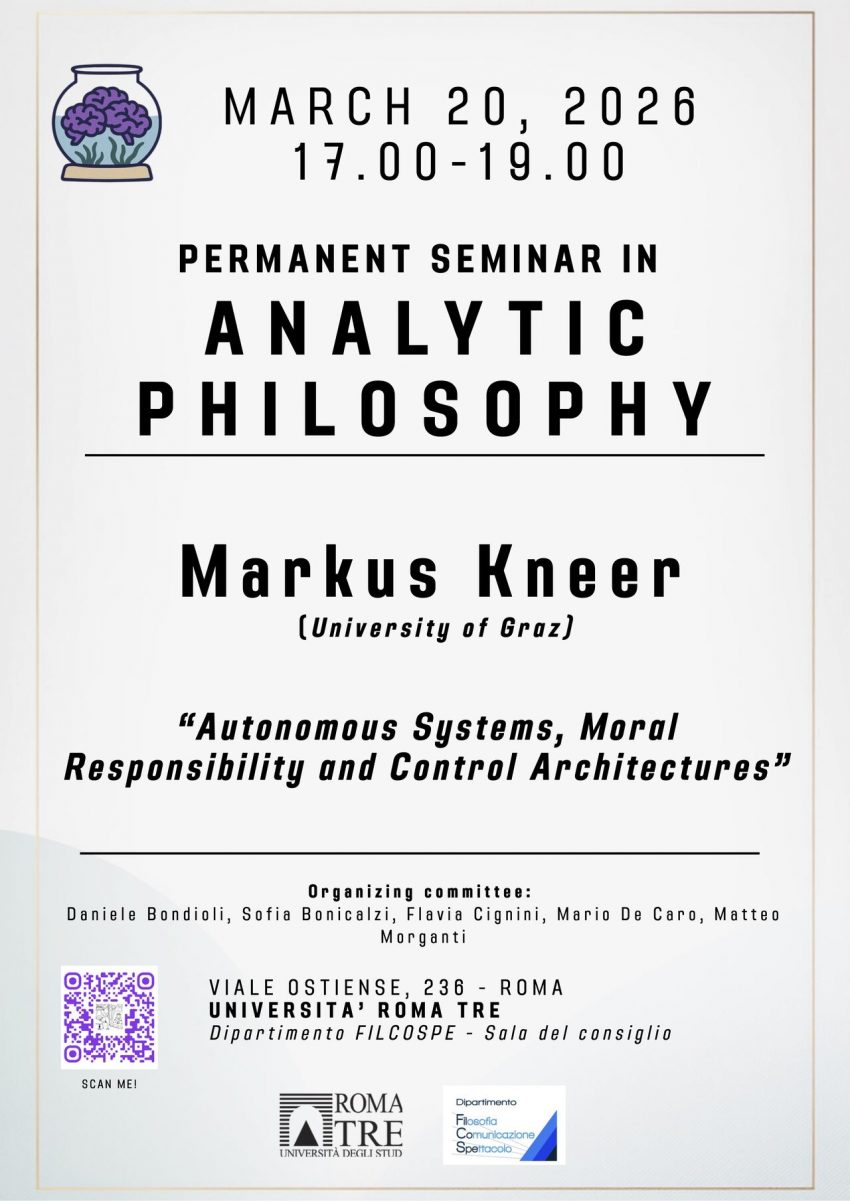
On March 20, from 17:00–19:00 (UTC+1), the Permanent Seminar in Analytic Philosophy (PSAP) of Università Roma Tre will host a talk by Markus Kneer about “Autonomous Systems, Moral Responsibility and Control Architectures.” The hybrid session can be accessed via Teams. The abstract reads:
Matthias (2004) and Sparrow (2007) have argued that the use of self-learning systems can engender “responsibility gaps” – situations in which nobody is morally responsible for a potential harm. In this talk, I will present empirical evidence as to whether laypeople are sensitive to such alleged “responsibility gaps” or whether their retributive dispositions might get in the way (see Danaher, 2016). I will also present new data concerning the question whether we can avoid such situations by imposing tight control architectures to ensure meaningful human control (see e.g. “human-in-the-loop v. on-the-loop,” Docherty, 2012; “tracking & tracing,” Santoni de Sio & van den Hoven, 2018).
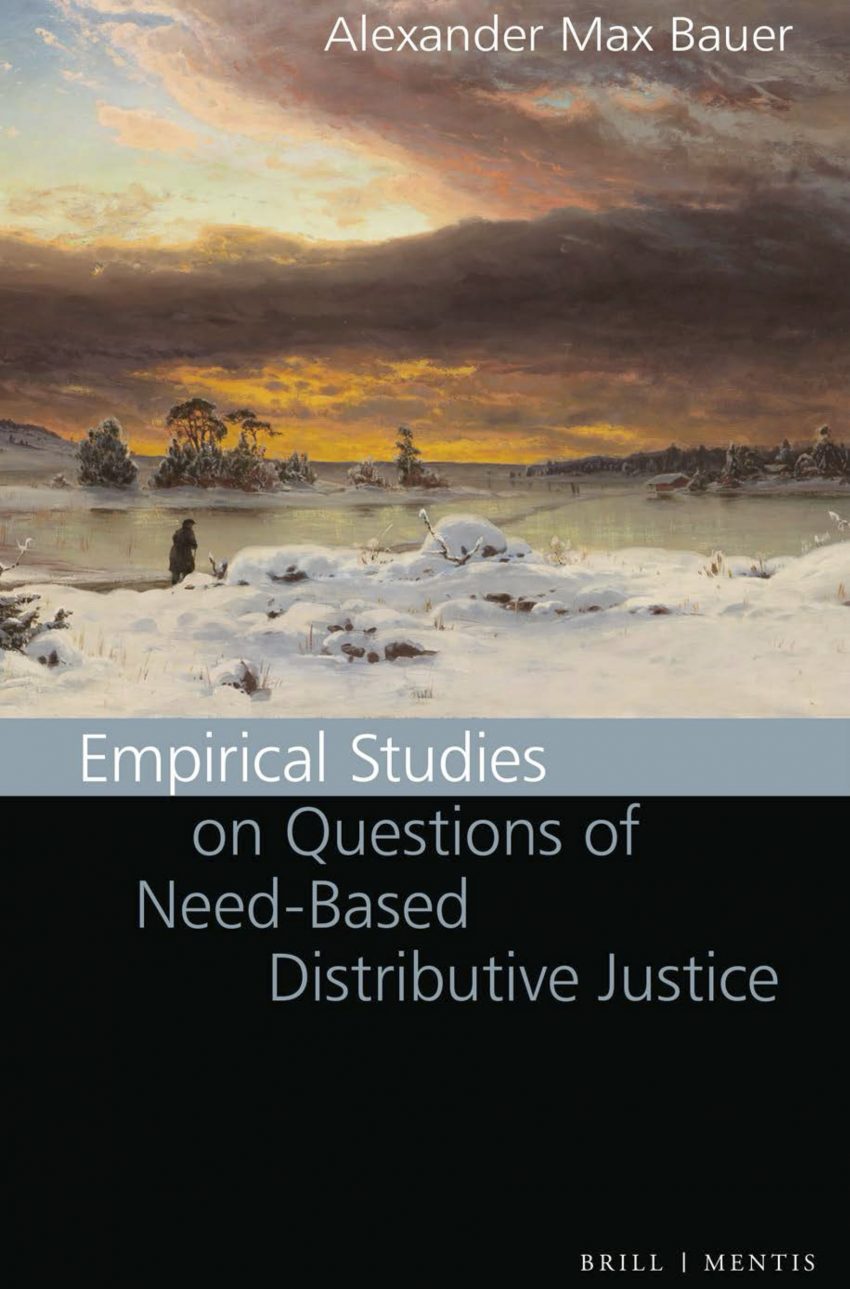
Impartial observers make gradual assessments of the fairness of distributions.
These assessments depend on how well an individual is supplied with a relevant good.
If information on a need threshold is given, these assessments are made relative to this reference point. (Bauer et al. 2023a [later published as Bauer et al. 2025])
Impartial decision-makers consider need, productivity, and accountability when making hypothetical distribution decisions.
If an individual’s productivity is not sufficient to cover their needs, these higher needs are partially compensated for (at the expense of other individuals who are not so badly off)
Willingness to compensate decreases if an individual is accountable for having produced less or for needing more. (Bauer et al. 2022)
Both impartial observers and impartial decision-makers attribute different levels of importance to different kinds of needs.
This reveals a hierarchy of needs in the following order: Survival, Decency, Belonging, Autonomy. (Bauer et al. 2023b)
Literature
Bauer, Alexander Max, Frauke Meyer, Jan Romann, Mark Siebel, and Stefan Traub (2022): “Need, Equity, and Accountability. Evidence on Third-Party Distribution Decisions from a Vignette Study,” Social Choice and Welfare 59, 769–814. (Link)
Bauer, Alexander Max, Adele Diederich, Stefan Traub, and Arne Robert Weiss (2023a): “When the Poorest Are Neglected. A Vignette Experiment on Need-Based Distributive Justice,” SSRN Working Paper 4503209. (Link)
Bauer, Alexander Max, Jan Romann, Mark Siebel, and Stefan Traub (2023b): “Winter is Coming. How Laypeople Think About Different Kinds of Needs,” PLoS ONE 18 (11), e0294572. (Link)
Bauer, Alexander Max (2024): Empirische Studien zu Fragen der Bedarfsgerechtigkeit, Oldenburg: University of Oldenburg Press. (Link)
Bauer, Alexander Max (2025): Empirical Studies on Questions of Need-Based Distributive Justice, Paderborn: mentis. (Link)
Bauer, Alexander Max, Adele Diederich, Stefan Traub, and Arne Robert Weiss (2025): “Thinking About Need. A Vignette Experiment on Need-Based Distributive Justice,” The Journal of Economic Inequality 23 (3), 667–693. (Link)
The 2025 “Basel-Oxford-NUS BioXPhi Summit,” organized by Tenzin Wangmo, Brian D. Earp, Carme Isern, Christian Rodriguez Perez, Emilian Mihailov, Ivar Rodriguez Hannikainen, and Kathryn Francis, will take place from June 26 to 27 at the University of Basel, Switzerland.
The program consists of 15 talks and seven posters, framed by two keynotes.
June 26, 8:30–17:30 (UTC+2)
Matti Wilks (University of Edinburgh): “Who Has an Expansive Moral Circle? Understanding Variability in Ascriptions of Moral Concern”
Eliana Hadjiandreou (University of Texas at Austin): “The Stringent Moral Circle – Self-Other Discrepancies in the Perceived Expansion of Moral Concern”
Daniel Martín (University of Granada): “Mapping the Moral Circle with Choice and Reaction Time Data”
Neele Engelmann (Max Planck Institute for Human Development): “Understanding and Preventing Unethical Behavior in Delegation to AI”
Yuxin Liu (University of Edinburgh): “An Alternative Path to Moral Bioenhancement? AI Moral Enhancement Gains Approval but Undermines Moral Responsibility”
Faisal Feroz (National University of Singapore): “Outsourcing Authorship – How LLM-Assisted Writing Shapes Perceived Credit”
Jonathan Lewis (National University of Singapore): “How Should We Refer to Brain Organoids and Human Embryo Models? A Study of the Effects of Terminology on Moral Permissibility Judgments”
Sabine Salloch (Hannover Medical School): “Digital Bioethics – Theory, Methods and Research Practice”
Markus Kneer (University of Graz): “Partial Aggregation in Complex Moral Trade-Offs”
June 27, 8:30–16:30 (UTC+2)
Federico Burdman (Alberto Hurtado University) and Maria Fernanda Rangel (University of California, Riverside): “Not in Control but Still Responsible – Lay Views on Control and Moral Responsibility in the Context of Addiction”
Vilius Dranseika (Jagiellonian University): “Gender and Research Topic Choice in Bioethics and Philosophy of Medicine”
Jodie Russell (University of Birmingham): “Sartre and Psychosis – Doing Intersectional, Phenomenological Interviews with People with Experience of Mental Disorder”
Aníbal M. Astobiza (University of Granada): “Spanish Healthcare Professionals’ Trust in AI – A BioXPhi Study”
Nick Byrd (Geisinger College of Health Science): “Reducing Existential Risk by Reducing the Allure of Unwarranted Antibiotics – Two Low-Cost Interventions”
Rana Qarooni (University of Edinburgh; University of York): “Prevalence of Omnicidal Tendencies”
Justin Sytsma and Melissa Snater: “Consciousness, Phenomenal Consciousness, and Free Will”
Myrto Mylopoulos: “Skilled Action and Metacognitive Control”
Samuel Murray: “Bringing Self-Control into the Future”
Walter Sinnott-Armstrong: “Who is Responsible? Split Brains, Dissociative Identity Disorder, and Implicit Attitudes”
Paul Noordhof and Ema Sullivan-Bissett: “The Everyday Irrationality of Monothematic Delusion”
John Turri: “Truth, Perspective, and Norms of Assertion – New Findings and Theoretical Advances”
Joanna Korman: “The Distinct Functions of Belief and Desire in Intentional Action Explanation”
Cory J. Clark, Heather M. Maranges, Brian B. Boutwell, and Roy F. Baumeister: “Free Enough – Human Cognition (and Cultural Interests) Warrant Responsibility”
Edouard Machery, Markus Kneer, Pascale Willemsen, and Albert Newen: “Beyond the Courtroom – Agency and the Perception of Free Will”
Katrina L. Sifferd: “Do Rape Cases Sit in a Moral Blindspot? The Dual Process Theory of Moral Judgment and Rape”
Shane Timmons and Ruth M. J. Byrne: “How People Think About Moral Excellence – The Role of Counterfactual Thoughts in Reasoning about Morally Good Actions”
Caroline T. Arruda and Daniel J. Povinelli Index: “Why Idealized Agency Gets Animal (and Human) Agency Wrong”
Literature
Henne, Paul, and Samuel Murray (eds.) (2024): Advances in Experimental Philosophy of Action, London, New York, and Dublin: Bloomsbury. (Link)
Applications are possible until November 25. The job announcement reads:
PhD scholarship at GSN
You can apply for a neurophilosophy PhD scholarship in an annually recurring call for scholarships (application period from early December to mid-February). The GSN offers a structured doctoral program with an independent PhD (GSN Doctoral Program), in which you can choose from a wide range of interdisciplinary courses together with your TAC (Thesis Advisory Board) to put together an interdisciplinary study program tailored to your individual research interests. This gives you a sound neuroscientific insight into the (natural) scientific contexts that are important for your neurophilosophical doctoral project. In addition, there is an extensive range of “soft skills” and an attractive social program.
Call for PhD scholarships in Neurophilosophy
The application round for 2024/25 is now open and will close on 17 February 2025 (12:00 noon CET).
The Graduate School of Systemic Neurosciences (GSN) at LMU Munich invites applications for several PhD scholarships in Neurophilosophy. The GSN is the teaching entity for the Munich Center of Neurosciences – Brain & Mind (MCN). By creating an interdisciplinary network of research, the GSN provides a stimulating environment for students and faculty to produce novel formulations of current concepts and theories. Successful applicants will be affiliated with the Research Center for Neurophilosophy and Ethics of Neurosciences at the GSN.
Projects in the research center fall in the following areas:
philosophy of cognitive neuroscience (explanation, reduction)
philosophy and cognitive science of agency (mental causation, free will, moral psychology, abilities)
philosophy and cognitive science of reasoning (e.g. deductive and non-deductive reasoning, logic and neural networks, decision making)
ethics of neuroscience (research ethics, enhancement)
philosophy of perception
philosophy and social cognition
In the new application round we encourage applications in smaller focus areas in order to build research groups. In the 2024/25 round the focus areas are:
human agency (esp. mental causation, complex action, multi-tasking, attention, reductive and non-reductive explanation of agency)
metacognition (esp. metacognition in perception, self-evaluation and sense of self)
group cognition (group epistemology, collective decisions and group responsibility)
However, single exceptional and independent projects in one of the other areas are also encouraged.
Applicants should have advanced training in philosophy (typically a Master’s degree in philosophy) and a genuine interest in the neurosciences. This includes the willingness to acquire substantial knowledge of empirical work relevant to their philosophical project. Cooperative projects with empirical scientists in the network of the MCN are strongly encouraged.
The application period will open on 1 December 2024 and will close on 17 February 2025 (12:00 noon CET). Please check our website and the GSN website for details concerning the application procedure. The application includes an outline of your proposed research project, a CV, an official transcript of your academic work (list of attended courses; grades), diplomas and two separate academic reference letters. Please also name two potential supervisors (possibly including one non-philosopher) from the core or affiliated neurophilosophy faculty of the GSN.
How to apply for a GSN PhD scholarship
Please follow the standard application process for GSN PhD applications:
In a previous post, I wrote about a course (which I taught together with Stephan Kornmesser in the summer term of 2024) for master’s students who had no previous contact with X-Phi at all. After learning some methodological and statistical basics and conducting their own small replication of Knobe (2003), they had the opportunity to develop their own questions and conduct their very own studies in small groups. Below, Bastian Göbbels and Marina Hinkel present some results from their study on the perception of the moral obligation to help others.
The Perception of the Moral Obligation to Help Others
Bastian Göbbels and Marina Hinkel
The United Nations calculated a donation amount for development aid in the 1970s that wealthy countries could contribute to prevent the global consequences of absolute poverty – 70 cents per 100 earned dollars. In 2013, only Denmark, Luxembourg, Norway, and Sweden reached this donation target. At that time, Germany was at 0.38–0.43 cents (cf. Singer 2013, 344). The bottom line is that we could contain extreme global poverty and its consequences relatively easily, but the reality is different.
Peter Singer raises the question of whether we have an obligation to help those in need and to whom we have moral obligations (by “we,” Singer means individuals in wealthy industrialized countries – including himself). Singer argues that we should, for example, prevent a certain level of absolute poverty because absolute poverty is bad, because we could prevent a level of absolute poverty without having to make comparable sacrifices, and if we can prevent something bad without having to make a comparable sacrifice, we should do so (cf. Singer 2013, 356f.). Singer reinforces the last premise by pointing out that it only requires us to prevent bad things and not to promote good things (this corresponds to the consequentialism of utilitarianism; cf. Singer 2017, 36).
Singer illustrates the principle of the obligation to help with a thought experiment about a child in a pond that is in danger of drowning. Here is how Singer himself describes the “drowning child”:
To challenge my students to think about the ethics of what we owe to people in need, I ask them to imagine that their route to the university takes them past a shallow pond. One morning, I say to them, you notice a child has fallen in and appears to be drowning. To wade in and pull the child out would be easy but it will mean that you get your clothes wet and muddy, and by the time you go home and change you will have missed your first class.
I then ask the students: do you have any obligation to rescue the child? Unanimously, the students say they do. The importance of saving a child so far outweighs the cost of getting one’s clothes muddy and missing a class, that they refuse to consider it any kind of excuse for not saving the child. Does it make a difference, I ask, that there are other people walking past the pond who would equally be able to rescue the child but are not doing so? No, the students reply, the fact that others are not doing what they ought to do is no reason why I should not do what I ought to do. (Singer 1997, par. 1f.)
The principle should be applied equally to all cases, regardless of whether I am the only person potentially helping, e.g., by saving the child in the pond, or one of many, e.g., by donating (cf. Singer 2017, 37). Although Singer does not regard failure to help as intentional killing but as a moral challenge (cf. Singer 2013, 354), he emphasizes elsewhere that absolute poverty means a death sentence and that the diseases responsible for this are preventable (cf. Singer 2013, 341f.).
Under the premises of universalization, impartiality, and equality, the spatial aspect – distance or proximity to the person in need – should be obsolete, according to Singer. In light of globalization, with today’s improved communication and transport conditions, distance can no longer be an excuse for lack of assistance (cf. Singer 2017, 37f.). Singer concedes: “The fact that a person is physically close to us […] may increase the likelihood that we will help them, but this does not prove that we should help them rather than any other person who happens to be at a greater distance” (Singer 2017, 37).
Singer argues that there is a certain level of extreme poverty that we can prevent without sacrificing anything of comparable moral significance in figures. On the one hand, he uses the amount calculated by the United Nations, which would be sufficient for basic development aid: 70 cents per 100 dollars earned. According to the World Bank in 2008, this would correspond to 1.25 dollars per day for a person’s basic needs (note currency-dependent purchasing power; cf. Singer 2013, 341). In 2008, the wealthy industrialized countries donated 19–43 cents for every 100 dollars earned (cf. Singer 2013, 344).
Based on Singer’s above-outlined thoughts, we wanted to investigate how spatial and social distance or proximity, as well as personal cost, influence the perception of moral obligation. To do this, we developed a vignette in which a child needs help from our subject. Between subjects, we varied (a) whether the child needs a new kidney directly from the subject or money for the same medical purpose, (b) whether our subject is said to know the child or not, and (c) whether the child is from the same neighbourhood, the same federal state, or a far-away country from the Global South. This resulted in a total of twelve different scenarios.
As an example, here is a translation of the vignette where a child from the neighbourhood, which the subject is said to know, needs money:
Imagine the following situation: You are informed that a child you know has life-threatening problems with his only kidney and, therefore, needs a donor organ. The child lives in your neighbourhood. You could donate one-third of your monthly income for the next two years without being at risk of losing your livelihood. With your help, the child would be saved.
After reading the vignette, subjects were asked to answer two yes-or-no questions: “Would you donate your money [kidney]?” and “Regardless of whether you would donate your money [kidney] yourself, do you think that someone in such a situation should donate their money [kidney]?” In the following, we will only look at the former question.
The online survey was programmed with LimeSurvey, and 630 subjects from Bilendi successfully participated (i.e., they did not fail an attention check and completed the survey).
A surprising finding is that more participants said they would donate a kidney than money (χ² ≈ 5.620, p < 0.05); see Figure 1. This increased willingness could be due to the fact that donating a kidney is perceived as more immediate and life-saving, while donating money is often perceived as less urgent.
Figure 1: Kidney vs. money
At the same time, we found that the willingness to donate does not change between the neighbourhood and the federal state (χ² ≈ 0.030, p > 0.1) but between the federal state and the far-away country (χ² ≈ 7.608, p < 0.01); see Figure 2.
Figure 2: Neighborhood vs. federal state and federal state vs. far-away country
Lastly, we didn’t find a significant difference when it comes to knowing the child or not (χ² ≈ 3.414, p > 0.05); see Figure 3.
Figure 3: Known vs. unknown
Our results are partly consistent with Peter Singer’s assumptions. Nevertheless, they show that people’s willingness to help – at least in our hypothetical scenarios – seems to decrease with distance. Also, the type of aid (kidney vs. money) seems to play a role, while social proximity does not. Of course, these results need to be taken with a grain of salt, and further, more elaborate research is necessary. Interestingly enough, there is a discrepancy between given answers and actual behavior, as illustrated by the low numbers of organ donations in reality. While respondents signal a high willingness to help in hypothetical scenarios, practical implementation falls short of these expectations.
Knobe, Joshua (2003): “Intentional Action and Side Effects in Ordinary Language,” Analysis 63 (3), 190–194. (Link)
Singer, Peter (1997): “The Drowning Child and the Expanding Circle,” New Internationalist 289. (Link)
Singer, Peter (2013): Praktische Ethik, translated by Oscar Bischoff, Jean-Claude Wolf, Dietrich Klose, and Susanne Lenz, 3rd edition, Stuttgart: Reclam. (Link)
Singer, Peter (2017): Hunger, Wohlstand und Moral, translated by Elsbeth Ranke, Hamburg: Hoffmann und Campe. (Link)
In a previous post, I wrote about a course (which I taught together with Stephan Kornmesser in the summer term of 2024) for master’s students who had no previous contact with X-Phi at all. After learning some methodological and statistical basics and conducting their own small replication of Knobe (2003), they had the opportunity to develop their own questions and conduct their very own studies in small groups. Below, Frederike Lüttich and Jule Rüterbories present some results from their study on the perception of responsibility in accidents involving autonomous and human-controlled vehicles.
The Perception of Responsibility in Accidents Involving Autonomous and Human-Controlled Vehicles
Frederike Lüttich and Jule Rüterbories
The relevance of autonomous systems as potential moral agents is growing with their use in areas such as medicine, the military, and traffic, where they have – or will have – to make decisions in ethical contexts. The capacity of such systems to act has far-reaching legal and ethical implications. A frequently discussed example (see, e.g., Goodall 2014, Awad et al. 2018, Cecchini, Brantley, and Dubljević 2023) is this one: Although autonomous vehicles promise greater safety, they are not flawless. In the event of unavoidable accidents, they have to make decisions about which lives to protect. The programming of such systems is complex and raises key ethical questions. Below, we examine the perception of responsibility in accidents involving autonomous and human-controlled vehicles.
To investigate this, we created an online questionnaire in which we presented a vignette about a car and a pedestrian at a traffic light. Between subjects, we varied (a) whether the car was operated autonomously or was human-driven, (b) whether it hit the pedestrian or swerved and crashed into a wall (the outcome is deadly either for the pedestrian or for the driver), and (c) whether the pedestrian (rightfully) used a crosswalk or illegally crossed a red traffic light. This resulted in a total of eight different combinations, as shown in Table 1.
Behavior of Pedestrian / Car
Hits Pedestrian
Hits Wall
Legally Uses Crosswalk
1
2
Illegally Crosses Red Light
3
4
Table 1: Between-subjects variations (presented either with an autonomous or human-driven car)
Here is a translation of the vignette for variation 1 with a self-driving car:
Imagine standing on a foggy main road and observing the following scenario: A self-driving car is driving at approximately 50 km/h towards a traffic light, which is being crossed by a woman illegally on red. The self-driving car’s sensors notice the woman too late, and it is unable to brake. The self-driving car could swerve. In doing so, it would surely hit a house wall and be completely destroyed. The self-driving car does not swerve and hits the woman. The woman dies.
After reading the vignette, participants were asked to answer the following yes-or-no question: “Is the self-driving car [the person driving] morally responsible?” At the end of the survey, and after passing an attention check, participants provided socio-demographic data, including gender, age, and level of education.
420 participants successfully passed the attention check and completed the survey. 209 women, 210 men, and one non-binary person took part. Their age ranged from 18 to 74 years, averaging 52 years. According to their statements, two people had no school-leaving qualifications, 195 had a lower secondary school leaving certificate, 95 had a technical college or university entrance qualification, 113 had a university degree, seven had a doctorate, and eight were currently studying.
Let us compare cases with (a) autonomously or human-driven cars, (b) the pedestrian or the wall being hit, and (c) the pedestrian (legally) using a crosswalk or (illegally) crossing a red traffic light.
Regarding (a), 56% of participants do not attribute responsibility to the autonomous vehicle, while 42% consider the human driver not to be responsible (χ² ≈ 7.942, p < 0.01); see Figure 1.
Figure 1: Self-driving car vs. human-driven car
Regarding (b), if the pedestrian dies, 70% of participants say that the car or driver is responsible. If the driver dies, the attribution of responsibility drops to 34% (χ² ≈ 46.662, p < 0.001); see Figure 2.
Figure 2: Pedestrian dies vs. driver dies
And finally, regarding (c), in scenarios where the pedestrian illegally crosses the road at a red light, 54% do not think the car or driver is responsible. If the pedestrian legally uses a crosswalk, this drops to 43% (χ² ≈ 5.002, p < 0.05); see Figure 3.
Figure 3: Illegally crossing vs. legally crossing
The attribution of responsibility is complex and highly dependent on the situation. The results show that responsibility is attributed more often to human-controlled vehicles than autonomous ones. Factors such as compliance with traffic regulations and the person affected by the crash further influence this.
To gain more detailed insights in the future, open questions and alternative scenarios would be useful. Demographic data could have revealed additional differences in age, gender, and education. The study was limited to German participants, so possible cultural differences were not considered. Also, a basic understanding of machine ethics and automation levels is essential to grasp the ethical and technical challenges of autonomous vehicles fully. Further studies should explore these aspects in more depth.
Awad, Edmond, Sohan Dsouza, Richard Kim, Jonathan Schulz, Joseph Henrich, Azim Shariff, Jean-François Bonnefon, and Iyad Rahwan (2018): “The Moral Machine Experiment,” Nature 563, 59–64. (Link)
Cecchini, Dario, Sean Brantley, and Veljko Dubljević (2023): “Moral Judgment in Realistic Traffic Scenarios. Moving Beyond the Trolley Paradigm for Ethics of Autonomous Vehicles,” AI & Society. (Link)
Gogoll, Jan, and Julian Müller (2016): “Autonomous Cars. In Favor of a Mandatory Ethics Setting,” Science and Engineering Ethics 23 (3), 681–700. (Link)
Knobe, Joshua (2003): “Intentional Action and Side Effects in Ordinary Language,” Analysis 63 (3), 190–194. (Link)
This year’s “Jornadas Novatores” conference will take place at the University of Salamanca from February 27 to 28. This time, it will be all about expertise, and experimental philosophy will also be considered (see below). Invited speakers are Reiner Grundmann (University of Nottingham) and Michel Croce (University of Genoa).
Abstracts for presentations can be submitted before January 7. The call reads:
Jornadas Novatores is an annual 2-day conference dedicated to topics in philosophy of science and technology, but also open to contributions in related branches of philosophy, including epistemology, argumentation theory, philosophy of language and mind, feminist philosophy etc. The next edition of “Jornadas Novatores” invites contributions that advance research on the topic of expertise and its relation to a broad range of issues of social relevance.
The topic of expertise and expert knowledge has gained momentum in the last decade, and it now occupies a central position in philosophy. Many important issues related to the nature and social function of experts have been discussed in depth. The analysis of the concept has led to identifying levels of expert knowledge, and the debate about its nature has distinguished objective (knowledge-based) approaches from reputational or functional approaches, for which the credentials and social role are essential to the attribution of expertise. From an epistemological perspective, expertise is generally understood as a combination of theoretical knowledge, skills and experience, but the exact relation between them is still under discussion. In argumentation theory, the appeal to expert opinion is treated as a special kind of argument, the evaluation criteria and strength of which is a matter of dispute. The many social and political dimensions of the impact of expertise on democratic societies have also been addressed, including the intricate problem of the asymmetry of power and responsibility that comes with the distribution of expertise in society.
These discussions have also brought to light questions about expertise and expert knowledge that have received less attention. The main aim of our 2-day conference is to advance these discussions by including questions and methods of research that have remained peripheral to the central debates on expertise, as well as to build bridges between philosophical research on the topic and other perspectives. We seek proposals that critically examine topics such as, but not limited to, the following:
Gender bias and expertise
Cultural and social factors that influence the adscription of expertise
Experimental approaches to study of the nature of expertise and its attribution
Experts’ disagreement in the context of scientific and technological public controversies
Expertise and critical thinking
Testimonial injustice and trust in experts
The many forms of pseudo-expertise
Trust in experts and trust in social institutions
The relation between trust, expertise and regulatory science.
Participation
We invite abstract submissions for 30-minute talks (with 10 minutes for discussion in a 40-minute slot). Please send your proposals (around 1000 words long, excluding bibliography, and prepared for blind review) to jornadasnovatores@usal.es before 7th of January.
The fifth instalment of “Agency and Intentions in Language” (AIL) is coming. Hosted by the University of Göttingen, it will take place online from January 29 to 31, 2025.
Abstracts for presentations can be submitted until December 18, 2025. The call reads:
Call for Papers
On the linguistic side, we welcome submissions examining any grammatical phenomena sensitive to the degree of agency or interpretation of an action as intentional versus accidental, such as controller choice, subjunctive obviation, licensing of polarity items, aspect choice in Slavic, case marking in ergative split languages and ‘out-of-control’ morphology. Topics of interest include, but are not restricted to, the following: ways in which natural languages manifest different degrees of agency or the distinction between intentional and accidental actions (morphological marking, syntactic structures, semantic denotations of verbs and adverbials, pragmatic and contextual differences); connections between agency, intentions, and event structure; relations between agency, intentions, and causation.
On the side of philosophy, we welcome submissions addressing any aspect related to philosophy of action, philosophy of mind, the nature of agency, intentions, and acting intentionally. Both theoretical and empirical research are welcome as they contribute to debates on various theories of action, free will, moral responsibility, nature of reasons, and practical rationality.
On the side of psychology, we welcome submissions that deal with agency, intentions, moral responsibility, and other related topics, broadly construed. Topics of interest include, but are not restricted to, the following: issues in developmental psychology, psycholinguistics, clinical psychology (the sense of agency in individuals with schizophrenia, OCD, etc.), and adults’ perception of agency and responsibility.
Submissions
Anonymous abstracts, not exceeding 2 pages (including references and examples), with font no less than 11 Times New Roman, and 2 cm margins, should be uploaded on AIL5 OpenReview site.
If you are not registered on OpenReview, we recommend you use your institutional email for registration – in this case, your profile will be activated automatically. If you decide to use your non-institutional email, please allow two weeks for the profile to be activated.
We expect to notify authors of their acceptance in early January 2025. Presentations will be allotted 30 minute slots with 15 minutes for questions and discussion.
Antonio Gaitán, Fernando Aguiar, and Hugo Viciana: “The Experimental Turn in Moral and Political Philosophy”
Part 1 – Methods and Foundations
Ivar R. Hannikainen, Brian Flanagan, and Karolina Prochownik: “The Natural Law Thesis Under Empirical Scrutiny”
Philipp Schoenegger and Ben Grodeck: “Concrete Over Abstract – Experimental Evidence of Reflective Equilibrium in Population Ethics”
Dana Kay Nelkin, Craig R. M. McKenzie, Samuel C. Rickless, and Arseny Ryazanov: “Trolley Problems Reimagined – Sensitivity to Ratio, Risk, and Comparisons”
Lieuwe Zijlstra: “The Psychology of Metaethics – Evidence For and Against Folk Moral Objectivism”
Thomas Pölzler: “The Explanatory Redundancy Challenge to Moral Properties”
Cuizhu Wang: “Belief Distributions and the Measure of Social Norms”
Mariìa Jimeìnez Buedo: “Coming Full Circle – Incentives, Reactivity, and the Experimental Turn”
Part 2 – Normative Ethics and Legal and Political Philosophy
Stefan Schubert and Lucius Caviola: “Virtues for Real-World Utilitarians”
Aurélien Allard and Florian Cova: “What Experiments Can Teach Us About Justice and Impartiality – Vindicating Experimental Political Philosophy”
Hadar Dancig-Rosenberg and Yuval Feldman: “A Behavioral Ethics Perspective on the Theory of Criminal Law and Punishment”
Douglas Husak: “Behavioral Ethics and the Extent of Responsibility”
François Jaquet: “Against Moorean Defences of Speciesism”
Part 3: Applied Issues
Blanca Rodrìguez: “Experimental Bioethics and the Case for Human Enhancement”
Norbert Paulo, Leonie Alina Möck, and Lando Kirchmair: “The Use and Abuse of Moral Preferences in the Ethics of Self-Driving Cars”
Urna Chakrabarty, Romy Feiertag, Anne-Marie McCallion, Brain McNiff, Jesse Prinz, Montaque Reynolds, Sukhvinder Shahi, Maya von Ziegesar, and Angella Yamamoto: “Adaptive Preferences – An Empirical Investigation of Feminist Perspectives”
Anastasia Chan, Marinus Ferreira, and Mark Alfano: “Reactionary Attitudes – Strawson, Twitter, and the Black Lives Matter Movement”
Literature
Viciana, Hugo, Antonio Gaitán, and Fernando Aguiar (eds.) (2023): Experiments in Moral and Political Philosophy, New York: Routledge. (Link)
To provide the best experiences, we use technologies like cookies to store and/or access device information. Consenting to these technologies will allow us to process data such as browsing behavior or unique IDs on this site. Not consenting or withdrawing consent, may adversely affect certain features and functions.
Functional
Always active
The technical storage or access is strictly necessary for the legitimate purpose of enabling the use of a specific service explicitly requested by the subscriber or user, or for the sole purpose of carrying out the transmission of a communication over an electronic communications network.
Preferences
The technical storage or access is necessary for the legitimate purpose of storing preferences that are not requested by the subscriber or user.
Statistics
The technical storage or access that is used exclusively for statistical purposes.The technical storage or access that is used exclusively for anonymous statistical purposes. Without a subpoena, voluntary compliance on the part of your Internet Service Provider, or additional records from a third party, information stored or retrieved for this purpose alone cannot usually be used to identify you.
Marketing
The technical storage or access is required to create user profiles to send advertising, or to track the user on a website or across several websites for similar marketing purposes.