The Experimental Philosophy Blog

Philosophy Meets Empirical Research

Menu
  • Home
  • About
  • Guidelines for Comments
  • Labs and Organizations
  • Resources
Menu

Tag: Knowledge

Call: “The Armchair on Trial”

Posted on February 22, 2026February 22, 2026 by Alexander Max Bauer

From July 9 to 11, 2026, the Vienna Forum for Analytic Philosophy (WFAP) will host its 15th annual graduate conference, titled “The Armchair on Trial – A Graduate Conference on Philosophical Methodology.” Hilary Kornblith, Jennifer Nagel, and Christian Nimtz are confirmed as keynote speakers.

Proposals for presentations can be submitted until February 28, 2026. The call reads:

This year’s annual WFAP graduate conference is devoted to debates around philosophical methodology. It is centered around the question of whether philosophy is best done from the philosophical armchair or whether it can and should be done using empirical methods. The conference is focused on the extent to which the emergence of naturalistic approaches and of experimental philosophy (“X-Phi”) pose a problem to ‘traditional’ armchair methods (e.g. consulting intuitions, conceptual analysis, reflective equilibrium, conceptual engineering). We are interested both in work that focuses on individual methods or on the relations between them (e.g. their compatibility).

We aim to bring together early career and advanced researchers in order to discuss questions such as:

  • What is the role of intuition in philosophy?
  • What is the role of a priori knowledge in philosophy?
  • What is the role of X-Phi in philosophy?
  • What is the role of conceptual analysis in philosophy?
  • What is the role of conceptual engineering in philosophy?
  • What is the role of linguistic and conceptual competence in philosophy?
  • What is the role of formal methods in philosophy?
  • Is philosophy importantly distinct from other sciences?
  • How can advocates of armchair methods best respond to the challenges raised by X-Phi?
  • Are armchair philosophy and X-Phi reconcilable?
  • Considering the methodological discussions listed above, are professional philosophers epistemically better positioned for answering philosophical questions than lay people? E.g. Do they have better conceptual competence? Are they expert intuiters?

We welcome submissions that apply these methodological issues to other philosophical debates as case studies.

Call: “Folk Epistemology”

Posted on August 26, 2025August 26, 2025 by Alexander Max Bauer

Mirko Farina, Artur Karimov, Anna Sakharova, Mikhail Khort, Daniel Lavrishchev, Vladislav Stasenko, and Natalia Khairullina are organizing a conference on “Folk Epistemology – Exploring Everyday Conceptions of Knowledge,” which will take place at the Kazan Federal University from October 24 to 25. The conference will be hybrid, featuring a dedicated online section in English.

Abstracts for presentations can be submitted until October 10. The call reads:

What is knowledge? Philosophers have long sought answers to this fundamental question within the confines of their studies. Yet contemporary epistemology faces a profound challenge: How universal and adequate are the intuitions underlying theories derived from “armchair” conceptual analysis? This challenge has emerged alongside intensive research into folk epistemology – the study of ordinary people’s conceptions of knowledge, truth, justification, reliability, and other epistemic categories. Data from experimental philosophy (x-phi) reveal that what seems obvious and universal to the armchair philosopher may vary significantly across cultural, social, linguistic, or educational contexts. Does this call into question the possibility of a unified theory of knowledge? Are folk intuitions a reliable test for the adequacy of philosophical concepts their inevitable foundation (as x-phi advocates argue) – or merely “empirical noise” unrelated to epistemology’s inherently normative aims?

Conference Goals

This conference aims to create a platform for critical and constructive discussion on the role of folk epistemic conceptions and intuitions in modern philosophy. Participants are invited to address the following key questions:

  • Conceptualizing Folk Epistemology: What are its boundaries? How is it manifested in language (epistemic modalities, knowledge verbs), social and cognitive practices (distribution of epistemic authority, source credibility, non-expert assessments of justification reliability)? How can we account for pragmatic and moral “encroachments” in knowledge descriptions?
  • Relevance of Folk Conceptions for Philosophical Theory: Should epistemological theories explicitly incorporate, refute, or methodologically disregard data on folk conceptions? What are their heuristic values and limitations?
  • Critical Analysis of X-Phi Methodology in Epistemology: How can empirical data enrich philosophical reflection? What are the limitations of experimental approaches in clarifying normative questions? How does variability in intuitions impact debates about epistemic universalism, contextualism, or relativism?
  • Applied Potential of X-Phi Data: How can research on folk epistemology (especially cross-cultural variations in epistemic conceptions) inform practical applications? How might this data improve AI systems (e.g., model training, dialogue agent design) and optimize human-AI interaction (e.g., fostering epistemic trust in intelligent assistants)?

Call for Interdisciplinary Dialogue

We aim to transcend disciplinary boundaries and welcome contributions from all scholars engaged in folk epistemology research. In addition to papers on the above themes, we particularly encourage:

  • Presentations of empirical/experimental studies on epistemic conceptions and intuitions by philosophers, psychologists, anthropologists, sociologists, and linguists.
  • Proposals for planned empirical research (experiments, surveys, linguistic analyses, etc.), including hypotheses, designs, and methodologies.

This segment will foster discussion on methodological challenges, brainstorming for refining x-phi tools, and exploring collaborative opportunities.

Submission Guidelines

To participate, please:

  • Complete the registration form: https://forms.gle/rCu72uaTJwc8GQZx6
  • Include your full name, contact email, presentation title, and abstract (100–250 words).
  • If you have any difficulties filling out this form or have any questions about the conference, please contact mikhort@gmail.com (Mikhail Khort).

Deadline: October 10, 2025.

Updates & Information

The conference schedule, detailed announcements, and additional information will be available via: Telegram Channel: https://t.me/kznphil
Call: “Philosophers on Philosophy”

Posted on August 26, 2025August 26, 2025 by Alexander Max Bauer

Renée Smith and Emily McGill prepare an edited volume with the working title “Philosophers on Philosophy – What is philosophy, how is philosophy done, and why do philosophy?”

Abstracts for chapters can be submitted until October 3. The call reads:

We invite chapter proposals for an edited volume exploring philosophers’ views on different aspects of metaphilosophy. The target audience is undergraduate and graduate students in philosophy and laypeople. These populations are often surprised that philosophers do not agree about what philosophy is, how it is done, whether it makes progress, what its value is, etc. Contributions to this volume will shed light on these topics and introduce the variety of metaphilosophical views contemporary philosophers hold.

Contributions will generally fit into one of the following topical areas and address several of the suggested subtopics; however, clearly there is the possibility of overlapping topics, and the following suggested subtopics are not exhaustive. Final essays should defend a particular view rather than merely describe it, be fewer than 2000 words, and be written for the target audience. Neither proposals nor final essays should make use of AI in any way.

What is philosophy? What distinguishes philosophy from other fields?

  • Topics, methods
  • Questions, disagreement
  • Goals, product
  • Philosophy, science, humanities

How is philosophy done? How do the methods in philosophy compare to those in other fields?

  • Logic, reason, analysis
  • Distinctions
  • Thought experiments, intuition
  • Experimental philosophy
  • The history of philosophy
  • Phenomenology

What does philosophy do? What is the goal/purpose of philosophy?

  • Progress in philosophy
  • Philosophical knowledge
  • Applied philosophy

What is the value of philosophy?

  • Philosophy in the undergraduate curriculum
  • Philosophy and society
  • Philosophy as a way of life
  • Philosophy, knowledge, understanding, uncertainty
  • The future of philosophy

Proposals

Please submit an abstract/proposal of approximately 200–300 words clearly identifying the overarching topic your essay will address and a current CV.

Timeline

  • Abstracts and CV: October 3, 2025
  • Essays: February 30, 2026
  • Peer review begins: March 15, 2026
  • Proposed publication: Spring 2027

Submissions/Questions

Please send your submissions/questions to Renée Smith, rsmith@coastal.edu, or Emily McGill, emcgill@coastal.edu, Coastal Carolina University.

Call (Extended): “The Many Faces of Expertise”

Posted on January 1, 2025January 1, 2025 by Alexander Max Bauer

This year’s “Jornadas Novatores” conference will take place at the University of Salamanca from February 27 to 28. This time, it will be all about expertise, and experimental philosophy will also be considered (see below). Invited speakers are Reiner Grundmann (University of Nottingham) and Michel Croce (University of Genoa).

Abstracts for presentations can be submitted before January 7. The call reads:

Jornadas Novatores is an annual 2-day conference dedicated to topics in philosophy of science and technology, but also open to contributions in related branches of philosophy, including epistemology, argumentation theory, philosophy of language and mind, feminist philosophy etc. The next edition of “Jornadas Novatores” invites contributions that advance research on the topic of expertise and its relation to a broad range of issues of social relevance.

The topic of expertise and expert knowledge has gained momentum in the last decade, and it now occupies a central position in philosophy. Many important issues related to the nature and social function of experts have been discussed in depth. The analysis of the concept has led to identifying levels of expert knowledge, and the debate about its nature has distinguished objective (knowledge-based) approaches from reputational or functional approaches, for which the credentials and social role are essential to the attribution of expertise. From an epistemological perspective, expertise is generally understood as a combination of theoretical knowledge, skills and experience, but the exact relation between them is still under discussion. In argumentation theory, the appeal to expert opinion is treated as a special kind of argument, the evaluation criteria and strength of which is a matter of dispute. The many social and political dimensions of the impact of expertise on democratic societies have also been addressed, including the intricate problem of the asymmetry of power and responsibility that comes with the distribution of expertise in society.

These discussions have also brought to light questions about expertise and expert knowledge that have received less attention. The main aim of our 2-day conference is to advance these discussions by including questions and methods of research that have remained peripheral to the central debates on expertise, as well as to build bridges between philosophical research on the topic and other perspectives. We seek proposals that critically examine topics such as, but not limited to, the following:

  • Gender bias and expertise
  • Cultural and social factors that influence the adscription of expertise
  • Experimental approaches to study of the nature of expertise and its attribution
  • Experts’ disagreement in the context of scientific and technological public controversies
  • Expertise and critical thinking
  • Testimonial injustice and trust in experts
  • The many forms of pseudo-expertise
  • Trust in experts and trust in social institutions
  • The relation between trust, expertise and regulatory science.

Participation

We invite abstract submissions for 30-minute talks (with 10 minutes for discussion in a 40-minute slot). Please send your proposals (around 1000 words long, excluding bibliography, and prepared for blind review) to jornadasnovatores@usal.es before 7th of January.

Workshop: “Methodological Trends and Challenges in Contemporary Philosophy”

Posted on October 23, 2024December 30, 2024 by Alexander Max Bauer

From October 25 to 26, the workshop “Methodological Trends and Challenges in Contemporary Philosophy,” organized by Martin Justin, Maja Malec, Olga Markič, Nastja Tomat, and Borut Trpin, will take place at the University of Ljubljana, Slovenia. The announcement reads:

Contemporary analytic philosophers have expanded their methodological toolkit beyond traditional philosophical inquiry, embracing a wide array of approaches that intersect with various disciplines. These methods include (but are not limited to) experimental approaches, which involve empirical testing and data collection to inform philosophical hypotheses; non-idealized and naturalized epistemology, which considers the real-world complexities of knowledge acquisition and justification; computer simulations and probabilistic modeling, which enable philosophers to explore complex systems and uncertainties in reasoning; neuroscientific methods, which offer insights into the neural underpinnings of cognitive processes and decision-making; formal ontology, which provides rigorous frameworks for analyzing concepts and categories; conceptual engineering, which involves the deliberate design and modification of conceptual frameworks to address philosophical problems; evolutionary modeling, which investigates the emergence and evolution of cognitive capacities and norms; and feminist perspectives, which critically examine power dynamics and social structures in philosophical discourse.

The upcoming workshop aims to delve into these methodological trends, showcasing recent research that employs these diverse approaches and addressing the challenges and opportunities they present for contemporary philosophy. Over the course of two days, the workshop will feature a total of 14 talks, evenly distributed with 7 talks scheduled for each day. Each keynote talk will span 75 minutes, while contributed talks will be allocated 45 minutes. This workshop seeks to enrich our understanding of contemporary philosophical inquiry and inspire new avenues of research.

October 25, 9:00–17:30 (UTC+2)

  • Jan Sprenger (University of Turin): “Semantic Modeling between Empirical Data and Norms of Rationality”
  • Olga Markič (University of Ljubljana): “Roles of Philosopher in Interdisciplinary Research”
  • Timothy Tambassi (Ca’ Foscari University of Venice): “Is Extensible Markup Language Perspectivist?”
  • Thomas Engeland (University of Bonn): “What Would Methodological Naturalism in Ethics Be?”
  • Paweł Polak (Pontifical University of John Paul II in Krakow) and Roman Krzanowski (Pontifical University of John Paul II in Krakow): “Ethics in Silico – Computer Modeling of Ethical Concepts in Autonomous AI Systems”
  • Michal Hladky (University of Geneva): “End of Logical Positivism? #toosoon”
  • Rafal K. Stepien (Austrian Academy of Sciences): “The Absent Elephant – Non-Western Methods in Contemporary Philosophy”

October 26, 9:00–16:45 (UTC+2)

  • Borut Trpin (Ludwig Maximilian University of Munich, University of Maribor, and University of Ljubljana): “Revisiting Epistemic Coherence From A Posterior-Probability Perspective”
  • Martin Justin (University of Maribor): “The Value of Social Coherence in Science – An Agent-Based-Modelling Exploration”
  • Raimund Pils (University of Salzburg): “Integrating Empirical Research and Philosophical Theorizing on the Scientific Realism Debate for Science Reporting”
  • Juan de Jager (University of Ljubljana): “Making Porosity More Porous – An Open Call for Brainstorming After Tanya Luhrmann’s Recent Findings”
  • Danilo Šuster (University of Maribor): “Open-Mindedness and the Appeal to Ignorance”
  • Nastja Tomat (University of Ljubljana): “Bounded Epistemic Rationality as a Link Between the Normative and the Descriptive”
  • Dunja Šešelja (Ruhr University Bochum): “When Expert Judgment Fails – Epistemic Trespassing and Risks to Collective Inquiry”

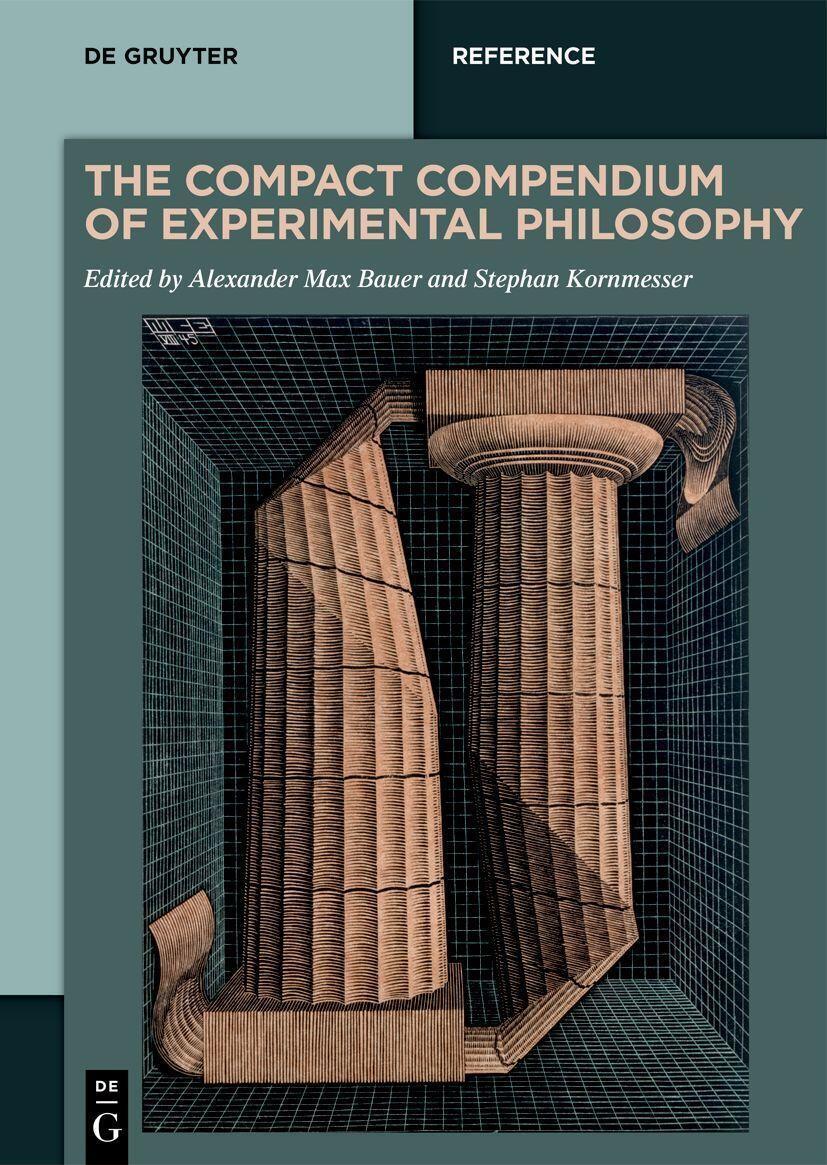
Hot Off The Press: “The Compact Compendium of Experimental Philosophy”

Posted on March 7, 2024January 3, 2025 by Alexander Max Bauer

“The Compact Compendium of Experimental Philosophy,” a new entry into the “De Gruyter Reference” series, brings together experimental philosophers from around the globe to provide interested readers with insights into many topics currently researched in X-Phi. See below for the table of contents.

Part 1 – The Philosophy of Experimental Philosophy

  • Justin Sytsma, Joseph Ulatowski, and Chad Gonnerman: “History and Philosophy of Experimental Philosophy – All in the Family”
  • Eugen Fischer and Justin Sytsma: “Projects and Methods of Experimental Philosophy”
  • Joachim Horvath: “Intuitions in Experimental Philosophy”
  • Theodore Bach: “Limitations and Criticism of Experimental Philosophy”

Part 2 – Topics from Theoretical Philosophy

  • Paul Henne: “Experimental Metaphysics – Causation”
  • James R. Beebe: “Experimental Epistemology – Knowledge and Gettier Cases”
  • Edouard Machery: “Experimental Philosophy of Language – Proper Names and Predicates”
  • Igor Douven, Shira Elqayam, and Karolina Krzyżanowska: “The Experimental Philosophy of Logic and Formal Epistemology – Conditionals”
  • Jonathan Waskan: “Experimental Philosophy of Science – Scientific Explanation”
  • Mark Phelan: “Experimental Philosophy of Mind – Conscious State Attribution”

Part 3 – Topics from Practical Philosophy

  • Justin Bruner: “Experimental Political Philosophy – Social Contract”
  • Raff Donelson: “Experimental Legal Philosophy – General Jurisprudence”
  • Thomas Nadelhoffer: “Experimental Philosophy of Action – Free Will and Moral Responsibility”
  • Rodrigo Díaz: “Experimental Philosophy of Emotion – Emotion Theory”
  • Ian M. Church: “Experimental Philosophy of Religion – Problem of Evil”
  • Florian Cova: “Experimental Philosophy of Aesthetics – Aesthetic Judgment”

Literature

Bauer, Alexander Max, and Stephan Kornmesser (eds.) (2023): The Compact Compendium of Experimental Philosophy, Berlin and Boston: Walter de Gruyter. (Link)

Search

Categories

Tags

Agency Artificial Intelligence Basic Needs Behavior Beliefs Bias Bioethics Blame Causation Cognitive Science Consciousness Corpus Analysis Cross-Cultural Research Decisions Determinism Distributive Justice Emotions Essentialism Expertise Folk Morality Framing Free Will Gender Intention Intuition Jurisprudence Knowledge Large Language Models Moral Psychology Norms Pejoratives Problem of Evil Psycholinguistics Rationality Reasoning Replication Responsibility Self Side-Effect Effect Slurs Truth Valence Values Virtue Well-Being

Recent Posts

  • Call: “The Armchair on Trial”
  • Call: “Interdisciplinary Perspectives on Linguistic Justice”
  • Call: “6th European Experimental Philosophy Conference”
  • Talk: “Ethics in the Lab” (Pascale Willemsen)
  • Talk: “Normality and Norms” (Josh Knobe)

Recent Comments

  1. Nova Praxis on The Folk Concept of ArtJuly 11, 2025

    This article highlights an important point: everyday people don’t rely on rigid definitions to determine what qualifies as art. They’re…

  2. Koen Smets on Priming Effects Are Fake, but Framing Effects Are RealMay 27, 2025

    That is indeed exactly the question I have as well. I operationalize it as having de facto contradicting intuitions, in…

  3. Joshua Knobe on Priming Effects Are Fake, but Framing Effects Are RealMay 24, 2025

    Hi Koen, Thanks once again. This idea brings up all sorts of fascinating questions, but for the purposes of the…

  4. Koen Smets on Priming Effects Are Fake, but Framing Effects Are RealMay 24, 2025

    Great! In the meantime I thought of another potentially interesting example of framing—Arnold Kling’s Three Languages of Politics. Just about…

  5. Joshua Knobe on Priming Effects Are Fake, but Framing Effects Are RealMay 23, 2025

    Thanks Koen! This is all super helpful.

Archives

  • February 2026
  • January 2026
  • December 2025
  • November 2025
  • October 2025
  • September 2025
  • August 2025
  • July 2025
  • June 2025
  • May 2025
  • April 2025
  • March 2025
  • February 2025
  • January 2025
  • December 2024
  • November 2024
  • October 2024
  • September 2024
  • August 2024
  • July 2024
  • June 2024
  • May 2024
  • April 2024
  • March 2024

Meta

  • Log in
  • Entries feed
  • Comments feed
  • WordPress.org

Imprint • Disclaimer • Privacy Statement • Cookie Policy

© 2024 The Experimental Philosophy Blog
Manage Consent
To provide the best experiences, we use technologies like cookies to store and/or access device information. Consenting to these technologies will allow us to process data such as browsing behavior or unique IDs on this site. Not consenting or withdrawing consent, may adversely affect certain features and functions.
Functional Always active
The technical storage or access is strictly necessary for the legitimate purpose of enabling the use of a specific service explicitly requested by the subscriber or user, or for the sole purpose of carrying out the transmission of a communication over an electronic communications network.
Preferences
The technical storage or access is necessary for the legitimate purpose of storing preferences that are not requested by the subscriber or user.
Statistics
The technical storage or access that is used exclusively for statistical purposes. The technical storage or access that is used exclusively for anonymous statistical purposes. Without a subpoena, voluntary compliance on the part of your Internet Service Provider, or additional records from a third party, information stored or retrieved for this purpose alone cannot usually be used to identify you.
Marketing
The technical storage or access is required to create user profiles to send advertising, or to track the user on a website or across several websites for similar marketing purposes.
  • Manage options
  • Manage services
  • Manage {vendor_count} vendors
  • Read more about these purposes
View Preferences
  • {title}
  • {title}
  • {title}