The Experimental Philosophy Blog

Philosophy Meets Empirical Research

Menu
  • Home
  • About
  • Guidelines for Comments
  • Labs and Organizations
  • Resources
Menu

Category: Logic

Call: “Philosophers on Philosophy”

Posted on August 26, 2025August 26, 2025 by Alexander Max Bauer

Renée Smith and Emily McGill prepare an edited volume with the working title “Philosophers on Philosophy – What is philosophy, how is philosophy done, and why do philosophy?”

Abstracts for chapters can be submitted until October 3. The call reads:

We invite chapter proposals for an edited volume exploring philosophers’ views on different aspects of metaphilosophy. The target audience is undergraduate and graduate students in philosophy and laypeople. These populations are often surprised that philosophers do not agree about what philosophy is, how it is done, whether it makes progress, what its value is, etc. Contributions to this volume will shed light on these topics and introduce the variety of metaphilosophical views contemporary philosophers hold.

Contributions will generally fit into one of the following topical areas and address several of the suggested subtopics; however, clearly there is the possibility of overlapping topics, and the following suggested subtopics are not exhaustive. Final essays should defend a particular view rather than merely describe it, be fewer than 2000 words, and be written for the target audience. Neither proposals nor final essays should make use of AI in any way.

What is philosophy? What distinguishes philosophy from other fields?

  • Topics, methods
  • Questions, disagreement
  • Goals, product
  • Philosophy, science, humanities

How is philosophy done? How do the methods in philosophy compare to those in other fields?

  • Logic, reason, analysis
  • Distinctions
  • Thought experiments, intuition
  • Experimental philosophy
  • The history of philosophy
  • Phenomenology

What does philosophy do? What is the goal/purpose of philosophy?

  • Progress in philosophy
  • Philosophical knowledge
  • Applied philosophy

What is the value of philosophy?

  • Philosophy in the undergraduate curriculum
  • Philosophy and society
  • Philosophy as a way of life
  • Philosophy, knowledge, understanding, uncertainty
  • The future of philosophy

Proposals

Please submit an abstract/proposal of approximately 200–300 words clearly identifying the overarching topic your essay will address and a current CV.

Timeline

  • Abstracts and CV: October 3, 2025
  • Essays: February 30, 2026
  • Peer review begins: March 15, 2026
  • Proposed publication: Spring 2027

Submissions/Questions

Please send your submissions/questions to Renée Smith, rsmith@coastal.edu, or Emily McGill, emcgill@coastal.edu, Coastal Carolina University.

Philosophy of Mind is Very Different Now

Posted on December 2, 2024January 1, 2025 by Joshua Knobe

A few decades ago, it felt like almost the entire field of philosophy of mind was focused on a pretty narrow range of questions (the mind-body problem, consciousness, the nature of intentionality, etc.). Insofar as anyone wanted to work on anything else, they often justified those interests by trying to explain how what they are doing could be connected back to this “core” of the field.

Clearly, things have changed a lot. These days, people are working on all sorts of different things that don’t connect back in any obvious way to the short list of topics that so dominated the field a few decades ago.

But if you look at various institutions that govern the field, it seems that there is a lag. Many of the norms and institutions we have in place don’t really make sense given the way the field is right now. They are just holdovers from the way the field used to be.

I bet that many readers will agree with the very general point I’ve been making thus far, but there’s room for lots of reasonable disagreement about exactly where our norms are showing a lag and where things need changing. I thought it might be helpful to write this post just to start that conversation. I’m going to suggest a few specific things, but I’d be very open to alternative views.

1. These days, many people in philosophy of mind are engaged in a broadly empirical inquiry into questions about how some specific aspect of the mind actually works: how visual perception works, how racism works, how memory works, how emotions work, and so forth.

When these people apply for jobs in philosophy of mind, it feels like there’s often a vague feeling that what they are doing is somehow “marginal” or “peripheral,” that it doesn’t really fall in the core of the field. But this no longer makes any sense! Contrast a person who is an expert on all the latest experimental studies about implicit bias with a person who is doing purely a priori work in the metaphysics of mind. Given the way the field works right now, there is no sense in which the former is less at the core of things than the latter. To the extent that the latter is seen as having a special status, this is just a residue from the way things were decades ago.

2. People working in philosophy of mind often want to learn about the history of the philosophy of mind. But what exactly is this history? For example, of all the things that Spinoza wrote, what should we call “Spinoza’s philosophy of mind”?

The traditional answer was basically: Of all the things that people in the history of philosophy wrote about the mind, the only ones that count as “history of philosophy of mind” are the ones that relate to the narrow list of questions discussed in late 20th century analytic philosophy. This involved excluding almost everything that figures in the history of philosophy said about the mind.

But again, this doesn’t make sense anymore. If people want to look at Spinoza’s philosophy of mind, I fear they would tend to look only at the discussion of the mind-body problem in Ethics, Book 2, i.e., the part that connects to this stuff discussed in 20th century philosophy of mind. But this is such a narrow way of thinking about discussions of the mind in the history of philosophy. Surely, Spinoza’s contributions to philosophy of mind go way beyond that; it’s just that most of his contributions are about how various specific things in the mind work. So these contributions might not be very closely related to things that philosophers of mind were working on in 1994, but they are extremely closely related to various things that philosophers of mind are working on in 2024.

3. Knowledge of mathematical or formal work is often helpful in philosophy, but we recognize that philosophers cannot possibly master all of the different formal methods that might be relevant to them in their work. So we always face questions of the form: Given that philosophers can’t know everything that would possibly be relevant, which methods do they absolutely need to know?

Now consider a graduate student working in philosophy of mind, and suppose that this student could either (a) take a course in logic but never take any courses in statistics or (b) take a course in statistics but never take any courses in logic.

It feels like there’s a norm in the field that (a) is more acceptable than (b). But does that really make sense anymore? I certainly agree that this is the background that would have been more essential a few decades ago, but if you look at what philosophers of mind are doing right now, it seems that statistics is used much more often than logic.

4. We have certain norms about which things philosophers are allowed to remain ignorant about and which they absolutely have to know. For example, a moral philosopher might say: “I am a consequentialist, and I think that non-consequentialist theories are mistaken.” But we would find it completely unacceptable for a moral philosopher to say: “I am a consequentialist, so I don’t know anything about recent work in non-consequentialist theories. I couldn’t even teach those theories at an undergraduate level.”

A question now arises about which norms would make sense in contemporary philosophy of mind. In many parts of philosophy of mind, the majority of people are using some kind of empirical approach, while a minority are using purely a priori approaches. We can imagine a person saying: “I am pursuing these questions using purely a priori methods, and I think it is a mistake to use empirical methods to address them.” But suppose someone said: “I don’t know anything about recent empirical studies on these questions. In fact, I couldn’t even teach a class about these studies at an undergraduate level.” Should we regard this sort of ignorance as acceptable? And if we do regard it as acceptable right now, might that just be a holdover from norms that really did make sense thirty years ago?

Again, I certainly don’t mean to be dogmatic about any of these four points, and I also don’t mean to suggest that these are the four most important areas in which we are facing a lag. Regardless of whether you agree or disagree about these for specific things, it does seem that the field has changed considerably, and I would love to hear your thoughts about how our norms should be evolving in light of that.
Workshop: “Methodological Trends and Challenges in Contemporary Philosophy”

Posted on October 23, 2024December 30, 2024 by Alexander Max Bauer

From October 25 to 26, the workshop “Methodological Trends and Challenges in Contemporary Philosophy,” organized by Martin Justin, Maja Malec, Olga Markič, Nastja Tomat, and Borut Trpin, will take place at the University of Ljubljana, Slovenia. The announcement reads:

Contemporary analytic philosophers have expanded their methodological toolkit beyond traditional philosophical inquiry, embracing a wide array of approaches that intersect with various disciplines. These methods include (but are not limited to) experimental approaches, which involve empirical testing and data collection to inform philosophical hypotheses; non-idealized and naturalized epistemology, which considers the real-world complexities of knowledge acquisition and justification; computer simulations and probabilistic modeling, which enable philosophers to explore complex systems and uncertainties in reasoning; neuroscientific methods, which offer insights into the neural underpinnings of cognitive processes and decision-making; formal ontology, which provides rigorous frameworks for analyzing concepts and categories; conceptual engineering, which involves the deliberate design and modification of conceptual frameworks to address philosophical problems; evolutionary modeling, which investigates the emergence and evolution of cognitive capacities and norms; and feminist perspectives, which critically examine power dynamics and social structures in philosophical discourse.

The upcoming workshop aims to delve into these methodological trends, showcasing recent research that employs these diverse approaches and addressing the challenges and opportunities they present for contemporary philosophy. Over the course of two days, the workshop will feature a total of 14 talks, evenly distributed with 7 talks scheduled for each day. Each keynote talk will span 75 minutes, while contributed talks will be allocated 45 minutes. This workshop seeks to enrich our understanding of contemporary philosophical inquiry and inspire new avenues of research.

October 25, 9:00–17:30 (UTC+2)

  • Jan Sprenger (University of Turin): “Semantic Modeling between Empirical Data and Norms of Rationality”
  • Olga Markič (University of Ljubljana): “Roles of Philosopher in Interdisciplinary Research”
  • Timothy Tambassi (Ca’ Foscari University of Venice): “Is Extensible Markup Language Perspectivist?”
  • Thomas Engeland (University of Bonn): “What Would Methodological Naturalism in Ethics Be?”
  • Paweł Polak (Pontifical University of John Paul II in Krakow) and Roman Krzanowski (Pontifical University of John Paul II in Krakow): “Ethics in Silico – Computer Modeling of Ethical Concepts in Autonomous AI Systems”
  • Michal Hladky (University of Geneva): “End of Logical Positivism? #toosoon”
  • Rafal K. Stepien (Austrian Academy of Sciences): “The Absent Elephant – Non-Western Methods in Contemporary Philosophy”

October 26, 9:00–16:45 (UTC+2)

  • Borut Trpin (Ludwig Maximilian University of Munich, University of Maribor, and University of Ljubljana): “Revisiting Epistemic Coherence From A Posterior-Probability Perspective”
  • Martin Justin (University of Maribor): “The Value of Social Coherence in Science – An Agent-Based-Modelling Exploration”
  • Raimund Pils (University of Salzburg): “Integrating Empirical Research and Philosophical Theorizing on the Scientific Realism Debate for Science Reporting”
  • Juan de Jager (University of Ljubljana): “Making Porosity More Porous – An Open Call for Brainstorming After Tanya Luhrmann’s Recent Findings”
  • Danilo Šuster (University of Maribor): “Open-Mindedness and the Appeal to Ignorance”
  • Nastja Tomat (University of Ljubljana): “Bounded Epistemic Rationality as a Link Between the Normative and the Descriptive”
  • Dunja Šešelja (Ruhr University Bochum): “When Expert Judgment Fails – Epistemic Trespassing and Risks to Collective Inquiry”

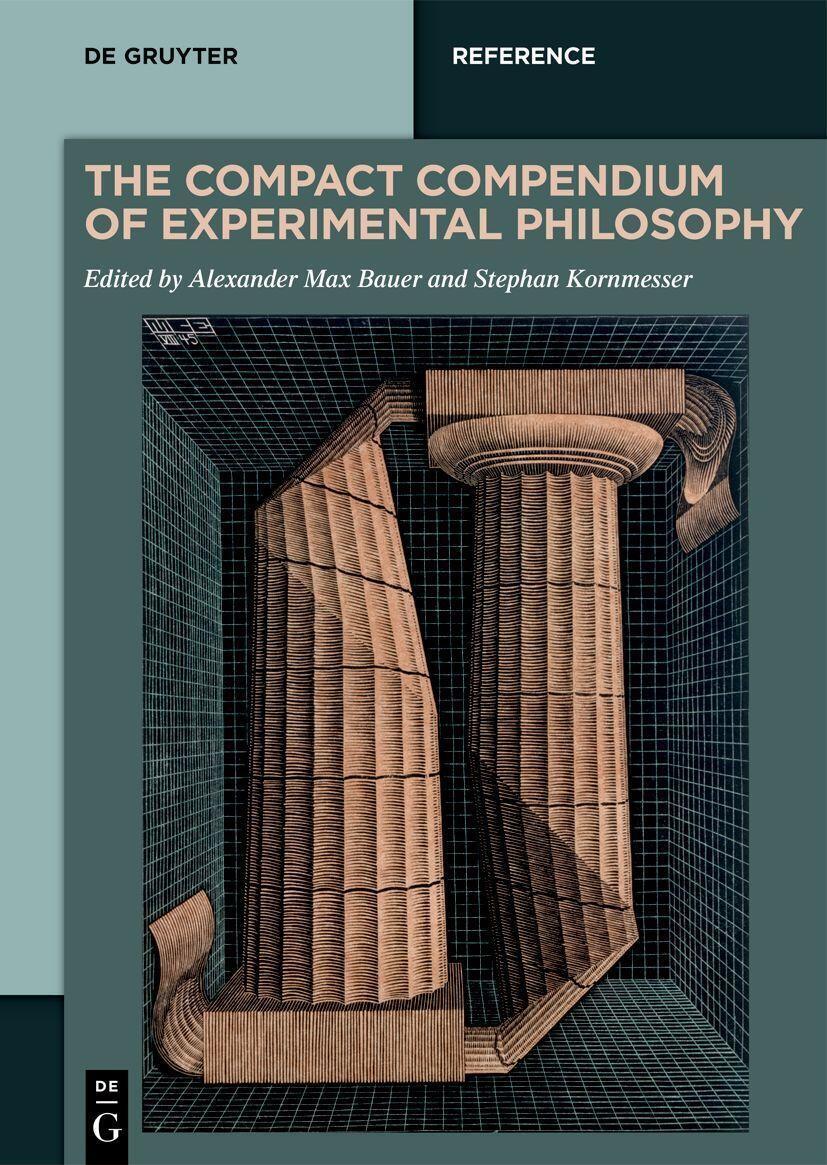
Hot Off The Press: “The Compact Compendium of Experimental Philosophy”

Posted on March 7, 2024January 3, 2025 by Alexander Max Bauer

“The Compact Compendium of Experimental Philosophy,” a new entry into the “De Gruyter Reference” series, brings together experimental philosophers from around the globe to provide interested readers with insights into many topics currently researched in X-Phi. See below for the table of contents.

Part 1 – The Philosophy of Experimental Philosophy

  • Justin Sytsma, Joseph Ulatowski, and Chad Gonnerman: “History and Philosophy of Experimental Philosophy – All in the Family”
  • Eugen Fischer and Justin Sytsma: “Projects and Methods of Experimental Philosophy”
  • Joachim Horvath: “Intuitions in Experimental Philosophy”
  • Theodore Bach: “Limitations and Criticism of Experimental Philosophy”

Part 2 – Topics from Theoretical Philosophy

  • Paul Henne: “Experimental Metaphysics – Causation”
  • James R. Beebe: “Experimental Epistemology – Knowledge and Gettier Cases”
  • Edouard Machery: “Experimental Philosophy of Language – Proper Names and Predicates”
  • Igor Douven, Shira Elqayam, and Karolina Krzyżanowska: “The Experimental Philosophy of Logic and Formal Epistemology – Conditionals”
  • Jonathan Waskan: “Experimental Philosophy of Science – Scientific Explanation”
  • Mark Phelan: “Experimental Philosophy of Mind – Conscious State Attribution”

Part 3 – Topics from Practical Philosophy

  • Justin Bruner: “Experimental Political Philosophy – Social Contract”
  • Raff Donelson: “Experimental Legal Philosophy – General Jurisprudence”
  • Thomas Nadelhoffer: “Experimental Philosophy of Action – Free Will and Moral Responsibility”
  • Rodrigo Díaz: “Experimental Philosophy of Emotion – Emotion Theory”
  • Ian M. Church: “Experimental Philosophy of Religion – Problem of Evil”
  • Florian Cova: “Experimental Philosophy of Aesthetics – Aesthetic Judgment”

Literature

Bauer, Alexander Max, and Stephan Kornmesser (eds.) (2023): The Compact Compendium of Experimental Philosophy, Berlin and Boston: Walter de Gruyter. (Link)

Search

Categories

Tags

Agency Artificial Intelligence Basic Needs Behavior Beliefs Bias Bioethics Blame Causation Cognitive Science Consciousness Corpus Analysis Cross-Cultural Research Decisions Determinism Distributive Justice Emotions Essentialism Expertise Folk Morality Framing Free Will Gender Intention Intuition Jurisprudence Knowledge Large Language Models Moral Psychology Norms Pejoratives Problem of Evil Psycholinguistics Rationality Reasoning Replication Responsibility Self Side-Effect Effect Slurs Truth Valence Values Virtue Well-Being

Recent Posts

  • Call: “The Armchair on Trial”
  • Call: “Interdisciplinary Perspectives on Linguistic Justice”
  • Call: “6th European Experimental Philosophy Conference”
  • Talk: “Ethics in the Lab” (Pascale Willemsen)
  • Talk: “Normality and Norms” (Josh Knobe)

Recent Comments

  1. Nova Praxis on The Folk Concept of ArtJuly 11, 2025

    This article highlights an important point: everyday people don’t rely on rigid definitions to determine what qualifies as art. They’re…

  2. Koen Smets on Priming Effects Are Fake, but Framing Effects Are RealMay 27, 2025

    That is indeed exactly the question I have as well. I operationalize it as having de facto contradicting intuitions, in…

  3. Joshua Knobe on Priming Effects Are Fake, but Framing Effects Are RealMay 24, 2025

    Hi Koen, Thanks once again. This idea brings up all sorts of fascinating questions, but for the purposes of the…

  4. Koen Smets on Priming Effects Are Fake, but Framing Effects Are RealMay 24, 2025

    Great! In the meantime I thought of another potentially interesting example of framing—Arnold Kling’s Three Languages of Politics. Just about…

  5. Joshua Knobe on Priming Effects Are Fake, but Framing Effects Are RealMay 23, 2025

    Thanks Koen! This is all super helpful.

Archives

  • February 2026
  • January 2026
  • December 2025
  • November 2025
  • October 2025
  • September 2025
  • August 2025
  • July 2025
  • June 2025
  • May 2025
  • April 2025
  • March 2025
  • February 2025
  • January 2025
  • December 2024
  • November 2024
  • October 2024
  • September 2024
  • August 2024
  • July 2024
  • June 2024
  • May 2024
  • April 2024
  • March 2024

Meta

  • Log in
  • Entries feed
  • Comments feed
  • WordPress.org

Imprint • Disclaimer • Privacy Statement • Cookie Policy

© 2024 The Experimental Philosophy Blog
Manage Consent
To provide the best experiences, we use technologies like cookies to store and/or access device information. Consenting to these technologies will allow us to process data such as browsing behavior or unique IDs on this site. Not consenting or withdrawing consent, may adversely affect certain features and functions.
Functional Always active
The technical storage or access is strictly necessary for the legitimate purpose of enabling the use of a specific service explicitly requested by the subscriber or user, or for the sole purpose of carrying out the transmission of a communication over an electronic communications network.
Preferences
The technical storage or access is necessary for the legitimate purpose of storing preferences that are not requested by the subscriber or user.
Statistics
The technical storage or access that is used exclusively for statistical purposes. The technical storage or access that is used exclusively for anonymous statistical purposes. Without a subpoena, voluntary compliance on the part of your Internet Service Provider, or additional records from a third party, information stored or retrieved for this purpose alone cannot usually be used to identify you.
Marketing
The technical storage or access is required to create user profiles to send advertising, or to track the user on a website or across several websites for similar marketing purposes.
  • Manage options
  • Manage services
  • Manage {vendor_count} vendors
  • Read more about these purposes
View Preferences
  • {title}
  • {title}
  • {title}