The Experimental Philosophy Blog

Philosophy Meets Empirical Research

Menu
  • Home
  • About
  • Guidelines for Comments
  • Labs and Organizations
  • Resources
Menu

Category: Ethics and Morals

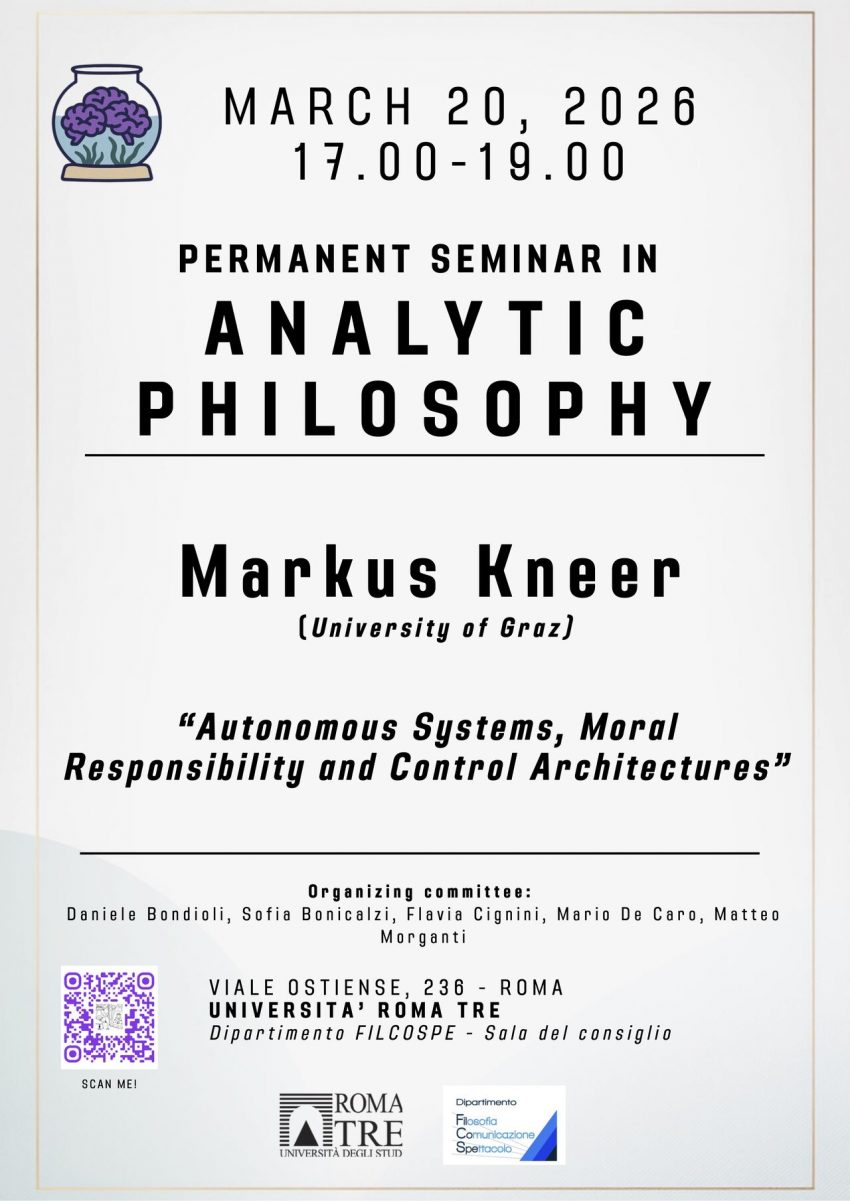
Talk: “Autonomous Systems, Moral Responsibility and Control Architectures” (Markus Kneer)

Posted on March 19, 2026April 17, 2026 by Alexander Max Bauer

On March 20, from 17:00–19:00 (UTC+1), the Permanent Seminar in Analytic Philosophy (PSAP) of Università Roma Tre will host a talk by Markus Kneer about “Autonomous Systems, Moral Responsibility and Control Architectures.” The hybrid session can be accessed via Teams. The abstract reads:

Matthias (2004) and Sparrow (2007) have argued that the use of self-learning systems can engender “responsibility gaps” – situations in which nobody is morally responsible for a potential harm. In this talk, I will present empirical evidence as to whether laypeople are sensitive to such alleged “responsibility gaps” or whether their retributive dispositions might get in the way (see Danaher, 2016). I will also present new data concerning the question whether we can avoid such situations by imposing tight control architectures to ensure meaningful human control (see e.g. “human-in-the-loop v. on-the-loop,” Docherty, 2012; “tracking & tracing,” Santoni de Sio & van den Hoven, 2018).

Call: “Toronto Workshop on Moral Psychology and Moral Theory”

Posted on March 19, 2026March 19, 2026 by Alexander Max Bauer

Organized by Andrew Sepielli, the “Toronto Workshop on Moral Psychology and Moral Theory” will take place at the University of Toronto from November 7 to 8, 2026.

Submissions for contributions can be submitted until July 1, 2026. The call reads:

The workshop aims to bring together philosophers, psychologists, and legal scholars working on questions about the relationship between empirical research on moral cognition and the foundations of moral theory. The goal is to foster interdisciplinary discussion about how empirical work in fields such as psychology, neuroscience, and evolutionary theory bears on moral judgment and the evaluation of moral beliefs.

Invited speakers include:

  • Paul Bloom (Psychology, University of Toronto / Yale University)
  • Joshua Knobe (Philosophy and Psychology, Yale University)
  • Liane Young (Psychology, Boston College)
  • Roseanna Sommers (Law and Psychology, University of Michigan)
  • Brendan de Kenessey (Philosophy, University of Toronto)

We invite submissions addressing topics at the intersection of empirical research and moral theory. Relevant topics include, but are not limited to:

  • experimental philosophy
  • the psychology of moral cognition
  • causal cognition and moral judgment
  • the neuroscience of moral judgment
  • evolutionary approaches to morality
  • empirical work bearing on normative ethics or metaethics
  • methodological questions about the role of empirical research in moral theory
  • debunking arguments and related challenges to moral belief

Five contributed papers will be selected. Contributed talks will consist of a 45-minute presentation followed by 45 minutes of discussion. The workshop is designed to be discussion-focused, with substantial time devoted to questions and conversation about each paper.

We welcome submissions from scholars in philosophy, psychology, law, and related disciplines. Submissions from early-career scholars are especially encouraged.

Submission Guidelines:

Please submit an abstract of 750–1000 words, along with a brief CV, to: torontomoralpsych@gmail.com 

Submissions should not be anonymized.

Important Dates:

Submission deadline: July 1, 2026

Notification of decisions: August 1, 2026

Limited support for travel and accommodation may be available.

Questions about the workshop may be directed to the conference organizer, Andrew Sepielli (Philosophy, University of Toronto), at: torontomoralpsych@gmail.com

Call: “Interdisciplinary Perspectives on Linguistic Justice”

Posted on February 22, 2026February 22, 2026 by Alexander Max Bauer

On September 8, 2026, the satellite workshop “Interdisciplinary Perspectives on Linguistic Justice” will accompany the 6th European Experimental Philosophy Conference at the University of Cagliari, Italy.

Proposals for talks can be submitted until May 1, 2026. The call reads:

The Conference will be accompanied by a Satellite Workshop on “Interdisciplinary Perspectives on Linguistic Justice” (IPLJ), to be held on 8 September 2026. The IPLJ Workshop will be held in collaboration with the Linguistic Justice Society (LJS). The IPLJ Workshop welcomes experimental and empirically informed contributions on linguistic justice broadly construed, to include linguistic diversity, accent bias and related topics. For the Workshop, we welcome only contributions in the form of talks. There will be no fees for those wishing to take part in the IPLJ Satellite Workshop, which will also be online-accessible.

Deadline: May 1st, 2026

https://openreview.net/group?id=EXPhi/2026/Conference/Workshop/IPLJ

Decisions expected by June 1st, 2026

Submitting authors will have or create a profile on OpenReview. Whereas new profiles with an institutional email will be activated automatically, new profiles created without an institutional email will go through a moderation process that can take up to two weeks. Abstracts for talks should be anonymized for review and not exceed 500 words. References and figure captions do not count towards the word limit. Please make sure all materials for review are anonymized.

Talk: “Normality and Norms” (Josh Knobe)

Posted on January 27, 2026January 27, 2026 by Alexander Max Bauer

The Center for Philosophy and the Health Sciences at Aarhus University is hosting a lecture by Joshua Knobe. It will take place on Thursday, January 29, 15:15–16:45 (UTC+1) via Zoom. The abstract reads:

The notion of normality plays a role in the way people understand many different scientifically important concepts. For example, normality figures in people’s understanding of what it is for a trait to be innate, what it is for one event to cause another, and what it is for the state to count as a disease. I will be presenting a theory about ordinary attributions of normality and then exploring the application of this theory to all three of these types of judgments. The theory is that ordinary attributions of normality involve a mixture of statistical judgments (how frequent something is) and evaluative judgments (how good something is). Thus, the key claim is that both statistical and evaluative judgments play a role in people’s ordinary understanding of innateness, causation and disease.

Hot Off The Press: “The Fruitfulness of Normative Concepts”

Posted on January 10, 2026January 10, 2026 by Alexander Max Bauer

In “The Fruitfulness of Normative Concepts,” Matt Lindauer argues for a strong connection between philosophical theory and its real-world applicability, also drawing on moral psychology and adjacent fields. The book’s summary reads:

Can philosophical concepts do real work in improving our world? Should we, when evaluating competing understandings of concepts like “justice,” “empowerment,” and “solidarity,” take into account whether these different understandings can actually help us to fight injustice, empower the oppressed, and promote solidarity between people? The Fruitfulness of Normative Concepts is the first book-length attempt to argue that the answer to both of these questions is an emphatic “yes.” In doing so, it provides a bold new defense of a tight relationship between philosophical theory and practice. The book advances the view that moral and political philosophers should be interested in the “fruitfulness” of normative concepts – how well they help us to solve practical problems that we inevitably face as human beings interacting with one another. This view has broad implications for a number of important contemporary philosophical debates that the book examines, including debates over the nature of moral motivation, the duties of the global affluent to the global poor, the nature of justice in diverse multicultural societies, ideal versus non-ideal theory in political philosophy, and conceptual engineering. Drawing on cutting-edge research in moral psychology and adjacent fields, the book also demonstrates that we now have the scientific tools to concretely evaluate the practical value of moral and political concepts. It issues an important call to continue developing the use of these tools and methods to produce more philosophically and scientifically significant work on the distinctive value of normative thought and practice.

Workshop: “XPHI UK Work in Progress Workshop Series”

Posted on November 15, 2025November 15, 2025 by Alexander Max Bauer

James Andow and Eugen Fischer have announced the first talks for this season’s “XPHI UK Work in Progress Workshop Series.” Talks will be held on Microsoft Teams. Anyone interested in joining can email james.andow@manchester.ac.uk.

November 26, 16:00–18:00 (UTC±0)

  • Qianyi Qin (CUNY Graduate Centre): “Imaginative Tendencies and Virtuality Tolerance – Re-Examining the Experience Machine”
  • Jumbly Grindrod (University of Reading): “Word Meanings in Transformer Language Models”

December 10, 16:00–18:00 (UTC±0)

  • Juan-Pablo Bermúdez (University of Southampton) and Gino Carmona (Universidad Externado de Colombia): “Goals and Plans in the Wild – The Effects of Poverty on Planning Agency”
  • Miklós Kürthy (University of Graz): “Care for Consistency”

January 14, 16:00–18:00 (UTC±0)

  • Monika Jovanović and Andrija Šoć (University of Belgrade): “A Matter of Taste? Toward Deliberative Experimental Aesthetics”
  • Markus Werning (Ruhr-Universität Bochum): t.b.a.

Talk: “Philosophical Arguments Can Boost Charitable Giving” (Eric Schwitzgebel and Kirstan Brodie)

Posted on October 25, 2025October 25, 2025 by Alexander Max Bauer

On Thursday, October 30, the first talk in the Experimental Philosophy Journal Series will take place on Zoom.

Celso de Oliveira Vieira, Alex Wiegmann, and Rodrigo Díaz write:

We are pleased to invite you to the first talk in the Experimental Philosophy Journal Series, the new journal dedicated to X-Phi.

In this session, Eric Schwitzgebel (California) and Kirstan Brodie (Cornell) will present their paper, “Philosophical arguments can boost charitable giving,” co-authored with Nemirow and Cushman. The preprint, in which the authors identify the elements of a range of philosophical arguments that boost charitable giving, is available here. The presentation will be followed by a commentary from Rodrigo Díaz (CSIC). He wrote “Do Moral Beliefs Motivate Action?,” accessible here. After that, the floor will be open for discussion. The authors will speak first, but the audience will be able to participate as well.

The session will take place online on October 30th at 10 AM PDT/6 PM CET.
Here is the Zoom link: http://tiny.cc/xphij1
For inquiries, please contact Celso Vieira at celso.deoliveiravieira@rub.de.

See you soon,
Celso, Alex, and Rodrigo

Call: “Valence Asymmetries”

Posted on October 25, 2025October 25, 2025 by Alexander Max Bauer

The Valence Asymmetries project, led by Isidora Stojanovic at the Universitat Pompeu Fabra in Barcelona, is looking for expressions of interest from people who would like to join. The call reads:

We are interested in including new team members in our project. Before opening a new position, we are inviting those interested in joining us to express their interest.

The new team member(s) should have research interests that align directly with the objectives of the project, broadly understood. They will already have a very solid publication track, will cherish interdisciplinary research, and will want to combine theoretical and empirical methodology.

We are particularly interested in the following research profiles:

  • Decision theory, philosophy of rationality & framing effects
  • Formal value theory & formal semantics
  • Philosophy of emotions & social and/or moral psychology
  • Moral cognition & philosophy of well-being

Additionally, any other research profile that offers a novel perspective on the project’s objectives is potentially welcome.

The duration of the contract will depend on the range of project tasks that the new team member will be hired to work on, and in any case cannot exceed the duration of the project (i.e. July 2029).

In addition to prospective candidates who would like to join us for a longer duration, we are also inviting tenured faculty who have a demonstrably heavy teaching load to consider joining us for a one year period (assuming that they can get a leave of absence from their home institution) that they can devote to research.

The expected gross salary is approx. 31.000 gross per year (negotiable for senior and/or already tenured faculty).

NB: The project’s team members must live in Barcelona (region), they regularly meet in person, attend seminars and conduct in-person research. The position is incompatible with living and/or spending considerable periods of time elsewhere.

If you are interested in joining the project, please send an email to Isidora Stojanovic (PI), explaining your motivation and interests, together with a complete CV.

Hot Off The Press: “Empirical Studies on Questions of Need-Based Distributive Justice”

Posted on October 8, 2025October 8, 2025 by Alexander Max Bauer

In “Empirical Studies on Questions of Need-Based Distributive Justice” (the English translation of last year’s “Empirische Studien zu Fragen der Bedarfsgerechtigkeit”), I recap a series of vignette studies that examine the role that needs play in dealing with problems of distributive justice. As I summarised in last year’s post:

Among other things, the following becomes clear:

  1. Impartial observers make gradual assessments of the fairness of distributions.
  2. These assessments depend on how well an individual is supplied with a relevant good.
  3. If information on a need threshold is given, these assessments are made relative to this reference point. (Bauer et al. 2023a [later published as Bauer et al. 2025])
  4. Impartial decision-makers consider need, productivity, and accountability when making hypothetical distribution decisions.
  5. If an individual’s productivity is not sufficient to cover their needs, these higher needs are partially compensated for (at the expense of other individuals who are not so badly off)
  6. Willingness to compensate decreases if an individual is accountable for having produced less or for needing more. (Bauer et al. 2022)
  7. Both impartial observers and impartial decision-makers attribute different levels of importance to different kinds of needs.
  8. This reveals a hierarchy of needs in the following order: Survival, Decency, Belonging, Autonomy. (Bauer et al. 2023b)

Literature

Bauer, Alexander Max, Frauke Meyer, Jan Romann, Mark Siebel, and Stefan Traub (2022): “Need, Equity, and Accountability. Evidence on Third-Party Distribution Decisions from a Vignette Study,” Social Choice and Welfare 59, 769–814. (Link)

Bauer, Alexander Max, Adele Diederich, Stefan Traub, and Arne Robert Weiss (2023a): “When the Poorest Are Neglected. A Vignette Experiment on Need-Based Distributive Justice,” SSRN Working Paper 4503209. (Link)

Bauer, Alexander Max, Jan Romann, Mark Siebel, and Stefan Traub (2023b): “Winter is Coming. How Laypeople Think About Different Kinds of Needs,” PLoS ONE 18 (11), e0294572. (Link)

Bauer, Alexander Max (2024): Empirische Studien zu Fragen der Bedarfsgerechtigkeit, Oldenburg: University of Oldenburg Press. (Link)

Bauer, Alexander Max (2025): Empirical Studies on Questions of Need-Based Distributive Justice, Paderborn: mentis. (Link)

Bauer, Alexander Max, Adele Diederich, Stefan Traub, and Arne Robert Weiss (2025): “Thinking About Need. A Vignette Experiment on Need-Based Distributive Justice,” The Journal of Economic Inequality 23 (3), 667–693. (Link)

Call: “Moral Epistemology and Social Progress”

Posted on August 26, 2025August 26, 2025 by Alexander Max Bauer

Antonio Gaitán Torres and Hugo Viciana organize a workshop on “Moral Epistemology and Social Progress – Experimental and Philosophical Perspectives,” which will take place at the Universidad de Sevilla from November 4 to 5.

Abstracts for presentations can be submitted until September 17. The call reads:

This focused workshop explores the intersection of empirical research on moral cognition and philosophical theories of social and moral progress. We bring together experimental philosophers and moral epistemologists to examine how empirical findings about moral intuitions, attitude change, and intellectual virtues inform our understanding of moral improvement at both individual and societal levels. The workshop features invited speakers alongside selected contributions from an open call for abstracts, fostering intimate discussion among researchers working at the forefront of experimental and theoretical approaches to moral progress. Submissions addressing experimental studies of moral judgment, philosophical accounts of moral progress, or the epistemology of moral improvement are particularly welcome.

We welcome submissions for 3–4 additional presentations at this workshop. Interested researchers should submit an abstract of 350–750 words addressing topics at the intersection of moral epistemology, experimental philosophy, and social progress. Abstracts might explore empirical studies of moral cognition, philosophical theories of moral improvement, experimental metaethics, intellectual virtues, the psychology of moral change, or related themes in moral epistemology. Please send your abstract to both hviciana@us.es and agaitan@hum.uc3m.es with the subject line “November Workshop.” The deadline for submissions is 17 September 2025. Selected presenters will have approximately 30 minutes for their presentation followed by discussion.

  • 1
  • 2
  • 3
  • Next

Search

Categories

Tags

Agency Artificial Intelligence Autonomous Systems Basic Needs Behavior Beliefs Bias Bioethics Blame Causation Cognitive Science Consciousness Corpus Analysis Cross-Cultural Research Decisions Determinism Distributive Justice Emotions Essentialism Expertise Folk Morality Framing Free Will Gender Intention Intuition Jurisprudence Knowledge Large Language Models Moral Psychology Norms Pejoratives Psycholinguistics Rationality Reasoning Replication Responsibility Self Side-Effect Effect Slurs Thought Experiments Truth Valence Values Virtue

Recent Posts

  • Where should I publish my X-Phi? A new resource
  • Call: “The New Measurement Heretics”
  • Summer School: “Advanced Methods in Eye Tracking”
  • Call: “New Methods in Semantics of Artefacts”
  • Call: “Law Observed”

Recent Comments

  1. Joanna Demaree-Cotton on Where should I publish my X-Phi? A new resourceApril 24, 2026

    Thanks for the comment, that's really useful. We'll definitely add AJP (missed you accidentally first time!), and that note.

  2. AJP Editor on Where should I publish my X-Phi? A new resourceApril 24, 2026

    AJP is published by Taylor & Francis, and we have an member of the editorial team ('associate editor' in our…

  3. Nova Praxis on The Folk Concept of ArtJuly 11, 2025

    This article highlights an important point: everyday people don’t rely on rigid definitions to determine what qualifies as art. They’re…

  4. Koen Smets on Priming Effects Are Fake, but Framing Effects Are RealMay 27, 2025

    That is indeed exactly the question I have as well. I operationalize it as having de facto contradicting intuitions, in…

  5. Joshua Knobe on Priming Effects Are Fake, but Framing Effects Are RealMay 24, 2025

    Hi Koen, Thanks once again. This idea brings up all sorts of fascinating questions, but for the purposes of the…

Archives

  • April 2026
  • March 2026
  • February 2026
  • January 2026
  • December 2025
  • November 2025
  • October 2025
  • September 2025
  • August 2025
  • July 2025
  • June 2025
  • May 2025
  • April 2025
  • March 2025
  • February 2025
  • January 2025
  • December 2024
  • November 2024
  • October 2024
  • September 2024
  • August 2024
  • July 2024
  • June 2024
  • May 2024
  • April 2024
  • March 2024

Meta

  • Log in
  • Entries feed
  • Comments feed
  • WordPress.org

Imprint • Disclaimer • Privacy Statement • Cookie Policy

© 2024 The Experimental Philosophy Blog
Manage Consent
To provide the best experiences, we use technologies like cookies to store and/or access device information. Consenting to these technologies will allow us to process data such as browsing behavior or unique IDs on this site. Not consenting or withdrawing consent, may adversely affect certain features and functions.
Functional Always active
The technical storage or access is strictly necessary for the legitimate purpose of enabling the use of a specific service explicitly requested by the subscriber or user, or for the sole purpose of carrying out the transmission of a communication over an electronic communications network.
Preferences
The technical storage or access is necessary for the legitimate purpose of storing preferences that are not requested by the subscriber or user.
Statistics
The technical storage or access that is used exclusively for statistical purposes. The technical storage or access that is used exclusively for anonymous statistical purposes. Without a subpoena, voluntary compliance on the part of your Internet Service Provider, or additional records from a third party, information stored or retrieved for this purpose alone cannot usually be used to identify you.
Marketing
The technical storage or access is required to create user profiles to send advertising, or to track the user on a website or across several websites for similar marketing purposes.
  • Manage options
  • Manage services
  • Manage {vendor_count} vendors
  • Read more about these purposes
View Preferences
  • {title}
  • {title}
  • {title}