The Interdisciplinary Centre for Ethics at Jagiellonian University in Kraków is welcoming proposals for ERC Starting Grants.
Expressions of interest are possible until July 10, 2026. The announcement reads:
The Interdisciplinary Centre for Ethics (INCET), a research centre within the Faculty of Philosophy at Jagiellonian University in Kraków, Poland, invites expressions of interest from researchers intending to apply for an ERC Starting Grant in the 2027 call.
We welcome proposals in philosophy, bioethics, philosophy of medicine, political philosophy, experimental philosophy, and related interdisciplinary fields, including projects at the intersection of philosophy and the social sciences, medicine, psychology, law, or data science.
INCET offers a vibrant international research environment and extensive experience in hosting and managing European research grants, including an ERC Starting Grant and multiple Horizon Europe MSCA projects.
Researchers interested in applying with INCET as their host institution are invited to send:
CV, including a list of publications;
short description of the proposed ERC project (1-2 pages).
Expression of interests should be sent no later than July 10, 2026, and will be reviewed on a rolling basis. Early contact is strongly encouraged to allow sufficient time for proposal development and institutional preparation.
Support for Candidates
If selected, candidates will receive support from experienced grant specialists at Jagiellonian University throughout the ERC application process. They will also have an opportunity to obtain detailed feedback on their proposals from INCET researchers. In addition, we plan to organise a dedicated workshop for ERC Starting Grant candidates.
Why INCET?
Internationally recognised research centre in ethics and practical philosophy;
strong record of success in securing European research funding;
dedicated support for ERC proposal development and grant management;
interdisciplinary collaborations across philosophy, medicine, psychology, and other fields;
full integration into the research community of Jagiellonian University, one of the leading research universities in Central Europe;
a dynamic academic environment in Kraków, a historic university city and one of the most attractive cultural destinations in Central Europe.
ERC Starting Grant 2027
ERC Starting Grants support outstanding early-career researchers of all nationalities who are establishing their own independent research programmes. To be eligible for an ERC Starting Grant in the 2027 call for proposals, the applicant must have defended their PhD no more than 10 years before 1 January 2027. More information about eligibility: https://erc.europa.eu/apply-grant/starting-grant
Timeline
Expression of interest submission deadline: 10 July 2026
Review results: 17 July 2026
A workshop for candidates: August 2026
Proposal development and internal review (including possible visits to Kraków): July–October 2026
Internal submission of the first draft: 31 August 2026
Call deadline: 14 October, 2026
Publication of the MSCA PF results: Summer 2027
Estimated project start (if funded): From October 2027
For informal enquiries and applications, please contact: incet@uj.edu.pl
Organized by Eugen Fischer, Joanna Demaree-Cotton, and James Andow, the “XPHI UK Work in Progress Workshop Series” continues. Anyone interested in presenting something can contact the organizers. They write:
We are delighted to announce a call for abstracts for the next series of UK XPHI Online. This is a monthly online workshop devoted to discussion of work in progress in experimental philosophy (broadly construed). We feature work from all areas of experimental philosophy, by researchers at all career stages, from the UK and all over the world. The workshop meets once a month on Teams, typically the second Wednesday of each month (16:00–18:00 UK time), for a two-hour session that typically features two talks (each 40 minutes plus 15 minutes Q&A). This call is for a series starting in October 2026. To submit, please email the organizers an abstract of up to 500 words by July 15, 2026, to james.andow@manchester.ac.uk.
Rodrigo Díaz (University of Geneva) Alexander Max Bauer (University of Oldenburg) Joanna Demaree-Cotton (University of Oxford)
Photo by Ahmad Ardity (Pixaby)
If you write experimental philosophy papers, you probably have a paper rejected precisely because it is experimental philosophy. The explicit reason for rejection might have been something direct like “What sort of method are the authors relying on? Is it experimental philosophy? If so, why should psychologists care about it?” or something vague like “The paper does not contain enough in-depth philosophical discussion and argument to be relevant for the general philosophical readership.”1 When thinking about where to (re)submit your paper, you might have wondered which venues welcome experimental philosophy (apart, of course, from the recently-launched journal Experimental Philosophy).
As an experimental philosopher, you might have intuitions (pun intended) about which journals welcome this kind of work, or anecdotal evidence from colleagues. However, as an experimental philosopher, you might also reject putting too much weight on individual intuitions and anecdotical evidence. This is why many of us have kept coming back to Justin Sytsma’s blog post “Publishing in experimental philosophy, part II: Some numbers on where we publish” on The New Experimental Philosophy Blog, which provided data from PhilPapers on the number of experimental philosophy papers published in different journals. Unfortunately, as well as being relatively hard to access since the blog went offline, the post is now about eight years old, and thus may not reflect recent publication trends.
The present post aims to provide updated PhilPapers data on the number of experimental philosophy papers published across different journals and to complement the crowdsourced data compiled on the Where should I publish my x-phi? website.
To examine which journals publish the most experimental philosophy papers, we first exported the complete list of papers within the “Experimental Philosophy” category of PhilPapers. Anyone can do this simply by going to the category page and selecting the relevant option on the right sidebar. The list of papers is the result of PhilPapers’ use of thrawling techniques and crowd-sourcing by its users.2 It is thus important to note that the list is not perfect and likely contains duplicates and miscategorized entries. Nevertheless, it is arguably better than individual intuitions and anecdotal data.
At the time of our analysis, this list contained 3434 entries (for reference, when Justin wrote his blog post, it was a little more than 1000). Going through this by hand would be beyond tedious. Hence, we wrote a little Python script to help us wade through the data. You can take a closer look at it on GitHub. So, if you’d like to do things differently from how we do in the following, you can just go ahead and try it yourself.
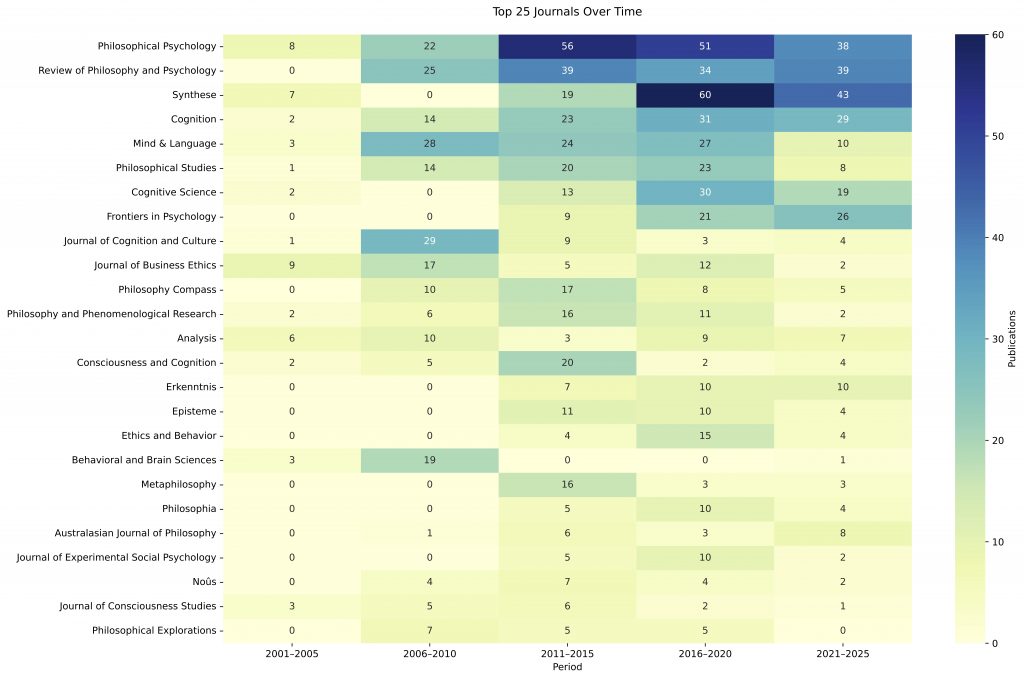
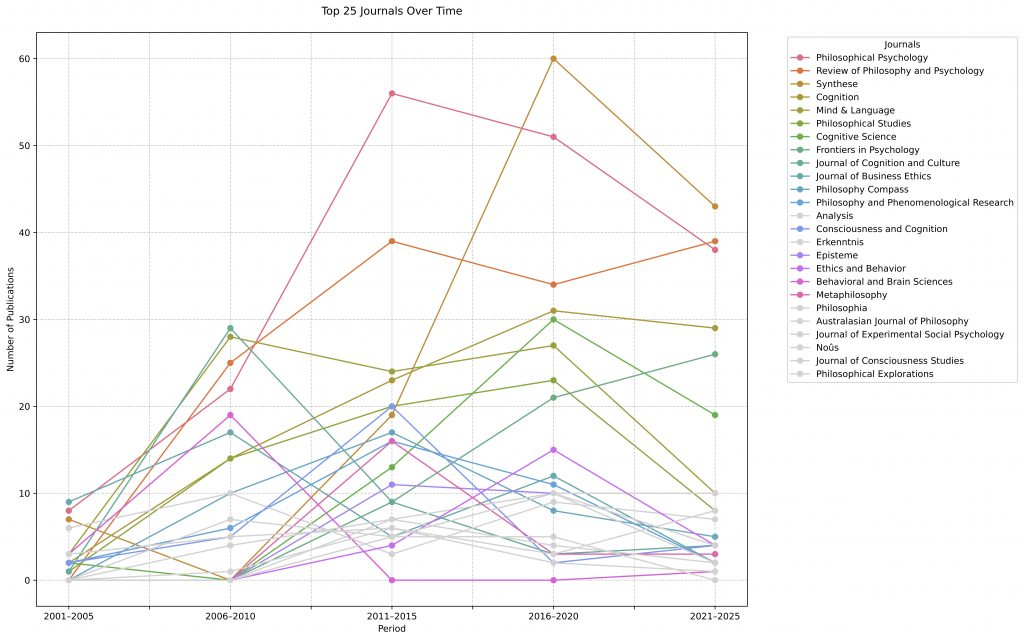
So, what does the script actually do? First, it takes the raw text data from PhilPapers and systematically breaks each reference down into its core components: authors, publication year, title, and source. Since the boundary between a paper’s title and its publishing source isn’t always perfectly clear, the script evaluates different punctuation marks as potential split points. It then runs a scoring system on the remaining text to determine if the source is likely to be an academic journal (for an overview of the script’s classifications, see Table 1). The script adds points to this “confidence score” if it detects classic journal patterns, like volume and issue numbers. It also adds points if it spots specific journal-related keywords (such as “ISSN” or “quarterly”). Conversely, it deducts points if it encounters keywords pointing to other publication formats (like “handbook” or “dissertation”). Based on this score, the entry is either classified as a “likely journal”, marked as “other”, or flagged for manual review. Finally, the script assigns each publication to a specific five-year period (e.g., “2001–2005”) and produces a list of the most frequently mentioned journals per time period (see Table 2) as well as two corresponding graphics (see Figures 1 and 2).
Such a – rather complex – automated approach is, of course, far from flawless. We rely on a few heuristics that introduce some pitfalls. For instance, because the parsing mechanism uses regular expressions to look for punctuation boundaries and volume numbers, it can easily get confused. And as explained above, we rely in part on manually curated dictionaries that are far from exhaustive. So, what happens when the script encounters an unmapped source or a weird edge case? It plays it safe and flags it. In this run, 102 entries were classified as “Needs review.” For this blog post, we didn’t manually sift through these entries.
Category
Number
Percent
Likely from a journal
2344
70.86 %
Likely not from a journal
862
26.06 %
Needs review
102
3.08 %
Total
3308
100.00 %
Table 1: Number of sources per category
Despite skipping these entries, the remaining dataset is more than large enough to reveal clear trends. Here is the breakdown of the top 25 journals publishing experimental philosophy over the last two decades:
Rank
Journal
2001–2005
2006–2010
2011–2015
2016–2020
2021–2025
Total
1
Philosophical Psychology
8
22
56
51
38
175
2
Review of Philosophy and Psychology
0
25
39
34
39
137
3
Synthese
7
0
19
60
43
129
4
Cognition
2
14
23
31
29
99
5
Mind & Language
3
28
24
27
10
92
6
Philosophical Studies
1
14
20
23
8
66
7
Cognitive Science
2
0
13
30
19
64
8
Frontiers in Psychology
0
0
9
21
26
56
9
Journal of Cognition and Culture
1
29
9
3
4
46
10
Journal of Business Ethics
9
17
5
12
2
45
11
Philosophy Compass
0
10
17
8
5
40
12
Philosophy and Phenomenological Research
2
6
16
11
2
37
13
Analysis
6
10
3
9
7
35
14
Consciousness and Cognition
2
5
20
2
4
33
15
Erkenntnis
0
0
7
10
10
27
16
Episteme
0
0
11
10
4
25
17
Ethics and Behavior
0
0
4
15
4
23
18
Behavioral and Brain Sciences
3
19
0
0
1
23
19
Metaphilosophy
0
0
16
3
3
22
20
Philosophia
0
0
5
10
4
19
21
Australasian Journal of Philosophy
0
1
6
3
8
18
22
Journal of Experimental Social Psychology
0
0
5
10
2
17
23
Noûs
0
4
7
4
2
17
24
Journal of Consciousness Studies
3
5
6
2
1
17
25
Philosophical Explorations
0
7
5
5
0
17
Table 2: Number of x-phi publications in journals per period
Figure 1: Heatmap of x-phi publications in journals per periodFigure 2: Line chart of x-phi publications in journals per period (journals which have published more than 10 x-phi papers in at least one period are highlighted)
Note that the top 25 venues account for 1279 of the 2344 cases identified as likely from a journal (see Table 1). This is slightly more than half (54.56 %). The other half is scattered across 379 different sources, 361 of which have published fewer than 10 x-phi articles in the past two decades. In sum, these data represent decent evidence that these 25 journals, at least, are open to publishing experimental philosophy.
But, of course, we would caution against over-interpreting these patterns. Even setting aside potential inaccuracies in the data itself (e.g., over- or under-estimations of papers published, miscategorizations of journals or subfield), these data are by no means a perfect signal of friendliness to experimental philosophy.
For one, the category of “Experimental Philosophy” on PhilPapers is defined broadly. We don’t know how these trends are affected by further divisions in the style and focus of papers within this broad category. For another, past trends (as Hume would remind us) are no guarantee of future behaviour. Editorial policies and inclinations can change over time. Furthermore, arguably a truer measure of a journal’s “friendliness” would be the rate of acceptance vs. rejection of submitted experimental philosophy papers (absolutely, and compared to the acceptance rate of non-experimental papers). However, we only have data on the number of accepted papers, not the number of rejected papers. Relatedly, publication trends will be affected not only by acceptance rates but also by submission rates. One explanation for why a journal has not published many experimental philosophy papers is that the journal is not open to publishing x-phi. But another explanation is that experimental philosophers simply haven’t been submitting their work to that journal.
This leads us to a final point. We hope these data are useful to experimental philosophers looking to identify venues where they can be confident that “but it’s experimental philosophy” will not be taken as a sufficient reason for rejection. Still, we would like to encourage experimental philosophers to submit their work to general philosophy journals, if they want their work (and experimental philosophy more generally) to reach a broader philosophical audience. The numbers show that general philosophy journals do not currently publish many experimental philosophy papers. But if we avoid submitting this kind of work to those journals, the situation can only get worse. Let’s try to avoid reifying the patterns observed until now.
These are, unfortunately, real examples from journal reports. ↩︎
Mariagrazia Portera is offering a fully funded PhD position at the University of Florence, Italy.
The announcement reads:
Are you passionate about bridging the gap between philosophy and the natural sciences? Do you want to investigate how aesthetic values, ecological concepts, and scientific practices intersect to shape our understanding of the living world? We are looking for a highly motivated, brilliant candidate to join our research team at the University of Florence for a fully funded PhD position starting in November 2026.
This PhD project sits at the cutting edge of contemporary philosophical and ecological debate, focusing on Aesthetics and Biodiversity. While the specific dissertation topic will be refined and tailored in collaboration with the selected candidate, the research will explore how aesthetic appreciation, valuation, and representation impact biodiversity conservation, ecological theories, and environmental policy. By joining our lab, you will benefit from an interdisciplinary ecosystem: You will work closely with the ABC-Lab (Aesthetics for Biological Conservation – Interdepartmental Lab), integrating philosophical inquiry with empirical insights.
Your research will be conducted within the framework of active, strategic agreements with the UniFi Department of Biology, offering access to cross-disciplinary expertise, seminars, and scientific networks. We welcome expressions of interest from candidates holding (or about to complete) a Master’s Degree (or equivalent) in Philosophy, Environmental Humanities, or related fields. Ideal candidates should demonstrate strong competencies or a solid background in one or more of the following areas: Aesthetics (Environmental, Evolutionary, or Empirical Aesthetics), Philosophy of Biodiversity / Environmental Philosophy, Philosophy of Biology / Philosophy of Science (with a particular focus on the relationship between “Sciences and Values”).
Fluency in English, excellent writing skills, and a strong propensity for interdisciplinary teamwork are essential. For inquiries and details about the application procedures (call for application will be officially open between the beginning of July and the beginning of August), please reach out to Mariagrazia Portera, mariagrazia.portera@unifi.it.
The Center for Logic, Language, and Cognition at the University of Turin invites expressions of interest regarding applications for this year’s Marie Skłodowska-Curie Postdoctoral Fellowship call.
Applications are possible until September 9, 2026. The announcement reads:
The Center for Logic, Language, and Cognition (LLC) at the University of Turin invites expressions of interest from postdoctoral researchers wishing to apply for a Marie Skłodowska-Curie Postdoctoral Fellowship (2026 call).
LLC is an interdisciplinary research center that brings together philosophers, logicians, linguists, psychologists, and computer scientists working on reasoning, language, and cognition. Most of its members belong to the Department of Philosophy and Education, ranked among the top 50 philosophy departments worldwide (QS World University Rankings).
We welcome proposals across the full range of the Center’s research, and especially in the following areas (potential supervisors in brackets):
The Center currently hosts two grants that offer a particularly active environment for postdoctoral work: COST-X (ERC Starting, PI Neri Marsili), on communicative norms and online misinformation, and HeaR (FIS, PI Elvira Di Bona), on auditory perception and memory.
Interested candidates are invited to send:
a CV, including a list of publications;
the name of one or two potential supervisors among the LLC faculty;
a description of the proposed project (length at the candidate’s discretion; please indicate whether you intend to apply for a Global Fellowship).
Please send these materials to Luca Borgonovo (luca.borgonovo@unito.it) by 20 June 2026 (soft deadline). The official EC deadline for full proposals is 9 September 2026; we will support selected candidates throughout the process.
The Dean-Med-Centre for Biomedical Ethics at the National University of Singapore is looking for a research fellow specialized in quantitative methods.
The Centre for Biomedical Ethics (CBmE) at the Yong Loo Lin School of Medicine, National University of Singapore, invites applications for a Research Fellow (Quantitative Research) position for CREST-SG (Collective Reflective Equilibrium for Science Translation – Singapore). The role is based in Singapore.
CREST-SG is a major national programme focused on empirically grounded, policy-relevant bioethics research across Healthy Longevity, Precision Medicine, Pandemics, and Artificial Intelligence, supported by a cross-cutting legal stream. The programme is led by Prof Julian Savulescu and Dr Sumytra Menon, working with Co-PIs A/P Michael Dunn, A/P Brian Earp, and Asst Prof Owen Schaefer. The successful applicant will report to A/P Brian Earp.
We are seeking an experienced and motivated postdoctoral researcher with expertise in quantitative research and ethical analysis to contribute to research, publications, and policy/practice-oriented outputs, while also supporting programme activities. This is an excellent opportunity for motivated postdoctoral researchers who are able to work independently, manage multiple workstreams, and thrive in an interdisciplinary environment.
Key responsibilities
Design, conduct, and analyse quantitative and mixed-methods research, including surveys and questionnaire-based studies
Integrate primary quantitative research data with practical ethical analysis
Lead the drafting of literature reviews, study materials, analysis, manuscripts, and reports
Prepare applications for research ethics review, amendments, and progress reporting, as required
Manage own research and administrative activities and coordinate multiple aspects of the work to meet internal deadlines
Support the organisation of workshops and meetings, including liaison with the programme administrator on logistics, communications, and event planning
Qualifications
PhD specialising in bioethics, or a discipline related to bioethics (e.g., philosophy, sociology, psychology); applicants holding a professional degree in medicine or law must also possess a PhD, together with formal training and demonstrated research experience in bioethics, from a reputable university
Strong track record in quantitative research
Ability to integrate empirical work with ethical, legal, or policy analysis
Peer-reviewed academic publications as sole or first author, relative to career stage
Excellent written and oral communication skills in English
Strong organisation and project management skills
Ability to work both collaboratively and independently
Contract
Full-time appointment commencing 1 Oct 2026
Initial appointment of 2 years, with the possibility of extension subject to satisfactory performance and funding availability up to 4.5 years
Application
Please submit
Cover letter
Curriculum vitae with contact details of three referees
One writing sample
Current and expected salary
Applications will be reviewed on a rolling basis until the position is filled.
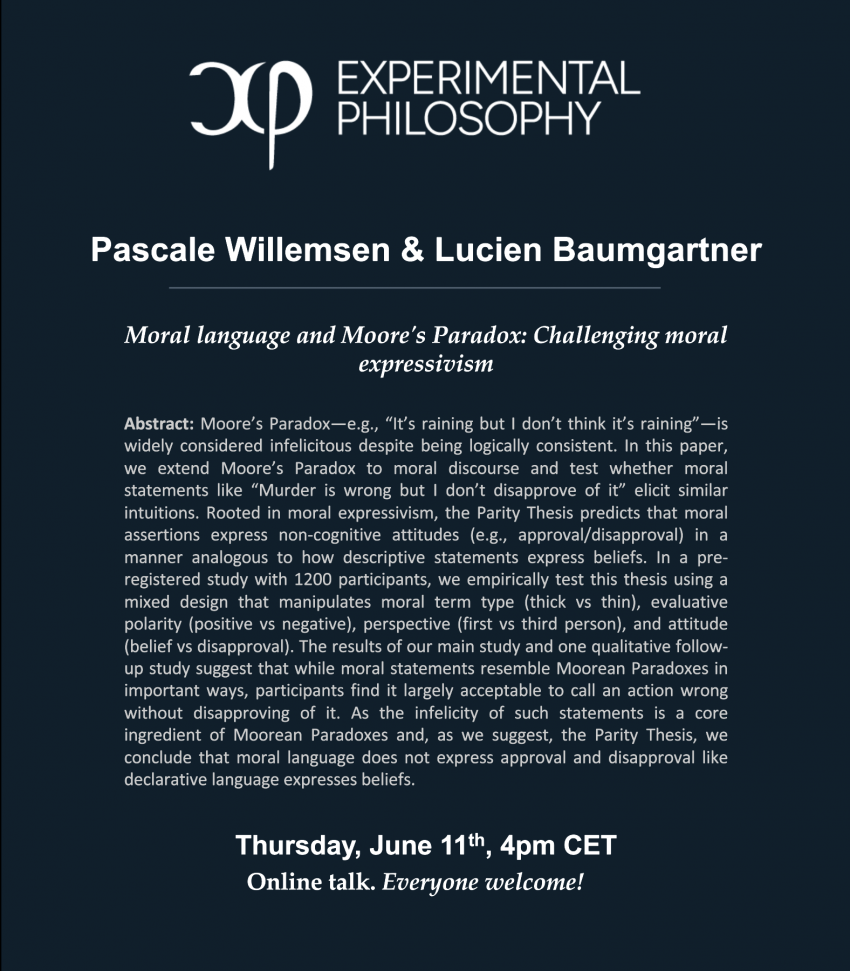
On June 11 from 16:00–18:00 (UTC+1), Pascale Willemsen and Lucien Baumgartner will talk about “Moral Language and Moore’s Paradox – Challenging Moral Expressivism.” The talk can be accessed via Zoom (Meeting ID: 651 0778 6432, Code: 235823). The abstract reads:
Moore’s Paradox – e.g., “It’s raining but I don’t think it’s raining” – is widely considered infelicitous despite being logically consistent. In this paper, we extend Moore’s Paradox to moral discourse and test whether moral statements like “Murder is wrong but I don’t disapprove of it” elicit similar intuitions. Rooted in moral expressivism, the Parity Thesis predicts that moral assertions express non-cognitive attitudes (e.g., approval/disapproval) in a manner analogous to how descriptive statements express beliefs. In a pre-registered study with 1200 participants, we empirically test this thesis using a mixed design that manipulates moral term type (thick vs thin), evaluative polarity (positive vs negative), perspective (first vs third person), and attitude (belief vs disapproval). The results of our main study and one qualitative follow-up study suggest that while moral statements resemble Moorean Paradoxes in important ways, participants find it largely acceptable to call an action wrong without disapproving of it. As the infelicity of such statements is a core ingredient of Moorean Paradoxes and, as we suggest, the Parity Thesis, we conclude that moral language does not express approval and disapproval like declarative language expresses beliefs.
From September 22 to 23, 2026, the workshop “Do Experiments Replicate? Philosophical Reflections on the Use and Misuse of Statistics and Econometrics” will take place at the Jagiellonian University, Poland.
Abstract submissions are possible until June 1, 2026. The call reads:
The workshop “Do experiments replicate? Philosophical Reflections on the Use and Misuse of Statistics and Econometrics” aims to provide a forum for exchanging ideas on the replicability of randomized experiments, such as randomized field experiments in economics, randomized controlled trials and preclinical studies in medicine, and psychological experiments.
The workshop promotes philosophical and methodological discussions of conceptual and methodological issues in statistical analysis, econometric modeling, and the methodology of experimentation.
Keynote Speakers:
Barbara Osimani
Samuel Fletcher
Experimental results are considered reliable because, under comparable conditions, they are expected to yield similar outcomes. However, this assumption has recently been challenged by numerous replication efforts that report results differing from those of the original studies in psychology, medicine, biology, the social sciences, and economics. A surprisingly large fraction of published findings have been found to be non-replicable. Replicability rates range from 11% for in vitro and in vivo preclinical research to 60–90% for clinical trials. Experimental economists fall within this range and, like psychological experimenters, achieve around 60% replicability.
The replication crisis has called into question the credibility of published findings and undermined trust in science. However, the replication crisis, with few exceptions, has received only limited attention from philosophy of science. Despite the efforts of several pioneers, the philosophical and conceptual problems in randomized controlled trials, randomized field experiments, laboratory experiments, econometric modeling, and the statistical analysis of experimental data remain largely uncharted territory in the philosophy of science. The workshop aims to establish a forum for exchanging ideas among philosophers of medicine and economics, philosophers of statistics, and methodologically inclined researchers interested in the conceptual problems of the replication crisis.
The Workshop “Do experiments replicate? Philosophical Reflections on the Use and Misuse of Statistics and Econometrics” invites contributions that focus on experimentation and statistical analysis in economics and medicine, as well as problems that trouble statistical inference from experiments, broadly construed.
Some exemplary topics of talks:
The design of randomized experiments in medicine and economics.
Statistical hypothesis testing.
Non-frequentist approaches to comparing treatment and control group outcomes.
Comparisons of design-based and model-based inference.
Estimating statistical models.
Measuring replication success and replicability rates.
Assessing the quality of empirical evidence.
Making inferences from the literature review with conflicting results.
Other problems in philosophy of statistics related to the replication crisis.
Abstracts no longer than 500 words (including references) should be submitted in an attachment, not including author details, by email with the subject ‘replication workshop’ sent to: mariusz.maziarz@uj.edu.pl.
Deadline for submission: June 1st, 2026
Decisions will be announced by June 15th, 2026.
This activity was supported by a grant funded by the Strategic Program Excellence Initiative at the Jagiellonian University.
On May 26 from 15:30–17:30 (UTC+2), Helen Fischer will talk about “Justified True Belief Revisited – A Psychological Perspective on ‘Knowledge’” at Heidelberg University. The talk can be accessed via Zoom. The abstract reads:
Modern societies rely fundamentally on the production, circulation, and recognition of reliable knowledge. Yet despite the normative and institutional prominence of knowledge, we know surprisingly little about what citizens themselves count as knowledge, to whom they attribute it, and on what grounds. A dominant philosophical account defines knowledge as Justified True Belief, requiring that a proposition be true, believed, and adequately justified. In this talk, I present a large-scale empirical test whether ordinary knowledge ascriptions adhere to this normative standard. In a preregistered conjoint experiment with a nationally quota-matched U.S. sample (N = 1,295), participants judged whether an agent “knows” propositions across a politically contested domain (climate change) and an uncontested domain (astrophysics). We fully crossed Justification (six levels varying strength and source), Truth (true vs. false), and Belief (strong vs. weak). Knowledge ascriptions systematically diverged from Justified True Belief across both domains. Belief exerted the strongest causal influence (Average causal effects: AMCE ≈ −0.42 for weak vs. strong belief), Truth was helpful but not necessary (AMCE ≈ 0.18 for true vs. false), and Justification contributed little or not at all (AMCE range across levels ≈ 0.00–0.05). This asymmetry had striking consequences: more than half of participants attributed knowledge even to false propositions when belief was strong, whereas only about one quarter attributed knowledge to true, strongly justified propositions when belief was weak. Across both domains, participants thus heavily prioritized conviction over truth and justification when judging whether others “know.” By showing that ordinary knowledge ascriptions more closely follow a model of “Strong Belief with optional Truth” than the normative account of Justified True Belief, these results help explain why low-justification and even false propositions can be treated as knowledge in public discourse.
From September 9 to 11, 2026, the workshop “Group Agency and Metaethics” will take place at the University of Vienna.
Abstract submissions are possible until May 31, 2026. The call reads:
We invite submissions for the workshop Group Agency and Metaethics. Metaethics concerns the study of the metaphysical, epistemological, semantic and psychological presuppositions and commitments of moral thought, talk and practice. However, the answers to these various questions are typically developed with a focus on individuals. The possibility that groups are normative or moral agents in their own right is rarely considered within metaethics. The aim of this workshop is to explore the significance of the possibility of group agency for debates in metaethics, and vice versa. The workshop will focus on group agency in connection to topics such as naturalism/non-naturalism; realism/anti-realism; cognitivism/non-cognitivism; the nature of normativity and norms; normative reasons; rationality; and experimental metaethics. We further welcome submissions on related issues that may be significant for these topics. By exploring groundbreaking topics at the intersection of metaethics and social ontology, the workshop hopefully will set the stage for future debates.
The workshop will feature four keynote speakers:
Prof. Carla Bagnoli (University of Modena and Reggio Emilia)
Prof. Bart Streumer (University of Groningen)
Asst. Prof. Asya Passinsky (Central European University)
Prof. Hans Bernhard Schmid (University of Vienna)
The workshop will take place at the University of Vienna from 9 to 11 September 2026. If you are interested in presenting at the workshop, please send your anonymized abstract to niels.de.haan@univie.ac.at with the subject line: Abstract Group Agency and Metaethics. The anonymized abstract should be approximately 500 words. Each speaker will be allotted 1 hour (incl. Q&A). The deadline for submissions is 31 May, 2026. We aim to send out the notifications of acceptance around 15 June, 2026.
There are bursaries available for students or precariously employed participants with a lack of available funding to (partially) cover accommodation and flights. If you would like to be considered for one of the bursaries, please indicate this in the email. If your submission is successful, you will be asked to provide a short description of your funding situation to ensure we can distribute the bursaries fairly.
The workshop is sponsored by the International Social Ontology Society (https://isosonline.org/) and the University of Vienna.
To provide the best experiences, we use technologies like cookies to store and/or access device information. Consenting to these technologies will allow us to process data such as browsing behavior or unique IDs on this site. Not consenting or withdrawing consent, may adversely affect certain features and functions.
Functional
Always active
The technical storage or access is strictly necessary for the legitimate purpose of enabling the use of a specific service explicitly requested by the subscriber or user, or for the sole purpose of carrying out the transmission of a communication over an electronic communications network.
Preferences
The technical storage or access is necessary for the legitimate purpose of storing preferences that are not requested by the subscriber or user.
Statistics
The technical storage or access that is used exclusively for statistical purposes.The technical storage or access that is used exclusively for anonymous statistical purposes. Without a subpoena, voluntary compliance on the part of your Internet Service Provider, or additional records from a third party, information stored or retrieved for this purpose alone cannot usually be used to identify you.
Marketing
The technical storage or access is required to create user profiles to send advertising, or to track the user on a website or across several websites for similar marketing purposes.