The Experimental Philosophy Blog

Philosophy Meets Empirical Research

Menu
  • Home
  • About
  • Guidelines for Comments
  • Labs and Organizations
  • Resources
Menu

Author: Alexander Max Bauer

Hot Off The Press: “Experimental Philosophy”

Posted on November 15, 2025January 10, 2026 by Alexander Max Bauer

There’s a new journal in town: Experimental Philosophy. Founded by Editors-in-Chief Alex Wiegmann, Ivar Hannikainen, and Pascale Willemsen, run by Managing Editor Nikolai Shurakov, and supported by a broad team of Section Editors, it’s a journal dedicated entirely to, well, experimental philosophy.

The editors write:

Experimental Philosophy is an open-access journal founded to enable authors to publish work in experimental philosophy without having to compromise on either the empirical or the philosophical side. The journal welcomes submissions relevant to the field of experimental philosophy, broadly interpreted to include experimental-philosophy studies, empirically informed philosophy, and discussions of methods and empirically informed and experimental philosophy, meta-studies, and critical responses to empirical work. Submissions are expected to make a significant contribution to philosophical discourse.

Experimental Philosophy is proud to be a completely fee-free journal. We do not collect any publication or processing charges under any circumstances, including from researchers unaffiliated with universities or research institutions. This policy reflects our firm commitment to social justice, equity, and the democratization of knowledge. We seek to ensure that the ability to contribute to and access philosophical research depends solely on the quality of ideas – not on institutional privilege or financial means.

Workshop: “XPHI UK Work in Progress Workshop Series”

Posted on November 15, 2025November 15, 2025 by Alexander Max Bauer

James Andow and Eugen Fischer have announced the first talks for this season’s “XPHI UK Work in Progress Workshop Series.” Talks will be held on Microsoft Teams. Anyone interested in joining can email james.andow@manchester.ac.uk.

November 26, 16:00–18:00 (UTC±0)

  • Qianyi Qin (CUNY Graduate Centre): “Imaginative Tendencies and Virtuality Tolerance – Re-Examining the Experience Machine”
  • Jumbly Grindrod (University of Reading): “Word Meanings in Transformer Language Models”

December 10, 16:00–18:00 (UTC±0)

  • Juan-Pablo Bermúdez (University of Southampton) and Gino Carmona (Universidad Externado de Colombia): “Goals and Plans in the Wild – The Effects of Poverty on Planning Agency”
  • Miklós Kürthy (University of Graz): “Care for Consistency”

January 14, 16:00–18:00 (UTC±0)

  • Monika Jovanović and Andrija Šoć (University of Belgrade): “A Matter of Taste? Toward Deliberative Experimental Aesthetics”
  • Markus Werning (Ruhr-Universität Bochum): t.b.a.

Job: “Experimental argument analysis” (Norwich, UK)

Posted on October 27, 2025October 27, 2025 by Alexander Max Bauer

The University of East Anglia is hiring a Research Associate to work from January 8 to June 30, 2026, on a research project in experimental philosophy.

Applications are possible until November 25. The job announcement reads:

Salary on appointment will be £31,236 per annum (pro rata), with an annual increment up to 37,694 per annum (pro rata).

An exciting opportunity has arisen for a Research Associate join the School of Psychology to conduct studies in experimental philosophy, as part of the research project “Experimental argument analysis: Reasoning with stereotypes” which is hosted by the UEA Experimental Philosophy Group.

As a Research Associate you will contribute to the research programme, analyse and interpret data, write up results and present information on research progress and outcomes.

You will have a graduate level qualification, equivalent qualification or experience and be able to work in a proactive and results driven manner in a high paced environment. You will also have strong interpersonal and communication skills, the ability to analyse and interpret data and work effectively as part of a team. Advanced skills directly relating to this research area and previous research experience would be advantageous.

This part-time (0.9 FTE) post is available from 8 January 2026 on a fixed-term basis until 30 June 2026.

UEA offers a variety of flexible working options and we encourage applications from individuals who would prefer a flexible working pattern including annualised hours, compressed working hours, part time, job share, term-time only and/or hybrid working. Details of preferred hours should be stated in the personal statement and will be discussed further at interview.

Benefits include:

  • 44 days annual leave inclusive of Bank Holidays and University Customary days (pro rata for part-time).
  • Family and Work-life balance policies including hybrid working and considerable maternity, paternity, shared parental leave and adoption leave.
  • Generous pension scheme with life cover for dependants, plus incapacity cover.
  • Health and Wellbeing: discounted access to Sportspark facilities, relaxation rooms, 320 acres of rolling parkland, wellbeing walks, Wellbeing Ambassador network, on-campus medical centre including NHS Dentist, Occupational Health and a 24/7 Employee Assistance Programme.
  • Campus Facilities: Sportspark, library, nursery, supermarket, post office, bars and catering outlets.
  • Exclusive shopping discounts to help cut the cost of household bills, childcare salary sacrifice scheme, Cycle to Work scheme and public transport discounts.
  • Personal Development: unlimited access to LinkedIn Learning courses, specialist advice and training from our Organisational Development and Professional Learning Team.

Closing date: 25 November 2025

The University holds an Athena Swan Silver Institutional Award in recognition of our advancement towards gender equality.

Further Information

For further information, including the Job Description and Person Specification, please see the attached Candidate Brochure.

For an informal discussion about the post please contact the PI, Professor Eugen Fischer via e.fischer@uea.ac.uk

Talk: “Philosophical Arguments Can Boost Charitable Giving” (Eric Schwitzgebel and Kirstan Brodie)

Posted on October 25, 2025October 25, 2025 by Alexander Max Bauer

On Thursday, October 30, the first talk in the Experimental Philosophy Journal Series will take place on Zoom.

Celso de Oliveira Vieira, Alex Wiegmann, and Rodrigo Díaz write:

We are pleased to invite you to the first talk in the Experimental Philosophy Journal Series, the new journal dedicated to X-Phi.

In this session, Eric Schwitzgebel (California) and Kirstan Brodie (Cornell) will present their paper, “Philosophical arguments can boost charitable giving,” co-authored with Nemirow and Cushman. The preprint, in which the authors identify the elements of a range of philosophical arguments that boost charitable giving, is available here. The presentation will be followed by a commentary from Rodrigo Díaz (CSIC). He wrote “Do Moral Beliefs Motivate Action?,” accessible here. After that, the floor will be open for discussion. The authors will speak first, but the audience will be able to participate as well.

The session will take place online on October 30th at 10 AM PDT/6 PM CET.
Here is the Zoom link: http://tiny.cc/xphij1
For inquiries, please contact Celso Vieira at celso.deoliveiravieira@rub.de.

See you soon,
Celso, Alex, and Rodrigo

Call: “The Fifth Annual Formal and Experimental Philosophy Workshop”

Posted on October 25, 2025October 25, 2025 by Alexander Max Bauer

Lake Forest College’s philosophy department is hosting “The Fifth Annual Formal and Experimental Philosophy Workshop” (FAX5), which will take place from March 20 to 21, 2026.

Abstracts for posters can be submitted until October 10. The call reads:

The Fifth Annual Formal and Experimental Philosophy Workshop (FAX5) at Lake Forest College brings together philosophers who use formal and experimental methods to address a wide range of philosophical questions. Although these methods have developed largely in isolation, they share data-driven foundations, often aim to answer similar questions, and can greatly enrich one another when integrated. Over two days, leading scholars and emerging researchers will share advances, explore collaborations, and develop new ways to combine empirical and formal methods. By fostering cross-methodological dialogue and building learning networks, FAX5 aims to strengthen, expand, and integrate these methods across the discipline.

Call for Poster Abstracts: The Fifth Annual Formal and Experimental Philosophy Workshop (FAX5) at Lake Forest College invites poster abstracts on topics in formal or experimental philosophy. Submissions (max 500 words) should be emailed as a single PDF and include: a title; an abstract; a full author list with the presenting author(s) in bold; and institutional affiliations. Please name your file “FAX5_Poster_LastName.pdf” (the first presenter’s last name) and use the subject line “FAX5 Poster Abstract Submission.” Send submissions to phenne [at] lakeforest [dot] edu. Posters will be selected for clarity, originality, and relevance to integrating or advancing formal or experimental methods in philosophy.

Call: “Valence Asymmetries”

Posted on October 25, 2025October 25, 2025 by Alexander Max Bauer

The Valence Asymmetries project, led by Isidora Stojanovic at the Universitat Pompeu Fabra in Barcelona, is looking for expressions of interest from people who would like to join. The call reads:

We are interested in including new team members in our project. Before opening a new position, we are inviting those interested in joining us to express their interest.

The new team member(s) should have research interests that align directly with the objectives of the project, broadly understood. They will already have a very solid publication track, will cherish interdisciplinary research, and will want to combine theoretical and empirical methodology.

We are particularly interested in the following research profiles:

  • Decision theory, philosophy of rationality & framing effects
  • Formal value theory & formal semantics
  • Philosophy of emotions & social and/or moral psychology
  • Moral cognition & philosophy of well-being

Additionally, any other research profile that offers a novel perspective on the project’s objectives is potentially welcome.

The duration of the contract will depend on the range of project tasks that the new team member will be hired to work on, and in any case cannot exceed the duration of the project (i.e. July 2029).

In addition to prospective candidates who would like to join us for a longer duration, we are also inviting tenured faculty who have a demonstrably heavy teaching load to consider joining us for a one year period (assuming that they can get a leave of absence from their home institution) that they can devote to research.

The expected gross salary is approx. 31.000 gross per year (negotiable for senior and/or already tenured faculty).

NB: The project’s team members must live in Barcelona (region), they regularly meet in person, attend seminars and conduct in-person research. The position is incompatible with living and/or spending considerable periods of time elsewhere.

If you are interested in joining the project, please send an email to Isidora Stojanovic (PI), explaining your motivation and interests, together with a complete CV.

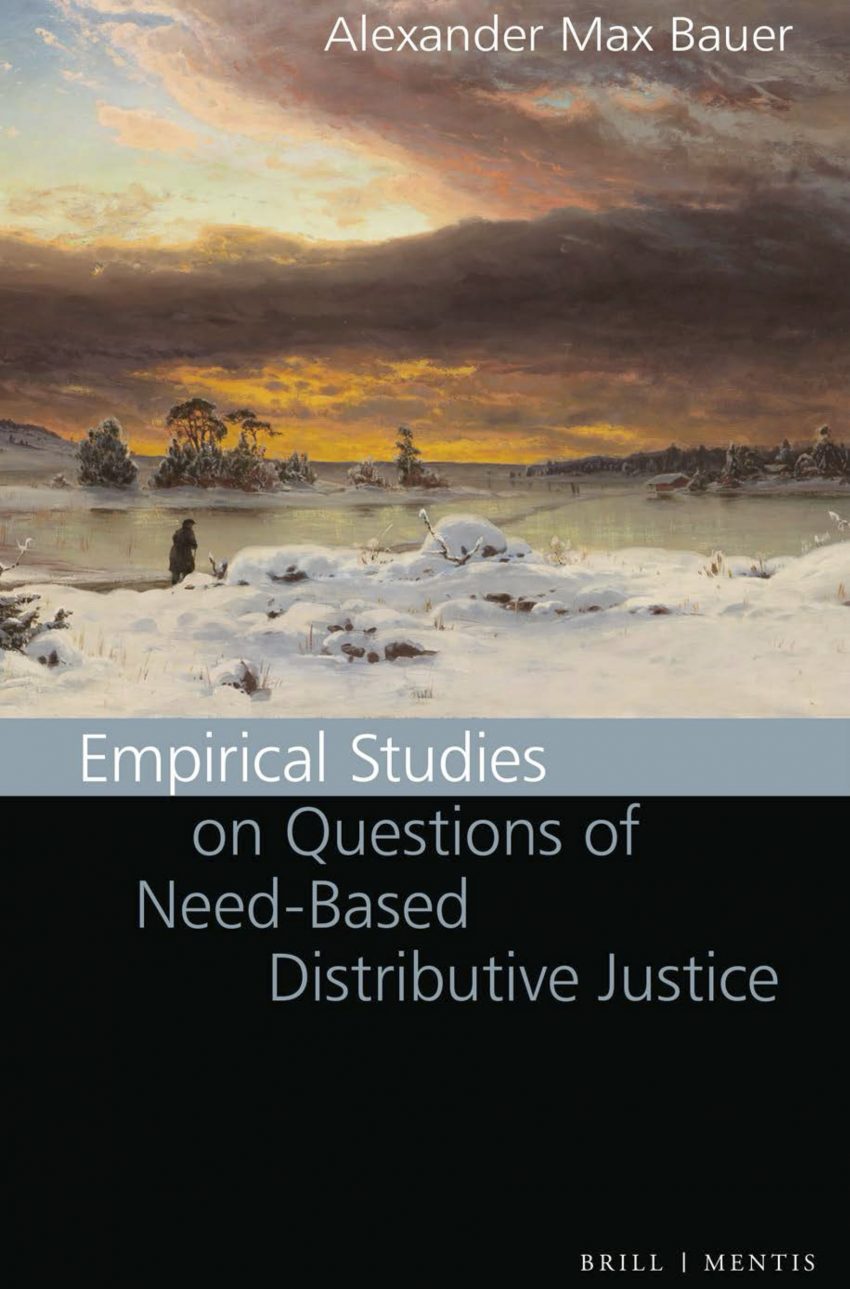
Hot Off The Press: “Empirical Studies on Questions of Need-Based Distributive Justice”

Posted on October 8, 2025October 8, 2025 by Alexander Max Bauer

In “Empirical Studies on Questions of Need-Based Distributive Justice” (the English translation of last year’s “Empirische Studien zu Fragen der Bedarfsgerechtigkeit”), I recap a series of vignette studies that examine the role that needs play in dealing with problems of distributive justice. As I summarised in last year’s post:

Among other things, the following becomes clear:

  1. Impartial observers make gradual assessments of the fairness of distributions.
  2. These assessments depend on how well an individual is supplied with a relevant good.
  3. If information on a need threshold is given, these assessments are made relative to this reference point. (Bauer et al. 2023a [later published as Bauer et al. 2025])
  4. Impartial decision-makers consider need, productivity, and accountability when making hypothetical distribution decisions.
  5. If an individual’s productivity is not sufficient to cover their needs, these higher needs are partially compensated for (at the expense of other individuals who are not so badly off)
  6. Willingness to compensate decreases if an individual is accountable for having produced less or for needing more. (Bauer et al. 2022)
  7. Both impartial observers and impartial decision-makers attribute different levels of importance to different kinds of needs.
  8. This reveals a hierarchy of needs in the following order: Survival, Decency, Belonging, Autonomy. (Bauer et al. 2023b)

Literature

Bauer, Alexander Max, Frauke Meyer, Jan Romann, Mark Siebel, and Stefan Traub (2022): “Need, Equity, and Accountability. Evidence on Third-Party Distribution Decisions from a Vignette Study,” Social Choice and Welfare 59, 769–814. (Link)

Bauer, Alexander Max, Adele Diederich, Stefan Traub, and Arne Robert Weiss (2023a): “When the Poorest Are Neglected. A Vignette Experiment on Need-Based Distributive Justice,” SSRN Working Paper 4503209. (Link)

Bauer, Alexander Max, Jan Romann, Mark Siebel, and Stefan Traub (2023b): “Winter is Coming. How Laypeople Think About Different Kinds of Needs,” PLoS ONE 18 (11), e0294572. (Link)

Bauer, Alexander Max (2024): Empirische Studien zu Fragen der Bedarfsgerechtigkeit, Oldenburg: University of Oldenburg Press. (Link)

Bauer, Alexander Max (2025): Empirical Studies on Questions of Need-Based Distributive Justice, Paderborn: mentis. (Link)

Bauer, Alexander Max, Adele Diederich, Stefan Traub, and Arne Robert Weiss (2025): “Thinking About Need. A Vignette Experiment on Need-Based Distributive Justice,” The Journal of Economic Inequality 23 (3), 667–693. (Link)

Call: “Valence Asymmetries”

Posted on September 19, 2025October 8, 2025 by Alexander Max Bauer

Isidora Stojanovic, Lorenza D’Angelo, Morgan Moyer, and Michelle Stankovic organizing a conference on “Valence Asymmetries,” which will take place at the Universitat Pompeu Fabra from March 19 to 20, 2026.

Abstracts for presentations can be submitted until September 30. The call reads:

The Valence Asymmetries ERC team is happy to announce that it will be organizing the first VALENCE ASYMMETRIES conference on March 19th–20th 2026 at the Pompeu Fabra University in Barcelona, Spain. The event is funded by Isidora Stojanovic’s ERC Advanced Grant “Valence Asymmetries: the positive, the negative, the good and the bad in language, mind and morality” (GA n° 101142133).

This interdisciplinary event will discuss themes which are central to the Valence Asymmetries project, including the role of valence asymmetries in perception, emotion, morality, language, and communication. Discussion will draw upon insights from philosophy, psychology, and linguistics.

There will be invited talks by Hans Alves, Frederique de Vignemont, Saif Mohammad, and Pascale Willemsen. There is also room for 4–6 additional talks, to be selected from open submissions. Each selected talk will be assigned a 50 min slot, including discussion.

We especially encourage submissions on the relation between value, valence, and polarity; theoretical and empirical accounts of valence asymmetries in language, including in negative strengthening, scalar inferences, and irony; the asymmetry between virtue and vice, and between praise and blame, in normative and applied ethics; as well as other discussions of valence asymmetries in linguistics, cognitive science, moral psychology, and cognate areas.

If you are interested in presenting your work at this venue, please submit a 2-page abstract to valence.asymmetries@upf.edu by Sep 30th, with the subject line “valence asymmetries submission.”

Talk: “Intentionality and Discrimination” (Nicole Gotzner and Kevin Reuter)

Posted on August 31, 2025October 25, 2025 by Alexander Max Bauer

On Tuesday, October 2, the XPRAG Wine Gatherings welcome Nicole Gotzner and Kevin Reuter to talk about “Intentionality and Discrimination” on Zoom. Kevin writes:

Experimental Pragmatics (XPrag) and Experimental Philosophy (XPhi) share a common vision: whenever our assumptions can be empirically tested against the world, we should rise to the occasion. On October 2nd, 2025, don’t miss a talk on “intentionality and discrimination” by Nicole Gotzner (University of Osnabrück) and Kevin Reuter (University of Gothenburg), followed by a discussion on how our communities can exchange ideas and spark new collaborations. We can’t wait to see you there!

The Zoom link and more information are available at the XPRAG Wine Gatherings’ website.

Call: “Folk Epistemology”

Posted on August 26, 2025August 26, 2025 by Alexander Max Bauer

Mirko Farina, Artur Karimov, Anna Sakharova, Mikhail Khort, Daniel Lavrishchev, Vladislav Stasenko, and Natalia Khairullina are organizing a conference on “Folk Epistemology – Exploring Everyday Conceptions of Knowledge,” which will take place at the Kazan Federal University from October 24 to 25. The conference will be hybrid, featuring a dedicated online section in English.

Abstracts for presentations can be submitted until October 10. The call reads:

What is knowledge? Philosophers have long sought answers to this fundamental question within the confines of their studies. Yet contemporary epistemology faces a profound challenge: How universal and adequate are the intuitions underlying theories derived from “armchair” conceptual analysis? This challenge has emerged alongside intensive research into folk epistemology – the study of ordinary people’s conceptions of knowledge, truth, justification, reliability, and other epistemic categories. Data from experimental philosophy (x-phi) reveal that what seems obvious and universal to the armchair philosopher may vary significantly across cultural, social, linguistic, or educational contexts. Does this call into question the possibility of a unified theory of knowledge? Are folk intuitions a reliable test for the adequacy of philosophical concepts their inevitable foundation (as x-phi advocates argue) – or merely “empirical noise” unrelated to epistemology’s inherently normative aims?

Conference Goals

This conference aims to create a platform for critical and constructive discussion on the role of folk epistemic conceptions and intuitions in modern philosophy. Participants are invited to address the following key questions:

  • Conceptualizing Folk Epistemology: What are its boundaries? How is it manifested in language (epistemic modalities, knowledge verbs), social and cognitive practices (distribution of epistemic authority, source credibility, non-expert assessments of justification reliability)? How can we account for pragmatic and moral “encroachments” in knowledge descriptions?
  • Relevance of Folk Conceptions for Philosophical Theory: Should epistemological theories explicitly incorporate, refute, or methodologically disregard data on folk conceptions? What are their heuristic values and limitations?
  • Critical Analysis of X-Phi Methodology in Epistemology: How can empirical data enrich philosophical reflection? What are the limitations of experimental approaches in clarifying normative questions? How does variability in intuitions impact debates about epistemic universalism, contextualism, or relativism?
  • Applied Potential of X-Phi Data: How can research on folk epistemology (especially cross-cultural variations in epistemic conceptions) inform practical applications? How might this data improve AI systems (e.g., model training, dialogue agent design) and optimize human-AI interaction (e.g., fostering epistemic trust in intelligent assistants)?

Call for Interdisciplinary Dialogue

We aim to transcend disciplinary boundaries and welcome contributions from all scholars engaged in folk epistemology research. In addition to papers on the above themes, we particularly encourage:

  • Presentations of empirical/experimental studies on epistemic conceptions and intuitions by philosophers, psychologists, anthropologists, sociologists, and linguists.
  • Proposals for planned empirical research (experiments, surveys, linguistic analyses, etc.), including hypotheses, designs, and methodologies.

This segment will foster discussion on methodological challenges, brainstorming for refining x-phi tools, and exploring collaborative opportunities.

Submission Guidelines

To participate, please:

  • Complete the registration form: https://forms.gle/rCu72uaTJwc8GQZx6
  • Include your full name, contact email, presentation title, and abstract (100–250 words).
  • If you have any difficulties filling out this form or have any questions about the conference, please contact mikhort@gmail.com (Mikhail Khort).

Deadline: October 10, 2025.

Updates & Information

The conference schedule, detailed announcements, and additional information will be available via: Telegram Channel: https://t.me/kznphil

  • Previous
  • 1
  • 2
  • 3
  • 4
  • 5
  • …
  • 8
  • Next

Search

Categories

Tags

Agency Artificial Intelligence Basic Needs Behavior Beliefs Bias Bioethics Blame Causation Cognitive Science Consciousness Corpus Analysis Cross-Cultural Research Decisions Determinism Distributive Justice Emotions Essentialism Expertise Folk Morality Framing Free Will Gender Intention Intuition Jurisprudence Knowledge Large Language Models Moral Psychology Norms Pejoratives Problem of Evil Psycholinguistics Rationality Reasoning Replication Responsibility Self Side-Effect Effect Slurs Truth Valence Values Virtue Well-Being

Recent Posts

  • Call: “The Armchair on Trial”
  • Call: “Interdisciplinary Perspectives on Linguistic Justice”
  • Call: “6th European Experimental Philosophy Conference”
  • Talk: “Ethics in the Lab” (Pascale Willemsen)
  • Talk: “Normality and Norms” (Josh Knobe)

Recent Comments

  1. Nova Praxis on The Folk Concept of ArtJuly 11, 2025

    This article highlights an important point: everyday people don’t rely on rigid definitions to determine what qualifies as art. They’re…

  2. Koen Smets on Priming Effects Are Fake, but Framing Effects Are RealMay 27, 2025

    That is indeed exactly the question I have as well. I operationalize it as having de facto contradicting intuitions, in…

  3. Joshua Knobe on Priming Effects Are Fake, but Framing Effects Are RealMay 24, 2025

    Hi Koen, Thanks once again. This idea brings up all sorts of fascinating questions, but for the purposes of the…

  4. Koen Smets on Priming Effects Are Fake, but Framing Effects Are RealMay 24, 2025

    Great! In the meantime I thought of another potentially interesting example of framing—Arnold Kling’s Three Languages of Politics. Just about…

  5. Joshua Knobe on Priming Effects Are Fake, but Framing Effects Are RealMay 23, 2025

    Thanks Koen! This is all super helpful.

Archives

  • February 2026
  • January 2026
  • December 2025
  • November 2025
  • October 2025
  • September 2025
  • August 2025
  • July 2025
  • June 2025
  • May 2025
  • April 2025
  • March 2025
  • February 2025
  • January 2025
  • December 2024
  • November 2024
  • October 2024
  • September 2024
  • August 2024
  • July 2024
  • June 2024
  • May 2024
  • April 2024
  • March 2024

Meta

  • Log in
  • Entries feed
  • Comments feed
  • WordPress.org

Imprint • Disclaimer • Privacy Statement • Cookie Policy

© 2024 The Experimental Philosophy Blog
Manage Consent
To provide the best experiences, we use technologies like cookies to store and/or access device information. Consenting to these technologies will allow us to process data such as browsing behavior or unique IDs on this site. Not consenting or withdrawing consent, may adversely affect certain features and functions.
Functional Always active
The technical storage or access is strictly necessary for the legitimate purpose of enabling the use of a specific service explicitly requested by the subscriber or user, or for the sole purpose of carrying out the transmission of a communication over an electronic communications network.
Preferences
The technical storage or access is necessary for the legitimate purpose of storing preferences that are not requested by the subscriber or user.
Statistics
The technical storage or access that is used exclusively for statistical purposes. The technical storage or access that is used exclusively for anonymous statistical purposes. Without a subpoena, voluntary compliance on the part of your Internet Service Provider, or additional records from a third party, information stored or retrieved for this purpose alone cannot usually be used to identify you.
Marketing
The technical storage or access is required to create user profiles to send advertising, or to track the user on a website or across several websites for similar marketing purposes.
  • Manage options
  • Manage services
  • Manage {vendor_count} vendors
  • Read more about these purposes
View Preferences
  • {title}
  • {title}
  • {title}