The Experimental Philosophy Blog

Philosophy Meets Empirical Research

Menu
  • Home
  • About
  • Guidelines for Comments
  • Labs and Organizations
  • Resources
Menu

Tag: Norms

Talk: “Normality and Norms” (Josh Knobe)

Posted on January 27, 2026January 27, 2026 by Alexander Max Bauer

The Center for Philosophy and the Health Sciences at Aarhus University is hosting a lecture by Joshua Knobe. It will take place on Thursday, January 29, 15:15–16:45 (UTC+1) via Zoom. The abstract reads:

The notion of normality plays a role in the way people understand many different scientifically important concepts. For example, normality figures in people’s understanding of what it is for a trait to be innate, what it is for one event to cause another, and what it is for the state to count as a disease. I will be presenting a theory about ordinary attributions of normality and then exploring the application of this theory to all three of these types of judgments. The theory is that ordinary attributions of normality involve a mixture of statistical judgments (how frequent something is) and evaluative judgments (how good something is). Thus, the key claim is that both statistical and evaluative judgments play a role in people’s ordinary understanding of innateness, causation and disease.

Hot Off The Press: “Advances in Experimental Philosophy of Law”

Posted on February 7, 2025 by Alexander Max Bauer

Edited by Karolina Prochownik and Stefan Magen, “Advances in Experimental Philosophy of Law,” a new entry into Bloomsbury’s “Advances in Experimental Philosophy” series, has recently been published. See below for the table of contents.

Part 1 – Topics in Experimental General Jurisprudence

  • Raff Donelson: “Experimental Approaches to General Jurisprudence”
  • Guilherme de Almeida, Noel Struchiner, and Ivar Hannikainen: “The Experimental Jurisprudence of the Concept of Rule – Implications for the Hart-Fuller Debate”

Part 2 – Topics in Experimental Particular Jurisprudence

  • Kevin Tobia: “Legislative Intent and Acting Intentionally”
  • Lara Kirfel and Ivar Hannikainen: Why Blame the Ostrich? Understanding Culpability for Willful Ignorance”
  • Paulo Sousa and Gary Lavery: “Culpability and Liability in the Law of Homicide – Do Lay Moral Intuitions Accord with Legal Distinctions?”
  • Levin Güver and Markus Kneer: “Causation and the Silly Norm Effect”

Part 3 – (New) Methods and Topics in Experimental Jurisprudence

  • Justin Sytsma: “Ordinary Meaning and Consilience of Evidence”
  • Pascale Willemsen, Lucien Baumgartner, Severin Frohofer, and Kevin Reuter: “Examining Evaluativity in Legal Discourse – A Comparative Corpus-Linguistic Study of Thick Concepts”
  • Leonard Hoeft: “A Case for Behavioral Studies in Experimental Jurisprudence”
  • Eric Martínez and Christoph Winter: “Experimental Longtermist Jurisprudence”

Literature

Prochownik, Karolina, and Stefan Magen (eds.) (2024): Advances in Experimental Philosophy of Law, London, New York, and Dublin: Bloomsbury. (Link)

Hot Off The Press: “Advances in Experimental Philosophy of Action”

Posted on February 7, 2025February 7, 2025 by Alexander Max Bauer

Edited by Paul Henne and Samuel Murray, “Advances in Experimental Philosophy of Action,” a new entry into Bloomsbury’s “Advances in Experimental Philosophy” series, has recently been published. See below for the table of contents.

  • Justin Sytsma and Melissa Snater: “Consciousness, Phenomenal Consciousness, and Free Will”
  • Myrto Mylopoulos: “Skilled Action and Metacognitive Control”
  • Samuel Murray: “Bringing Self-Control into the Future”
  • Walter Sinnott-Armstrong: “Who is Responsible? Split Brains, Dissociative Identity Disorder, and Implicit Attitudes”
  • Paul Noordhof and Ema Sullivan-Bissett: “The Everyday Irrationality of Monothematic Delusion”
  • John Turri: “Truth, Perspective, and Norms of Assertion – New Findings and Theoretical Advances”
  • Joanna Korman: “The Distinct Functions of Belief and Desire in Intentional Action Explanation”
  • Cory J. Clark, Heather M. Maranges, Brian B. Boutwell, and Roy F. Baumeister: “Free Enough – Human Cognition (and Cultural Interests) Warrant Responsibility”
  • Edouard Machery, Markus Kneer, Pascale Willemsen, and Albert Newen: “Beyond the Courtroom – Agency and the Perception of Free Will”
  • Katrina L. Sifferd: “Do Rape Cases Sit in a Moral Blindspot? The Dual Process Theory of Moral Judgment and Rape”
  • Shane Timmons and Ruth M. J. Byrne: “How People Think About Moral Excellence – The Role of Counterfactual Thoughts in Reasoning about Morally Good Actions”
  • Caroline T. Arruda and Daniel J. Povinelli Index: “Why Idealized Agency Gets Animal (and Human) Agency Wrong”

Literature

Henne, Paul, and Samuel Murray (eds.) (2024): Advances in Experimental Philosophy of Action, London, New York, and Dublin: Bloomsbury. (Link)

In What Sense are Generics Normative?

Posted on December 23, 2024December 28, 2024 by Joshua Knobe

Suppose you see a teacher speaking to a student in an insulting or degrading way. You might go up to the teacher and say: “What are you doing? That’s not what a teacher does when students are having trouble.” And then you might say:

  • A teacher tries to help her students.

Here you are using a special type of sentence called a generic. Moreover, you are using this sentence in a way that is normative. That is, you aren’t just saying that teachers generally tend to help their students; you seem to be saying that helping one student is a way of fulfilling some kind of ideal.

The specific sort of normative claim you are making here is a puzzling one, and I don’t feel like I completely understand it. To begin with, it’s clearly not just a claim about what someone should do. For example, it’s not just the claim: teachers should help their students. Instead, it seems to mean something more like: helping one’s students is what follows from the characteristic ideals of being a teacher.

To see this, imagine that you see a teacher listening to Coldplay. You are outraged because you believe that teachers should have better taste in music. In such a case, you could not express the thought you are thinking by saying: “A teacher has good taste in music.” The reason is that even if you think that teachers should have good taste in music, you presumably do not think that this is something that follows from the characteristic ideals of being a teacher.

Okay then, what do we even mean when we speak of the “characteristic ideals” of a particular kind of thing? Unfortunately, I don’t know. I wish I could say something more helpful about this, but I don’t feel like I have a good handle on it yet.

Instead, I just want to suggest that this somewhat mysterious kind of normativity is really a big deal, i.e., that all sorts of different questions we face in understanding people’s ordinary cognition boil down to understanding this kind of normativity, meaning that if we could understand it, we would be able to understand all sorts of different aspects of the way people think.

In people’s ordinary way of thinking about things, people don’t seem to be concerned only about what you should do. They also seem to be very concerned about what follows from certain sorts of characteristic ideals. People have a notion of the characteristic ideals of being a teacher, the characteristic ideals of being a scientist, the characteristic ideals of being a Christian. Then they also have a way of thinking about the characteristic ideals of certain sorts of situations and certain sorts of objects. These notions seem to be right at the heart of people’s ordinary way of making sense of the world.

Just as a first step down this road, consider sentences like:

  • That’s not how one behaves at a Jewish wedding.

Or, more colloquially:

  • That’s not how you behave at a Jewish wedding.

Sentences like these seem to express something pretty fundamental about how people ordinarily understand the behavior that is called for in certain situations. We have a sense that it is sometimes possible to identify a certain behavior that is just “what one does” in a particular type of situation. This notion seems to be normative in some important sense, but how should that normativity be understood?

James Kirkpatrick and I have argued that they are normative in the same hard-to-capture sense that generics are normative. What do we mean when we say that something is “what you do at a Jewish wedding”? We don’t just mean something like: when someone is at a Jewish wedding, she should do this thing. Rather, we are saying something more like: doing this is a way of conforming to the characteristic ideals that follow from being at a Jewish wedding. (For example, you might think that the best thing to do if you are at a Jewish wedding is to ignore all the proceedings and start thinking instead about some profound philosophical question – but this has nothing to do with the characteristic ideal of Jewish weddings per se, and you could not speak about it using this specific type of sentence.)

Now consider the traditional philosophical question regarding knowledge attributions like:

  • Rachel knows how to behave at a Jewish wedding.

This sentence also seems to be saying something normative. It isn’t just saying that Rachel knows something that would be a way of behaving at a Jewish wedding; it seems to be saying that Rachel knows that “right” way of behaving, or the way of behaving that conforms to certain ideals. But which ideals? An obvious hypothesis would be: the exact same ideal we discussed in the previous paragraph. That is, the sentence means something at least broadly like: Rachel knows a way of behaving that conforms to the characteristic ideals that follow from being an action performed at a Jewish wedding.

Finally, consider judgments about persistence over time. Suppose that today we form a club for discussing recent experiments and call it the “Experiment Discussion Club.” Over the course of many years, certain features of the original club are lost but others are retained. Now suppose someone looks at the thing that exists ten years from now and says:

  • Ultimately, this isn’t even the Experiment Discussion Club anymore.

How do people decide whether this sentence is true or false?

In a series of amazing papers, Kevin Tobia finds experimental evidence that intuitions about persistence over time in cases like these depend on something normative. Basically, people’s intuitions depend on whether the changes involve the object getting better vs. worse. People will be especially inclined to say that the club isn’t even the Experiment Discussion Club anymore if it gets a lot worse, whereas if the club changes by getting a whole lot better, people will say that it is still the Experiment Discussion Club – just a more awesome version of that club.

But better in which specific sense? It certainly doesn’t seem that it is just a matter of getting better in any old way. For example, suppose people in the club stopped doing experiments entirely and instead focused on fighting for human rights. You might think that this would make the club better, but it would not make the club better at being the Experiment Discussion Club. It seems that it is not just a matter of being better but rather a matter of being better at embodying the specific ideals that are characteristic of the object itself.
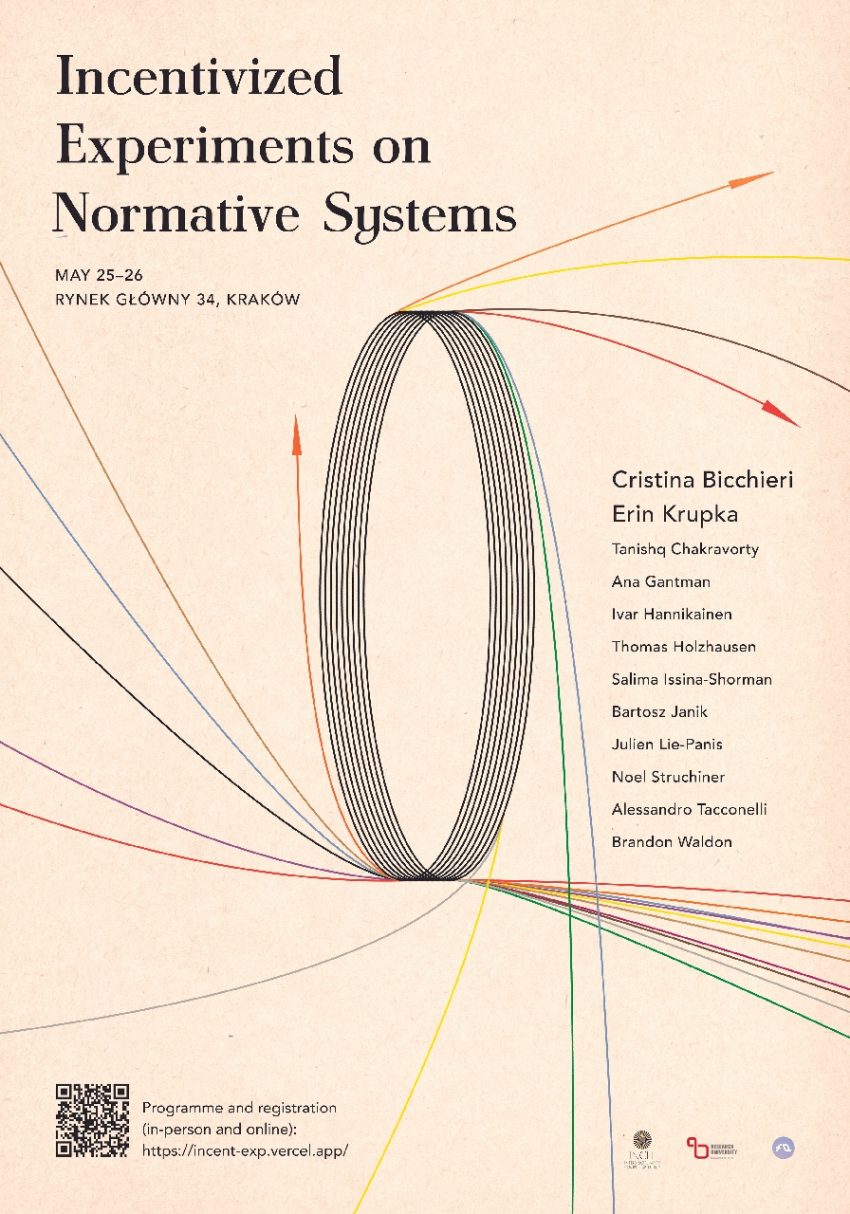
The Power of Norms

Posted on December 12, 2024January 1, 2025 by Joshua Knobe

In many communities, there is a shared sense that if someone disses you, it is pretty normal to react by punching them. But academia is not like that. In academia, if someone disses your research, it would be considered wildly abnormal to react by punching them. This shared understanding then has a very large impact on behavior. If you understand how academia works, you almost certainly will not react to someone who disses your research by punching them. This is an example of the power of norms.

One common view about the power of norms is that they operate by having an impact on people’s beliefs. For example, one might think that people observe that academics never never punch each other and therefore conclude that punching people is bad (or that punching people would lead to negative social consequences, or some other belief of this sort). I don’t think that this is the right way to understand the power of norms, and I want to sketch a very different approach.

To begin with, let’s note an obvious but deeply important fact about how people make decisions. Typically, when we face a choice, there are an enormous number of possible options, but we only consider a small subset of these options. For example, suppose someone points out a problem in my research, and I am trying to figure out how to respond. Perhaps I would consider three possible options: address the issue by doing further empirical work, or by doing further computational work, or just don’t do anything. As for all other possible options, I simply would not think about them at all. Take the possible of trying to learn some organic chemistry in the hopes that this will give me a valuable insight into the problem. Most likely, this option just would not occur to me.

Now let’s note a second key fact. When it comes to the options that people don’t consider, people might not form any belief about whether those options are good or bad. Thus, suppose someone says: “I notice that he did not respond to this problem by learning organic chemistry. Is that because he believes that learning organic chemistry wouldn’t be a good way to address it?” The correct answer would be: “No! He hasn’t formed any beliefs at all about whether learning organic chemistry would be a good way to address this problem. The whole possibility has not occurred to him.”

This is where we see the power of norms. When an option violates a norm, people tend not to think about it all. (For experimental evidence, see this paper.) So if there is a norm in academia that you can’t respond to disses by punching people, the usual upshot would be that people who are dissed just don’t even consider the possibility of responding to disses with punches. The whole idea just never occurs to them. My point is that this is the power of norms: they completely transform our lives by having an impact on which possibilities occur to us and which do not.

This phenomenon is not a matter of existing norms leading people to conclude that certain options are bad. It is something much more fundamental. Indeed, if someone does form the belief that a particular option is bad, this would show that the norm was not exerting the sort of power one might have expected it to have. Consider an academic who thinks: “Well, there are clear disadvantages to punching this person.” The very fact that an academic is thinking this at all should make us think that the norm does not have the kind of grip on them we would expect it to have.

So let’s distinguish the ways that norms can impact beliefs vs. the ways that norms can truly have a power over you and transform your whole way of thinking about life. To begin with, it’s clear that norms can indeed change your beliefs. If I ask you what you think about responding to a particular academic criticism by starting a fistfight, you might think about that option and go through a process in which you infer something from the fact that you never observe anyone performing this behavior. But this is not an example of the power of norms! On the contrary, it is an example of a case in which norms are not able to exert their full power. When we are truly in the grip of a norm, it’s not just that the norm impacts what we think of an option – it’s that it impacts which options we even think of at all.

Changing Explanatory Theories vs. Changing Norms

Posted on December 8, 2024December 28, 2024 by Joshua Knobe

Suppose you want to do something to decrease the amount of sexist behavior in the world. One thing you might do is try to change people’s explanatory theories. Perhaps you think that sexism is caused in part by people seeing certain outcomes as the result of a biological essence. You might then try an intervention in which you change people’s beliefs about gender and biology. A very different strategy would be to try to change prevailing norms. Some overtly sexist things were considered normal in the America of fifty years ago but are considered highly abnormal in America right now. So in a culture like today’s America, there might be certain sexist behaviors that almost never even come to mind as possible options.

The difference between these two approaches (theories vs. norms) is a very fundamental one. In this quick post, I want to focus on bringing out just one of the key differences. Changing people’s theories is the kind of thing one might be able to do in, say, 10 minutes. But changing norms is not like that. If you want to change the norms in a community, you can’t do it in 10 minutes. It’s the sort of thing you would hope to accomplish over the course of 10 years.

First, consider the point about theories. We are all familiar with times where we are wondering why something is happening, we read something that tells us the answer, and then we immediately adjust our explanatory theory. That’s just how theories work. The same point then arises for theories about social issues. At the moment, I have no idea why it is that such a high percentage of chess grandmasters are male. So if you presented me with a magazine article that provided strong evidence for a particular explanation, there’s a very good chance you could convince me. Over the course of 10 minutes or so, I might go from a state of having no idea why this happens to a state of being convinced by your explanatory theory. One might wonder whether this intervention would have any deep effect on my behavior, but at a minimum, it would successfully change my beliefs.

Changing norms is a fundamentally different type of process. If a given community has a norm of telling lots of sexist jokes, there’s no way you could possibly change that norm through a 10 minute intervention. That’s just not the way norms work. The process of changing a norm requires much more time and effort. As a simple illustration, there has recently been a change of norms that led to the use of preregistration, open data and open code, but that change took around a decade or so.

Of course, one might think it could be possible to have a quick intervention that led to a big change in people’s perceptions of the norms in their community, but studies indicate that this hope is also not warranted. There has been a lot of research about interventions that briefly tell people about the percentage of folks in their community who perform a particular behavior, but research finds that this sort of quick intervention rarely works. Presumably, the reason is that quickly telling people about certain percentages is not something that can change their representation of the community norm in the relevant sense.

With all this in the background, let’s now consider a very general hypothesis. I’m not sure whether the hypothesis is true, but I do think it is very much worth considering.

The hypothesis is that quick interventions like changing people’s explanatory theories just fundamentally do not work. If you want to do something that changes someone’s psychological states in a way that would lead that person to engage in less sexist behavior, there is no way you can do that through an intervention that lasts 10 minutes. The only things that work are large interventions like changing the norms within a community, which typically take years to complete.

Before the replication crisis, it certainly seemed as though we had lots of evidence that quick interventions on explanatory theories could yield large effects on behavior – but most of that evidence seems to be evaporating. Growth mindset interventions designed to change people’s explanatory theories about achievement don’t seem to lead to higher achievement. Interventions designed to change beliefs about free will don’t seem to impact cheating behavior. Interventions designed to change beliefs about genetics don’t seem to have much impact on judgments about punishment. Some recent studies indicate that interventions designed to reduce genetic essentialism don’t have any impact on prejudice.

One possible reaction to all of this would be that we haven’t yet found the exact right interventions on explanatory theories or the exact right downstream behaviors to measure… but another possible reaction would be that we are just fundamentally not looking in the right place.

Philosophy of Mind is Very Different Now

Posted on December 2, 2024January 1, 2025 by Joshua Knobe

A few decades ago, it felt like almost the entire field of philosophy of mind was focused on a pretty narrow range of questions (the mind-body problem, consciousness, the nature of intentionality, etc.). Insofar as anyone wanted to work on anything else, they often justified those interests by trying to explain how what they are doing could be connected back to this “core” of the field.

Clearly, things have changed a lot. These days, people are working on all sorts of different things that don’t connect back in any obvious way to the short list of topics that so dominated the field a few decades ago.

But if you look at various institutions that govern the field, it seems that there is a lag. Many of the norms and institutions we have in place don’t really make sense given the way the field is right now. They are just holdovers from the way the field used to be.

I bet that many readers will agree with the very general point I’ve been making thus far, but there’s room for lots of reasonable disagreement about exactly where our norms are showing a lag and where things need changing. I thought it might be helpful to write this post just to start that conversation. I’m going to suggest a few specific things, but I’d be very open to alternative views.

1. These days, many people in philosophy of mind are engaged in a broadly empirical inquiry into questions about how some specific aspect of the mind actually works: how visual perception works, how racism works, how memory works, how emotions work, and so forth.

When these people apply for jobs in philosophy of mind, it feels like there’s often a vague feeling that what they are doing is somehow “marginal” or “peripheral,” that it doesn’t really fall in the core of the field. But this no longer makes any sense! Contrast a person who is an expert on all the latest experimental studies about implicit bias with a person who is doing purely a priori work in the metaphysics of mind. Given the way the field works right now, there is no sense in which the former is less at the core of things than the latter. To the extent that the latter is seen as having a special status, this is just a residue from the way things were decades ago.

2. People working in philosophy of mind often want to learn about the history of the philosophy of mind. But what exactly is this history? For example, of all the things that Spinoza wrote, what should we call “Spinoza’s philosophy of mind”?

The traditional answer was basically: Of all the things that people in the history of philosophy wrote about the mind, the only ones that count as “history of philosophy of mind” are the ones that relate to the narrow list of questions discussed in late 20th century analytic philosophy. This involved excluding almost everything that figures in the history of philosophy said about the mind.

But again, this doesn’t make sense anymore. If people want to look at Spinoza’s philosophy of mind, I fear they would tend to look only at the discussion of the mind-body problem in Ethics, Book 2, i.e., the part that connects to this stuff discussed in 20th century philosophy of mind. But this is such a narrow way of thinking about discussions of the mind in the history of philosophy. Surely, Spinoza’s contributions to philosophy of mind go way beyond that; it’s just that most of his contributions are about how various specific things in the mind work. So these contributions might not be very closely related to things that philosophers of mind were working on in 1994, but they are extremely closely related to various things that philosophers of mind are working on in 2024.

3. Knowledge of mathematical or formal work is often helpful in philosophy, but we recognize that philosophers cannot possibly master all of the different formal methods that might be relevant to them in their work. So we always face questions of the form: Given that philosophers can’t know everything that would possibly be relevant, which methods do they absolutely need to know?

Now consider a graduate student working in philosophy of mind, and suppose that this student could either (a) take a course in logic but never take any courses in statistics or (b) take a course in statistics but never take any courses in logic.

It feels like there’s a norm in the field that (a) is more acceptable than (b). But does that really make sense anymore? I certainly agree that this is the background that would have been more essential a few decades ago, but if you look at what philosophers of mind are doing right now, it seems that statistics is used much more often than logic.

4. We have certain norms about which things philosophers are allowed to remain ignorant about and which they absolutely have to know. For example, a moral philosopher might say: “I am a consequentialist, and I think that non-consequentialist theories are mistaken.” But we would find it completely unacceptable for a moral philosopher to say: “I am a consequentialist, so I don’t know anything about recent work in non-consequentialist theories. I couldn’t even teach those theories at an undergraduate level.”

A question now arises about which norms would make sense in contemporary philosophy of mind. In many parts of philosophy of mind, the majority of people are using some kind of empirical approach, while a minority are using purely a priori approaches. We can imagine a person saying: “I am pursuing these questions using purely a priori methods, and I think it is a mistake to use empirical methods to address them.” But suppose someone said: “I don’t know anything about recent empirical studies on these questions. In fact, I couldn’t even teach a class about these studies at an undergraduate level.” Should we regard this sort of ignorance as acceptable? And if we do regard it as acceptable right now, might that just be a holdover from norms that really did make sense thirty years ago?

Again, I certainly don’t mean to be dogmatic about any of these four points, and I also don’t mean to suggest that these are the four most important areas in which we are facing a lag. Regardless of whether you agree or disagree about these for specific things, it does seem that the field has changed considerably, and I would love to hear your thoughts about how our norms should be evolving in light of that.

Call: “The Puzzle of Social Behavior – Game Theory and Beyond”

Posted on November 5, 2024December 30, 2024 by Alexander Max Bauer

Mantas Radzvilas and Wolfgang Spohn organize a workshop on “The Puzzle of Social Behavior – Game Theory and Beyond” at the University of Bielefeld. It will take place from April 3 to 5, 2025.

Abstracts for presentations can be submitted until January 6, 2025. The call reads:

There are up to 5 further slots of 40 minutes (30 minutes talk, 10 minutes discussion) for presentations. Everyone interested in presenting themselves is invited to apply for participation. Early-career researchers and scholars from underrepresented groups are particularly encouraged to apply.

For this purpose, please submit an abstract of your talk of at most 1000 words (2 pages) and a CV till January 6, 2025. Decisions on the submissions will be made within four weeks. Those selected will be invited to participate including a coverage of travel and accommodation costs.

Please send your application both to: mantas.radzvilas@uni-konstanz.de and wolfgang.spohn@uni-konstanz.de

Abstract: The workshop will be co-organized by the Reinhart-Koselleck project “Reflexive Decision and Game Theory” of Wolfgang Spohn at the University of Konstanz and the Center of Interdisciplinary Research at the University of Bielefeld. Its game-theoretic part is particularly concerned with foundational issues of game theory. Which is hence the topic of the second workshop of this project.

Social reality is built on the capacity of human beings to engage in social behavior – complex forms of intentional, coordinated actions involving more than one individual. For several decades, game theory has served as the primary conceptual framework for developing a variety of theories aiming to explain social behavior, such as social norms, prosocial preferences, virtual bargaining, and team reasoning theories. All of these theories converge on the idea that social behavior is sustained by sufficiently aligned interests and beliefs of the interacting individuals, yet they disagree on how these necessary alignments of interests and beliefs come about. A number of game-theoretic accounts of social behavior can claim substantial amounts of experimental results as supporting evidence. In many cases, experimental evidence supports multiple accounts equally, thus creating a problem of underdetermination. To conclude, after a number of decades of intensive development, a unified mathematical framework of game theory has not been able to produce a unified account of social behavior.

This conceptually unsatisfactory state of affairs raises a number of important questions. Is there a methodology to select among the competing accounts? Should these accounts be viewed as competing theories of social behavior, or rather as theories that complement one another? Are there better unconsidered alternatives to existing theories? Is game theory truly the best approach towards explaining social behavior?

The purpose of the workshop is to advance the discussion on these and other philosophical questions related to the status of game-theoretic explanations of social behavior.

Workshop: “XPHI UK Work in Progress Workshop Series”

Posted on September 21, 2024January 1, 2025 by Alexander Max Bauer

The “XPHI UK Work in Progress Workshop Series,” organized by James Andow and Eugen Fischer, continues. They write:

We are looking forward to the next series of our monthly online workshop devoted to discussion of work in progress in experimental philosophy. The workshop is held via Teams, the second Wednesday of each month, 16:00–18:00 UK time. Except for the opening keynote session, all sessions will have two presentations. Please email to register and receive the links (by the day before the session you hope to attend would be ideal).

October 9, 16:00–18:00 (UTC+1)

  • Shaun Nichols (Cornell University): “The PSR and the Folk Metaphysics of Explanation”

November 13, 16:00–18:00 (UTC±0)

  • Monica Ding (King’s College London): “Non-Factive Understanding – Evidence from English, Cantonese, and Mandarin”
  • María Alejandra Petino Zappala (German Cancer Research Center), Phuc Nguyen (German Cancer Research Center), Andrea Quint (German Cancer Research Center), and Nora Heinzelmann (University of Erlangen-Nuremberg): “Digital Interventions to Boost Vaccination Intention – A Report”

December 11, 16:00–18:00 (UTC±0)

  • Elis Jones (Konrad Lorenz Institute for Evolution and Cognition Research): “The Problem of Baselining – Philosophy, History, and Coral Reef Science”
  • April H. Bailey (University of Edinburgh) and Nicholas DiMaggio (University of Chicago Booth School of Business): “Of Minds and Men”

January 8, 16:00–18:00 (UTC±0)

  • Ajinkya Deshmukh (The University of Manchester) and Frederique Janssen-Lauret (The University of Manchester): “Reincarnation and Anti-Essentialism – An Argument Against the Essentiality of Material Origins”
  • Ethan Landes (University of Kent) and Justin Sytsma (Victoria University of Wellington): “LLM Simulated Data – The Good, the Bad, and the Ugly”

February 12, 16:00–18:00 (UTC±0)

  • Elzė Sigutė Mikalonytė (University of Cambridge), Jasmina Stevanov (University of Cambridge), Ryan P. Doran (University of Cambridge), Katherine A. Symons (University of Cambridge), and Simone Schnall (University of Cambridge): “Transformed by Beauty – Exploring the Influence of Aesthetic Appreciation on Abstract Thinking”
  • Poppy Mankowitz (University of Bristol): “Experimenting With ‘Good’”

March 12, 16:00–18:00 (UTC±0)

  • Kathryn Francis (University of Leeds), Maria Ioannidou (University of Bradford), and Matti Wilks (University of Edinburgh): “Does Dietary Identity Influence Moral Anthropocentrism?”
  • Jonathan Lewis (University of Manchester), James Toomey (University of Iowa), Ivar Hannikainen (University of Granada), and Brian D. Earp (National University of Singapore): “Normative Authority, Epistemic Access, and the True Self”

Hot Off The Press: “Experiments in Moral and Political Philosophy”

Posted on July 29, 2024January 9, 2025 by Alexander Max Bauer

“Experiments in Moral and Political Philosophy,” a new entry into the “Routledge Studies in Ethics and Moral Theory” series, edited by Hugo Viciana, Antonio Gaitán, and Fernando Aguiar, comprises 17 chapters. See below for the table of contents.

  • Antonio Gaitán, Fernando Aguiar, and Hugo Viciana: “The Experimental Turn in Moral and Political Philosophy”

Part 1 – Methods and Foundations

  • Ivar R. Hannikainen, Brian Flanagan, and Karolina Prochownik: “The Natural Law Thesis Under Empirical Scrutiny”
  • Philipp Schoenegger and Ben Grodeck: “Concrete Over Abstract – Experimental Evidence of Reflective Equilibrium in Population Ethics”
  • Dana Kay Nelkin, Craig R. M. McKenzie, Samuel C. Rickless, and Arseny Ryazanov: “Trolley Problems Reimagined – Sensitivity to Ratio, Risk, and Comparisons”
  • Lieuwe Zijlstra: “The Psychology of Metaethics – Evidence For and Against Folk Moral Objectivism”
  • Thomas Pölzler: “The Explanatory Redundancy Challenge to Moral Properties”
  • Cuizhu Wang: “Belief Distributions and the Measure of Social Norms”
  • Mariìa Jimeìnez Buedo: “Coming Full Circle – Incentives, Reactivity, and the Experimental Turn”

Part 2 – Normative Ethics and Legal and Political Philosophy

  • Stefan Schubert and Lucius Caviola: “Virtues for Real-World Utilitarians”
  • Aurélien Allard and Florian Cova: “What Experiments Can Teach Us About Justice and Impartiality – Vindicating Experimental Political Philosophy”
  • Hadar Dancig-Rosenberg and Yuval Feldman: “A Behavioral Ethics Perspective on the Theory of Criminal Law and Punishment”
  • Douglas Husak: “Behavioral Ethics and the Extent of Responsibility”
  • François Jaquet: “Against Moorean Defences of Speciesism”

Part 3: Applied Issues

  • Blanca Rodrìguez: “Experimental Bioethics and the Case for Human Enhancement”
  • Norbert Paulo, Leonie Alina Möck, and Lando Kirchmair: “The Use and Abuse of Moral Preferences in the Ethics of Self-Driving Cars”
  • Urna Chakrabarty, Romy Feiertag, Anne-Marie McCallion, Brain McNiff, Jesse Prinz, Montaque Reynolds, Sukhvinder Shahi, Maya von Ziegesar, and Angella Yamamoto: “Adaptive Preferences – An Empirical Investigation of Feminist Perspectives”
  • Anastasia Chan, Marinus Ferreira, and Mark Alfano: “Reactionary Attitudes – Strawson, Twitter, and the Black Lives Matter Movement”

Literature

Viciana, Hugo, Antonio Gaitán, and Fernando Aguiar (eds.) (2023): Experiments in Moral and Political Philosophy, New York: Routledge. (Link)

  • 1
  • 2
  • Next

Search

Categories

Tags

Agency Artificial Intelligence Basic Needs Behavior Beliefs Bias Bioethics Blame Causation Cognitive Science Consciousness Corpus Analysis Cross-Cultural Research Decisions Determinism Distributive Justice Emotions Essentialism Expertise Folk Morality Framing Free Will Gender Intention Intuition Jurisprudence Knowledge Large Language Models Moral Psychology Norms Pejoratives Problem of Evil Psycholinguistics Rationality Reasoning Replication Responsibility Self Side-Effect Effect Slurs Truth Valence Values Virtue Well-Being

Recent Posts

  • Call: “The Armchair on Trial”
  • Call: “Interdisciplinary Perspectives on Linguistic Justice”
  • Call: “6th European Experimental Philosophy Conference”
  • Talk: “Ethics in the Lab” (Pascale Willemsen)
  • Talk: “Normality and Norms” (Josh Knobe)

Recent Comments

  1. Nova Praxis on The Folk Concept of ArtJuly 11, 2025

    This article highlights an important point: everyday people don’t rely on rigid definitions to determine what qualifies as art. They’re…

  2. Koen Smets on Priming Effects Are Fake, but Framing Effects Are RealMay 27, 2025

    That is indeed exactly the question I have as well. I operationalize it as having de facto contradicting intuitions, in…

  3. Joshua Knobe on Priming Effects Are Fake, but Framing Effects Are RealMay 24, 2025

    Hi Koen, Thanks once again. This idea brings up all sorts of fascinating questions, but for the purposes of the…

  4. Koen Smets on Priming Effects Are Fake, but Framing Effects Are RealMay 24, 2025

    Great! In the meantime I thought of another potentially interesting example of framing—Arnold Kling’s Three Languages of Politics. Just about…

  5. Joshua Knobe on Priming Effects Are Fake, but Framing Effects Are RealMay 23, 2025

    Thanks Koen! This is all super helpful.

Archives

  • February 2026
  • January 2026
  • December 2025
  • November 2025
  • October 2025
  • September 2025
  • August 2025
  • July 2025
  • June 2025
  • May 2025
  • April 2025
  • March 2025
  • February 2025
  • January 2025
  • December 2024
  • November 2024
  • October 2024
  • September 2024
  • August 2024
  • July 2024
  • June 2024
  • May 2024
  • April 2024
  • March 2024

Meta

  • Log in
  • Entries feed
  • Comments feed
  • WordPress.org

Imprint • Disclaimer • Privacy Statement • Cookie Policy

© 2024 The Experimental Philosophy Blog
Manage Consent
To provide the best experiences, we use technologies like cookies to store and/or access device information. Consenting to these technologies will allow us to process data such as browsing behavior or unique IDs on this site. Not consenting or withdrawing consent, may adversely affect certain features and functions.
Functional Always active
The technical storage or access is strictly necessary for the legitimate purpose of enabling the use of a specific service explicitly requested by the subscriber or user, or for the sole purpose of carrying out the transmission of a communication over an electronic communications network.
Preferences
The technical storage or access is necessary for the legitimate purpose of storing preferences that are not requested by the subscriber or user.
Statistics
The technical storage or access that is used exclusively for statistical purposes. The technical storage or access that is used exclusively for anonymous statistical purposes. Without a subpoena, voluntary compliance on the part of your Internet Service Provider, or additional records from a third party, information stored or retrieved for this purpose alone cannot usually be used to identify you.
Marketing
The technical storage or access is required to create user profiles to send advertising, or to track the user on a website or across several websites for similar marketing purposes.
  • Manage options
  • Manage services
  • Manage {vendor_count} vendors
  • Read more about these purposes
View Preferences
  • {title}
  • {title}
  • {title}