The Experimental Philosophy Blog

Philosophy Meets Empirical Research

Menu
  • Home
  • About
  • Guidelines for Comments
  • Labs and Organizations
  • Resources
Menu

Month: August 2025

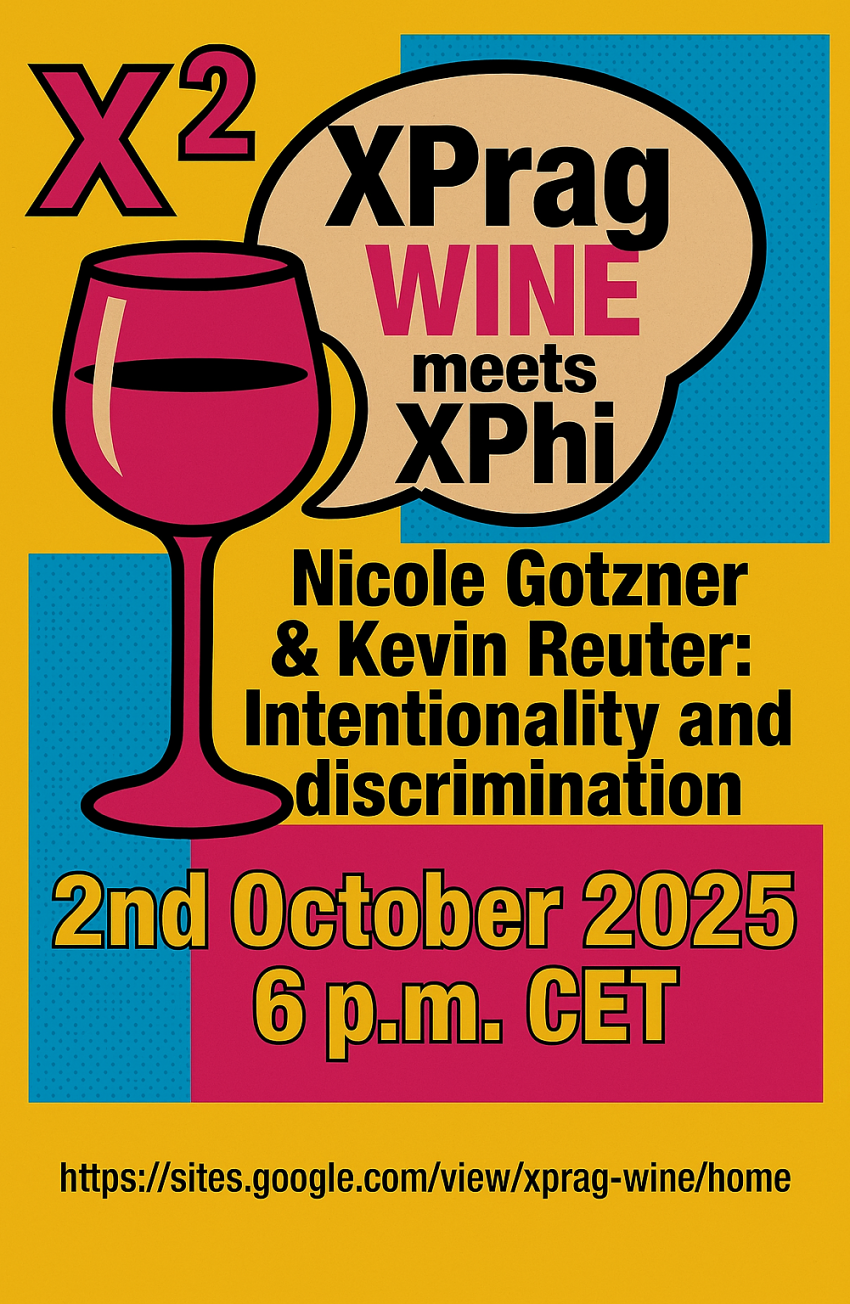
Talk: “Intentionality and Discrimination” (Nicole Gotzner and Kevin Reuter)

Posted on August 31, 2025October 25, 2025 by Alexander Max Bauer

On Tuesday, October 2, the XPRAG Wine Gatherings welcome Nicole Gotzner and Kevin Reuter to talk about “Intentionality and Discrimination” on Zoom. Kevin writes:

Experimental Pragmatics (XPrag) and Experimental Philosophy (XPhi) share a common vision: whenever our assumptions can be empirically tested against the world, we should rise to the occasion. On October 2nd, 2025, don’t miss a talk on “intentionality and discrimination” by Nicole Gotzner (University of Osnabrück) and Kevin Reuter (University of Gothenburg), followed by a discussion on how our communities can exchange ideas and spark new collaborations. We can’t wait to see you there!

The Zoom link and more information are available at the XPRAG Wine Gatherings’ website.

Call: “Folk Epistemology”

Posted on August 26, 2025August 26, 2025 by Alexander Max Bauer

Mirko Farina, Artur Karimov, Anna Sakharova, Mikhail Khort, Daniel Lavrishchev, Vladislav Stasenko, and Natalia Khairullina are organizing a conference on “Folk Epistemology – Exploring Everyday Conceptions of Knowledge,” which will take place at the Kazan Federal University from October 24 to 25. The conference will be hybrid, featuring a dedicated online section in English.

Abstracts for presentations can be submitted until October 10. The call reads:

What is knowledge? Philosophers have long sought answers to this fundamental question within the confines of their studies. Yet contemporary epistemology faces a profound challenge: How universal and adequate are the intuitions underlying theories derived from “armchair” conceptual analysis? This challenge has emerged alongside intensive research into folk epistemology – the study of ordinary people’s conceptions of knowledge, truth, justification, reliability, and other epistemic categories. Data from experimental philosophy (x-phi) reveal that what seems obvious and universal to the armchair philosopher may vary significantly across cultural, social, linguistic, or educational contexts. Does this call into question the possibility of a unified theory of knowledge? Are folk intuitions a reliable test for the adequacy of philosophical concepts their inevitable foundation (as x-phi advocates argue) – or merely “empirical noise” unrelated to epistemology’s inherently normative aims?

Conference Goals

This conference aims to create a platform for critical and constructive discussion on the role of folk epistemic conceptions and intuitions in modern philosophy. Participants are invited to address the following key questions:

  • Conceptualizing Folk Epistemology: What are its boundaries? How is it manifested in language (epistemic modalities, knowledge verbs), social and cognitive practices (distribution of epistemic authority, source credibility, non-expert assessments of justification reliability)? How can we account for pragmatic and moral “encroachments” in knowledge descriptions?
  • Relevance of Folk Conceptions for Philosophical Theory: Should epistemological theories explicitly incorporate, refute, or methodologically disregard data on folk conceptions? What are their heuristic values and limitations?
  • Critical Analysis of X-Phi Methodology in Epistemology: How can empirical data enrich philosophical reflection? What are the limitations of experimental approaches in clarifying normative questions? How does variability in intuitions impact debates about epistemic universalism, contextualism, or relativism?
  • Applied Potential of X-Phi Data: How can research on folk epistemology (especially cross-cultural variations in epistemic conceptions) inform practical applications? How might this data improve AI systems (e.g., model training, dialogue agent design) and optimize human-AI interaction (e.g., fostering epistemic trust in intelligent assistants)?

Call for Interdisciplinary Dialogue

We aim to transcend disciplinary boundaries and welcome contributions from all scholars engaged in folk epistemology research. In addition to papers on the above themes, we particularly encourage:

  • Presentations of empirical/experimental studies on epistemic conceptions and intuitions by philosophers, psychologists, anthropologists, sociologists, and linguists.
  • Proposals for planned empirical research (experiments, surveys, linguistic analyses, etc.), including hypotheses, designs, and methodologies.

This segment will foster discussion on methodological challenges, brainstorming for refining x-phi tools, and exploring collaborative opportunities.

Submission Guidelines

To participate, please:

  • Complete the registration form: https://forms.gle/rCu72uaTJwc8GQZx6
  • Include your full name, contact email, presentation title, and abstract (100–250 words).
  • If you have any difficulties filling out this form or have any questions about the conference, please contact mikhort@gmail.com (Mikhail Khort).

Deadline: October 10, 2025.

Updates & Information

The conference schedule, detailed announcements, and additional information will be available via: Telegram Channel: https://t.me/kznphil

Call: “Philosophers on Philosophy”

Posted on August 26, 2025August 26, 2025 by Alexander Max Bauer

Renée Smith and Emily McGill prepare an edited volume with the working title “Philosophers on Philosophy – What is philosophy, how is philosophy done, and why do philosophy?”

Abstracts for chapters can be submitted until October 3. The call reads:

We invite chapter proposals for an edited volume exploring philosophers’ views on different aspects of metaphilosophy. The target audience is undergraduate and graduate students in philosophy and laypeople. These populations are often surprised that philosophers do not agree about what philosophy is, how it is done, whether it makes progress, what its value is, etc. Contributions to this volume will shed light on these topics and introduce the variety of metaphilosophical views contemporary philosophers hold.

Contributions will generally fit into one of the following topical areas and address several of the suggested subtopics; however, clearly there is the possibility of overlapping topics, and the following suggested subtopics are not exhaustive. Final essays should defend a particular view rather than merely describe it, be fewer than 2000 words, and be written for the target audience. Neither proposals nor final essays should make use of AI in any way.

What is philosophy? What distinguishes philosophy from other fields?

  • Topics, methods
  • Questions, disagreement
  • Goals, product
  • Philosophy, science, humanities

How is philosophy done? How do the methods in philosophy compare to those in other fields?

  • Logic, reason, analysis
  • Distinctions
  • Thought experiments, intuition
  • Experimental philosophy
  • The history of philosophy
  • Phenomenology

What does philosophy do? What is the goal/purpose of philosophy?

  • Progress in philosophy
  • Philosophical knowledge
  • Applied philosophy

What is the value of philosophy?

  • Philosophy in the undergraduate curriculum
  • Philosophy and society
  • Philosophy as a way of life
  • Philosophy, knowledge, understanding, uncertainty
  • The future of philosophy

Proposals

Please submit an abstract/proposal of approximately 200–300 words clearly identifying the overarching topic your essay will address and a current CV.

Timeline

  • Abstracts and CV: October 3, 2025
  • Essays: February 30, 2026
  • Peer review begins: March 15, 2026
  • Proposed publication: Spring 2027

Submissions/Questions

Please send your submissions/questions to Renée Smith, rsmith@coastal.edu, or Emily McGill, emcgill@coastal.edu, Coastal Carolina University.

Call: “Moral Epistemology and Social Progress”

Posted on August 26, 2025August 26, 2025 by Alexander Max Bauer

Antonio Gaitán Torres and Hugo Viciana organize a workshop on “Moral Epistemology and Social Progress – Experimental and Philosophical Perspectives,” which will take place at the Universidad de Sevilla from November 4 to 5.

Abstracts for presentations can be submitted until September 17. The call reads:

This focused workshop explores the intersection of empirical research on moral cognition and philosophical theories of social and moral progress. We bring together experimental philosophers and moral epistemologists to examine how empirical findings about moral intuitions, attitude change, and intellectual virtues inform our understanding of moral improvement at both individual and societal levels. The workshop features invited speakers alongside selected contributions from an open call for abstracts, fostering intimate discussion among researchers working at the forefront of experimental and theoretical approaches to moral progress. Submissions addressing experimental studies of moral judgment, philosophical accounts of moral progress, or the epistemology of moral improvement are particularly welcome.

We welcome submissions for 3–4 additional presentations at this workshop. Interested researchers should submit an abstract of 350–750 words addressing topics at the intersection of moral epistemology, experimental philosophy, and social progress. Abstracts might explore empirical studies of moral cognition, philosophical theories of moral improvement, experimental metaethics, intellectual virtues, the psychology of moral change, or related themes in moral epistemology. Please send your abstract to both hviciana@us.es and agaitan@hum.uc3m.es with the subject line “November Workshop.” The deadline for submissions is 17 September 2025. Selected presenters will have approximately 30 minutes for their presentation followed by discussion.

Hackathon: “Data-Driven Methods in Philosophy”

Posted on August 21, 2025August 21, 2025 by Alexander Max Bauer

Gregor Bös and Max Noichl organize a hackathon on “Data-Driven Methods in Philosophy,” which will take place in Utrech from October 16 to 18. Before and after, hybrid meetings will also take place.

Their announcement reads:

Computational methods have transformed academic research, including in the humanities. Philosophers have been comparatively slow to adopt them, but as contemporary language modelling techniques now enable much more sophisticated analyses, they are seeing increasing interest. We want to explore techniques from the digital humanities, linguistics and AI research (Betz 2022) that can support the study of philosophical and scientific corpora, with applications for philosophy of science (Lean, Rivelli & Pence 2021; Noichl 2023. See also the contributions to Pence & Rivelli 2022), the history of philosophy (Petrovich, Verhaegh, Bös et al. 2024; Verhaegh, Petrovich & Bös forthcoming), and metaphilosophy (Petrovich, 2022).

This activity is built around a “hackathon” – an extended period of collaborative programming and discussion. During the three-day in-person event, the participants develop their own projects, either individually or in small groups. The first two days start with keynote lectures that present state-of-the-art research. In the lead-up to the event, we organize two hybrid seminars, in which participants present recent research to each other, to get an idea of what’s possible in this space. During the seminars, participants brainstorm research ideas and discuss with seminar leaders how to apply digital methods, identify appropriate data sources, and determine which digital skills to develop. During the event, our keynote speakers Charles Pence and Gregor Betz contribute their expertise in argument representation, LLMs, digital methods for history and philosophy of science. They will also be available during the event to discuss research ideas, share practical knowledge, and support the seminar participants.

As an additional help for participants without programming experience or who have not yet used data-driven methods in their research, the organizers prepare coding templates and assist in using LLMs for writing code. More experienced participants can focus on exchanging ideas and developing their own projects. A few weeks after the hackathon, we reconvene in a hybrid event to discuss the results of the projects and avenues for further work.

The aim of the course is to offer an introduction to data-driven methods for philosophy and focuses on participant-designed research projects. At the end of the course, participants:

a) Know examples of state-of-the-art data-driven research methods in philosophy and are in a
good position to apply them.
b) Have gained experience in starting their own computational philosophy project
In the best case, the hackathon can be the starting point for a research project in the participants’
domain of expertise.

Workshop: “Data-Driven Methods for Philosophy”

Posted on August 21, 2025August 21, 2025 by Alexander Max Bauer

Gregor Bös and Max Noichl organize the Satellite workshop “Data-Driven Methods for Philosophy” at this year’s conference of the Gesellschaft für Analytische Philosophie (GAP). The workshop will take place at the University of Düsseldorf from September 12 to 13.

Their announcement reads:

Computational methods have revolutionized most fields of academic research, including the humanities. More recently, they have also been put to use in the philosophy of science, history of philosophy, and metaphilosophy. In this satellite workshop, we discuss techniques from the digital humanities, network science, and artificial intelligence that can support the study of philosophical corpora.

The workshop comprises keynote lectures by Prof. Catherine Herfeld and Prof. Adrian Wüthrich that showcase computational methods in philosophical research. After these showcases, Gregor Bös and Max Noichl will assist the participants in developing their own initial research questions that make use of digital methods and explore first implementations. The organizers have prepared templates to support participants without programming experience or who have not yet used computational methods in their research. More experienced participants can use the sessions to exchange ideas and develop their own projects, presenting the state of their progress in the concluding session.

If participants already have project ideas when signing up, we encourage them to get in contact with the organizers to discuss potential data sources and methods. Participants are also very welcome to sign up to continue working on existing digital projects and to contribute to the exchange of approaches.

Call: “Laws Many Users”

Posted on August 21, 2025August 21, 2025 by Alexander Max Bauer

Alex Davies and Nikolai Shurakov organize a conference on “Law’s Many Users – Legal Interpretation Within and Beyond Legal Institutions,” which will take place at the University of Tartu from November 12 to 14.

Abstracts for presentations can be submitted until August 12. The call reads:

Law is interpreted and implemented by many hands. Some of them belong to judges, legislators, or lawyers – but many belong to nurses, teachers, municipal officials, or department heads: professionals who encounter law not in courtrooms or casebooks, but in institutional documents, contracts, checklists, and internal protocols. These actors do not interpret law as legal theorists or as abstract “laypeople,” but as role-bound individuals embedded in specific organizational contexts. Their understanding of legal norms is shaped by institutional incentives, bureaucratic hierarchies, resource constraints, inherited routines, and pressures to defer to internal authorities. They are interpreters, but also implementers – conduits through which law acquires practical meaning.

While experimental jurisprudence has deepened our understanding of how legal concepts like causation, intention, or rights are grasped by legal experts and ordinary citizens, it has rarely focused on this middle terrain: how individuals interpret legal rules as part of their job, within the constraints and affordances of organizational life.

This conference is an occasion for exploring that terrain.

Call for Abstracts (submission deadline: August 12, 2025)

We invite submissions from scholars across disciplines interested in how laws and regulations are interpreted, implemented, and transformed in real-world institutional settings.

Legal meaning is shaped not only in courts or legislatures, but in offices, classrooms, clinics, and council chambers – by actors whose interpretations are framed by professional roles, organizational logics, and institutional incentives. This conference invites reflection on the interpretive practices that emerge in such contexts, and how these practices affect what law becomes in use.

We welcome work from experimental jurisprudence, philosophy of language, linguistics, law & economics, public administration, and related fields. Contributions may be theoretical, empirical, or methodological.

Possible topics include (but are not limited to):

  • Studies of how non-lawyers interpret and apply legal or regulatory texts
  • Experimental investigations of interpretation in institutional settings
  • Pragmatic and semantic analysis of policy and legal communication
  • Incentive structures and role-based reasoning in interpretation
  • Legal meaning as mediated through contracts, guidelines, or protocols
  • Interpretive drift and discretion in organizational environments
  • Extensions or critiques of experimental jurisprudence beyond traditional contexts
  • Interdisciplinary methods for studying law “in the wild”

Abstracts are applications for either 30-minute slots (20 minute talk + 10 minute discussion) OR 1-hour slots (30–40 minute talk + 30–20 minute Q&A). Abstracts (max. 600 words – excluding a list of references) should: (a) make clear the line of argument for the conclusion defended; (b) make clear the relevance of the envisioned talk to the conference theme; (c) make clear whether your applying for a 30-minute or 60-minute slot; and (d) be prepared for anonymous review.

Submitting Abstracts: Abstracts should be submitted with a separate coversheet (author, email, institution) to laws.many.users@gmail.com.
Search

Categories

Tags

Agency Artificial Intelligence Autonomous Systems Basic Needs Behavior Beliefs Bias Bioethics Blame Causation Cognitive Science Consciousness Corpus Analysis Cross-Cultural Research Decisions Determinism Distributive Justice Emotions Essentialism Expertise Folk Morality Framing Free Will Gender Intention Intuition Jurisprudence Knowledge Large Language Models Moral Psychology Norms Pejoratives Psycholinguistics Rationality Reasoning Replication Responsibility Self Side-Effect Effect Slurs Thought Experiments Truth Valence Values Virtue

Recent Posts

  • Call: “Artificial Life as Experimental Philosophy”
  • Conference: “Social Ontology and Empirical Inquiry”
  • Talk: “I wasn’t thinking about that!” (Franz Berto and Aybüke Özgün)
  • Call: “Measuring the Mind”
  • Talk: “Philosophical Thought Experiments Elicit Conflicting Intuitions” (Joshua Knobe and Ivar Hannikainen)

Recent Comments

  1. Nova Praxis on The Folk Concept of ArtJuly 11, 2025

    This article highlights an important point: everyday people don’t rely on rigid definitions to determine what qualifies as art. They’re…

  2. Koen Smets on Priming Effects Are Fake, but Framing Effects Are RealMay 27, 2025

    That is indeed exactly the question I have as well. I operationalize it as having de facto contradicting intuitions, in…

  3. Joshua Knobe on Priming Effects Are Fake, but Framing Effects Are RealMay 24, 2025

    Hi Koen, Thanks once again. This idea brings up all sorts of fascinating questions, but for the purposes of the…

  4. Koen Smets on Priming Effects Are Fake, but Framing Effects Are RealMay 24, 2025

    Great! In the meantime I thought of another potentially interesting example of framing—Arnold Kling’s Three Languages of Politics. Just about…

  5. Joshua Knobe on Priming Effects Are Fake, but Framing Effects Are RealMay 23, 2025

    Thanks Koen! This is all super helpful.

Archives

  • April 2026
  • March 2026
  • February 2026
  • January 2026
  • December 2025
  • November 2025
  • October 2025
  • September 2025
  • August 2025
  • July 2025
  • June 2025
  • May 2025
  • April 2025
  • March 2025
  • February 2025
  • January 2025
  • December 2024
  • November 2024
  • October 2024
  • September 2024
  • August 2024
  • July 2024
  • June 2024
  • May 2024
  • April 2024
  • March 2024

Meta

  • Log in
  • Entries feed
  • Comments feed
  • WordPress.org

Imprint • Disclaimer • Privacy Statement • Cookie Policy

© 2024 The Experimental Philosophy Blog
Manage Consent
To provide the best experiences, we use technologies like cookies to store and/or access device information. Consenting to these technologies will allow us to process data such as browsing behavior or unique IDs on this site. Not consenting or withdrawing consent, may adversely affect certain features and functions.
Functional Always active
The technical storage or access is strictly necessary for the legitimate purpose of enabling the use of a specific service explicitly requested by the subscriber or user, or for the sole purpose of carrying out the transmission of a communication over an electronic communications network.
Preferences
The technical storage or access is necessary for the legitimate purpose of storing preferences that are not requested by the subscriber or user.
Statistics
The technical storage or access that is used exclusively for statistical purposes. The technical storage or access that is used exclusively for anonymous statistical purposes. Without a subpoena, voluntary compliance on the part of your Internet Service Provider, or additional records from a third party, information stored or retrieved for this purpose alone cannot usually be used to identify you.
Marketing
The technical storage or access is required to create user profiles to send advertising, or to track the user on a website or across several websites for similar marketing purposes.
  • Manage options
  • Manage services
  • Manage {vendor_count} vendors
  • Read more about these purposes
View Preferences
  • {title}
  • {title}
  • {title}